
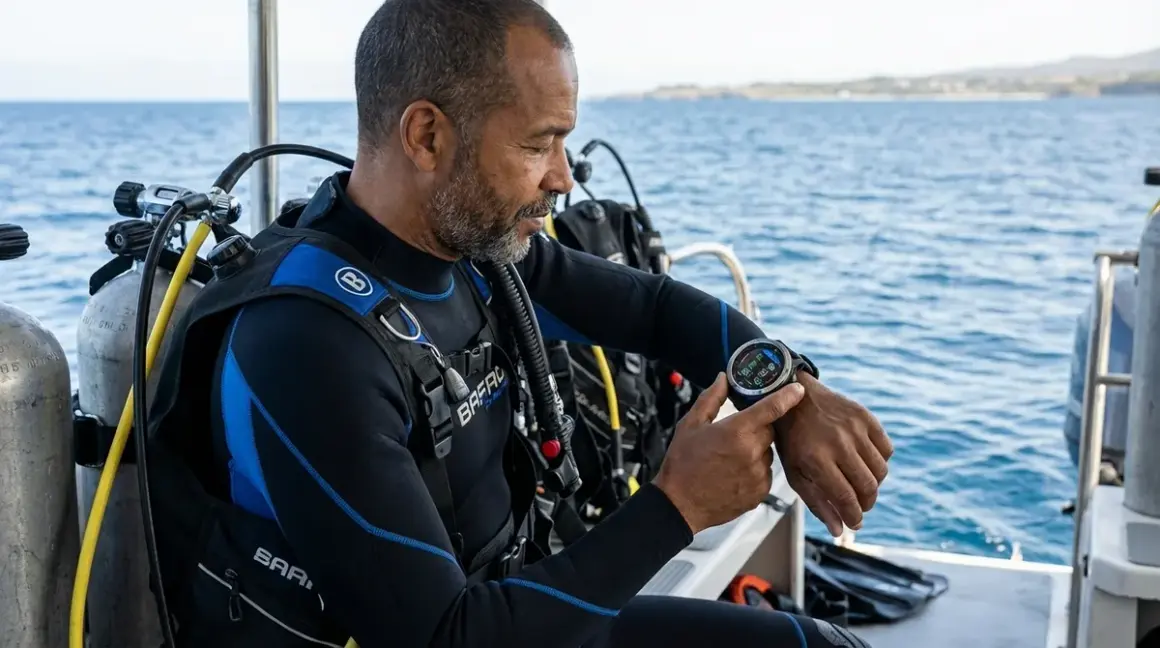

I remember the first time a student asked me why her fitness tracker couldn't measure her heart rate underwater. She'd been monitoring her workouts religiously on land and wanted the same data while diving. At the time—this was maybe seven years ago—I told her the technology wasn't there yet. Well, times have changed. Biometric dive technology is now real, functional, and increasingly integrated into the computers we wear underwater. These systems track everything from heart rate and breathing patterns to skin temperature and workload, translating physiological data into actionable dive information. Whether you're a nervous new diver wondering if your elevated heart rate affects your air consumption or a technical diver trying to optimize decompression profiles based on actual exertion levels, biometric systems are changing how we understand our bodies at depth.
What Is Biometric Dive Technology?
Biometric dive technology refers to dive computers and wearable systems that monitor and record physiological data—heart rate, respiratory rate, skin temperature, and sometimes even blood oxygen saturation—during a dive. Unlike traditional dive computers that only track environmental variables (depth, time, water temperature, tank pressure), biometric systems add a layer of real-time physiological monitoring to the mix.
The technology integrates sensors either directly into a dive computer housing or through wireless connection to separate sensor modules. Most commonly, you'll see optical heart rate sensors embedded in the back of a wrist-mounted dive computer, or chest-strap heart rate monitors that transmit data via low-frequency radio waves that can penetrate water over short distances. A few high-end systems have started incorporating skin temperature sensors and accelerometers that estimate workload based on movement patterns.
This isn't just fitness tracking underwater—though that's part of it. The data feeds into algorithms that can adjust no-decompression limits, estimate remaining bottom time more accurately based on your actual breathing rate, and even warn you when physiological stress indicators suggest you should slow down or abort a dive. I've watched this technology evolve from clunky, unreliable prototypes to genuinely useful tools, though we're still early enough in the adoption curve that not every feature works as advertised.
How Biometric Dive Technology Works
The core of most biometric dive systems is optical heart rate monitoring, the same technology your fitness tracker uses on land. LEDs on the back of the dive computer emit green or red light into your skin, and photodiodes measure how much light reflects back. Blood absorbs more light than surrounding tissue, and as your heart pumps blood through capillaries in your wrist, the amount of reflected light changes in rhythm with your pulse. The computer's algorithm processes these fluctuations to calculate beats per minute.
Here's where it gets trickier underwater: water pressure compresses tissues, cold constricts blood vessels near the skin surface, and gloves interfere with sensor contact. The Garmin Descent Mk3i and similar models address this with multiple LED wavelengths and more sensitive photodiodes, plus algorithms tuned specifically for the reduced capillary blood flow you get at depth and in cold water. I've tested several systems in water ranging from 82°F in Cozumel to 48°F in Puget Sound, and accuracy definitely degrades in cold conditions—more on that later.
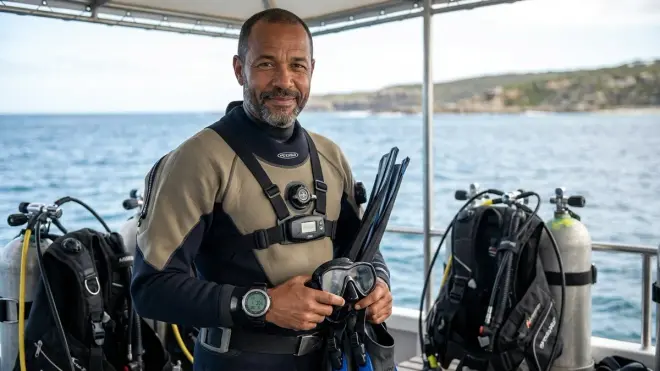
Chest-strap heart rate monitors avoid some of these issues by measuring electrical signals from your heart directly, similar to an EKG. These systems use conductive electrodes in contact with your skin and transmit data to your dive computer via proprietary low-frequency wireless protocols. ANT+ is common on land but doesn't work underwater; most dive-specific systems use something in the 5-10 kHz range that can penetrate water for three to six feet. You wear the strap under your wetsuit or drysuit, and as long as there's good contact with skin and the computer is on the same arm or reasonably close, transmission is reliable.
Respiratory rate estimation works differently depending on the system. Some computers calculate it indirectly from heart rate variability—your heart rate naturally fluctuates with your breathing cycle, speeding up slightly on inhalation and slowing on exhalation. More sophisticated systems integrate with tank-mounted transmitters that already monitor tank pressure wirelessly; by tracking the rate of pressure decrease, they can estimate your breathing rate in liters per minute. The Shearwater Peregrine TX with integrated air monitoring does this, and when combined with heart rate data, it gives you a surprisingly accurate picture of your real-time air consumption efficiency.
Skin temperature sensors are the simplest component—just a thermistor in contact with your skin, separate from the water temperature sensor. The differential between core body temperature (estimated from skin temp) and ambient water temperature helps estimate thermal stress and can factor into decompression calculations. Some algorithms theorize that colder core temps might affect inert gas uptake and elimination, though this is still somewhat controversial in the research literature.
All this data feeds into the dive computer's algorithm. Traditional models like Bühlmann ZHL-16C or RGBM use fixed assumptions about workload and breathing rate. Biometric systems can adjust these parameters in real time. If your heart rate spikes and stays elevated, the computer might assume you're working hard, breathing faster, and therefore on-gassing nitrogen more quickly—which shortens your no-decompression limit. If you're calm, breathing slowly, and showing minimal exertion, it might extend your bottom time slightly. The degree to which different manufacturers actually adjust their algorithms varies; some just display the data without changing dive planning, while others integrate it fully into their tissue loading calculations.
Why Biometric Dive Technology Matters
The most immediate practical benefit is improved air consumption awareness. I've logged plenty of dives where a new student burns through their tank in 25 minutes because they're nervous, breathing rapidly, and finning inefficiently. Seeing your heart rate and respiratory rate displayed in real time creates a feedback loop. You notice your heart rate climbing, you consciously slow your breathing, you watch the number drop. It's the same principle as meditation apps or biofeedback training on land, just applied underwater.
For instructors and divemasters, biometric data adds a safety dimension. If you're leading a group and one diver's heart rate suddenly spikes and stays high, that's a signal to check in. Maybe they're panicking, maybe they're working too hard against current, maybe they're having an actual medical issue. You can't always tell from behavior—people hide stress well underwater—but the numbers don't lie. I haven't personally had to abort a dive based on biometric data yet, but I know guides who have, and in each case the diver was grateful afterward.
More accurate decompression modeling is the promise that gets technical divers interested. Traditional algorithms use population-average assumptions about workload and breathing. But if you're a fit diver with a resting heart rate of 55 bpm doing a relaxed wreck dive, you're not on-gassing nitrogen at the same rate as someone with a resting heart rate of 80 bpm who's fighting surge in a cave. Theoretically, a biometric-integrated algorithm could account for that. The catch: we don't yet have decades of validation data for these adaptive algorithms the way we do for the traditional models. Shearwater and a few others are starting to build this database, but I'm not ready to trust my decompression entirely to adaptive algorithms for dives with significant mandatory stops. For recreational no-decompression diving, though, the risk-reward calculation is different.
Post-dive analysis is where I've personally found the most value. Downloading your dive data and seeing heart rate overlaid with depth and time tells a story. You see exactly where you got stressed—maybe during a mask flood drill, maybe when you descended too fast, maybe when you saw that shark you weren't expecting. You also see when you achieved that flow state where your heart rate drops, your breathing slows, and you're moving efficiently through the water. For improving your diving, this feedback is gold. You can review how to read dive computer data more effectively with biometric layers included.
Types and Variations of Biometric Dive Systems
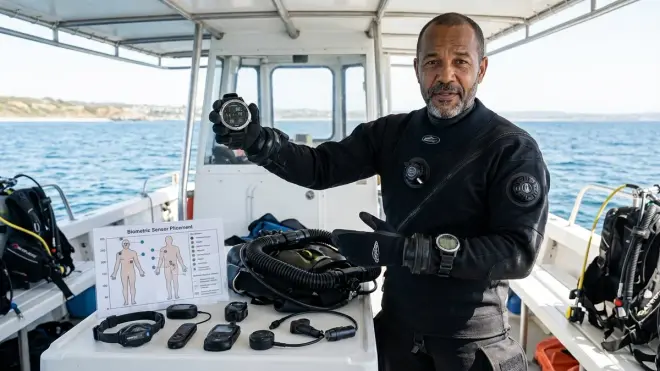
Wrist-mounted integrated systems are the most common and user-friendly category. Computers like the Garmin Descent series, Suunto D5, and Ratio iX3M2 GPS all have optical heart rate sensors built into the back of the watch case. You charge them, strap them on, and dive—no additional components needed. The downside: accuracy varies with fit, cold water, and wrist position. If you wear the computer over a wetsuit sleeve or drysuit seal, readings get unreliable. These work best in tropical and temperate conditions with the computer directly against bare skin or under a thin exposure suit.
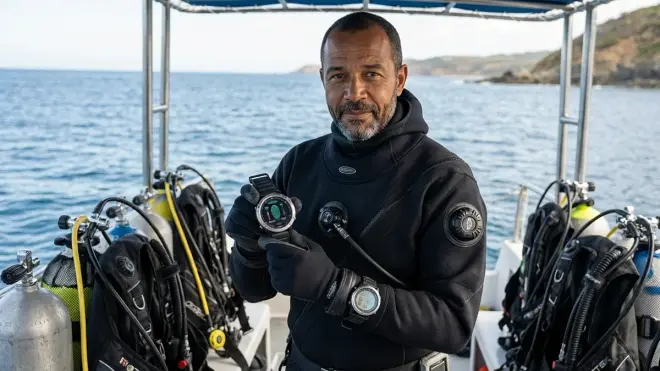
Chest-strap systems offer better accuracy at the cost of convenience. You wear a transmitter belt with electrode pads against your chest—similar to what you'd use for running or cycling—and it sends data to your wrist-mounted computer. The Suunto EON Core with Heart Rate Belt uses this configuration. Electrode contact needs to be good, which means the belt goes under your wetsuit or drysuit base layer, tight enough not to shift. I find these more reliable in cold water and at depth, but they're one more thing to remember, one more battery to maintain, and one more strap to adjust before you splash.
Tank-integrated biometric systems combine wireless tank pressure monitoring with breathing pattern analysis and sometimes heart rate data from a separate transmitter. Shearwater's Peregrine TX and Perdix AI models fall into this category. The tank transmitter screws into your first-stage high-pressure port and sends pressure data to your computer, which calculates surface air consumption (SAC) rate and respiratory minute volume. When paired with a heart rate monitor, you get a complete physiological picture. These are my preferred setup for technical diving where I'm already running multiple transmitters for stage bottles and want all my data in one place. Compatibility with different transmitter brands varies—check whether your system supports only proprietary transmitters or works with open protocols. Understanding intermediate pressure settings matters here because first-stage configuration affects transmitter installation.
Standalone biometric pods are the least common but potentially the most versatile. These are small sealed modules that you clip to your BC or attach to a computer via short cable, adding biometric sensing to computers that don't have it built in. I've seen a few prototypes but nothing that's hit mainstream market penetration yet. The appeal is upgrading existing gear without replacing your whole dive computer.
Different manufacturers also vary in what they do with the data. Some, like Garmin, mostly just display and record it—you get to see your heart rate, but it doesn't affect decompression calculations. Others, like certain Suunto models, feed the data into adaptive algorithms that genuinely change your dive profile in real time. Make sure you understand which camp your system falls into. For a broader overview of modern dive computer features, check out our complete guide to dive computers.
Practical Considerations and Limitations
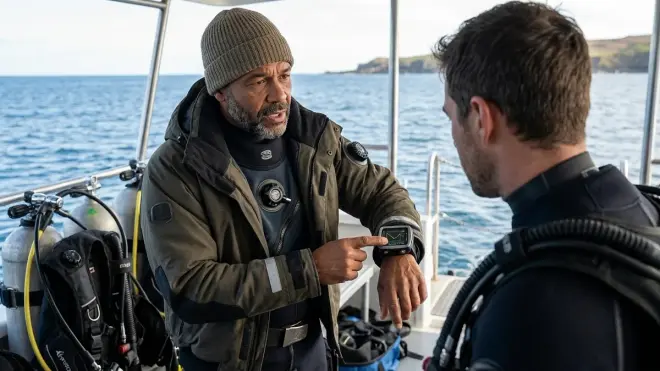
Let's talk about what actually works and what's still marketing hype. Optical heart rate sensors in cold water remain problematic. Below about 65°F water temperature, peripheral vasoconstriction reduces blood flow to your extremities enough that wrist-based sensors struggle. I've compared wrist optical readings to chest-strap readings during the same dive in 50°F water, and the wrist sensor sometimes drops the signal entirely or reports numbers that are obviously wrong—like 45 bpm when I'm finning hard against current. Chest straps don't have this problem because they measure electrical signals, not blood flow.
Glove interference is another issue. If you're wearing thick gloves—say, 5mm or 7mm neoprene for cold water—and your dive computer is outside the glove, the optical sensor isn't against your skin. Some divers try wearing the computer under the glove, but that's awkward and can restrict circulation. For cold-water diving where you need serious thermal protection, a chest strap is the more reliable option. Choosing the right wetsuit for cold conditions matters too, because thicker suits often mean thicker gloves.
Battery life takes a hit when you activate continuous heart rate monitoring. A dive computer that might last 20-30 hours of dive time with standard features will drop to 12-15 hours with biometric monitoring running. For liveaboard trips where you're doing four or five dives a day over a week, you'll need to charge more frequently. Some computers let you toggle heart rate monitoring on and off to preserve battery; I usually keep it on for training dives or challenging conditions and off for easy recreational dives where I don't need the data.
Calibration and fit matter more than with land-based systems. You need to wear the computer snug enough for good sensor contact but not so tight you restrict circulation or mark up your skin. The band should sit about one finger-width up from your wrist bone, and if you have tattoos on your wrist, be aware they can interfere with optical sensors—the ink absorbs the LED light differently than skin does. For chest straps, you need to wet the electrode pads before putting them on (saliva works if you don't have water handy) and make sure the strap is snug enough not to shift when you're putting on your BC.
Data accuracy is good but not medical-grade. These are recreational and professional dive computers, not medical devices. The heart rate readings are typically within ±5 bpm of actual at surface level under ideal conditions, and that's good enough for dive monitoring and training feedback. But if you have a cardiac condition and your doctor needs precise data, these aren't the right tools. Also worth noting: most dive computer algorithms haven't been validated specifically with adaptive biometric adjustment for deep technical diving. We're still building that evidence base. I treat biometric data as supplementary information, not gospel.
One more thing: connectivity and data export vary widely. Some systems sync beautifully with apps on your phone via Bluetooth, automatically uploading dive logs with full biometric data included. Others require proprietary cables and clunky desktop software that hasn't been updated since 2019. Before you buy, check what the post-dive data experience actually looks like—this is part of why I prefer systems from companies that also make fitness wearables. They know how to build usable apps and cloud platforms. For comprehensive dive computer selection criteria, read our guide on how to choose a dive computer.
Frequently Asked Questions
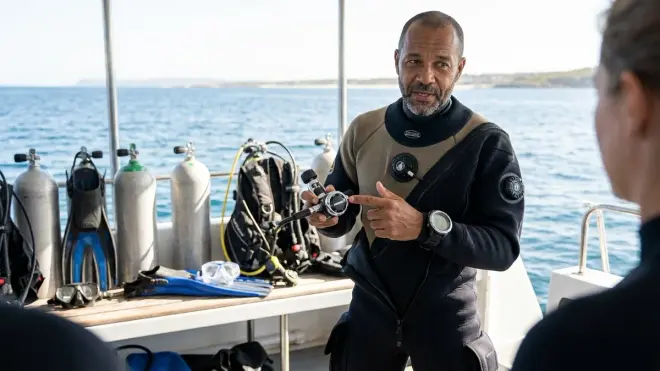
How accurate is heart rate monitoring in dive computers compared to fitness trackers on land?
Optical heart rate sensors in dive computers use the same fundamental technology as fitness trackers, but underwater conditions make them less accurate. At the surface in warm water with proper fit, you'll typically see accuracy within ±5 bpm compared to a chest strap. As you descend and water temperature drops, peripheral vasoconstriction reduces blood flow to your wrist, which can degrade optical sensor accuracy to ±10-15 bpm or cause intermittent signal loss. Chest-strap monitors maintain better accuracy throughout the dive because they measure electrical signals directly from your heart rather than relying on blood flow at your extremities. In water below 60°F or when wearing thick gloves, chest straps are significantly more reliable than wrist-based optical sensors.
Do biometric dive computers actually change decompression calculations based on heart rate?
It depends entirely on the manufacturer and specific model. Some dive computers, like certain Garmin Descent models, display heart rate and respiratory data but don't integrate it into their decompression algorithm—they still use traditional fixed-parameter models like Bühlmann ZHL-16C. Other systems, particularly some Suunto computers with their Fused RGBM algorithm, do incorporate physiological data into adaptive calculations that can shorten or extend no-decompression limits based on estimated workload. Shearwater is actively researching adaptive algorithms but as of 2026 hasn't fully integrated real-time biometric adjustment into their production models for decompression calculation purposes. Always check your specific computer's technical documentation to understand whether biometric data affects dive planning or is purely informational.
Can I use a regular fitness tracker heart rate monitor with my dive computer?
Generally no, because consumer fitness trackers use wireless protocols like Bluetooth or ANT+ that don't transmit through water beyond a few inches. Dive-specific heart rate monitors use low-frequency radio waves, typically in the 5-10 kHz range, that can penetrate water over distances of three to six feet. Additionally, consumer fitness devices aren't pressure-rated for depth—most will flood and fail immediately. If your dive computer supports external heart rate monitoring, you need to use either the manufacturer's proprietary chest strap or one specifically designed for underwater use. Some systems are compatible with standard chest straps if used at the surface, but once you submerge, you need dive-rated equipment with appropriate wireless transmission.
What's the best setup for biometric monitoring in cold water diving?
For water temperatures below 65°F, a chest-strap heart rate monitor significantly outperforms wrist-based optical sensors. The chest strap measures electrical signals that aren't affected by peripheral vasoconstriction, while wrist sensors struggle when blood flow to your extremities decreases in cold conditions. Wear the chest strap directly against your skin under your wetsuit or drysuit base layer, positioned just below your chest muscles with the electrode pads wet for good contact. Make sure the strap is snug but not restrictive—you should be able to fit one or two fingers underneath. Pair this with a dive computer that has robust cold-water performance; understanding cold-water regulator performance is equally important since your breathing apparatus faces similar challenges in these conditions.
How does biometric data help reduce air consumption during dives?
Real-time heart rate and respiratory rate monitoring creates a biofeedback loop that helps you recognize and control physiological stress. When you see your heart rate displayed on your computer climbing above your normal resting range, it prompts conscious breathing control and relaxation techniques—slowing your breath, checking your buoyancy, reducing unnecessary movement. Studies show that anxious or working divers can consume air at rates 50-100% higher than relaxed divers; by actively managing your physiological state, you can bring your consumption closer to your optimal baseline. Over multiple dives, reviewing post-dive biometric data also reveals patterns—maybe you always get tense during descents, or burn more air swimming into current—and identifying these patterns lets you work on specific skills. This is particularly valuable during training; mastering buoyancy control while monitoring your heart rate teaches you what calm, efficient diving actually feels like in your body.
Integration with Other Dive Systems
One aspect of biometric dive technology that doesn't get enough attention is how it connects—or fails to connect—with the rest of your gear ecosystem. I've been diving long enough to remember when every piece of equipment was completely standalone. Now everything has wireless capability, but not everything actually talks to each other.
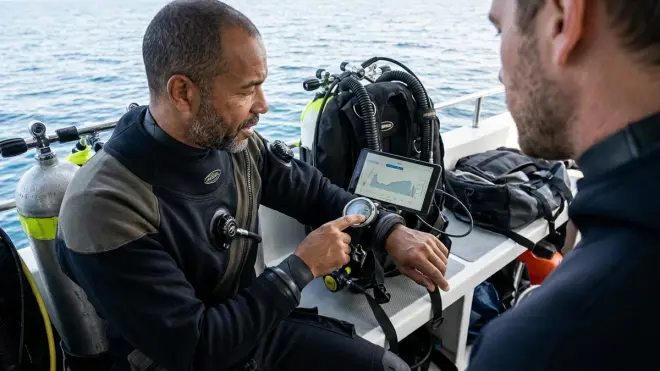
Tank pressure integration is the most mature connection point. If you're running a wireless tank transmitter already—and if you're doing any kind of technical diving or just want better gas management, you should be—many biometric systems can pull that data and correlate it with your heart rate. The computer calculates your surface air consumption (SAC) rate and, more importantly, shows you in real time how your consumption changes with exertion. I've watched students have genuine "aha" moments when they see their SAC rate jump from 0.5 cubic feet per minute to 0.9 while they're thrashing around trying to clear a mask. That immediate feedback is powerful.
Buoyancy compensator integration is still mostly theoretical, but a few experimental systems are trying to incorporate accelerometer data to detect rapid ascents or descents. The idea is that if your BC auto-inflates or you're dumping too much air too fast—detectable from pressure changes and movement patterns—combined with elevated heart rate, the system could flag a potential panic situation. We're not quite there yet, but I've seen prototypes. For now, understanding how to properly fit and adjust your BCD remains a manual skill.
Underwater camera systems are an interesting use case. Some photographers have started using biometric data to review which moments during a dive produced their best images. Turns out, there's often a correlation between lower heart rates—that calm, focused state—and better composition and timing. Combine this with dive computer timestamps and you can map your physiological state to your photo metadata. It's niche, but if you're serious about underwater photography and video, it's worth considering.
The biggest missing piece right now is cross-platform compatibility. If you have a Garmin dive computer, a Shearwater transmitter, and a Suunto compass, nothing talks to anything else unless you manually export and combine data. There's no universal standard like USB-C for dive gear communication. Some manufacturers are protective of their proprietary protocols; others are just slow to adopt open standards. This fragmentation means you often end up locked into one manufacturer's ecosystem if you want seamless integration, which limits your choices and inflates costs.
Real-World Performance: What I've Actually Seen
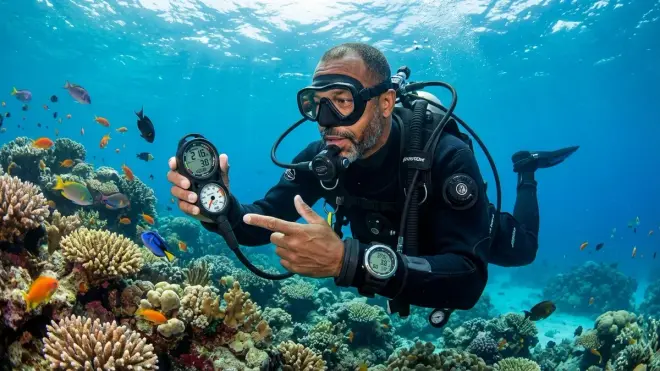
I tested the Garmin Descent Mk2i extensively over about sixty dives in 2024 and 2025, split between tropical reef dives in Indonesia, cold-water wreck dives in Washington state, and pool training sessions. In 78-84°F water with the computer snug against bare skin, heart rate readings matched my chest strap within 3-5 bpm most of the time. The data was genuinely useful—I could see my heart rate settle as I got comfortable on a dive, spike when I encountered strong current, and gradually climb near the end of a dive as I got tired.
In 48-52°F Puget Sound water, performance degraded noticeably. Wearing the computer over a 5mm wetsuit sleeve meant frequent signal dropouts. When I moved it under the sleeve directly against skin, accuracy improved but still lagged behind the chest strap by 10-15 bpm during exertion. Below 50 feet, the optical sensor sometimes just gave up entirely for several minutes at a time. For these conditions, I switched to using a Suunto chest strap with an EON Steel, and that setup was rock solid.
The post-dive data has been more valuable than I expected. I can look back at a 60-minute dive and see exactly when I was working hard (heart rate 110-120 bpm), when I was coasting (75-85 bpm), and how quickly I recovered after exertion. Comparing this across multiple dives shows improvement in fitness and efficiency—my average heart rate for equivalent profiles has dropped about 8 bpm over two years, which translates to measurably better air consumption.
Here's what didn't work as well as advertised: the "adaptive no-decompression limits" on one system I tested were so conservative when my heart rate was elevated that they were essentially useless. On a dive where I was swimming moderately hard for the first ten minutes—heart rate around 105 bpm—the computer cut my no-decompression time by six minutes compared to a traditional algorithm running on a different computer at the same depth. Maybe that's physiologically justified, but it felt overly cautious compared to decades of established dive table and algorithm safety records. I ended up turning off the adaptive feature and just using the heart rate data for information.
The Safety and Training Angle
Beyond the gadget appeal, biometric monitoring has legitimate safety applications that are starting to change how some dive operations work. A few liveaboards I know have started issuing biometric-enabled rental computers to guests, with guides monitoring pooled data on tablets. If someone's heart rate stays elevated throughout a dive, especially compared to their baseline from previous days, that's a conversation starter. Sometimes it's nothing—just an exciting shark encounter. Sometimes it reveals that a diver is uncomfortable, overweighted, or dealing with equipment that doesn't fit right.
For training, the feedback loop is invaluable. I run an advanced buoyancy workshop where students do a series of drills—hovering motionless, doing a slow 360-degree rotation, swimming backwards—while monitoring their heart rate. The goal is maintaining a heart rate within 10 bpm of their resting baseline throughout. It sounds simple, but it's hard. New divers often see their heart rate climb 20-30 bpm the moment they start any task that requires concentration. With practice, they learn to stay calm and breathe slowly even when challenged, and the heart rate numbers prove they've actually achieved that mental state rather than just thinking they have.
Rescue scenarios are another application. When we practice simulated out-of-air emergencies or unconscious diver recovery, I can review afterward exactly how each student's physiology responded. Did their heart rate spike to 140 bpm the moment they had to make a decision? Did it stay elevated throughout the drill, or did they calm down once they started executing their training? This data helps identify who needs more stress inoculation training and who's already maintaining composure under pressure.
One caution: biometric data can create false confidence. I've seen divers—often tech divers who love data and gadgets—obsess over their numbers to the point that they're staring at their computer screen instead of diving. Your heart rate isn't the dive; it's one data stream among many. You still need to monitor your buddy, check your gauges, maintain situational awareness, and follow your dive plan. The biometrics are supplementary, not central. If you find yourself more focused on hitting target heart rate zones than on the actual experience of diving, you've lost the plot.
Looking Ahead: Where This Technology Is Going
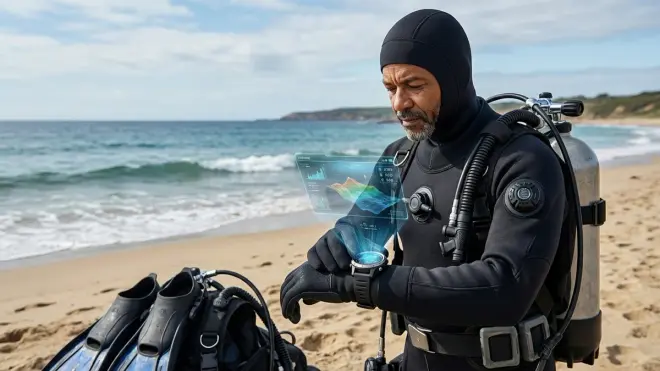
The biometric dive computers we have in 2026 are first-generation tools. They work, they provide useful data, but they're still fairly crude. The next wave—some of which is already in development—will be more sophisticated.
Multi-sensor fusion is the obvious next step. Instead of just heart rate, we'll see computers that combine heart rate variability, skin temperature, accelerometer data, breathing rate from tank monitoring, and maybe even blood oxygen saturation (pulse oximetry underwater is technically challenging but not impossible). Algorithms will use all these inputs to build a more complete picture of physiological stress and workload.
Predictive alerts are starting to appear. Instead of just showing you that your heart rate is high, future systems will warn you when patterns suggest developing problems. Maybe your heart rate is creeping up slowly over the course of a dive, or your breathing rate is increasing while your heart rate stays stable—patterns that might indicate CO2 retention, equipment malfunction, or impending panic. The computer could prompt you to check your gear, adjust your breathing, or end the dive.
Integration with AI dive planning is where things get really interesting, and somewhat controversial. Imagine a system that learns your individual physiology over hundreds of dives, then uses that data to generate personalized dive plans and decompression schedules. Your computer knows that you tend to get cold after 40 minutes in 70°F water, that your heart rate stays lowest when you're between 30-60 feet, and that your air consumption increases by 30% when water temperature drops below 65°F. It could suggest optimal dive profiles based on that history. Whether we should trust algorithms to make those decisions—or whether that removes too much of the diver's responsibility for their own planning—is a debate that's just starting.
Medical integration is both promising and problematic. Some systems are exploring connections to medical alert databases, so if you have a cardiac event underwater, your dive computer could transmit basic medical information to rescuers. Privacy concerns are significant, obviously. But for divers with pre-existing conditions who want to continue diving safely, having that data available in an emergency could save their life.
What I hope we don't see is biometric technology being used to create artificial barriers. I don't want dive operators requiring certain physiological profiles to grant access to dive sites, or insurance companies using dive computer data to set premiums. The data should empower divers to dive safer and more effectively, not become another mechanism for exclusion or surveillance.
Making the Decision: Is Biometric Worth It for You?
Here's my honest take after several years with these systems: biometric dive technology is genuinely useful for training, interesting for data enthusiasts, and somewhat helpful for safety—but it's not essential.
If you're a new diver still working on basic skills—buoyancy, breathing control, gear management—biometric feedback can accelerate your learning. Seeing your heart rate spike when you're stressed and watching it settle as you apply good technique creates a concrete connection between mental state and physical performance. For that use case, even a mid-range biometric computer is worth considering. Make sure you've also dialed in your BCD fit and pre-dive safety checks, since equipment issues will spike your heart rate regardless of skill level.
If you're an experienced diver who wants to optimize performance—better air consumption, lower physiological stress, more efficient movement—the post-dive data analysis is valuable. You can identify patterns in your diving, track improvements over time, and make informed adjustments to technique and equipment. Pair this with regular dive computer maintenance and proper sensor calibration for best results.
If you're a technical diver doing decompression diving, the case is less clear. Yes, the data is interesting. Yes, theoretically it could improve decompression accuracy. But the algorithms aren't validated to the same degree as traditional models, and I'm not willing to bet my spinal cord on software that hasn't been refined over decades of use. I use biometric data as supplementary information, but I plan my dives based on conservative traditional algorithms. Maybe in another five or ten years, once we have substantially more validation data, that will change.
If you're a casual recreational diver who does a few vacation dives each year, you probably don't need this. A reliable dive computer without biometric features will serve you perfectly well at a lower cost, with simpler maintenance, and without the battery life compromises. Spend your money on more diving instead.
For cold-water divers specifically: if you're going biometric, go chest strap. Don't waste money on a wrist-based optical system if most of your diving is below 60°F. The accuracy degradation in cold water makes wrist optical sensors borderline useless. Check out our recommendations for best biometric dive computers to see which systems handle cold water best, and understand how this pairs with how to choose the right wetsuit for thermal management.
Summary
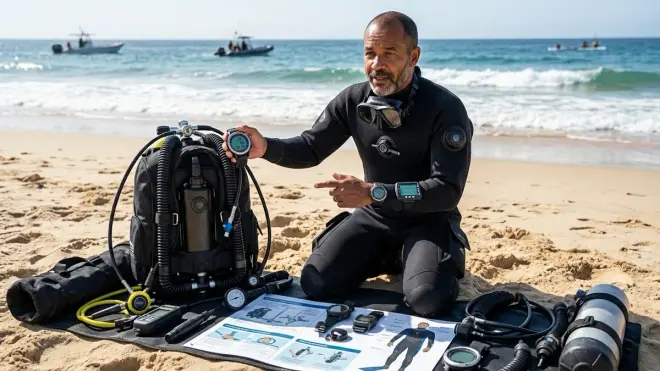
Biometric dive technology transforms your dive computer into a physiological monitoring system, tracking heart rate, breathing patterns, and thermal stress in real time. The technology works—mostly—using optical sensors or chest straps to measure pulse, algorithms to estimate respiratory rate, and thermistors to track skin temperature. Accuracy varies significantly with water temperature, equipment fit, and depth; wrist-based optical sensors struggle in cold water while chest straps maintain reliability across conditions. Some systems integrate biometric data into adaptive decompression algorithms, while others simply display and record it for post-dive analysis. The practical benefits include improved air consumption through biofeedback, better training outcomes from physiological awareness, and potential safety advantages from real-time stress monitoring. The limitations include reduced cold-water accuracy for optical sensors, battery life compromises, lack of cross-platform compatibility, and algorithms that haven't yet been validated over decades of use. For new divers focused on skill development and experienced divers optimizing performance, biometric systems offer genuine value. For technical divers and cold-water specialists, chest-strap systems are worth considering but shouldn't replace conservative traditional dive planning. For casual recreational divers in warm water, the technology is interesting but not essential—your dive computer budget is better spent on fundamental reliability than on biometric features you'll rarely use. As these systems mature and accumulate more validation data, they'll likely become standard equipment, but in 2026 we're still in the early adoption phase where the technology works but hasn't yet been proven indispensable.