


I've had more than a few dive students stare at me blankly when I mention regulator intermediate pressure during equipment discussions. Their eyes glaze over like I've started speaking a different language. But here's the thing: understanding regulator intermediate pressure (IP) isn't just nerdy tech-speak—it's fundamental to knowing how your life support system actually works underwater and why it sometimes doesn't work the way you expect.
In this guide, you'll learn what intermediate pressure is, how it affects your breathing experience at depth, why it matters for regulator performance, and how to recognize when IP settings might be causing problems. Whether you're a newer diver trying to understand your gear better or someone considering technical diving who needs to grasp these concepts, I'll break it down in plain language with real examples from my years underwater. We'll cover the basic mechanics, typical IP ranges, troubleshooting steps, and what you should communicate to your technician during servicing.

Time commitment: 15-20 minutes to understand the concepts, though you'll build on this knowledge throughout your diving career.
What You'll Need
Before diving into the technical details, here's what will help you get the most from this guide:
- Your own regulator (helpful for visual reference, but not required)
- Basic understanding of first and second stage functions (if you need a refresher, check out The Complete Guide to Scuba Regulators)
- Notepad or digital notes for jotting down your regulator's specifications
- Your regulator's service manual or manufacturer specs (optional but useful)
- Access to a qualified regulator technician (for any actual adjustments—this is not a DIY situation)
Step 1: Understanding What Intermediate Pressure Actually Is
Let's start with the fundamentals. Intermediate pressure is the reduced air pressure that exists between your first stage and second stage—hence "intermediate." When you breathe from your regulator underwater, air makes a two-stage journey: first, your first stage reduces the high pressure from your tank (typically 3,000-3,500 PSI when full) down to an intermediate pressure of around 120-145 PSI above ambient water pressure. Then your second stage reduces that intermediate pressure down to ambient pressure—the pressure of the surrounding water—so you can breathe comfortably.
Think of it like a two-step staircase for air pressure. That middle step—the intermediate pressure—is what we're talking about.
I remember a dive in Cozumel where a student's regulator started breathing noticeably wet and gurgling. After the dive, we discovered her IP had crept up to nearly 160 PSI—way too high. That excess pressure was overwhelming her second stage's ability to seal properly. The air you breathe has to pass through this intermediate pressure zone, and if that pressure isn't right, everything downstream suffers.
The intermediate pressure is maintained by a spring and valve system inside your first stage. As you descend and ambient pressure increases, the first stage automatically compensates, maintaining that 120-145 PSI differential above whatever depth you're at. At the surface, if ambient is 14.7 PSI, your intermediate pressure might be 135 PSI above that. At 99 feet (4 atmospheres), the first stage maintains roughly that same 135 PSI above the now-higher ambient pressure. It's elegant engineering when it works correctly.
Step 2: Recognizing Why IP Settings Matter for Performance
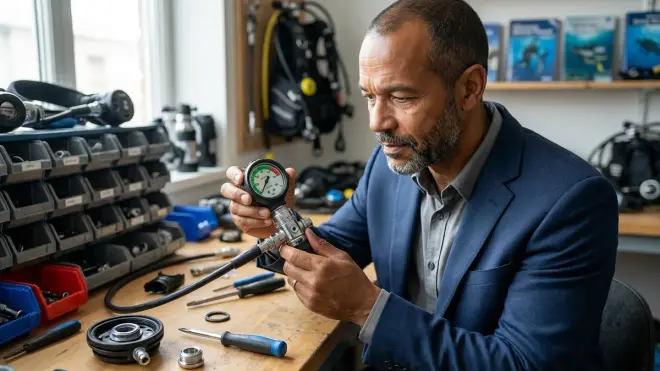
Here's what the manufacturer claims: IP settings are calibrated at the factory and rarely need adjustment. Here's what actually happens at depth: IP drift is common, especially as regulators age, and even small variations significantly impact breathing performance.
Low intermediate pressure (below manufacturer specifications, typically under 120 PSI over ambient) creates higher breathing resistance, particularly on inhalation. I've tested regulators with IP readings around 110 PSI, and at 80 feet you're working noticeably harder to pull air. This happens because the second stage has less pressure differential to work with—it's like trying to sip a thick milkshake through a narrow straw.
High intermediate pressure (above specs, typically over 150 PSI over ambient) causes different problems: freeflows, leaking second stages, wet breathing, and excessive air delivery. I've had this happen on me at 90 feet in 48-degree water off the Washington coast—the reg started delivering air continuously because the second stage couldn't hold back the excess pressure. Not dangerous if you're prepared, but it'll drain your tank fast and definitely gets your attention.
The IP setting also affects your work of breathing (WOB) across your entire dive range. Regulators are typically tuned for optimal performance between 130-140 PSI intermediate pressure. Within this range, the second stage valve operates most efficiently, opening and closing crisply in response to your breathing demands. Outside this range, performance degrades in measurable ways that you'll feel as increased effort or erratic air delivery.
For technical divers and cold water enthusiasts, IP becomes even more critical. Cold water regulators are often tuned to slightly lower IP settings (125-135 PSI) to reduce the likelihood of ice-induced freeflows, though this comes with a minor trade-off in breathing ease.
Step 3: Learning How to Identify IP-Related Problems
You can't measure intermediate pressure yourself without specialized tools—specifically an intermediate pressure gauge that connects to a first stage LP port. But you absolutely can recognize the symptoms of incorrect IP settings during actual diving.
Signs your IP might be too high:
- Second stage hisses or leaks air when not in your mouth
- Slight continuous airflow (freeflow) that worsens at depth or in cold water
- Wet, gurgly breathing, especially during exhalation
- BCD inflator button becomes overly sensitive or inflates aggressively
- Your technician mentions you're going through tank air faster than your dive profile suggests
Signs your IP might be too low:
- Noticeably harder inhalation effort, particularly below 60 feet
- Feeling like you can't get a full breath at depth
- Second stage feels "mushy" or unresponsive
- Breathing resistance increases disproportionately as you descend
- Regulator performs fine in the pool but feels restricted on ocean dives
I had a student once who kept complaining that her rental regulator "didn't give enough air" on deeper dives beyond 70 feet. She was working through air faster than other students because she was breathing harder to compensate. We swapped her reg for another, and the problem vanished—the original was likely running low IP, probably around 110-115 PSI instead of the 135 PSI it should have been set to.
Context matters too. DIN valve connections generally maintain more consistent IP than yoke connections because they create a more secure seal, but both can develop IP problems if the first stage internals need service.
Step 4: Understanding the IP Adjustment Process (For Technician Communication)
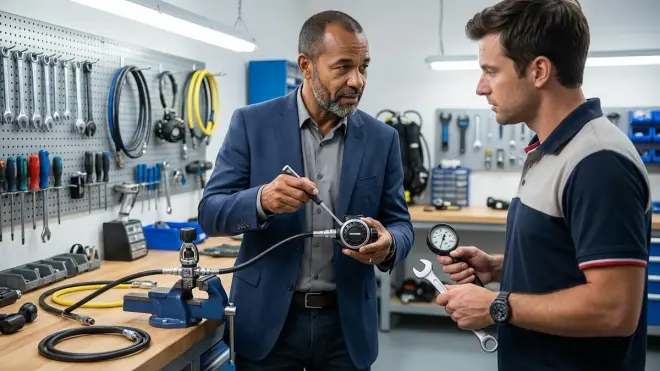
Let me be crystal clear: you should not attempt to adjust your regulator's intermediate pressure yourself unless you're a certified regulator technician. This isn't gatekeeping—it's safety. Improper adjustment can create life-threatening freeflows or breathing failures underwater. But understanding the process helps you communicate effectively with your technician and recognize when they're doing quality work.
Technicians adjust IP using a specialized tool to turn the adjusting screw or collar inside the first stage. This changes the spring tension on the valve that controls pressure reduction. Tightening increases spring pressure, which raises IP. Loosening decreases spring tension, lowering IP. Sounds simple, but the adjustment is precise—we're talking about quarter-turn increments.
The proper procedure involves:
- Connecting an intermediate pressure gauge to an LP port
- Pressurizing the first stage with a tank
- Purging the second stage repeatedly to get a stable reading
- Making micro-adjustments to reach manufacturer specifications
- Testing under pressure repeatedly to ensure stability
- Checking for creep (IP slowly rising when the reg sits pressurized)
When you take your regulator for service, ask your technician what your IP reading is. Write it down. A good tech will gladly share this information—it's part of your regulator's health profile. Typical specifications are stamped in the service manual, usually between 130-145 PSI for most recreational regulators, though this varies by manufacturer and model.
If your IP is outside specs by more than 10 PSI, ask why and what was done to correct it. If it's within specs but you're experiencing breathing problems, discuss whether adjusting toward the higher or lower end of the acceptable range might address your specific issues.
Step 5: Connecting IP to Regulator Maintenance and Service Intervals
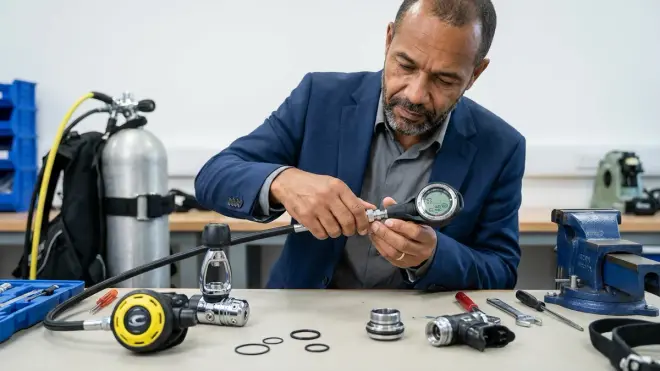
Here's something I learned the expensive way on a liveaboard trip to Indonesia: intermediate pressure doesn't stay constant over time. As your first stage accumulates dive hours, several things happen that affect IP stability. O-rings compress and harden. The main valve seat develops grooves from repeated contact with the high-pressure valve. Internal components corrode microscopically, especially in divers who don't rinse thoroughly or dive frequently in silty conditions. Spring tension can weaken slightly.
All of these factors cause IP to drift, usually upward. I've seen regulators drift 15-20 PSI over 100-150 dive hours. That's why annual service or service at manufacturer-recommended intervals is genuinely important, not just a revenue scheme. During service, technicians don't just replace o-rings—they measure IP, compare it to baseline, and re-tune the first stage if drift has occurred.
The service schedule outlined in our complete regulator maintenance guide typically recommends annual service or every 100 dive hours, whichever comes first. For regulators used in cold water, heavy particulate environments, or commercial diving, intervals should be shorter—every 50-75 hours or six months.
Keep a log of your IP readings from each service. If you notice significant drift patterns—say, your IP consistently climbs 10+ PSI between services—that tells you something about how that particular first stage ages. Some designs are more stable than others. Diaphragm first stages tend to maintain IP more consistently than piston designs, though piston regs often deliver better breathing performance within their optimal IP range.
IP creep is another phenomenon to understand. This is when your IP slowly rises over time while your regulator sits pressurized—not during breathing, just sitting there. Even 5-10 PSI of creep over 10 minutes suggests your first stage valve isn't sealing perfectly. It's not always immediately dangerous, but it indicates wear that should be addressed during service.
Step 6: Recognizing IP Variations Across Different Regulator Designs
Not all regulators target the same intermediate pressure, and understanding why tells you a lot about design philosophy. Balanced first stages typically run IP settings between 135-145 PSI. These designs compensate for changes in tank pressure, maintaining consistent breathing regardless of whether your tank is at 3,000 PSI or 500 PSI. The higher IP supports this compensation mechanism.
Unbalanced first stages—common in entry-level regulators and many beginner-friendly models—often operate at slightly lower IP, typically 125-135 PSI. You'll notice breathing effort increases slightly as your tank pressure drops, particularly below 700 PSI. This is normal for the design, not a defect.
Overbalanced first stages (like several Atomic Aquatics and Scubapro models) actually increase IP as you descend. At the surface, they might deliver 135 PSI, but at 100 feet they're delivering 145-150 PSI. The theory is that this compensates for increased breathing resistance at depth. In practice, I've found the difference is subtle—marketing makes it sound more dramatic than it feels underwater.
Cold water-optimized regulators frequently run lower IP settings (125-135 PSI) to reduce heat loss through adiabatic cooling during rapid pressure reduction. When high-pressure air expands quickly to intermediate pressure, it cools dramatically. Higher IP means more expansion, more cooling, and greater risk of ice formation in the first stage. Lower IP reduces this risk, which is why technical cold water divers often request their regs be tuned to the lower end of acceptable IP ranges.
I've tested this directly—same regulator model, one tuned to 135 PSI and one to 145 PSI, both used under identical conditions in 42-degree water off Vancouver Island. The higher-IP reg developed frost on the first stage body after 25 minutes at 60 feet. The lower-IP reg stayed clear for the full 40-minute dive. The difference in breathing effort was barely noticeable, but the freeflow risk was significantly different.
Step 7: Testing Your Understanding with Practical Observation

Now that you understand the concepts, here's how to apply this knowledge practically without needing to become a technician. Next time you're at the dive shop or on a boat, pay attention to how different regulators breathe. When you try rental equipment or a buddy's reg, notice the inhalation resistance and exhaust characteristics.
Borrow an IP gauge if you have access to one through your shop or instructor. Even just seeing the measurement process demystifies the concept. Watch your technician during service—ask to see the IP reading before and after adjustment. Most shops are happy to show interested divers what they're doing.
Keep notes on your own regulator's performance across different conditions:
- How does it breathe at 30 feet versus 90 feet?
- Do you notice changes in breathing resistance as your tank pressure drops?
- Has performance changed over the past 20-30 dives since your last service?
- Does cold water affect breathing characteristics?
These observations help you communicate effectively with your technician. Instead of saying "it breathes funny," you can say "I'm noticing increased inhalation resistance below 70 feet compared to how it performed right after service last year." That's actionable information that points directly toward IP drift or other first stage issues.
For technical divers or those advancing beyond recreational limits, consider taking a regulator repair course. Organizations like Scuba Engineers Institute and several manufacturers offer training that teaches proper IP adjustment, troubleshooting, and maintenance. You'll need this knowledge if you're moving toward self-sufficient diving where equipment failure could be life-threatening.
Pro Tips & Common Mistakes
Pro tip from years of testing: Keep your service records and specifically note IP readings. I maintain a spreadsheet for every regulator I own, logging IP, work of breathing, and any adjustments made. Over time, patterns emerge. One of my personal regs consistently drifts upward about 8 PSI per 75 dive hours—clockwork. Knowing this, I schedule service proactively before it becomes a problem.
Common mistake: Assuming that because a regulator breathes fine at the surface or in the pool, the IP is correct. Pool depths aren't sufficient to reveal IP-related problems. A regulator with IP at 115 PSI might feel acceptable at 12 feet but become restrictive at 80 feet. Always evaluate performance across your normal diving depth range.
Another mistake: Ignoring minor symptoms until they become major problems. That slight hiss from your second stage? That's potentially high IP pushing past the valve seat. That tiny increase in breathing effort you've noticed over the past month? Likely IP drift. Address these early, during normal service, rather than discovering a freeflow or breathing failure at depth.
Pro tip for cold water divers: If you regularly dive below 50°F, discuss with your technician whether tuning your IP to the lower end of specifications makes sense. You'll trade a tiny amount of breathing ease for significantly reduced freeflow risk. That's usually a worthwhile trade-off.
Critical point: Never attempt DIY IP adjustment unless you're certified to do so. I've seen divers permanently damage first stages by over-tightening adjustment screws, stripping threads, or creating dangerous high-IP conditions. The money you save by skipping professional service isn't worth the risk of equipment failure underwater.
Frequently Asked Questions

What is the normal intermediate pressure for a scuba regulator?
Normal intermediate pressure for most recreational scuba regulators ranges from around 130 to 145 PSI above ambient water pressure, with the optimal setting typically between 135-140 PSI. The exact specification varies by manufacturer and regulator model, so always reference your specific regulator's service manual for the precise target IP range.
Can I adjust my regulator's intermediate pressure myself?
You should not adjust your regulator's intermediate pressure yourself unless you are a certified regulator technician with proper training, tools, and manufacturer specifications. Incorrect IP adjustment can create dangerous breathing failures or freeflows underwater, and attempting DIY adjustment will void your manufacturer warranty and potentially create life-threatening equipment malfunctions.
How often does intermediate pressure need to be checked?
Intermediate pressure should be checked during every annual service or at manufacturer-recommended service intervals, typically every 100 dive hours or 12 months, whichever comes first. If you notice changes in breathing performance, suspect IP drift, or dive in demanding conditions like cold water or heavy silt, more frequent checks may be warranted.
What causes intermediate pressure to drift over time?
Intermediate pressure drifts over time due to o-ring compression and hardening, valve seat wear from repeated contact, spring tension weakening, and corrosion or debris accumulation on internal components. This drift typically occurs gradually over 50-150 dive hours and is a normal part of regulator aging that professional service addresses.
Summary
Understanding regulator intermediate pressure transforms your relationship with your life support equipment from mysterious black box to comprehensible system. You now know that IP is the reduced air pressure between first and second stages, typically 130-145 PSI above ambient pressure, and that it directly affects breathing resistance, freeflow risk, and overall regulator performance.
You've learned to recognize symptoms of incorrect IP—from excessive breathing resistance with low pressure to freeflows and leaking with high pressure. You understand why IP drifts over time, why annual service matters, and how different regulator designs target different IP ranges for specific diving conditions.
Most importantly, you can now communicate effectively with your technician, track your regulator's health through service records, and make informed decisions about maintenance timing and equipment selection. Next time you're underwater at 80 feet breathing comfortably, you'll appreciate the precise pressure regulation happening between your tank and your lungs—and you'll know exactly what intermediate pressure means for that experience.