
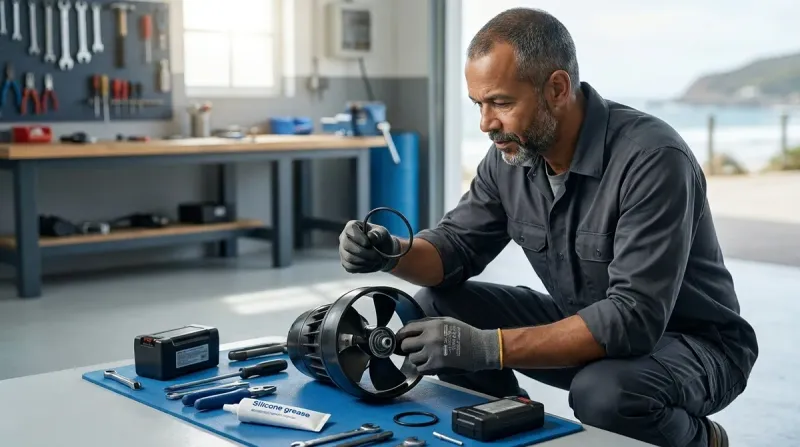

Proper underwater scooter maintenance is the difference between a reliable DPV that gets you through hundreds of dives and an expensive paperweight that floods on dive thirty. I learned this the hard way when a neglected main shaft seal failed on me during a wreck penetration in North Carolina—the scooter went from smooth thrust to dead weight in about fifteen seconds, and I spent the rest of that dive doing a very ungraceful finning exit while my buddy tried not to laugh.
This checklist covers the essential maintenance tasks every DPV owner needs to perform, from daily pre-dive checks to annual service requirements. Whether you're running a high-end Yamaha 350Li Underwater Scooter for technical diving or a recreational unit for reef cruising, these procedures will keep your scooter sealed, charged, and ready to dive.
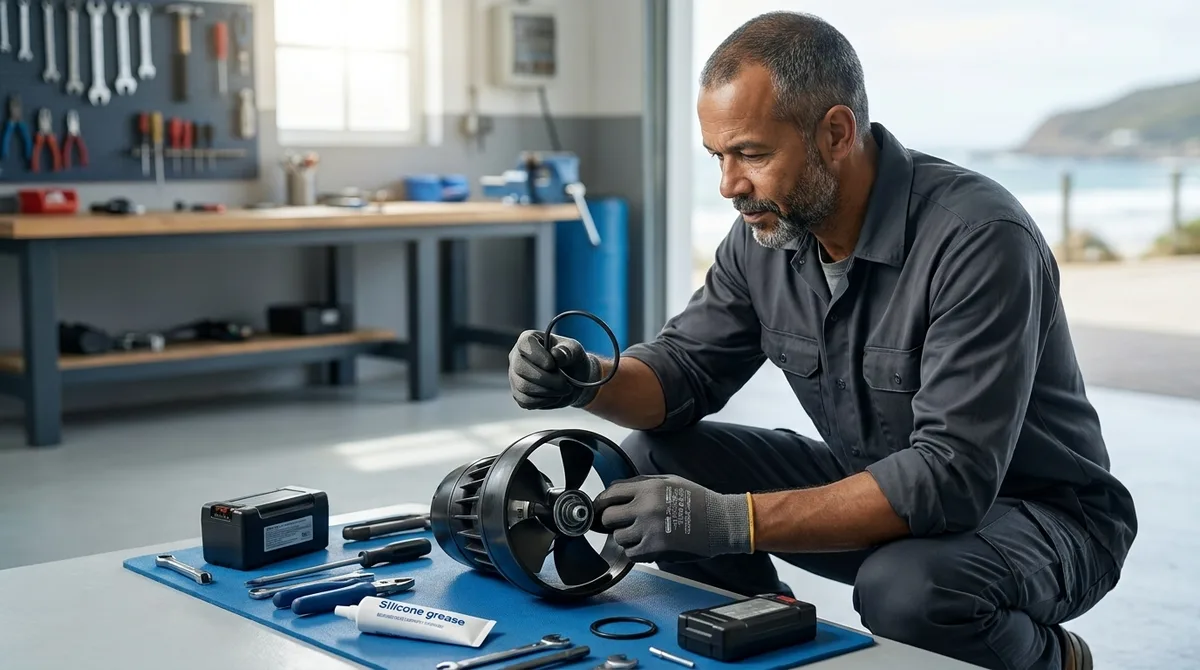
Pre-Dive Inspection (Every Dive)
These checks take about five minutes and catch 90% of potential problems before you're underwater. I run through this sequence on the boat or beach before every dive—it's become muscle memory at this point, just like checking my regulator's IP settings or verifying my dive computer is in the right mode.
Main shaft O-ring visual inspection: Look for any visible cuts, flat spots, or embedded debris before you even think about getting wet. A compromised shaft seal is your most common flood point—I've seen more scooters flood from damaged shaft O-rings than all other causes combined.
Battery charge level verification: Check your actual battery gauge, not just what you remember from last time. Lithium-ion cells can self-discharge 2-3% per month, and if you're six weeks out from your last dive, that "full" battery might be sitting at 85%.
Nose cone seal condition: Run your finger around the entire nose cone O-ring groove to feel for any grit, sand, or salt crystals that could compromise the seal. Even a single grain of sand can create a leak path once you're at depth and the pressure differential increases.
Propeller rotation test: Spin the prop by hand and feel for any grinding, binding, or unusual resistance. Free rotation means your seals aren't binding and your bearings are in good shape—if it feels sticky, don't dive it until you've diagnosed the problem.
Buoyancy check: Test your scooter's trim in the water before the dive. A properly maintained DPV should be neutrally buoyant or slightly negative (0.5-1 lb in saltwater). If it's suddenly much heavier or lighter than usual, you may have water intrusion or a buoyancy module issue.
Mounting point security: Verify all attachment points, handle bolts, and safety leash connections are tight and secure. I've watched a DPV handle come loose at 80 feet during a current dive—not fun when you're trying to maintain position on a drift.
Control trigger response: Test your speed trigger through its full range of motion before you descend. Sticky or unresponsive controls at the surface will only get worse with cold and pressure.
Audible self-test sequence: Many modern DPVs run a diagnostic beep sequence when powered on. Know what your scooter's normal startup sounds are, because an abnormal pattern often indicates a sensor or system fault.
Post-Dive Cleaning and Rinse Protocol
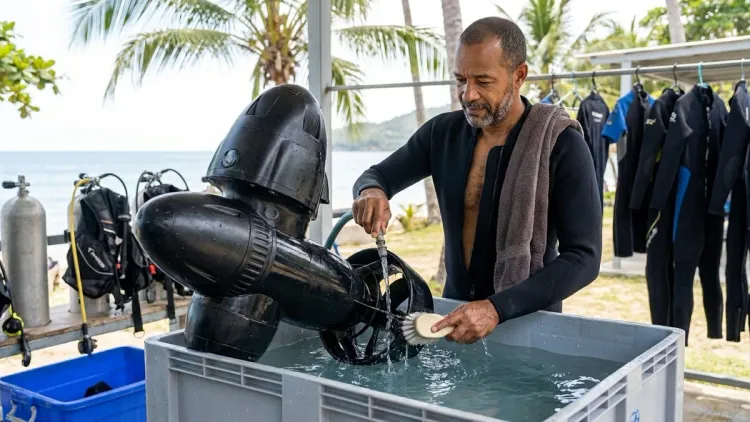
This is where most recreational DPV owners get lazy, and it's why I see so many units with corroded contacts and seized components. Salt water is incredibly destructive to the precision seals and electrical contacts in your scooter—proper post-dive care extends service life by years.
Immediate freshwater rinse within 30 minutes: Don't let your scooter sit in salt water or salt air any longer than necessary. As soon as you're off the boat, rinse the entire exterior with fresh water, paying special attention to the prop shaft, nose cone seal interface, and any electrical contacts.
Prop shaft flush procedure: While rinsing, manually rotate the propeller to flush any salt water from around the shaft seal. I usually spin mine through 10-15 full rotations under running fresh water to ensure I've displaced any trapped salt.
Battery compartment inspection: After rinsing, open the battery compartment in a clean, dry environment and visually inspect all contacts for any signs of moisture, corrosion, or salt deposits. If you see any moisture where there shouldn't be any, your seal has failed—don't dive that scooter again until you've serviced it.
Charge port cleaning: Use a soft brush or compressed air to clean the charge port and remove any salt residue. Corroded charge contacts are one of the most common failure points on recreational DPVs, and it's entirely preventable with basic cleaning.
Storage position: Store your DPV horizontally in a cool, dry location away from direct sunlight. Vertical storage can put unnecessary stress on shaft seals over time, and heat accelerates battery degradation.
O-Ring and Seal Maintenance Schedule
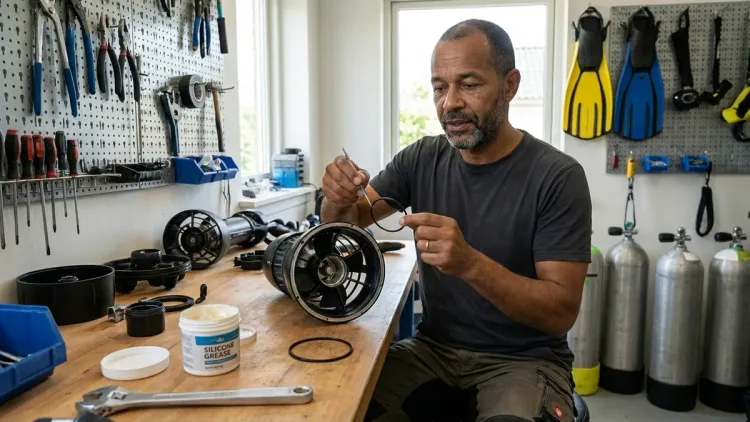
O-rings are your scooter's first and last line of defense against flooding. Here's what the manufacturer claims about O-ring life: most recommend annual replacement regardless of condition. Here's what actually happens: if you're diving regularly in warm, clean water and maintaining your seals properly, they'll often last 18-24 months. But if you're diving in cold water, silty conditions, or doing more than 50 dives per year, you need to inspect more frequently and replace proactively.
Monthly visual inspection (active diving): If you're diving weekly or more, pull your main seals monthly and inspect under good lighting. Look for any compression set (permanent flattening), surface cracks, or hardening. A healthy O-ring should still have some give when you squeeze it—if it feels hard like plastic, replace it.
O-ring lubrication application: Use only manufacturer-specified silicone grease (usually Christo-Lube or equivalent marine-grade formulation). Apply a very thin, even coating—you want just enough to make the O-ring slightly glossy, not a thick goopy layer. Excess lubricant attracts debris and can actually compromise the seal.
Groove cleaning procedure: Before reinstalling any O-ring, clean its groove completely using a lint-free cloth and isopropyl alcohol. I use cotton swabs to get into the corners where salt and debris accumulate. Any contamination in the groove can prevent proper O-ring seating.
Spare O-ring kit management: Keep a complete spare O-ring kit in your gear bag, and actually know where it is. I carry spares for the main shaft seal, nose cone, and battery compartment—these are your critical flood points, and having spares has saved more than one dive trip for me.
Annual complete seal replacement: Replace all primary O-rings at least once per year, regardless of their apparent condition. O-ring material degrades over time from ozone exposure, UV, and chemical reactions with salt water, even when the scooter is stored properly. This is cheap insurance—a complete O-ring kit costs around $40, while a flooded scooter motor costs $800-$1,200 to replace.
Cold water seal upgrades: If you're diving regularly in water below 50°F, consider upgrading to low-temperature rated O-rings (usually EPDM rubber rather than standard nitrile). Standard O-rings can lose flexibility in cold water, increasing your flood risk—I switched to cold-rated seals after a close call on a 42°F wreck dive where I noticed my shaft seal wasn't seating properly.
Battery Care and Storage Best Practices
Battery maintenance is probably the most misunderstood aspect of DPV care. Most recreational scooters now use lithium-ion batteries, which have very different care requirements than the old NiMH packs. I've seen divers treat their expensive lithium batteries like they're indestructible, then wonder why their $1,500 battery pack is dead after two seasons.
Charge level for storage: Store lithium-ion batteries at 50-60% charge for long-term storage (more than two weeks between uses). Storing at 100% charge accelerates capacity loss over time, while storing at 0% can cause permanent damage. If I'm not diving for a month, I deliberately discharge to about 60% before putting the scooter away.
Temperature management during charging: Charge batteries in a temperature range of 50-80°F. Charging in cold temperatures (below 40°F) can cause lithium plating and permanent capacity loss, while charging in heat (above 90°F) accelerates degradation. I never charge my DPV battery in direct sunlight or in a closed car.
Monthly maintenance charging: If you're not diving regularly, give your battery a partial discharge/recharge cycle every 30-45 days. This keeps the battery management system calibrated and prevents individual cells from drifting out of balance. I set a phone reminder because it's easy to forget.
Contact cleaning ritual: Every 10 dives or so, disconnect your battery and clean all contacts with isopropyl alcohol and a clean cloth. Corrosion on battery contacts increases resistance, which reduces runtime and can cause overheating during discharge. This takes about three minutes and makes a measurable difference in performance.
Capacity monitoring over time: Keep a dive log that tracks your actual runtime versus expected runtime based on speed settings. If your scooter is consistently dying 20% faster than it used to, your battery is degrading and you need to plan your dives accordingly or budget for a replacement.
Disposal and replacement planning: Lithium-ion batteries typically last 300-500 full charge cycles before they degrade to 80% of original capacity. For most recreational divers, that's 3-5 years of use. Plan ahead for battery replacement—don't wait until your pack completely dies during a dive trip, because lead times on DPV batteries can be 4-8 weeks.
For more comprehensive battery and electrical system details, check out our technical breakdown of how underwater scooters work, which covers battery chemistry, motor configurations, and power management systems.
Service Intervals and Professional Maintenance
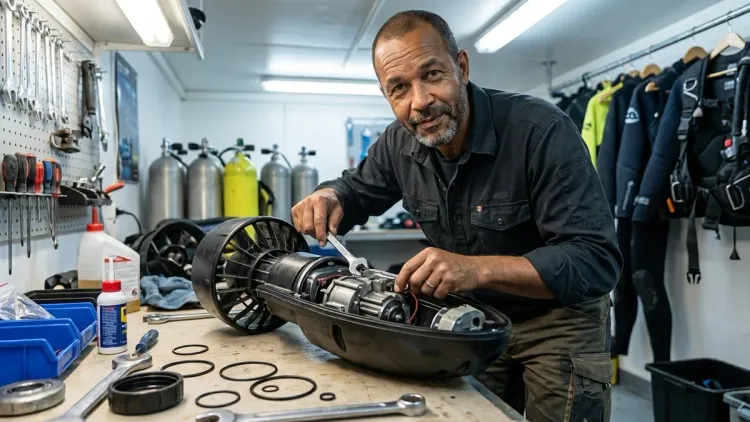
Some maintenance tasks require professional service or specialized tools. Here's the reality: even if you're mechanically inclined and do all your own regulator service, certain DPV tasks are beyond DIY scope. Motor bearings, electronic speed controllers, and internal pressure sensors require calibration equipment and expertise most of us don't have.
Annual factory service: Send your scooter to an authorized service center once per year for complete disassembly, inspection, and seal replacement. Yes, it costs $200-$400 depending on the model, and yes, it's worth every penny. Professional service catches problems you can't see or test for—worn bearings, corroded internal contacts, pressure sensor drift.
Motor bearing inspection (every 200 hours or annually): Motor bearings operate in a sealed environment, but they still wear over time. Worn bearings increase friction, reduce runtime, and can eventually cause complete motor failure. This requires disassembly and specialized tools—not a DIY job unless you're really committed.
Electronic speed controller diagnostics: ESC failures are relatively rare, but when they happen, they're catastrophic—your scooter either won't start or runs at full speed with no throttle control. Annual service includes ESC function testing and firmware updates if available.
Propeller and shaft assembly replacement: Props don't last forever, especially if you've dinged them on rocks or coral (we've all done it). Inspect your prop every 50 dives for chips, cracks, or blade damage. Even minor damage creates vibration and reduces efficiency—I replace my prop every 100 dives or sooner if I notice any damage.
Flood sensor calibration: Modern DPVs have internal flood sensors that should shut down the motor if water intrusion is detected. These sensors need periodic testing and calibration to ensure they'll actually work when needed. This is another factory service item.
If you're planning a liveaboard trip with heavy DPV use, schedule your annual service at least a month before departure. Nothing ruins a dive vacation faster than discovering your scooter needs service when you're already at the resort.
Final Check Before You Go
Here's your condensed pre-dive verification sequence—run through this list before entering the water:
✓ Main shaft O-ring inspected and lubricated
✓ Battery at 80%+ charge level
✓ Nose cone seal clean and properly seated
✓ Propeller spins freely with no binding
✓ All mounting points and handles secure
✓ Speed trigger responds smoothly through full range
✓ Scooter powers on with normal startup sequence
✓ Buoyancy and trim verified in water before descent
✓ Backup propulsion plan established (can you swim back if the scooter fails?)
This is also a good time to review your complete pre-dive DPV safety checklist, which covers emergency procedures and bailout planning.
Frequently Asked Questions
How often should I replace my DPV's main shaft O-ring?
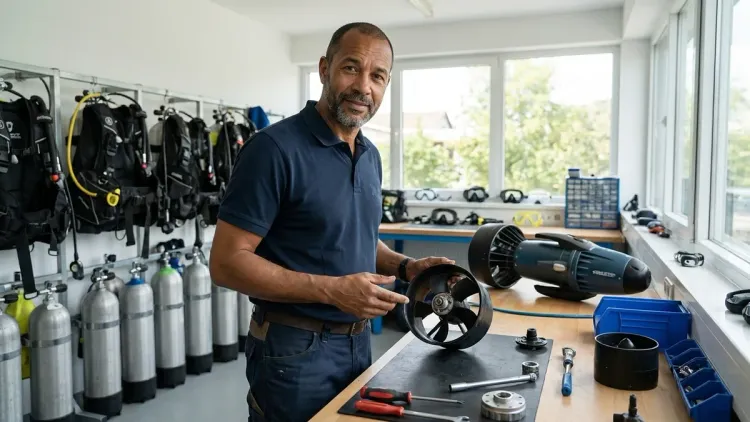
Replace your main shaft O-ring at least once per year regardless of its apparent condition, or immediately if you notice any cuts, compression set, or hardening. For high-volume diving (50+ dives per year) or operation in silty conditions, inspect monthly and replace every six months—shaft seal failure is the most common cause of catastrophic DPV flooding, and O-rings are cheap insurance against a $2,000 repair bill.
Can I use my scooter immediately after charging, or should I let the battery rest?
Lithium-ion batteries can be used immediately after charging without any rest period required, though they'll perform slightly better if allowed to cool to ambient temperature first. The bigger issue is charging immediately before a dive trip when you haven't tested the scooter recently—always do a full function test and brief runtime trial at least 24 hours before a dive to ensure your battery is actually holding a charge and your scooter is operating normally.
What should I do if I notice moisture inside my battery compartment after a dive?
Stop diving the scooter immediately and do not attempt to charge or operate it. Remove the battery in a clean, dry environment, and thoroughly dry both the battery and compartment using a lint-free cloth. Inspect all seals for visible damage and check for any signs of salt deposits or corrosion on the contacts. If you find anything concerning, the scooter needs professional service before diving again—moisture in the battery compartment indicates a seal failure, and continuing to use the scooter risks battery damage, electronic failure, or fire hazard during charging.
Final Thoughts
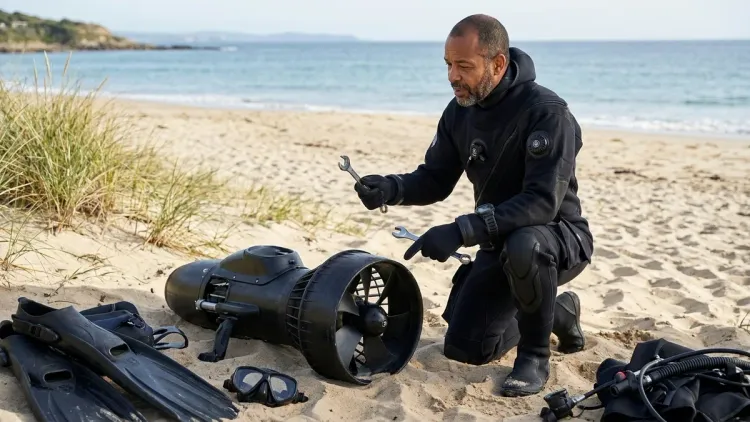
Underwater scooter maintenance isn't complicated, but it does require consistency. The divers I know who get 5+ years and 500+ dives from their DPVs are the ones who spend five minutes after every dive doing proper rinse and inspection, not the ones who hose it off occasionally and hope for the best.
I treat my DPV maintenance with the same discipline I apply to regulator service or BCD care—these are life-support systems and propulsion systems that need to work when I need them, often in situations where failure is more than just inconvenient. A well-maintained scooter opens up dive sites and experiences that would be impossible on fins alone, but only if you can trust it to keep running.
The good news is that modern DPVs are remarkably reliable if you follow the basic maintenance protocols outlined in this checklist. Most catastrophic failures I've witnessed were entirely preventable—flooded scooters had neglected shaft seals, dead batteries weren't properly maintained, seized props had been stored vertical in a hot garage for six months. Do the basic work, follow the schedule, and your scooter will be ready every time you need it.
Marcus Okafor
PADI Master Scuba Diver Trainer
3,000+ dives across six continents