
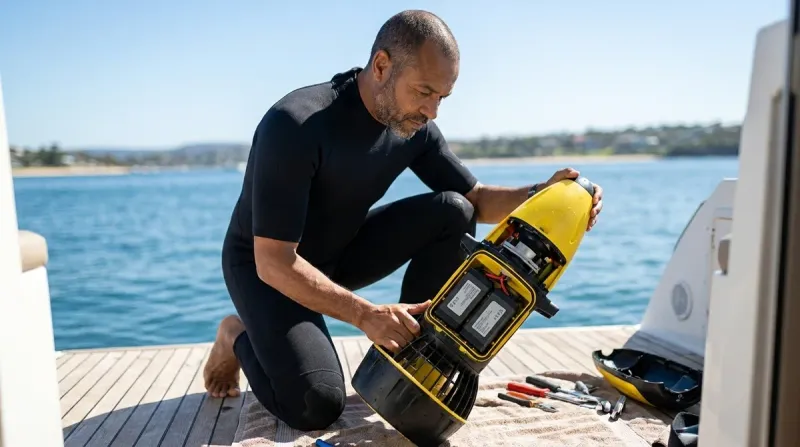

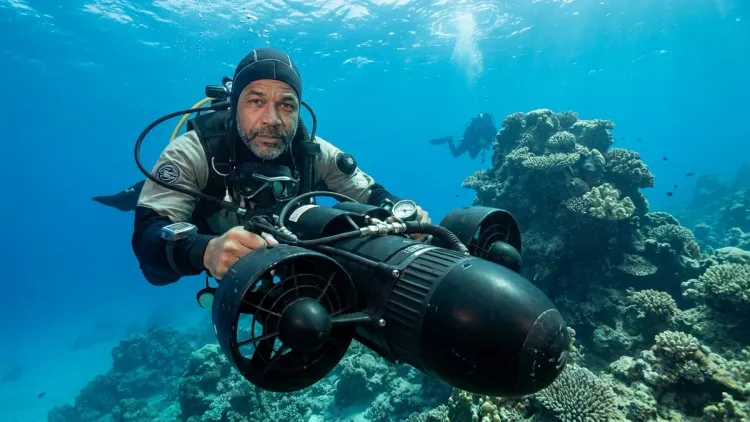
I still remember the first time I clipped onto an underwater scooter off Grand Cayman—watching the reef slide past at three knots felt like I'd suddenly been granted superpowers. But the real magic wasn't the speed; it was understanding how underwater scooters work and why that particular combination of brushless motor and lithium-ion cells could pull me and my full tech rig across two miles of wall without breaking a sweat. If you've ever wondered what's actually happening inside that sealed cylinder when you squeeze the trigger, you're in the right place.
What Is an Underwater Scooter?
An underwater scooter—technically called a diver propulsion vehicle (DPV)—is a battery-powered torpedo-shaped device that generates thrust to pull divers through the water. At its core, it's remarkably simple: a waterproof housing contains a battery pack, motor controller, and propeller assembly, all sealed against seawater intrusion to depth ratings typically ranging from 40 meters recreational units to 150+ meters for technical models.
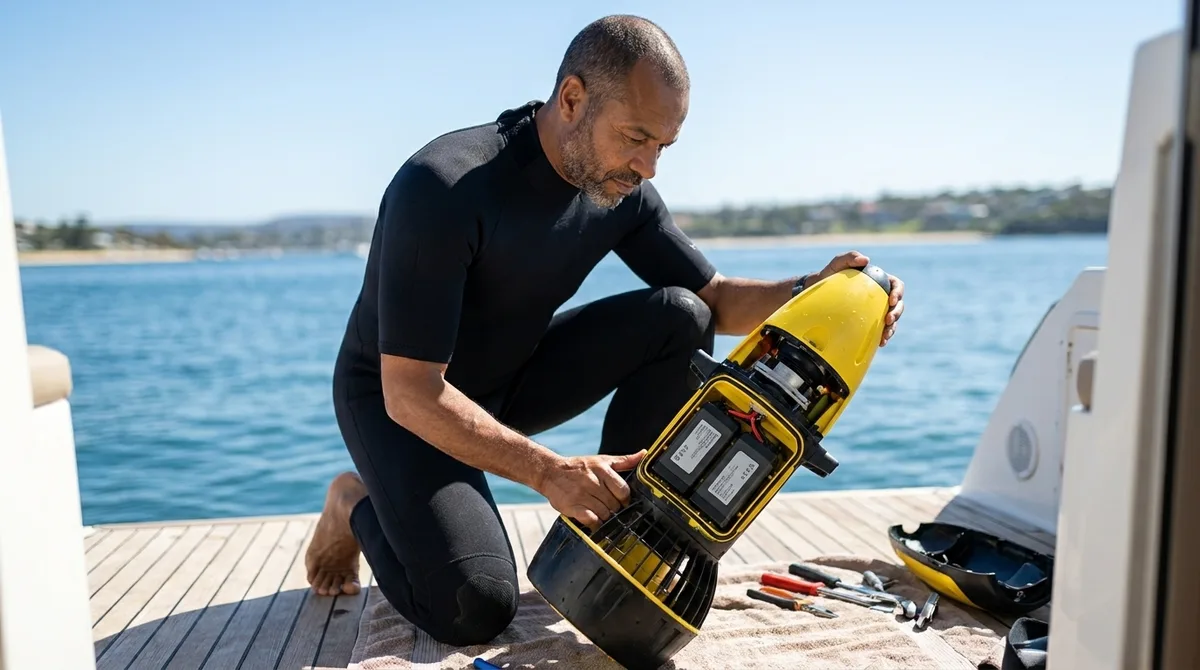
The term "scooter" is a bit misleading if you're picturing something you stand on. These are underwater tools you hold in front of you or clip to your harness, and they work by converting electrical energy into rotational force at the propeller. The propeller creates a pressure differential—lower pressure in front of the blades, higher pressure behind—which generates forward thrust. You don't ride on top of it; it tows you.
Most recreational models produce 20 to 80 pounds of thrust, while technical cave and wreck exploration units can exceed 100 pounds. That might not sound like much compared to surface boats, but underwater, where drag dominates and mass is nearly neutralized by buoyancy, even 30 pounds of thrust is enough to move you and your gear at two to three knots—faster than most divers can comfortably kick for more than a few minutes.
Understanding how underwater scooters work starts with recognizing they're sealed systems operating in a hostile environment where a single o-ring failure can flood thousands of dollars of electronics in seconds.
How Underwater Scooters Work: The Complete Propulsion System
When you press the trigger on a DPV, you're completing an electrical circuit that feeds battery power through a motor controller to the propulsion motor. Let's break down each component, because the devil—and the performance differences—are absolutely in these details.
Battery Chemistry and Energy Density
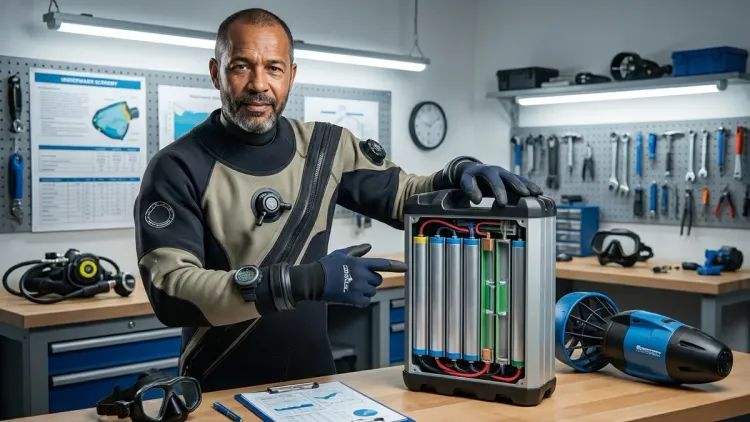
Modern underwater scooters almost exclusively use lithium-ion or lithium-polymer battery packs, though you'll occasionally still see older sealed lead-acid (SLA) models from the early 2010s floating around used gear markets. The chemistry matters enormously. Lithium cells deliver around 150-250 Wh/kg (watt-hours per kilogram), while SLA batteries struggle to hit 40 Wh/kg. In practical terms, this means a 6-pound lithium pack can provide the same runtime as a 25-pound lead-acid brick.
The cells are typically configured in series-parallel arrangements—14S4P is common for 52V nominal voltage packs—to achieve both the voltage the motor needs and the capacity measured in amp-hours (Ah). A quality recreational scooter battery might be rated at 13Ah and 52V, giving you about 676 Wh of total capacity. At moderate speed settings drawing 300W, that's over two hours of runtime, though real-world performance drops with cold water, high-speed operation, and battery age.
Temperature affects lithium cells significantly. Below 40°F, internal resistance climbs and available capacity drops by 20-30%. I've watched a scooter that comfortably ran 90 minutes in the Caribbean choke down to 55 minutes in Puget Sound at 48°F. The battery management system (BMS) inside the pack monitors cell voltage, temperature, and current draw, shutting down the system if parameters exceed safe limits—which is great for safety, frustrating when it happens mid-dive.
Motor Types and Controller Design
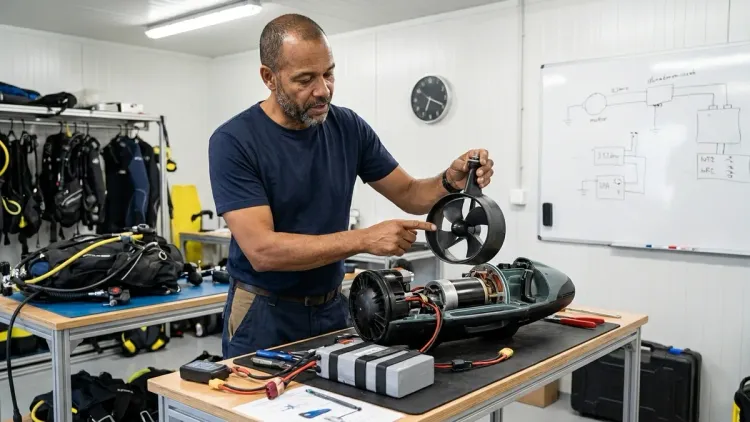
The heart of how underwater scooters work is the motor itself. Nearly all modern DPVs use brushless DC motors (BLDC), which are dramatically more efficient and reliable than the brushed motors common two decades ago. Brushless motors have no physical contact between stationary and rotating components—instead, the motor controller sequences current through electromagnetic coils in the stator to create a rotating magnetic field that drives permanent magnets mounted on the rotor shaft.
This design eliminates brush wear, reduces electrical noise, and achieves efficiency ratings around 85-92% compared to 70-80% for brushed designs. More efficiency means less battery drain per unit of thrust, which directly translates to longer range. The motor controller—often a three-phase electronic speed controller (ESC) borrowed from drone or electric vehicle technology—modulates power delivery by rapidly switching DC battery voltage into the three-phase AC waveform the motor needs.
High-end technical scooters like the Suex XJOY 37 use field-oriented control (FOC) algorithms that monitor rotor position in real-time and adjust current timing for maximum torque efficiency across the RPM range. Cheaper recreational models use simpler trapezoidal commutation, which works fine but wastes some energy as heat. That heat has to go somewhere, and in a sealed housing, thermal management becomes critical—overheating can thermally stress seals and battery cells.
Propeller Design and Thrust Generation
The propeller converts rotational mechanical energy into thrust, and this is where hydrodynamic engineering gets fascinating. Most recreational scooters use two or three-blade plastic propellers with diameters between 180mm and 250mm. Technical DPVs often step up to four or five-blade designs in reinforced nylon or occasionally machined aluminum for the most demanding cave penetrations.
Blade pitch—the angle at which the blade slices through water—determines the relationship between RPM and thrust. Higher pitch generates more thrust per revolution but requires more torque, which drains the battery faster. Lower pitch spins easier but moves less water per revolution. Quality manufacturers balance pitch against motor torque curves and typical dive profiles, aiming for a sweet spot where the motor operates near its peak efficiency RPM at cruise speed.
Shrouded propellers—where the blades spin inside a duct or nozzle—are increasingly common on mid-range and up models. The shroud does two things: it improves thrust efficiency by 15-25% by reducing tip vortex losses, and it dramatically improves safety by preventing fingers, straps, and kelp from contacting the spinning blades. I've seen unshrouded props chew through webbing faster than you can react; shrouded designs are a legitimate safety upgrade, not just marketing.
Why Understanding DPV Mechanics Matters
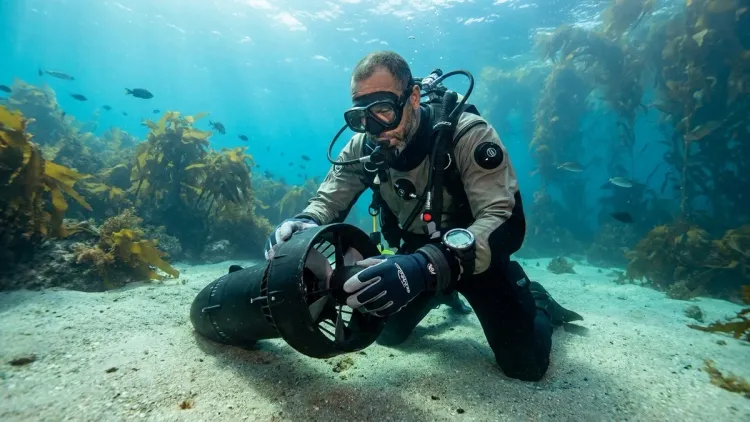
Knowing how underwater scooters work isn't academic—it directly affects your dive planning, equipment choices, and safety margins. When you understand that your scooter's 60-minute runtime assumes moderate speed in 77°F water with a fresh battery, you'll automatically build in the 30% reserve needed for cold water, aging cells, or the extra drag from side-mounted stages or camera rigs.
Battery capacity limits your range more than any other single variable. If your DPV consumes 400W at cruise speed and you have a 600Wh pack, your theoretical runtime is 90 minutes—but real-world practice demands you surface with at least 30-40% remaining capacity to account for navigation errors, current changes, or assisting a buddy whose scooter failed. That 90-minute pack realistically gives you 55 minutes of usable bottom time before you need to turn the dive.
Motor efficiency determines how much of your battery capacity actually reaches the propeller as thrust versus being wasted as heat. An 85% efficient motor uses 15% of input power for heat generation—manageable. A 70% efficient design wastes 30%, which shortens runtime and accelerates thermal wear on seals. This is why brushless motors became standard; the efficiency gain alone adds 15-20 minutes to dive time on the same battery.
Understanding propeller load and thrust curves helps you choose appropriate speeds. Most scooters offer three to five power settings. Running at maximum speed might look impressive on the surface, but power consumption increases roughly with the cube of velocity—doubling your speed requires eight times the power. Running full-throttle the entire dive burns through batteries in 30-40 minutes and leaves you with no reserve. Moderate cruise settings balance speed against endurance, typically maximizing distance covered per watt-hour consumed.
The sealed housing design introduces failure modes you need to recognize. O-ring seals—usually two or three primary seals on the nose cone and tail cap—are the only barriers between seawater and your electronics. Regular maintenance and inspection isn't optional. I've seen a $3 o-ring failure flood a $4,500 scooter because the diver hadn't serviced seals in two years. Pressure testing before dive trips and annual seal replacement are non-negotiable if you're serious about DPV diving.
Types of Underwater Scooter Propulsion Systems
While the basic principle of how underwater scooters work remains constant—battery drives motor, motor spins propeller—implementation details create distinct categories optimized for different dive profiles.
Recreational Single-Speed and Variable-Speed Models
Entry-level recreational scooters typically use single-speed or three-speed transmission systems with basic on-off triggers. These work fine for casual reef cruising and eliminate the complexity and cost of sophisticated speed controllers. You'll find these in models producing 30-50 pounds of thrust with runtimes around 60-90 minutes at recreational depth limits.
Variable-speed designs use proportional triggers or twist-grip throttles that modulate power delivery across a continuous range. This gives you finer control for maneuvering in tight spaces, maintaining precise depth in strong currents, or conserving battery on long transits. The tradeoff is added controller complexity and typically higher cost. Most technical divers consider variable speed mandatory; most vacation divers are perfectly happy with simple three-position switches.
Technical Multi-Stage Systems
High-end technical DPVs often incorporate gear reduction systems between the motor and propeller. A small high-RPM motor drives a planetary gear set that reduces shaft speed while multiplying torque. This lets manufacturers use smaller, lighter motors while still generating 80-100+ pounds of thrust from relatively modest battery packs.
The Genesis 3.2 DPV, for example, uses a 3:1 gear reduction that allows a compact 500W motor to produce thrust equivalent to a much larger direct-drive setup. The gear train adds mechanical complexity and introduces another maintenance point—gears need lubrication and periodic inspection—but the weight savings for travel or long cave penetrations make it worthwhile for serious technical divers.
Some technical models also feature dual-motor configurations for redundancy on extreme dives where scooter failure hundreds of meters into an overhead environment is potentially fatal. These systems can operate on a single motor at reduced thrust if one fails, providing enough propulsion to exit safely rather than forcing the diver to swim out—a scenario that often exceeds gas planning limits.
Hybrid and Specialized Designs
A small category of hybrid scooters combines battery power with manual override or alternative propulsion. These are rare and typically custom-built for scientific or military applications, but worth mentioning for completeness. Some research DPVs include low-drag freewheeling propellers that let divers kick-swim without fighting propeller resistance if the battery dies.
You'll also see specialized designs for surface swimming—essentially waterproof pool toys using open propellers and minimal depth ratings—but these aren't dive scooters in any meaningful sense. Actual DPVs are rated for depth, built with flood-resistant seals, and designed to handle the pressure differentials and thermal stresses of repeated compression cycles.
Frequently Asked Questions
How does an underwater scooter propel you forward?
An underwater scooter propels you forward by using a battery-powered electric motor to spin a propeller, which creates thrust by accelerating water backward according to Newton's third law—the propeller pushes water back, and the water pushes the scooter and diver forward with equal and opposite force.
What type of battery do most dive scooters use in 2026?
Most dive scooters in 2026 use lithium-ion or lithium-polymer battery packs because they offer three to five times the energy density of older sealed lead-acid batteries, meaning longer runtimes with significantly less weight, typically around 150-250 watt-hours per kilogram compared to 40 Wh/kg for lead-acid.
How deep can you dive with an underwater scooter?
You can dive with most recreational underwater scooters to depths of 40 meters (130 feet), while technical models are pressure-rated to 100-150+ meters (330-500 feet), with the depth limit determined by the housing's pressure rating and seal integrity rather than motor function, since electric motors work fine under pressure.
Why are brushless motors better for underwater scooters?
Brushless motors are better for underwater scooters because they eliminate the physical brush contact that wears out in brushed motors, achieving 85-92% efficiency compared to 70-80% for brushed designs, which translates directly to 15-25% longer runtime from the same battery capacity and dramatically reduced maintenance requirements.
How long does a DPV battery last on a single charge?
A DPV battery typically lasts 60-120 minutes of continuous use on a single charge depending on speed setting, water temperature, and battery capacity, with runtime dropping 20-30% in cold water below 50°F due to increased battery internal resistance and reduced chemical reaction rates in lithium cells.
Wrapping Up Scooter Mechanics
The elegance of how underwater scooters work comes down to electrical energy efficiently converted to mechanical thrust through sealed systems designed to survive one of the harshest operating environments on the planet. Understanding the interplay between battery chemistry, motor efficiency, and propeller design helps you make smarter equipment choices, plan dives with realistic runtime expectations, and recognize when that marketing claim about "revolutionary new thrust technology" is genuine innovation versus repackaged hype.
Every time you clip onto a DPV and glide across a reef wall that would take 40 minutes to kick across, you're trusting thousands of watt-hours flowing through circuit boards mere millimeters from the ocean, separated only by rubber o-rings and machined aluminum threads. Respect that system—understand how to maintain those seals, monitor your battery state, and plan your dives with the same conservative gas rules you'd apply to your regulator and breathing gas supply. The technology is remarkably reliable when properly maintained, but the physics of sealed underwater electronics doesn't forgive neglect.
If you're considering adding a scooter to your kit or just curious about what's happening inside that torpedo you rented in Cozumel, understanding the fundamentals makes you a better, safer DPV diver. And honestly, knowing exactly how that trigger squeeze becomes forward motion makes the whole experience that much cooler.