
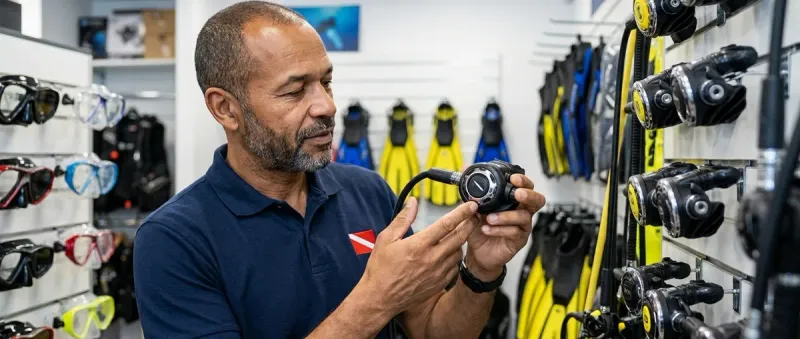

Figuring out how to choose a scuba regulator can feel overwhelming when you're staring at a wall of chrome and hoses, each one promising effortless breathing and bulletproof reliability. I've been there—first as a confused student wondering why one reg costs twice as much as another that looks identical, and now as an instructor watching students make the same purchasing mistakes I did. In this guide, I'll walk you through the exact process I use to match divers with regulators that actually suit their needs, covering everything from environmental sealing for cold water to breathing resistance at depth and the difference between balanced and unbalanced designs. Whether you're buying your first regulator or upgrading from a hand-me-down, you'll learn how to decode the specs that matter and ignore the marketing that doesn't.
Time to complete this decision process: 2-3 hours of research plus hands-on testing if possible
Skill level: All levels—beginners benefit most, but experienced divers often discover they've been missing critical considerations
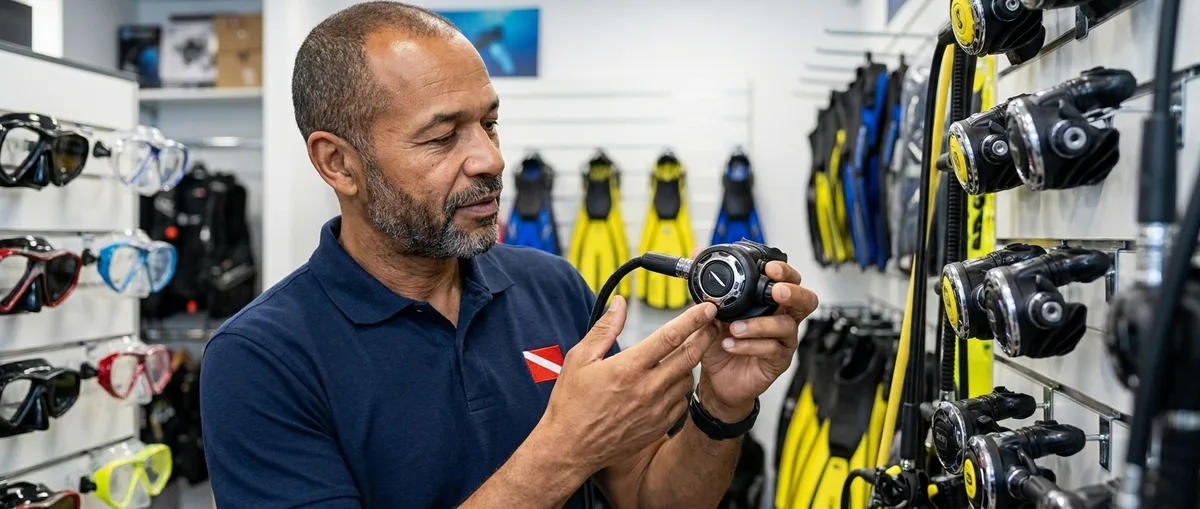
What You'll Need
Before you start comparing regulators, gather:
- Your dive log or a realistic assessment of your diving habits (frequency, destinations, water temperatures)
- Your BCD setup details (jacket vs back-inflate affects hose routing preferences)
- Tank valve specifications (check if your local dive shops use DIN or yoke connections)
- Budget range (be honest—a $300 reg that you'll actually service beats a $700 one you'll neglect)
- Access to authorized service centers (manufacturer websites list these—critical for warranty and annual maintenance)
- Your travel frequency (if you're flying more than twice a year, weight matters)
- Cold water diving plans (anything below 50°F requires specific environmental sealing)
Step 1: Define Your Primary Diving Environment
Here's what the manufacturer claims: "Our regulator performs flawlessly in all conditions." And here's what actually happens at depth: regulators are purpose-built tools, and trying to make one design work for both tropical reef diving and ice diving is like wearing flip-flops on a glacier.
Start by identifying where you'll do 70% of your diving over the next two years. I tell my students to ignore aspirational diving ("I might do a liveaboard in Indonesia someday") and focus on what they'll realistically do next season. If you're diving California kelp forests every other weekend, you need environmental sealing on both first and second stages to prevent freeflows in 48°F water. That means sealed diaphragm first stages or sealed piston designs with heat sinks—not the stripped-down travel reg that works beautifully in Cozumel but turns into a hazard in Monterey.
For warm water diving (above 75°F), you have more flexibility. Unbalanced piston regulators breathe perfectly fine at recreational depths, weigh less, and cost significantly less to service. I've logged hundreds of dives in the Red Sea and Caribbean on basic unbalanced regs, and breathing resistance at 60 feet is indistinguishable from my sealed diaphragm technical rig.
Water temperature also dictates service intervals. Cold water diving introduces moisture that freezes and contaminates, meaning you'll need annual service even with light use. Warm water diving in stable environments can sometimes stretch to 18-24 months between services if you're meticulous about rinsing and storage.
Step 2: Understand First Stage Design and Intermediate Pressure
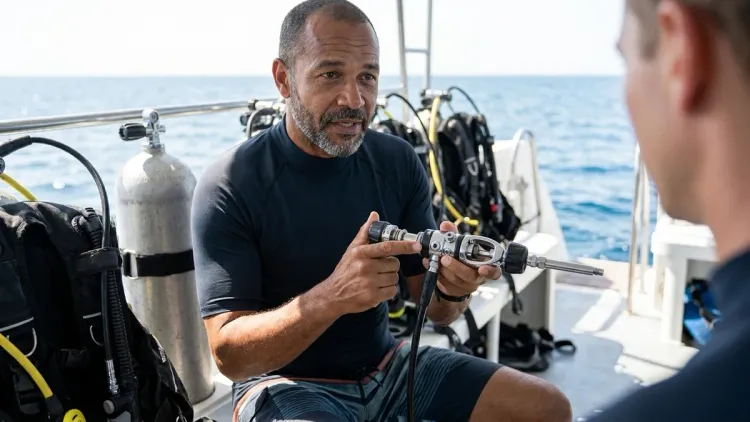
The first stage reduces tank pressure (typically 3,000 PSI) to intermediate pressure—usually 135-145 PSI above ambient pressure. This is where regulators diverge into piston versus diaphragm designs, and the difference matters more than any salesperson will admit.
Piston first stages use a moving piston to regulate pressure. They're mechanically simpler, have fewer parts, and deliver slightly better airflow because there's less friction in the system. The Scubapro MK25 EVO is the gold standard here—I've used one for seven years in everything from tech diving to basic instruction, and it breathes effortlessly even when I'm running four students off one tank doing pool drills. But pistons require environmental sealing for cold water (achieved through sealed chambers or grease-filled systems), and they're more sensitive to contamination from dirty air fills.
Diaphragm first stages use a flexible rubber diaphragm to separate the mechanical parts from water, making them naturally environmentally sealed. They're the default choice for cold water, contaminated environments (lake diving with sediment), or technical diving where reliability trumps everything else. I've had diaphragm regs like the Apeks XTX200 freeflow on me at 90 feet in 48-degree water during testing, but only because I deliberately purged them underwater to simulate a failure—they recover instantly and keep delivering air.
Balanced versus unbalanced refers to whether breathing resistance increases as tank pressure drops. Balanced first stages maintain consistent intermediate pressure throughout the dive, while unbalanced designs get slightly harder to breathe as your tank drops below 500 PSI. For recreational diving, this difference is academic. For deep or technical diving where you're managing gas switches and decompression, balanced designs eliminate one variable.
Check the IP specification—135-145 PSI is standard. Higher IP (some regs run 150+) can improve airflow but increases stress on second stage components, potentially shortening service intervals.
Step 3: Match Second Stage Performance to Depth and Workload
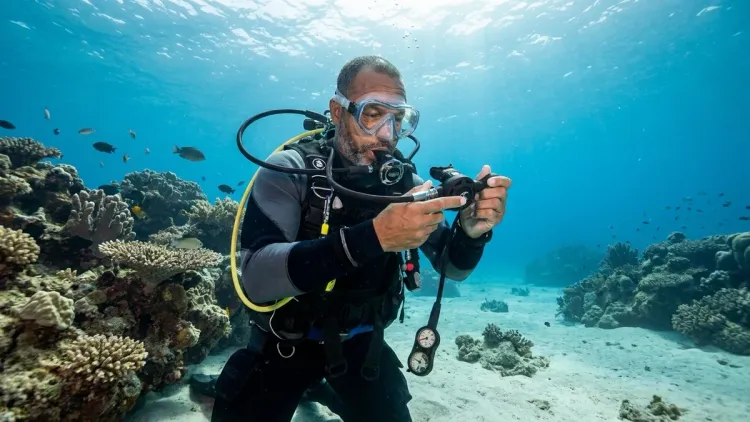
The second stage is where intermediate pressure becomes breathable air, and this is where you'll feel the difference between a $200 regulator and a $600 one—but only in specific conditions.
Breathing resistance is measured in joules per liter at specific depths and respiratory minute volumes. Manufacturers love to quote numbers like "0.8 J/L at 50 meters," but here's what that translates to underwater: below 0.9 J/L feels effortless even during strenuous swimming; 1.0-1.2 J/L is noticeable during exertion but not problematic; anything above 1.5 J/L feels like breathing through a cocktail straw when you're working hard.
The best way to evaluate this is in-water testing at depth. Most dive shops will let you test regulators in a pool, but that's useless—you need to descend to your typical diving depth (60-100 feet for most recreational divers) and do some work. Swim against current, ascend and descend a few times, and notice if you're ever consciously aware of breathing effort. If you are, that regulator isn't right for you.
I've tested dozens of second stages, and the performance gap narrows significantly once you're above the $400 price point. The real differentiators are ergonomic details: purge button placement, whether the exhaust tee creates bubbles in your field of vision, and how the mouthpiece fits your jaw. I've seen divers struggle with top-tier regs simply because the mouthpiece angle caused jaw fatigue after 45 minutes.
For cold water performance, look for metal construction (brass or stainless steel) in the second stage body, not plastic. Heat transfer from your exhaled breath keeps the mechanism warm and prevents ice formation. The Poseidon Xstream uses a completely different design with side exhaust, and while it breathes beautifully in cold water, the side exhaust bothered me constantly in tight wreck penetration because bubbles deflected off surfaces unpredictably.
Step 4: Evaluate Port Configuration and Hose Routing
This is where I see divers make expensive mistakes because they never considered how the regulator integrates with their complete rig.
Count your required connections: primary second stage, alternate air source (octopus), low-pressure inflator hose for your BCD, and at least one high-pressure port for an SPG or dive computer transmitter. Technical divers add multiple HP ports for redundant pressure gauges and extra LP ports for drysuit inflation.
Swivel or turret first stages (like the Scubapro MK25 or Apeks MTX-R) route hoses in multiple directions, reducing hose strain and creating cleaner streamlining. They're essential for sidemount or technical configurations but add weight and cost for basic recreational diving. Fixed-port first stages work perfectly fine if you're diving a standard single-tank back-inflate setup.
High-pressure port placement matters more than you'd think. If you're using a hoseless AI computer, the HP port needs to be positioned so the transmitter doesn't get knocked during tank handling. I've cracked two transmitters over the years because the HP port pointed straight up and got smashed against boat benches.
Consider hose lengths at this stage too. Standard recreational setups use a 26-28 inch primary second stage hose, 36-40 inch octopus hose, and 26 inch LP inflator hose. If you're moving toward technical diving or using a jacket BCD versus back-inflate configuration, you'll need a 5-7 foot primary hose and completely different routing, which affects which first stage design works best.
Step 5: Assess Serviceability and Long-Term Ownership Costs
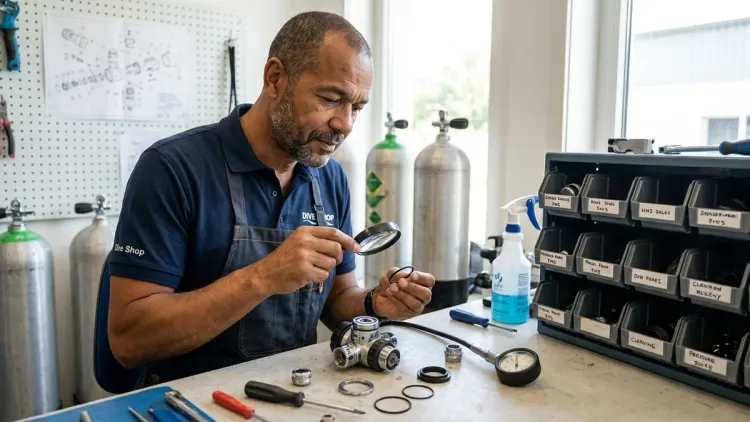
The sticker price is irrelevant. What matters is cost per dive over five years, and that calculation depends entirely on service requirements, parts availability, and whether you have local authorized technicians.
Annual regulator service runs $80-150 depending on the brand and whether you need parts. PADI and other training agencies recommend annual service regardless of dive count, though some manufacturers (Atomic Aquatics notably) offer extended service intervals if you're meticulous about care. I follow the annual schedule religiously after watching a student's reg freeflow violently on the surface because a corroded LP seat failed—it had been three years since service, and she'd only done 20 dives.
Parts availability is critical if you travel internationally. Scubapro, Apeks, and Aqualung have service networks everywhere. I've gotten my Scubapro serviced in Thailand, Egypt, and Mexico without issue. Smaller boutique brands might deliver better performance, but if you're stuck on a remote liveaboard and need service, you're out of luck. Check the manufacturer's service center list before buying.
Some manufacturers include free parts for life if you service annually through authorized dealers. This sounds great until you realize the service labor costs the same whether parts are free or not, and many dealers pad labor costs to compensate. Run the math—sometimes paying for parts and using a cheaper independent technician saves money over five years.
I keep detailed service records in a waterproof log that lives in my dive bag, noting date, technician, what was replaced, and any performance notes from the subsequent dives. This creates resale value (proving maintained equipment) and helps me spot patterns—if I'm replacing the same o-ring every year, something in my rinsing routine needs adjustment.
Step 6: Determine DIN Versus Yoke Connection Requirements
The DIN versus yoke debate frustrates new divers because the answer depends entirely on where you dive, not which system is "better."
Yoke (also called A-clamp) connections clamp over the tank valve and seal via an o-ring on the tank valve itself. They're the standard in North America, the Caribbean, and most tropical dive destinations. Maximum rated working pressure is 3,000 PSI (200 bar), perfectly adequate for recreational diving. Yoke connections are faster to attach, less fussy about tank valve threading, and easier to rent tanks for worldwide.
DIN connections screw directly into the tank valve, with the o-ring on the regulator side. They're standard in Europe, common in technical diving, and mandatory for tanks above 3,000 PSI (like 3,442 PSI tanks common in technical diving). The threaded connection is mechanically more secure and less prone to blowing out under high pressure or impact.
Here's what I tell students: if you dive exclusively in one region, match the local standard. If you travel internationally, get a yoke regulator and carry a DIN conversion kit (assuming your first stage supports it). Converting yoke to DIN takes 30 seconds with the right adapter. Converting DIN to yoke requires a spinning adapter that adds bulk and creates a potential failure point.
I dive a DIN configuration personally because I do technical diving and use high-pressure tanks, but I keep a yoke adapter in my save-a-dive kit for travel. I've used it exactly twice in 3,000 dives—once in Honduras when the shop had only yoke valves, once in the Philippines when a DIN valve threading was damaged. Both times I was grateful to have the option rather than sitting out dives.
Step 7: Test Breathing Performance and Ergonomic Fit
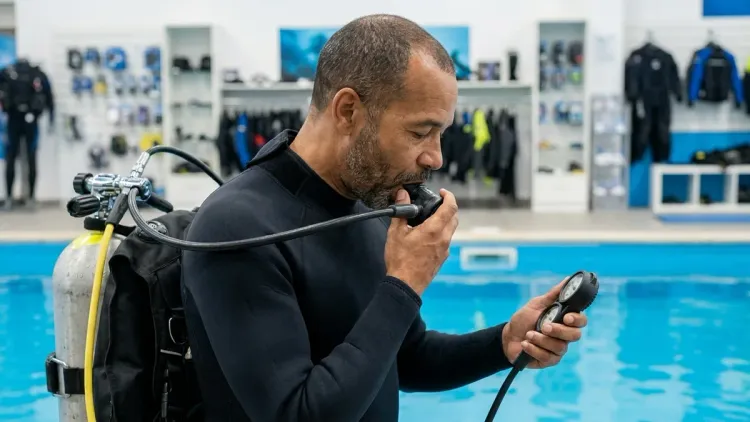
Never buy a regulator without putting it in your mouth, and ideally, never buy one without diving it first. Here's how I evaluate fit and breathing performance in ways that actually predict real-world comfort.
Mouthpiece comfort seems trivial until you're 45 minutes into a dive and your jaw is cramping. Stock mouthpieces are designed for average-sized mouths, which means they're wrong for half of all divers. Pay attention to the angle the mouthpiece sits in your mouth—if you're constantly biting down to maintain the seal, you'll hate it after an hour. Orthodontic or custom mouthpieces solve this, but they're an additional $30-50 expense.
Weight in your mouth varies dramatically between regs. A second stage that feels fine on the boat becomes exhausting underwater when you're constantly pulling it back into position. I prefer second stages under 200 grams, which stay put better and reduce jaw fatigue. The extra weight of metal second stages (for cold water performance) is the tradeoff you make for freeflow resistance.
Purge button accessibility matters in emergencies. I test this by closing my eyes and reaching for the purge—if I can't find and activate it instantly, that's a problem. Some purges require significant finger pressure, which is fine when you're calm but potentially difficult when you're stressed or wearing thick gloves.
For breathing resistance testing, request pool time or shallow ocean checkout dives before purchasing. Descend to 30-40 feet minimum and evaluate these specific scenarios: breathing normally at rest, breathing heavily after exertion, breathing while inverted (simulating a camera shot or equipment retrieval), and recovery after a full purge. The regulator should deliver air instantly without hesitation or "fluttering" (that annoying vibration in some second stages during inhalation).
If the shop won't let you test a $500-700 regulator in water before purchase, find a different shop. Every dive retailer I respect offers demo days or trial periods, because they know fit matters more than specs.
Step 8: Factor in Travel Weight and Redundancy Requirements
For divers who travel more than twice annually, regulator weight becomes a deciding factor that easily justifies price differences. I learned this the hard way after a trip to Indonesia where my kit plus camera housing hit baggage limits, and I paid $200 in overweight fees.
A complete regulator system (first stage, two second stages, hoses, and SPG) ranges from 1,200 grams (2.6 lbs) for lightweight travel configs to over 2,000 grams (4.4 lbs) for heavy-duty cold water regs with environmental sealing. On a single trip, that 1.8-pound difference means nothing. Over 10 trips annually, it's the margin between staying under baggage limits or paying fees every time.
Titanium first stages like the Atomic T3 drop 30-40% of the weight compared to brass, but at significant cost premiums (often $1,000+). I can't justify that expense for most recreational divers, but for full-time dive professionals or extreme travel divers, the weight savings compound across multiple regulators, BCDs, and exposure suits.
Redundancy requirements escalate weight considerations for liveaboard and remote diving. If you're diving remote locations without nearby hyperbaric chambers, carrying a complete backup regulator is non-negotiable. I keep a sealed diaphragm reg as my primary and an unbalanced piston travel reg as backup—the piston reg weighs less and costs less to service, and it's perfectly adequate as an emergency backup that might get used twice a year.
Octopus alternatives like integrated alternate air sources (combo inflator/second stage units) save weight and streamline hose routing, but they complicate air sharing and create single points of failure. I'm not a fan for advanced diving, but they work fine for basic recreational contexts where air sharing is exceedingly rare and always close to the surface.
Pro Tips & Common Mistakes
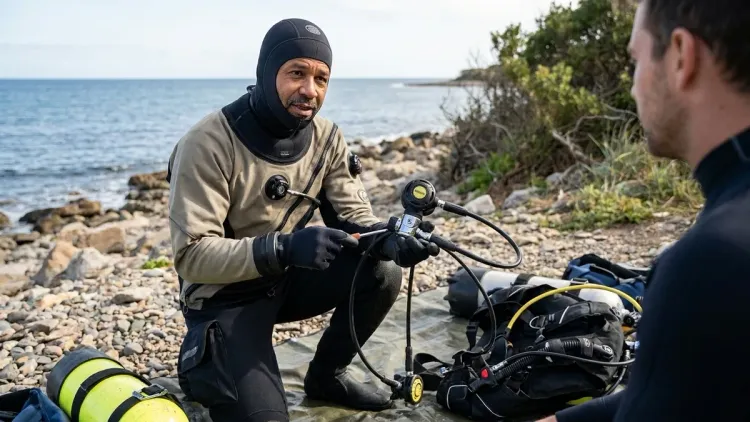
Don't buy based on breathing ease in the shop. I've watched countless divers test-breathe regs at atmospheric pressure and declare one "way better than the other." At sea level, every regulator breathes effortlessly because you're only working against IP, not ambient pressure. The difference appears at depth when you add 3-4 atmospheres of pressure. Always test at your typical diving depth or skip the breath test entirely.
Service interval flexibility is a trap. Manufacturers who advertise "service every two years or 300 dives" are technically correct, but every technician I know recommends annual service regardless. Salt crystals corrode brass, o-rings degrade from UV exposure during storage, and intermediate pressure drift happens gradually. The divers I've seen with catastrophic reg failures (full freeflow, IP lockup) all had extended service beyond manufacturer recommendations.
Adjustable second stages sound useful but often aren't. The knob that increases cracking pressure (effort required to start airflow) helps prevent freeflow in strong current, but I've never actually needed it in 3,000 dives. It adds a failure point and something else to fiddle with underwater when you should be focused on the dive. If your reg is properly tuned during service, you won't need adjustment.
Cold water sealing isn't binary. Some regs claim "suitable for cold water" but only have first stage environmental sealing, leaving the second stage vulnerable to ice formation. For true cold water diving (below 40°F), you need both first and second stage protection, which usually means all-metal second stage construction and sealed/heated first stages.
The biggest mistake I see: buying a regulator before understanding your BCD, tank configuration, and diving trajectory. Your regulator integrates into a complete life support system. Buying the reg first locks you into specific hose configurations and port arrangements that might not match the BCD or technical training you pursue later. Figure out your complete system first, then spec the regulator to match.
Frequently Asked Questions
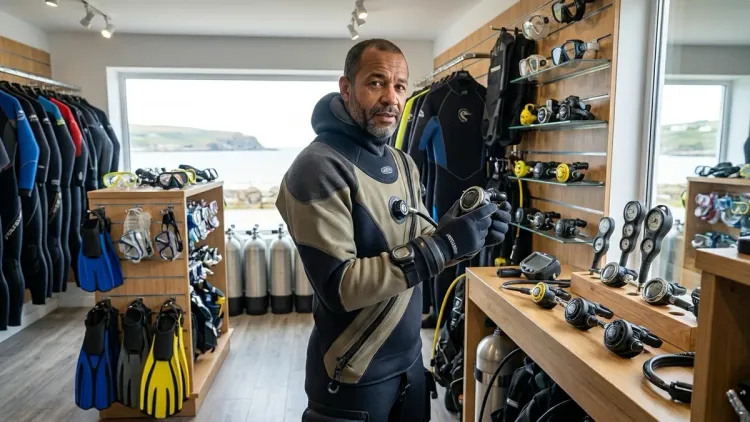
How much should I spend on my first scuba regulator?
Plan on $400-600 for a quality regulator system (first stage, two second stages, SPG) that will serve you for five-plus years with proper maintenance. Below $400, you're making compromises on durability, breathing performance at depth, or serviceability that often cost more long-term. Above $600, you're paying for features (titanium weight savings, multiple HP ports, exotic materials) that benefit technical or professional divers but provide marginal value for recreational diving. The sweet spot for most recreational divers is a balanced diaphragm or sealed piston first stage paired with a quality second stage from established manufacturers with widespread service networks.
Do I really need environmental sealing if I only dive warm water occasionally?
No, you don't need environmental sealing for consistent warm water diving above 60°F, and you'll save $150-300 on the regulator purchase plus $20-40 on every service by choosing a non-sealed design. The exception is if you dive in contaminated freshwater (lakes with sediment, quarries with algae) or plan to dive cold water even once or twice per year—in those cases, environmental sealing prevents catastrophic freeflow failures that can end dives or create genuine safety issues. I've never regretted having environmental sealing when I needed it, but I've watched divers struggle with freeflows because they didn't invest in proper cold water equipment for a "one-time" trip to Monterey.
Should I buy the same regulator brand as my instructor uses?
Only if it matches your diving profile and budget—instructor preferences reflect their specific use cases (often cold water, technical, or high-volume teaching) that may not align with your recreational diving plans. That said, there's value in choosing equipment your instructor can service, troubleshoot, and provide backup for during training. I recommend asking your instructor which three regulator systems they'd choose for your specific diving plans and budget, then testing those options yourself rather than defaulting to their personal gear. The regulator that works for someone logging 300 dives annually in 48°F water might be complete overkill for someone doing 20 Caribbean reef dives per year.
How often do I really need to service my regulator?
Follow manufacturer recommendations exactly—typically annually or after 100 dives, whichever comes first—and don't extend service intervals even if the regulator seems to be breathing fine. Regulator failures rarely announce themselves gradually; they happen suddenly when an o-ring fails, IP drifts out of spec, or a seat develops a groove that causes freeflow. Annual service runs $80-150 depending on parts requirements, and it's the cheapest insurance policy in diving. I maintain detailed service schedules for all my regulators and have never had a catastrophic failure in 15 years, while students who skip service routinely show up with barely-functional equipment that requires complete rebuilds costing more than consistent maintenance would have.
Summary
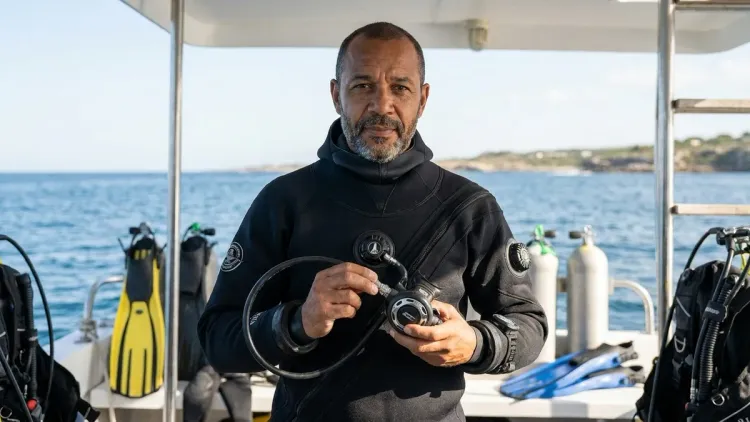
Learning how to choose a scuba regulator comes down to matching technical specifications—environmental sealing, balanced versus unbalanced designs, first stage configuration, and breathing resistance—to your actual diving conditions rather than aspirational scenarios or marketing claims. Start by defining where you'll dive 70% of the time, understand the real-world differences between piston and diaphragm first stages, prioritize serviceability and long-term costs over initial price, and always test breathing performance at depth before committing to a purchase. The right regulator isn't the most expensive one or the one with the most features—it's the one that delivers reliable air in your specific diving environment, fits your budget for maintenance and service, and integrates cleanly with your complete equipment system. I've watched too many divers agonize over spec sheets and then choose based on sale pricing, only to discover the regulator doesn't suit their actual needs six months later. Take the time to match performance to your diving style now, and you'll have a reliable breathing system for hundreds of dives ahead.