
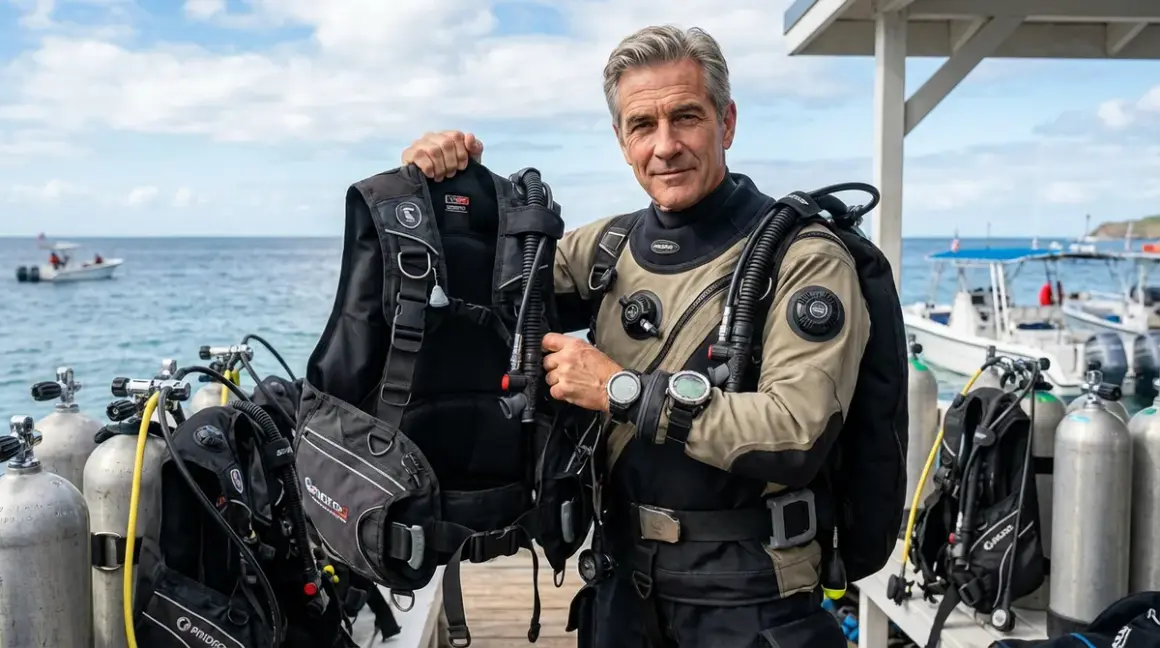

The verdict: Back inflate BCDs offer superior trim and streamlining for experienced divers, while jacket-style BCDs provide more surface stability and intuitive buoyancy control for beginners and surface-heavy diving. After four decades of watching divers wrestle with their buoyancy compensators in every condition imaginable, I can tell you that the jacket BCD vs back inflate debate isn't about which design is objectively better—it's about matching the tool to your actual diving profile, not the one you imagine yourself doing.
This article breaks down the practical differences between these two BCD designs using real performance metrics: trim characteristics at depth, surface flotation angles, weight distribution patterns, travel weight considerations, and the specific scenarios where each design genuinely excels. I've fitted hundreds of divers into both styles, and I've seen what works when the marketing claims meet saltwater reality.

Quick Comparison
| Criterion | Jacket BCD | Back Inflate BCD |
|---|---|---|
| Surface Stability | Excellent—wraps air around torso, keeps you vertical | Poor—pushes face-forward, requires finning to stay upright |
| Underwater Trim | Moderate—tends toward upright position | Excellent—promotes horizontal streamlined position |
| Weight on Land | 5.5–8 lbs typical; distributed around torso | 4.5–7 lbs typical; concentrated on back plate area |
| Learning Curve | Intuitive—feels like a life jacket | Moderate—requires practice for surface comfort |
| Travel Profile | Bulkier when packed (360° bladder) | More packable (single-plane bladder) |
| Typical Lift Capacity | 18–25 lbs for recreational models | 22–35 lbs for comparable sizes |
| Price Range | around $250–$650 for quality models | around $300–$800 for quality models |
Surface Stability and Pre-Dive Comfort
Here's the thing most comparison articles skip: the majority of your time wearing a BCD happens on the surface, not at depth. Between entry, pre-dive checks, surface intervals, and exits, you're floating around waiting for something to happen. And this is where jacket BCDs absolutely dominate.
A jacket-style BCD distributes air in a bladder that wraps around your sides and chest—models like the Scubapro Hydros Pro🛒 Amazon or Aqua Lung Rogue🛒 Amazon use 360° wraparound bladders constructed from 420-denier nylon with polyurethane coating. When inflated at the surface, this design keeps you vertical and stable, head well above water, without any effort. I've watched seasoned divers in back inflate units constantly sculling with their hands or finning to keep their faces out of the water, especially in chop. In full current off Palm Beach with a camera rig, that's exhausting.
Back inflate BCDs like the Zeagle Ranger🛒 Amazon or Dive Rite Transpac🛒 Amazon concentrate all buoyancy behind your shoulders. The physics are simple: air wants to go up, and when it's all behind you, it rotates your torso face-down into the water. You're fighting that rotational force every second you're waiting for the boat ladder. Some manufacturers add crotch straps to reduce the ride-up effect, but that doesn't change the forward pitch. I tell newer divers: if you're doing multiple boat dives with significant surface time, especially in anything beyond flat-calm conditions, the jacket design will save you energy you didn't know you were wasting.
The one exception I've seen work consistently is technical divers in drysuits with staged cylinders—they've got so much other gear pulling them into horizontal position that the back inflate's surface disadvantage becomes less pronounced. But for single-tank recreational diving in a 3mm wetsuit? The jacket wins this category decisively.
Underwater Trim and Streamlining
Once you descend past 15 feet, the story reverses completely. Back inflate BCDs promote a horizontal, streamlined body position that reduces drag, improves air consumption, and keeps you from kicking up silt on wrecks or reefs. The bladder sits against your tank and back plate area, creating a single plane of buoyancy directly along your spine. Models like the Apeks Black Ice🛒 Amazon or Halcyon Eclipse🛒 Amazon wing use single-bladder designs—typically 500–630 denier Cordura with urethane or welded seams—that minimize profile and keep the center of buoyancy high on your torso.
This matters underwater because your trim angle affects everything from how efficiently you move to whether you're destroying the reef you came to see. I've watched jacket BCD divers unconsciously maintain a 20–30° upright angle at depth, constantly fin-kicking to move forward instead of gliding. The jacket's wraparound bladder doesn't push you upright as aggressively as it does on the surface, but it doesn't encourage horizontal positioning either. You end up fighting your own buoyancy system.
In contrast, back inflate designs—especially when paired with proper weight distribution and buoyancy control techniques—let you achieve that neutral, motionless hover photographers dream about. The lift capacity tends to run higher too: a size medium back inflate often delivers 28–32 lbs of lift compared to 20–24 lbs for a comparable jacket, because the single bladder can be larger without wrapping uncomfortably around your ribs.
The trade-off is learning curve. New divers in back inflate BCDs often struggle initially because the system doesn't naturally hold them in the beginner-friendly upright position. I've seen people so frustrated on their first checkout dives that they switched back to jackets permanently. But divers who commit to the adaptation period—usually 5–10 dives to build muscle memory—generally report better buoyancy control and reduced fatigue on longer dives. If you're planning to move toward underwater photography or wreck penetration where precise positioning matters, the back inflate's trim advantage becomes non-negotiable.
Weight Distribution and On-Land Comfort
Nobody talks enough about the 200 yards you walk from the parking lot to the beach entry, or the ladder climb back onto a rocking dive boat with 50 lbs of gear strapped to your body. Weight distribution on land is where both designs reveal their engineering compromises.
Jacket BCDs spread the weight load across your chest, sides, and back using integrated weight pockets—typically two 10–12 lb pouches positioned at your lower ribcage or waist area. The Cressi Travelight🛒 Amazon and Mares Hybrid🛒 Amazon both use this configuration with quick-release Velcro and buckle systems. The distribution feels balanced when you're standing upright, but here's what I've seen over thousands of surface intervals: that chest and side weight pulls forward when you bend over to don fins or pick up a camera, creating shoulder strain. The wraparound bladder also adds bulk that makes the BCD feel like you're wearing a thick vest—comfortable in water, bulky on deck.
Most jacket models weigh 5.5–7 lbs empty (some travel-specific designs like the Scubapro Litehawk🛒 Amazon drop to around 4.8 lbs using lighter nylon blends), and you're adding 15–20 lbs of lead in the integrated pockets. That's 20–27 lbs distributed around your entire torso circumference.
Back inflate BCDs concentrate weight on your shoulder blades and spine. Models like the Zeagle Ranger use a backpack-style harness with padded shoulder straps and lumbar support—similar to a quality hiking pack. Weight pockets (usually two 8–12 lb pouches) sit at your lower back or clip to the tank cam band. Empty weight runs 4.5–6.5 lbs for most designs, slightly lighter than jackets because there's less bladder material and fewer panels.
I tell people this feels more natural walking around because it mimics how humans carry heavy loads—centered on your back, not wrapped around your chest. But there's a critical fit requirement: the harness must be properly adjusted. I've seen divers suffering with back inflate BCDs because the shoulder straps were three inches too loose, letting the whole rig sag and pull backward. If you're considering a back inflate, read our guide on how to properly fit and adjust your BCD before you commit to a purchase. An improperly fitted back inflate is worse than a jacket in every measurable way.
Travel Weight and Packability
If you're flying to Cozumel or Bonaire and paying around $30 per pound for overweight baggage, the difference between a compact travel BCD and a bulky one is real money. I've been traveling with dive gear since airlines actually handled bags gently (that was a long time ago), and I can pack a back inflate into half the space of a comparable jacket.
The physics are straightforward: a jacket BCD's 360° bladder creates a hollow tube shape that doesn't compress efficiently. Even when you roll it tight and strap it down, you're fighting trapped air pockets and curved bladder panels. A quality travel jacket like the Scubapro Litehawk weighs around 4.8 lbs and can compress to about 14" × 10" × 6" if you're aggressive, but it still takes up a quarter of your checked bag.
Back inflate BCDs use a single-plane wing bladder that collapses nearly flat when deflated. Models like the Apeks WTX-D30🛒 Amazon or Hollis LTS🛒 Amazon pack down to roughly 12" × 10" × 3"—thin enough to layer against the inside of your gear bag without dominating space. Combined with slightly lower typical weights (4.5–6 lbs for travel-oriented models), you're saving 1–2 lbs and gaining space for an extra wetsuit or camera strobe.
The catch is durability during travel. Jacket BCDs with hard plastic backpacks offer more protection for the inflator mechanism and dump valves during baggage handling. I've seen back inflate wings damaged by careless handling because there's less structural protection around the bladder—punctures from buckles, crimped inflator hoses, torn shoulder strap attachments. If you're traveling frequently with a back inflate, invest in a quality padded gear bag and pack your BCD with soft items around the bladder and valve assemblies.
For divers who log 2–3 international trips yearly, the back inflate's packability advantage is significant enough to influence the decision. But if you're doing mostly local boat diving and throwing your gear in a car trunk, it's irrelevant.
Integrated Weight Systems and Ditchability
Both jacket and back inflate designs offer integrated weight pockets, but the accessibility and emergency ditchability differ in ways that matter during actual problem scenarios. I've participated in rescue training exercises where we simulate unconscious diver recovery, and the differences become obvious fast.
Jacket BCDs typically position weight pockets at your waist or lower ribcage, accessible from the front or sides. The Aqua Lung Zuma🛒 Amazon uses a pull-handle system where you grab a bright-colored handle, pull straight out, and the entire 10 lb pocket releases. The Oceanic Hera🛒 Amazon places pockets at your sides with Velcro and buckle retention—you lift a flap, pull a tab, and the weight drops free. In an emergency, you can reach these releases yourself or a buddy can access them from any angle. I've conducted hundreds of weight-ditching drills, and jacket-style systems are consistently faster and more intuitive under stress.
Back inflate BCDs mount weight pockets on the back plate area or rear waist belt—locations you can't see or easily reach yourself. The Zeagle Ranger's weight system sits at your lumbar area, requiring you to reach behind and down to find the release pulls. Some models like the Dive Rite Transpac use weight pouches that thread onto the cam band, which are secure during diving but slow to ditch in an emergency. For a buddy assisting an unconscious diver, these rear-mounted pockets are accessible, but it requires rolling the diver or approaching from behind.
From a pure safety standpoint, I prefer weight systems I can reach without assistance. But here's the nuance: proper weighting (covered thoroughly in our BCD lift capacity guide) means you should never need to ditch weight in a recreational diving emergency if your BCD is functioning. The scenario where you're overweighted, your BCD has completely failed, and you need to ditch to reach the surface—that's a compounding failure that suggests deeper problems with dive planning.
Still, the accessibility difference is real, and for less experienced divers or those diving in challenging conditions, the jacket BCD's easier weight access provides a psychological comfort factor that shouldn't be dismissed.
Who Should Choose a Jacket BCD
Jacket-style BCDs are the right choice if you're a newer diver logging fewer than 50 dives, especially if you're doing boat diving with significant surface intervals in anything beyond flat calm water. The surface stability alone justifies the design—you'll conserve energy, stay comfortable during pre-dive briefings, and have an easier time managing your gear during entries and exits.
They're also ideal for divers who prioritize ease of use over performance optimization. If you dive 6–10 times per year on vacation, you want gear that feels intuitive every time you put it on, even if it's been six months since your last dive. Jacket BCDs deliver that immediate familiarity without requiring ongoing skill maintenance.
I also recommend jackets for divers with back or shoulder issues who find the backpack-style harness of a back inflate uncomfortable. The distributed weight and softer wraparound feel of a quality jacket like the Scubapro Hydros Pro (which uses a modular flexible harness system) can be significantly more comfortable for people with chronic pain.
For a comprehensive look at matching BCD designs to your experience level, check out our guide to choosing a buoyancy compensator.
Who Should Choose a Back Inflate BCD
Back inflate BCDs are the better option if you're committed to improving your diving skills and plan to log 20+ dives annually. The horizontal trim advantage accelerates your development as a diver, improving air consumption, reducing environmental impact, and enabling advanced activities like underwater photography where precise positioning is mandatory.
They're essential for technical divers, wreck penetration, or anyone moving toward overhead environments. The streamlined profile, higher lift capacities (often 30+ lbs for larger wing designs), and compatibility with backplate-and-wing configurations make back inflates the foundation of technical diving setups. If you're planning to add stage cylinders, drysuits, or cold water gear, start with a back inflate now rather than switching later.
I also recommend them for frequent travelers who fly to dive destinations regularly. The packability and weight savings are measurable benefits that compound over time. Just budget for a quality gear bag to protect your investment during baggage handling.
Finally, back inflates make sense for divers who are comfortable on the surface and don't mind the face-forward pitch. If you're a strong swimmer, experienced in rough water, or diving primarily from shore entries where surface time is minimal, the surface stability disadvantage becomes irrelevant.
Frequently Asked Questions
Can you switch from a jacket BCD to a back inflate BCD easily?
Yes, most divers adapt to a back inflate BCD within 5–10 dives, though the transition requires deliberate practice with surface skills and buoyancy control. The biggest adjustment is learning to manage the face-forward pitch at the surface—expect to work harder with fin kicks and hand sculling during surface intervals until you develop the muscle memory. I recommend making the switch during pool sessions or calm shore dives rather than on a charter boat in 4-foot seas. The underwater portion of the transition is usually easier because the horizontal trim feels natural once you get past the initial learning curve. Check out our BCD pre-dive checklist to ensure your new back inflate is properly configured before your first open water dive with it.
Do back inflate BCDs really improve your trim that much compared to jacket BCDs?
Back inflate BCDs provide a noticeable trim advantage for most divers, typically reducing your body angle from 20–30° upright to 0–10° horizontal at neutral buoyancy. The single-plane bladder design concentrates buoyancy along your spine, which naturally encourages a streamlined position without constant finning or body adjustment. However, trim is influenced by multiple factors: weight distribution, tank position, your body composition, and exposure suit buoyancy. I've seen improperly weighted divers struggle with trim in back inflate BCDs because they're fighting lead placement rather than the BCD design. The back inflate creates the potential for better trim, but it won't magically fix poor weighting or underdeveloped buoyancy skills. For detailed guidance on optimizing your setup, read our article on what buoyancy compensators do and how each component affects your position in the water.
Are jacket BCDs safer for beginners than back inflate BCDs?
Jacket BCDs offer surface stability and intuitive buoyancy control that reduce task loading for new divers, making them a safer choice during initial training when students are already managing multiple new skills simultaneously. The wraparound bladder keeps your head above water without effort, which reduces anxiety and fatigue during surface intervals—both safety factors that matter when you're still building confidence. However, "safer" doesn't mean back inflates are dangerous for beginners; it means the learning curve is steeper and requires more focused skill development. Some training agencies and instructors start students in back inflates from day one without issue, provided the instruction emphasizes surface management techniques. The safety difference comes down to individual comfort level and instructional approach rather than an inherent design flaw in either style.
Bottom Line
The jacket BCD vs back inflate decision comes down to honest self-assessment: Are you diving to relax on vacation and enjoy the underwater scenery, or are you committed to becoming a more skilled diver who logs frequent bottom time? Neither answer is wrong, but they lead to different gear choices.
In my experience, most recreational divers who log 5–12 dives annually are better served by quality jacket BCDs like the Scubapro Hydros Pro or Aqua Lung Rogue. The surface comfort, intuitive operation, and ease of re-learning after months away from the water outweigh the trim disadvantages for that dive profile.
But if you're serious about diving—planning 20+ dives yearly, pursuing photography, moving toward technical training, or frequently traveling to dive destinations—invest in a back inflate now. The Zeagle Ranger, Apeks Black Ice, or a proper backplate-and-wing setup will support your development and grow with your skills in ways a jacket simply won't.
I've fitted enough divers over four decades to know this: the best BCD is the one that matches your actual diving, not the diving you imagine yourself doing someday. Be honest about your plans, test both styles if possible, and don't let shop sales pressure or internet forum arguments override your own comfort and diving goals.