
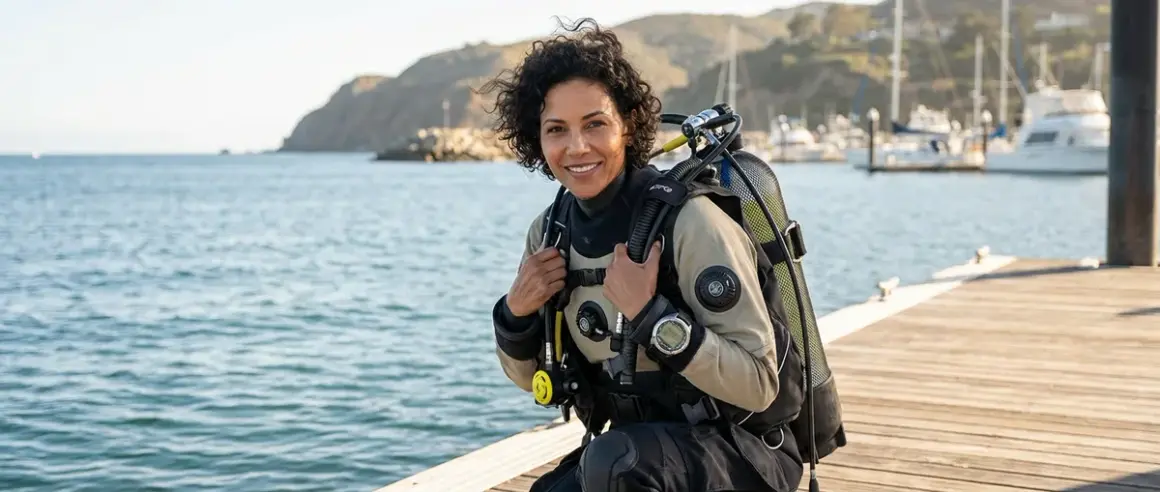

I'll be honest—when I first started diving, I thought how to fit a BCD was something instructors just handled during checkout. I'd shrug it on, clip the waist strap, and assume whatever position it landed in was "correct." Then I spent an entire week in Cozumel with shoulder straps that dug into my collarbone every time I inflated, and a tank that shifted left every time I turned my head to frame a shot. It wasn't until a divemaster casually adjusted three straps on my surface interval that I realized I'd been diving uncomfortable for months.
Learning how to fit a BCD properly changed everything for me—my buoyancy control improved, my air consumption dropped, and I could finally focus on composing photos instead of constantly readjusting my gear. In this guide, I'll walk you through the exact process I now use before every dive trip, whether I'm fitting my own BCD or testing a rental. You'll learn the step-by-step sequence for adjusting every strap, how to check your fit in and out of the water, and the small tweaks that make a huge difference in comfort. This should take about 15-20 minutes the first time you do it, and less than 5 minutes once you know your settings.

What You'll Need
- Your BCD (already assembled with tank and regulator attached for accurate weight distribution)
- A full scuba tank (the weight matters—an empty tank gives you a false fit)
- A buddy or mirror (to check back panel alignment and shoulder strap position)
- A wetsuit or drysuit (if that's what you'll be diving in—thickness changes fit significantly)
- Weight belt or integrated weights (if you use them—they affect how the BCD sits on your hips)
- A pool or shallow water (optional but highly recommended for final checks)
- A notebook or phone (to record your strap settings for future reference)
Step 1: Start With the Right Size BCD
Before you even touch a strap, you need to make sure you're wearing the correct BCD size. This confused me at first too—I assumed "small" meant the same thing across brands, but BCD sizing varies wildly. Some manufacturers size by chest circumference, others by height and weight charts, and a few just use vague S/M/L categories.
Put the BCD on over whatever exposure suit you'll actually be diving in. The thickness of your wetsuit or drysuit changes everything—a BCD that fits perfectly over a 3mm suit might be impossibly tight over a 7mm with a hood and vest. I learned this the hard way on a cold-water trip where I borrowed a thicker wetsuit and suddenly couldn't close my chest strap.
With the BCD on and completely deflated, you should be able to fit a flat hand between the bladder and your lower back. If there's more than four inches of gap, you probably need a smaller size. If you can't fit your hand in at all, or if the shoulder straps are already maxed out on their longest setting, size up. The cummerbund or waist strap should wrap around your natural waist (where your body bends when you lean sideways) with at least three inches of adjustment remaining on each side.
Check that the tank sits centered on your back without pulling left or right. If the BCD feels twisted or lopsided even before you tighten anything, that's a sizing problem, not an adjustment problem. For more context on how BCD design affects fit, check out What Is a Buoyancy Compensator Device: BCD Components and Function Explained.
Step 2: Adjust the Shoulder Straps First
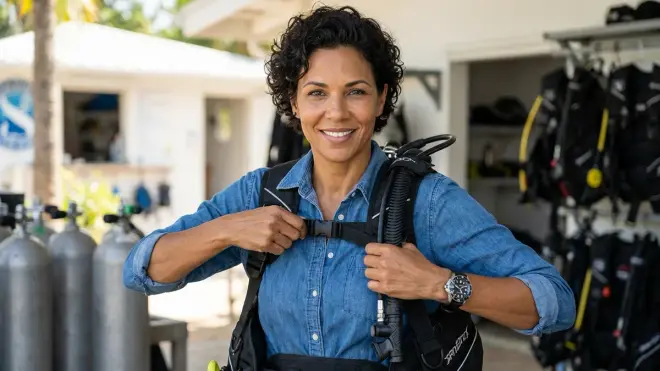
This is where most people—including me for way too long—get the sequence wrong. Always adjust shoulder straps before you touch anything else. The shoulders set the foundation for how the entire BCD hangs on your body.
Loosen both shoulder straps completely, then put the BCD on with the tank attached. Let it hang naturally without pulling anything tight yet. The top of the backplate (or the top edge of the bladder if you're using a jacket-style BCD) should sit roughly at the base of your neck—about where a backpack would rest. If it's riding up toward your ears or sagging down between your shoulder blades, you've got a sizing issue, not a strap issue.
Now tighten both shoulder straps evenly, pulling them snug but not tight. You should feel the weight of the tank settle onto your shoulders and upper back, but you shouldn't feel pressure points or pinching. I like to do a shoulder roll test here—lift your shoulders up toward your ears, then drop them. If the BCD shifts up and stays there, the straps are too loose. If you feel the straps digging in, they're too tight.
One trick I picked up from a dive buddy in Belize: tighten the straps while standing straight, then lean forward at the waist like you're horizontal in the water. The BCD should stay put without sliding up your back. If it rides up, tighten another half-inch. The goal is to feel like the BCD is part of your body, not something draped over it.
Step 3: Set the Chest Strap for Stability
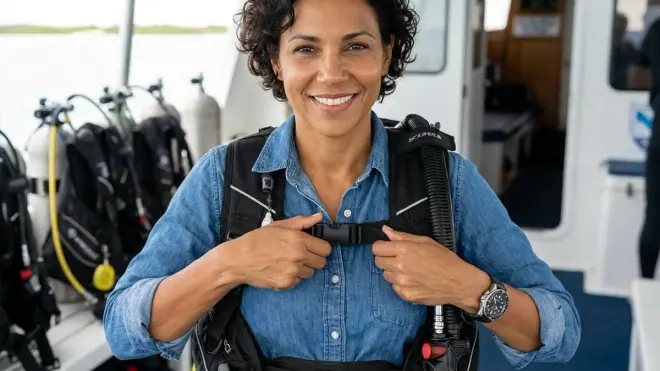
The chest strap (also called the sternum strap) is criminally underrated. For my first year of diving, I left mine dangling unused because I didn't understand what it actually did. Then I started carrying a camera rig for underwater photography, and suddenly that chest strap became essential for keeping my shoulder straps from sliding off when I raised my arms to frame a shot.
Position the chest strap about two inches below your collarbone—roughly in line with your armpits. If it's too high, it'll press against your throat when you look up. Too low, and it won't do anything to stabilize the shoulder straps. Some BCDs have sliding chest straps that you can move up and down the shoulder straps; others have fixed positions. If yours is fixed and sits in the wrong place, that's another sign you might need a different BCD size or style.
Clip the chest strap and tighten it until you feel light pressure across your sternum. You're not trying to compress your chest—you should still be able to take a full breath easily. The purpose is to keep the shoulder straps from splaying outward when you move your arms. Do a quick arm raise test: lift both arms straight out in front of you like you're reaching for something. The shoulder straps should stay in place on your shoulders without sliding toward your neck.
I dive with a back-inflate BCD most of the time now, and I keep my chest strap slightly looser than I did with my old jacket-style. Back-inflates naturally pull your shoulders back a bit, so too much chest strap tension feels restrictive. Jacket-style BCDs tend to need a firmer chest strap to counteract the forward pull of the front bladder.
Step 4: Secure the Waist Strap or Cummerbund
This is the strap that does the most actual work, and it's also the one that varies most between BCD styles. The waist strap should sit on your hip bones, not your belly. If it's riding up on your waist, it'll slide around during the dive. If it's too low on your hips, it won't stabilize the tank properly.
With your shoulder straps and chest strap already set, clip and tighten the waist strap until it feels snug against your body. You should be able to slide two fingers under it comfortably, but not your whole hand. I like to do a twist test here—rotate your torso left and right like you're looking behind you. The BCD should rotate with you as a single unit, not lag behind or shift position.
If you're using integrated weights (which I finally switched to last year because I got tired of messing with weight belts), make sure the weight pockets are positioned evenly on both sides before you tighten the waist strap. Uneven weights will torque your whole body, and no amount of strap adjustment will fix that.
Some BCDs have a cummerbund instead of a simple strap—it's basically a wide elastic band with Velcro that wraps around your lower torso. These are more forgiving than fixed straps, but they can loosen gradually during a dive as the neoprene compresses at depth. I've started checking my cummerbund at my safety stop on every dive because I've had it come completely loose twice. Not dangerous, just annoying.
For BCDs with pull-tight waist straps, remember that you'll need to loosen them when you add air to the BCD at depth. A strap that feels perfect on the surface can become uncomfortably tight at 60 feet when your bladder is inflated. Understanding BCD lift capacity helps you anticipate how much the bladder will expand.
Step 5: Adjust the Tank Position and Secure the Cam Band
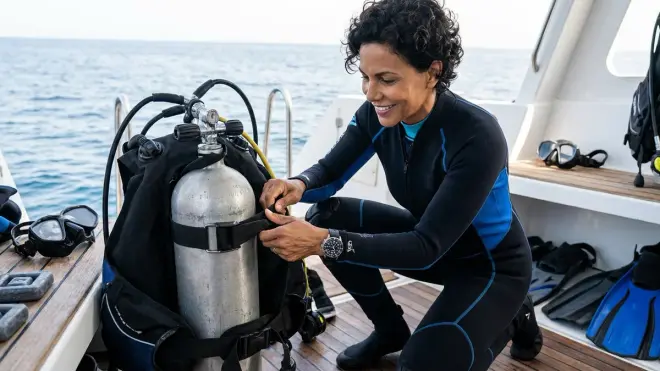
Tank position affects everything—your trim, your balance, your ability to reach your valve, and whether your BCD feels like it's trying to tip you backward or forward in the water. I spent months struggling with buoyancy before someone pointed out that my tank was sitting two inches too low.
With all your straps set, reach back and feel where the top of your tank sits relative to the top of your head. You should be able to tilt your head back and feel the tank valve with the top of your head, but it shouldn't be pressing against your skull. If you can't reach the valve with your head, the tank is too low. If the valve is poking you in the base of your skull, it's too high.
Most BCDs use a cam band (a strap with a buckle that wraps around the tank) to secure the cylinder. Loosen the cam band completely, slide the tank up or down in the BCD until it's positioned correctly, then retighten. Pull that cam band tight—I mean really tight. A loose cam band is one of the most common causes of tanks shifting during a dive, and it's terrifying when you're underwater and suddenly feel the weight distribution on your back change.
Do a valve reach test: reach back with your right hand and try to touch your tank valve. You should be able to reach it without straining, though you don't need to be able to fully grasp it unless you're training for self-sufficient diving. This is mostly about making sure the tank isn't so low that it shifts your center of gravity backward.
One more thing I learned from experience: check the tank position again after you put the BCD on the second time. The first time you assemble your rig, you might not get it perfect. I always do a quick check after my surface interval before dive two, because sometimes the cam band loosens slightly after the first dive.
Step 6: Fine-Tune Adjustable Straps and Accessories
Now that the main structure is set, you can dial in the smaller adjustments. Most modern BCDs have D-rings, dump valves, and corrugated hose positions that can be tweaked for personal preference. This is where diving style really matters—the setup I use for photography is different from what I'd use for just recreational sightseeing.
Check the position of your low-pressure inflator hose (the corrugated hose you use to add air). It should hang naturally where you can reach it without looking down, usually somewhere around your left collarbone. Some BCDs let you clip this hose to a D-ring or retainer when it's not in use; I always do this because I've had the hose snag on coral twice when it was dangling freely.
If your BCD has adjustable D-rings, position them where you'll actually use them. I keep one on my left chest for clipping my camera rig's strobe arm during ascents, and one on my right hip for a reef hook. D-rings that sit behind you or in places you can't reach with one hand are basically useless.
Check the position and routing of any dump valves—most BCDs have at least two, one on the left shoulder and one on the right hip or lower back. Make sure you know where they are and can reach them easily. I prefer BCDs where I can pull the dump valve while holding my camera, because fumbling between gear controls and camera controls is how I miss shots.
If your BCD has trim weight pockets (small pockets for fine-tuning weight distribution, separate from the main integrated weights), consider where you need extra weight. I keep 1-2 pounds in the upper trim pockets because back-inflate BCDs can sometimes make you feel feet-heavy, and that tiny bit of upper weight balances me out perfectly.
Step 7: Test Your Fit in the Water

Here's the truth: you can't fully evaluate BCD fit on land. Everything changes when you're horizontal, neutrally buoyant, and dealing with water resistance. If you have access to a pool or shallow confined water area, spend 15 minutes testing your fit before you commit to a dive.
Enter the water with your full rig—tank, weights, wetsuit, everything. Descend to about 5-10 feet and achieve neutral buoyancy. Now do a slow 360-degree rotation, face down, like you're scanning the reef for critters. Pay attention to any points where the BCD feels like it's shifting, pulling, or creating pressure.
Try this hover test, which a dive instructor in Honduras taught me: get neutrally buoyant, put your arms straight out in front of you, and stay completely still for 30 seconds. If you feel the BCD sliding up your back, your shoulder straps are too loose. If you feel pressure points on your hips or shoulders, something's too tight. If you feel like you're being tipped forward or backward, your tank position needs adjustment.
Swim normally for a few minutes, then stop and check how you feel. Do your shoulders hurt? Is the chest strap digging in? Can you still reach your inflator hose easily when you're horizontal? I always do a few practice buoyancy control exercises during this test because smooth buoyancy is impossible if your BCD is fighting you.
One last water test: inflate your BCD fully, then deflate it completely while horizontal. Watch how the bladder compresses and makes sure no straps suddenly become too tight or too loose as the air volume changes. This is especially important for jacket-style BCDs, where the bladder surrounds your torso and the fit can change dramatically between inflated and deflated states.
Step 8: Document Your Settings for Future Reference
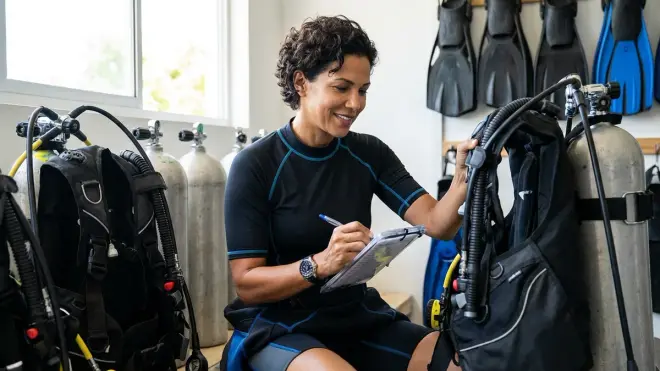
This step sounds obsessive, but it's saved me so much hassle. Take five minutes to write down all your strap settings after you've dialed in the perfect fit. Most BCD straps have numbered adjustment holes or marked sections—note exactly which hole or position you're using for each strap.
I keep a note on my phone with: shoulder strap positions (left and right, because they're not always symmetrical), chest strap position, waist strap setting, and tank height measurement (I measure from the top of the BCD backplate to the tank valve and write down the distance). This way, if I need to completely break down my BCD for travel in my gear bag, I can reassemble it to exactly the same settings at my destination.
This is also incredibly useful if you're renting gear or trying out different BCDs. I have notes for three different rental BCD models at my local shop because I've tested them all, and now when I book a trip I can request the model I know fits me and set it up in 90 seconds.
Take a photo of yourself wearing the fully adjusted BCD from the front, side, and back. Sounds silly, but visual reference is faster than trying to remember exactly where that chest strap sat. I have a whole album of "gear fit photos" on my phone, and I reference them constantly.
If you dive with different exposure suit thicknesses (like I do—3mm in Belize, 5mm in California), document settings for each. The fit that works over a thin tropical suit won't work over a thick cold-water suit. I mark my notes with "3mm settings" and "5mm settings" so I don't have to relearn every time I switch environments.
Pro Tips & Common Mistakes
Never adjust your BCD straps underwater for the first time. I've seen divers try to "fix" a loose waist strap at 40 feet and end up in an awkward position with their buddy trying to help while both of them blow their buoyancy. If something feels wrong during a dive, note it mentally and fix it on the surface.
Wetsuit compression changes fit as you descend. Your BCD might feel perfect at 10 feet and too loose at 60 feet because your neoprene compressed. Some divers compensate by starting with straps slightly tighter than feels ideal on the surface. I don't do this because I find it uncomfortable during the descent, but it's worth trying if you consistently notice looseness at depth.
The most common mistake I see (and made myself constantly) is over-tightening everything. Tighter doesn't mean better. An overly tight BCD restricts your breathing, limits your range of motion, and creates fatigue faster. You want snug contact, not compression. If you're leaving red marks on your shoulders after a dive, you're too tight.
Check your fit every few dives, especially if you're on a multi-day trip. The repeated wet-dry cycles, sun exposure, and stress on straps can cause webbing to stretch or buckles to slip. I do a quick fit check every morning before my first dive of the day, and I've caught loose shoulder straps and cam bands more than once.
If you're struggling with fit and you've tried everything, consider that you might be using the wrong BCD style for your body type and diving preferences. I switched from a jacket-style to a back-inflate BCD partly because of fit issues—my short torso made jacket-style BCDs bunch up around my neck. Sometimes the problem isn't your adjustment technique; it's the equipment itself. Reading how to choose a buoyancy compensator helped me understand what might work better for my build.
Frequently Asked Questions
How tight should my BCD straps be?
Your BCD straps should be snug enough that the BCD doesn't shift position when you move, but loose enough that you can slide two fingers under each strap comfortably. If you can fit your whole hand under a strap, it's too loose; if you can't fit two fingers, it's too tight. The shoulder straps should support the weight of the tank without creating pressure points, and the waist strap should sit firmly on your hip bones without restricting your breathing or compressing your torso.
Can I adjust my BCD straps while wearing it?
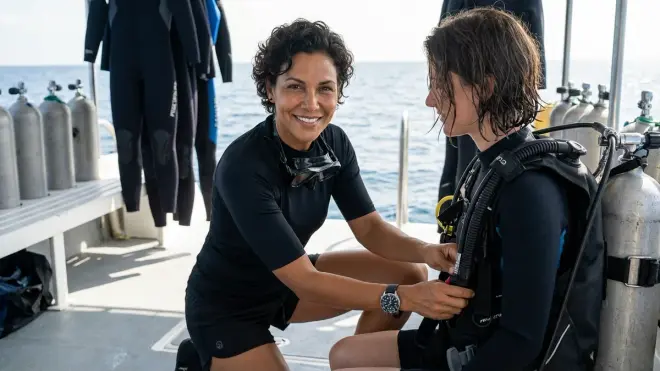
Yes, all BCD straps are designed to be adjusted while wearing the unit, though it's much easier with a buddy helping you. Shoulder straps can be tricky to reach on your own—I usually ask someone to check the back view and tell me if the straps look even. The waist strap and chest strap are easy to adjust solo. However, avoid making major adjustments underwater; surface first, make changes, then redescend if needed for additional testing.
How do I know if my BCD is the wrong size?
If your straps are maxed out (either fully loosened or fully tightened) and the fit still doesn't feel right, you likely need a different size. Other signs include: the tank consistently sits too high or too low even with cam band adjustments, the shoulder straps slide off your shoulders constantly, you can't reach the chest strap buckles to clip them together, or there's a large gap (more than four inches) between the bladder and your lower back when fully deflated. BCD sizing varies significantly between brands and styles, so a "medium" in one brand might fit like a "large" in another.
Should I adjust my BCD differently for different types of diving?
Generally, the core fit (shoulder, chest, and waist strap positions) should remain the same regardless of dive type, but you might make small adjustments for specific scenarios. For example, when I'm diving with my camera equipment, I sometimes loosen my chest strap slightly to allow more arm mobility for positioning strobes. For drift diving or dives with strong currents, I tighten everything an extra notch because the water resistance can cause straps to work loose. Cold water diving with thicker exposure suits requires loosening all straps compared to your tropical settings. The key is starting with a solid baseline fit and making minor tweaks based on conditions.
Summary
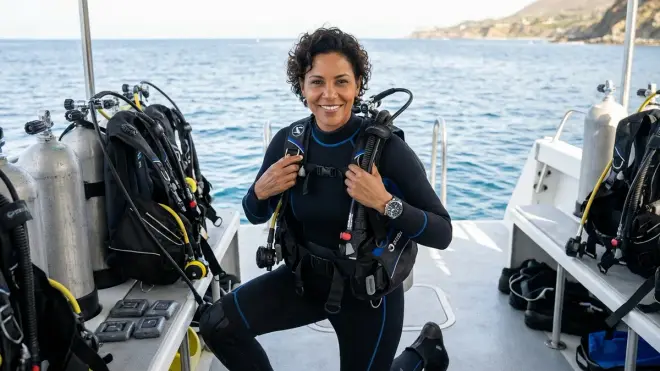
Learning how to fit a BCD properly was one of those skills I wish I'd mastered earlier in my diving journey. A well-fitted BCD disappears into the background—you stop thinking about your gear and start thinking about the dive itself, whether that's photography, marine life observation, or just enjoying the weightlessness. The process takes a little patience the first time through, but once you've documented your settings and understand the sequence, you can dial in a perfect fit in minutes.
Remember that fit is personal and situational. What works for me might not work for you, and what works in a 3mm suit in tropical water won't work in a 7mm with a hood. Don't be afraid to experiment, ask for help from more experienced divers, and make adjustments until everything feels right. Before each dive trip, I now spend 20 minutes going through this entire process, and it's completely eliminated the discomfort and distraction I used to deal with underwater.
Your BCD is one of the most important pieces of equipment you own—spend the time to fit it properly. The difference between "good enough" and "properly adjusted" is the difference between thinking about your gear and forgetting you're wearing it. For ongoing gear care, check out the BCD maintenance checklist to keep everything functioning smoothly, and review the BCD pre-dive safety check to build a consistent routine before every dive. Get the fit right once, document it, and you'll be comfortable on every dive that follows.