
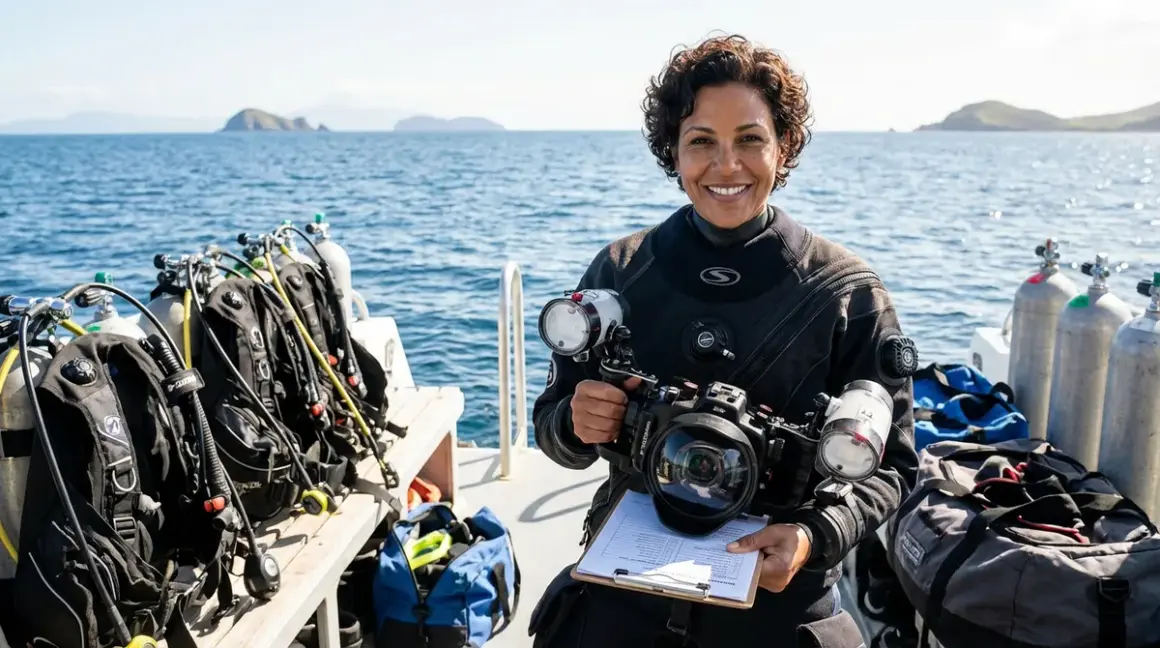

I still remember my first dive with a camera—I was so excited to capture the reef that I forgot my spare o-rings and spent the entire surface interval panicking about whether my housing was properly sealed. Three years and way too many "oops, I forgot that" moments later, I've finally gotten my underwater photography gear checklist down to a system that actually works. This checklist covers everything you need to bring on every dive, organized by category so you can double-check before you zip up your bag. Whether you're shooting with a compact camera or you've upgraded to a mirrorless setup like I did last year, this list will help you avoid those heart-sinking "I left it at the hotel" realizations.
Camera and Housing Essentials
These are the non-negotiables—the core gear that makes underwater photography possible. I keep these items in a dedicated camera bag that lives inside my main dive bag, so I always know where they are.
Camera body with fully charged battery: I learned the hard way that "75% charge" is not enough for a two-tank dive. Always start at 100%, and if your camera eats battery like mine does, bring it fully topped off the night before.
Underwater housing with fresh o-ring: Check that main o-ring every single dive. I wipe it clean with a microfiber cloth and inspect it under good light before I seal the housing—no exceptions. If it looks even slightly nicked or has any debris, replace it. Underwater camera housings are only as good as their seals.
Port (flat or dome, depending on your lens): Match your port to your lens—wide-angle shots usually need a dome port, while macro works with a flat port. I keep a small label on each port so I don't grab the wrong one when I'm rushing.
Desiccant packet inside housing: These little silica gel packs prevent fogging by absorbing moisture trapped inside the housing. I replace mine every few dive days, especially in humid climates like Belize where moisture sneaks in everywhere.
Memory card (and a spare): I shoot RAW files because I'm still learning to edit, and those files are huge. A 64GB card fills up fast on a good reef dive, so I always pack a backup card in my BCD pocket as insurance.
Lens cleaning cloth: Saltwater spray and fingerprints are inevitable. A small microfiber cloth lives in my housing case, and I use it before every dive to wipe down the front of my port.
Understanding proper underwater camera maintenance routines has saved me from several potential disasters—especially when it comes to o-ring care and post-dive rinsing.
Lighting Equipment
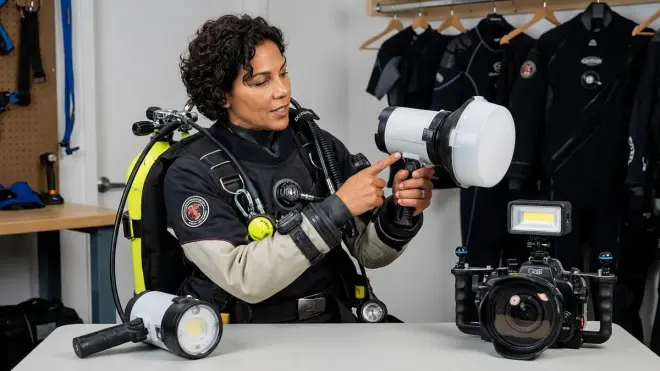
Natural light disappears fast underwater—after about 30 feet, reds vanish completely and everything looks blue-green. That's where your lighting gear comes in. I spent my first 20 photo dives without strobes, and looking back at those images... well, let's just say artificial lighting makes a massive difference.
Strobes or video lights: I use strobes for stills because they freeze motion and bring back lost colors. If you shoot video, continuous video lights are your friend instead. Either way, you need something to illuminate your subject and fight that natural color loss.
Mounting arms and clamps: These position your lights at the right angle to avoid backscatter (those annoying white specks that ruin photos when you light up particles in the water). I use two flexible arms so I can angle my strobes outward and slightly forward.
Sync cables or optical triggers: These connect your strobes to your camera. Fiber optic cables are more reliable than wireless triggers in my experience, though they're one more thing to keep track of between dives.
Spare batteries for lights: Nothing worse than your strobe dying halfway through a dive. I keep fully charged spares in a small waterproof case that clips to my BCD—learned that lesson after missing a turtle encounter because my light gave up.
Diffusers for strobes: These soften harsh light and prevent blown-out highlights on reflective subjects like fish scales. I don't use them every dive, but for macro work they're essential.
The backscatter issue took me forever to figure out—I kept getting these cloudy, particle-filled photos until someone explained proper strobe positioning. Understanding backscatter honestly transformed my wide-angle reef shots.
Buoyancy and Stabilization Gear
Here's something they don't tell you in basic photography tutorials: perfect buoyancy control is more important than expensive camera gear. I've taken sharper photos with a cheap compact and solid buoyancy than I have with my mirrorless when I'm bobbing around like a cork.
Well-maintained BCD with reliable inflator: Your buoyancy compensator keeps you stable while you compose shots. I prefer a back-inflate BCD because it positions me more horizontally, which is ideal for photography, but use what works for your diving style.
Properly weighted system: Add a pound or two extra when you're carrying camera gear—housings are often slightly negative, and you don't want to be fighting to stay down while trying to shoot. I adjust my weights based on whether I'm using my small setup or my larger housing.
Camera lanyard or retractor: This attaches your housing to your BCD so if you need both hands free (like when checking your dive computer), your camera stays safe. I use a coiled lanyard because straight ones get tangled in everything.
Pointer stick (optional but useful): Some divers use these to steady themselves on rocks (never on coral, obviously) when shooting macro. I'm still figuring out if I like using one, but on sites with dead rock formations, it helps.
Mastering buoyancy control for underwater photography took me at least 30 dives of practice. I still mess it up sometimes when I get excited about a subject, but it's getting more natural.
Backup and Safety Items
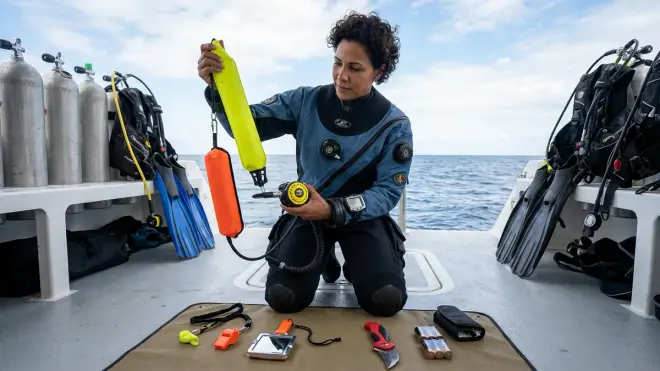
The ocean is unpredictable, and gear fails. These backup items have saved multiple dives for me, and they take up almost no space in your bag.
Spare housing o-rings: Keep at least two spares in a small case. I use a contact lens case—it's waterproof, compact, and the perfect size. Apply a tiny bit of silicone grease to each spare so they're ready to install if needed.
Silicone grease for o-rings: A small tube goes a long way. Don't over-apply it—just enough to make the o-ring slide smoothly when you close your housing. Too much grease actually attracts debris.
Allen keys and screwdriver for housing: These tighten any loose screws or adjust your mounting system. My housing uses specific hex sizes, so I keep a small multi-tool with those sizes in my camera case.
Ziplock bags for emergency sealing: If your housing fails or you suspect a leak, you can seal your camera in a bag as a temporary measure. It's not ideal, but it's better than a flooded camera.
Lens cap for surface intervals: Protect your port from scratches and accidental bumps while the housing sits on the boat between dives. I use a neoprene cover that stays attached with a lanyard.
Foam padding or neoprene case: For transporting your housed camera on the boat. Housings are tough, but they can crack if they fall on a hard deck or get knocked around.
Following a solid BCD pre-dive safety check routine helps me catch issues before they become problems—same principle applies to camera gear checks.
Final Check Before You Go
Here's the mental checklist I run through before every dive. I physically touch each item as I verify it—sounds silly, but it works.
Camera Check:
- Battery charged, memory card inserted, settings confirmed
- Housing sealed with clean o-ring, no hair or debris in seal
- Port attached correctly, lens clean
- Desiccant packet inside housing
Lighting Check:
- Strobes or lights charged and tested
- Arms and clamps tightened
- Sync cables connected
Support Gear:
- Camera attached to BCD with lanyard
- Weights adjusted for camera rig
- Spare o-rings and tools in BCD pocket
Backup Items:
- Silicone grease accessible
- Spare batteries packed
- Surface interval protection ready
I also do a quick dive computer setup check to make sure my computer is ready—you need to track your bottom time and depth just as carefully when you're shooting, even though it's easy to get distracted by compositions.
Frequently Asked Questions
What is the most important item on an underwater photography gear checklist?
The most important item on an underwater photography gear checklist is a properly sealed underwater housing with a clean, undamaged o-ring, because a housing failure means a flooded camera and a ruined dive trip. I check my o-ring before every single dive without exception—it takes 30 seconds and prevents catastrophic equipment loss.
How do I organize my underwater camera gear for dive travel?
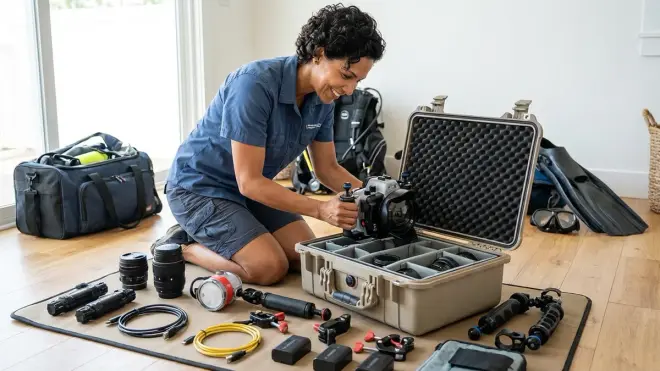
Organize your underwater camera gear by using a dedicated padded case for your housing and ports, keeping small items like o-rings and tools in labeled ziplock bags or small waterproof containers, and packing batteries and memory cards in your carry-on luggage rather than checked bags. I learned to use a scuba travel bag system that separates my camera gear from my wet dive equipment, which keeps everything organized and prevents damage during transport.
Should I bring my underwater camera on my first few dives at a new site?
You should skip bringing your underwater camera on your first dive at a new site and focus entirely on buoyancy, navigation, and getting comfortable with the conditions, then bring your camera on the second dive once you understand the environment. I made the mistake of shooting on my first dive at a site with strong current once, and I was so focused on my camera that I didn't enjoy the dive and got separated from my buddy—not worth it.
Final Thoughts
Building an underwater photography gear checklist that actually works takes time and a few mistakes—I'm still tweaking mine based on what I forget or what breaks. The key is being honest with yourself about what you genuinely need versus what looks cool but sits unused in your bag. Start simple, especially if you're new to underwater photography, and add gear as you figure out what your shooting style actually requires.
I keep a printed version of this checklist laminated in my dive bag, and I check it the night before every dive trip. It sounds obsessive, but it's saved me from showing up at the boat without critical items more times than I want to admit.
The truth is, the best underwater photography gear checklist is the one you'll actually use consistently. Whether you're diving the reefs here in Belize or exploring different sites around the world, having a reliable system means you spend less time worrying about gear and more time capturing those incredible underwater moments that made you fall in love with diving in the first place.