
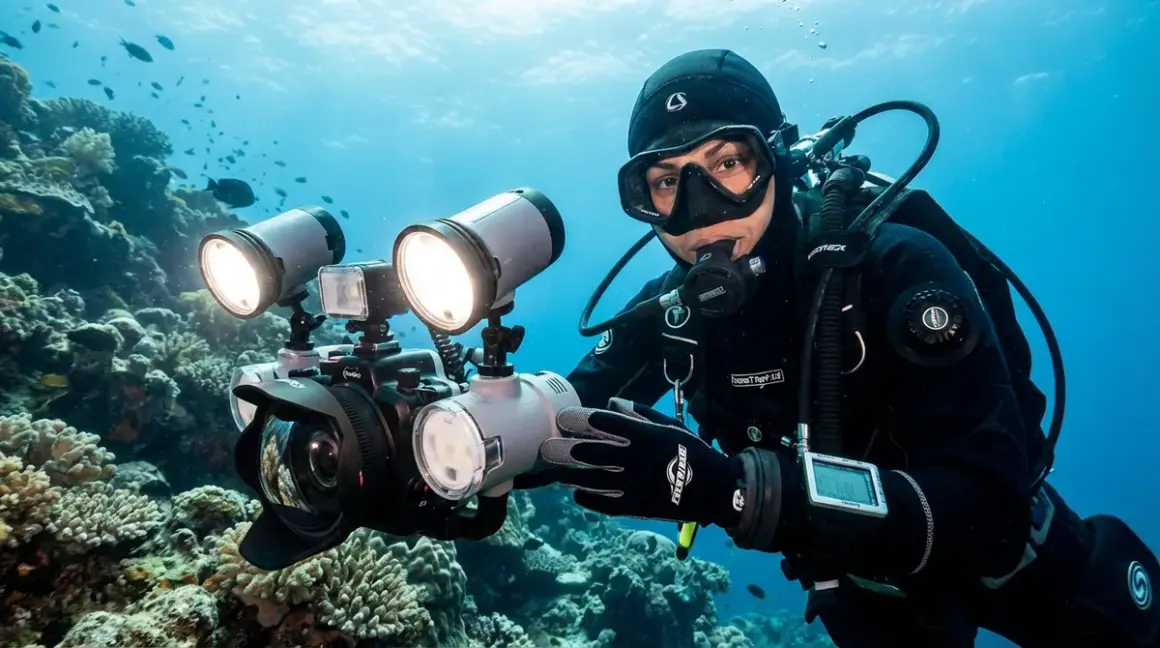

For most underwater photographers starting out, strobes deliver sharper, more color-accurate stills with less backscatter, while continuous video lights excel for shooting video and practicing composition—but the right choice depends entirely on whether you're primarily shooting photos or footage. When I started researching strobes vs video lights underwater about two years ago, I honestly felt overwhelmed by all the conflicting advice. This comparison breaks down the real-world differences between these two lighting systems, covering light output and coverage, power consumption, backscatter control, versatility, and travel considerations so you can choose the right setup for your diving style.
Quick Comparison: Strobes vs Video Lights
| Criteria | Strobes | Continuous Video Lights |
|---|---|---|
| Primary Use | Still photography | Video and stills (hybrid) |
| Light Output | 10,000-30,000+ lumens (burst) | 1,000-10,000 lumens (continuous) |
| Power Duration | 100-400+ flashes per charge | 45-120 minutes continuous run time |
| Backscatter Control | Excellent (light only fires on exposure) | Poor to moderate (constant illumination) |
| Color Temperature | 5000-6500K (adjustable on high-end models) | 3000-6500K (many have variable temp) |
| Weight (typical dual setup) | 1.2-2.8 kg in housing with arms | 0.8-2.4 kg in housing with arms |
| Recycle Time | 0.1-2.5 seconds between shots | N/A (always on) |
| Price Range (pair) | Around $400–$3,000+ | Around $200–$1,800+ |
| Battery Type | Proprietary lithium or AA (4-8 cells) | Rechargeable lithium (18650 or proprietary) |
| Best For | Macro, wide-angle stills, freezing motion | Video footage, composition preview, hybrid shooting |
Light Output and Coverage
This is where the strobes vs video lights underwater debate gets really interesting, because we're comparing two completely different types of power delivery.
Strobes dump massive amounts of light in a split-second burst—anywhere from 10,000 to over 30,000 lumens during that flash. That burst completely overpowers ambient light, which means you get vivid colors even at 80 feet where everything looks blue-green naturally. I remember the first time I fired a proper strobe setup at 60 feet on a reef in Belize—suddenly all those purples and yellows on the coral just popped back to life. It felt like magic, honestly.
The beam angle on most strobes ranges from 90 to 120 degrees, with some offering diffusers that spread light even wider for ultra-wide-angle work. My Sea&Sea YS-D3 Lightning strobes🛒 Amazon (which I saved up for over six months) have a 110-degree beam angle that covers my full-frame camera with a 16mm fisheye without any dark corners. But here's the catch I didn't realize at first: positioning matters hugely. If your strobes are too close to your camera port, you'll light up every bit of suspended sediment between you and your subject—that's backscatter, which can absolutely ruin underwater photos.
Video lights, on the other hand, produce continuous illumination at much lower power levels—typically 1,000 to 10,000 lumens. That sounds like a lot less, and it is, but because the light is constant rather than a brief flash, it's enough to see your subject and your camera screen clearly. When I borrowed a friend's Light & Motion Sola 15000🛒 Amazon setup (which actually puts out about 15,000 lumens combined), I could finally see what my camera was actually focusing on before I hit the shutter button. That preview capability is something strobes just can't offer.
Coverage patterns on video lights vary wildly. Some have narrow 45-degree spot beams for macro work, while others spread light across 90-120 degrees for wider scenes. Many newer models like the Keldan Luna 8🛒 Amazon have adjustable beam angles, which I think is brilliant for divers who shoot both macro and wide-angle. The trade-off is that continuous lights at recreational depths (40-100 feet) don't have enough punch to completely restore colors the way strobes do—you'll still get that blue-green color cast unless you're really close to your subject or you correct it in post-processing using white balance adjustments.
One thing I wish someone had told me earlier: lumen ratings on video lights can be misleading. Manufacturers measure them at the LED source, not at the subject. Once you factor in the lens, the water column, and the distance to your subject, that advertised 8,000-lumen light might only deliver 2,000-3,000 lumens where it counts. Strobes don't really have this problem because their guide numbers (measured in meters at ISO 100) are standardized measurements that actually help you calculate exposure accurately.
Power Consumption and Battery Life
This is where continuous video lights really show their limitations, especially on dive trips where you're doing three or four dives a day.
Strobes are insanely efficient because they only fire for a fraction of a second per shot. A quality strobe with four AA batteries or a proprietary lithium pack will give you anywhere from 100 to 400+ full-power flashes on a single charge. My Sea&Sea YS-D3 strobes run on four AA batteries each, and I typically get 200-250 full-power flashes per set—that's easily two or three dives, sometimes four if I'm being conservative with my shooting. I started using Eneloop Pro rechargeable AAs (2,500 mAh capacity) and honestly, they're a game-changer compared to alkaline batteries, which die fast in cold water and can leak if you're not careful.
Higher-end strobes like the Inon Z-330🛒 Amazon or Backscatter Mini Flash (MF-2)🛒 Amazon use proprietary lithium battery packs that can deliver 300-500+ flashes and recharge via USB-C in 2-3 hours. That convenience is worth the extra cost if you're shooting a lot, but I'm still building my gear collection piece by piece, so AA compatibility was more practical for me starting out.
Video lights, by contrast, burn through power continuously. A typical mid-range video light with a 5,200 mAh lithium battery pack will run for 45-90 minutes at full power, maybe 90-120 minutes at 50% power. That sounds decent until you realize a recreational dive often lasts 50-60 minutes—so you're basically getting one dive per charge, maybe two if you're conservative. I borrowed a pair of cheaper video lights on a trip to Utila last year, and by the third dive of the day, both were dead. I ended up shooting the last dive with just ambient light and my disappointment.
Premium lights like the Light & Motion Sola 15000 or Keldan Luna 8 have battery packs that push 2-3 hours of run time at moderate power, but you're paying around $800–$1,200 per light for that. And even then, if you're doing back-to-back dives, you're still scrambling to recharge during surface intervals. Most video lights charge via USB-C or proprietary chargers that take 2-4 hours to fully recharge, so you really need backup batteries if you're serious about shooting video all day. That adds weight, cost, and complexity.
Here's something I didn't expect: video lights also generate noticeable heat after running for 15-20 minutes at full power. The Sola lights I borrowed got warm enough that I could feel it through the housing grip. It's not dangerous or anything, but it's a reminder that you're running a high-drain system underwater. Strobes, by comparison, stay cool because they're only active for milliseconds at a time.
One practical advantage for video lights: they're great for night dives even if you're not shooting. I've used my borrowed lights as dive lights during night dives, which was handy, but it also meant I wasn't conserving battery for actual photography.
Backscatter Control and Image Quality
This is honestly the biggest reason I ended up prioritizing strobes for my underwater photography setup.
Backscatter happens when your light source illuminates suspended particles—plankton, sand, algae—floating between your camera and your subject. In the resulting photo, those particles show up as bright white or colored spots that ruin the image. It's especially bad in murky water, after a storm, or when you're shooting near the sand. I learned about this the hard way on a dive in Caye Caulker where I kept my video lights pointed straight forward. Every single photo looked like it was snowing underwater. Super frustrating.
Strobes minimize backscatter in two key ways. First, they only fire for about 1/1000th of a second, so there's way less time for stray particles to reflect light back into your lens. Second, and more importantly, you can position strobes on long articulating arms (usually 8-12 inches or more) far away from your camera housing and angle them past your subject. This creates cross-lighting or backlighting that skips over most of the particles in the water column. Once I mounted my strobes on 10-inch Ultralight arms and angled them outward at about 45 degrees, my backscatter problems dropped by like 80%. It took some practice to nail the positioning, but it's made a huge difference.
Video lights, being continuous, illuminate every particle in the water constantly, and because they're often mounted closer to the camera (for balance and to minimize bulk), you get way more backscatter. You can reduce it somewhat by angling your lights outward or using diffusers, but you can't eliminate it the way strobes do. In clear water, this isn't a dealbreaker. In typical Caribbean visibility of 60-80 feet, it's noticeable. In green temperate water with 20-foot viz, it's a disaster.
Beyond backscatter, strobes also deliver sharper images because they freeze motion. That ultra-short flash duration means even if your subject is moving—a fish, a crab, swaying soft coral—the strobe captures it crisply. Video lights don't freeze motion; you're relying entirely on your shutter speed, which means if you're shooting at 1/60th or 1/125th (common for underwater stills), any subject movement or camera shake shows up as blur. I've definitely thrown away shots where the fish was just slightly blurry because my continuous light couldn't freeze the motion.
There's also a color rendering difference. High-quality strobes produce daylight-balanced light (5000-6500K) that accurately reproduces the reds, oranges, and yellows that disappear underwater. You can tweak your camera's white balance settings to fine-tune things, but strobes give you a strong starting point. Video lights vary in color temperature—cheaper ones tend toward cooler blue-white tones (6000K+), while premium models offer adjustable color temperature or even RGB modes for creative effects. But even at 5500K, a continuous light at depth doesn't restore colors as vividly as a strobe burst does, simply because it's not as powerful.
One area where video lights win: you can see exactly how your lighting looks before you press the shutter. With strobes, you're shooting blind—you fire the shutter, check the back of your camera, adjust your strobe position or power, and try again. It's trial and error. With video lights, what you see on your LCD is basically what you'll get, which makes learning composition and lighting angles way easier. When I was first figuring out buoyancy control for underwater photography, being able to see my framing in real-time with video lights helped a ton.
Versatility: Stills, Video, and Hybrid Shooting
If you only care about shooting stills, strobes are the obvious choice. But if you want to shoot both photos and video on the same dive—or if you're still figuring out which you prefer—the calculus changes.
Strobes are purpose-built for still photography and they excel at it, but they're basically useless for video. You can't run a strobe continuously (well, some have a weak LED focus light, but it's nowhere near bright enough for actual video work). So if you invest in a pair of quality strobes and then decide six months later that you really want to shoot video, you're either buying a second set of lights or dealing with dark, color-shifted footage.
Video lights give you the flexibility to shoot both stills and video, which is a huge advantage if you're still exploring what you like. I know several divers who started with a single good video light, shot both photos and video with it, and then added a second light or upgraded once they figured out their preferences. The downside is that your stills won't look as good as they would with strobes—less color, more backscatter, no motion-freezing—but they're still usable, especially in shallow, clear water.
Some newer hybrid lights like the Backscatter Hybrid Flash (HF-1)🛒 Amazon or Kraken Hydra 5000+ WSRU🛒 Amazon combine strobe and continuous modes in one unit. They have a powerful LED for continuous shooting and a flash tube or high-intensity LED burst mode for stills. I haven't used one myself yet (they're usually around $700–$900 each), but the idea makes a lot of sense for divers who don't want to carry two completely separate lighting systems. The trade-off is that the strobe mode is usually less powerful than a dedicated strobe, and the continuous mode drains battery faster than a dedicated video light. They're a compromise, but a smart one if versatility is your priority.
One thing I'm still figuring out: whether I even want to shoot video regularly. I started diving because I wanted to capture the reefs I was seeing, and for me that's always meant stills. But I've seen some beautiful video footage from other divers, and there's definitely a pull to try it. If I'd known three years ago that I'd be this committed to still photography, I probably would've bought strobes even sooner. But starting with a single video light (borrowed from a friend) let me learn lighting angles and camera settings without a huge upfront investment.
Travel and Logistics
This section might seem boring, but if you're a diver who travels for most of your diving—like I do—it actually matters a lot.
Strobes, especially AA-powered ones, are incredibly travel-friendly when it comes to power logistics. I can throw a pack of 16 Eneloop AAs in my gear bag and not worry about finding outlets, dealing with different voltage standards, or packing bulky chargers. Airlines allow AA batteries in carry-on or checked bags (though lithium AAs have some restrictions), and I can buy emergency backups in basically any town if I run out. That peace of mind is worth a lot when you're diving in remote locations.
Strobes with proprietary lithium batteries are slightly less convenient—you need to pack the specific charger, and some airlines have watt-hour limits on lithium batteries (usually 100Wh for carry-on). The Inon Z-330 battery pack is 50Wh, well under the limit, but it's still one more thing to remember. I've heard stories of divers forgetting their charger and being stuck without strobes for a whole trip. That's less likely with AAs.
Video lights with lithium batteries are more of a hassle. Most use 18650 cells or proprietary packs in the 50-100Wh range, which means you're packing chargers, checking watt-hour ratings, and hoping you remembered all the cables. If you're running two video lights and need backup batteries for each, that's four battery packs, two chargers, and a tangle of USB cables. I get stressed just thinking about it. For a weeklong dive trip with multiple daily dives, you basically need those backup batteries, which adds weight and cost.
Physical size and weight vary a lot. Compact strobes like the Inon S-2000🛒 Amazon or Backscatter Mini Flash weigh around 200-300 grams each (in air), while bigger strobes like the Sea&Sea YS-D3 Lightning or Ikelite DS-161 are 500-700 grams. A full dual-strobe rig with arms, clamps, and housing can easily hit 2-3 kg total. Video lights tend to be lighter—most are 200-500 grams each—but once you add the arms and mounts, the weight difference isn't huge.
Where video lights sometimes win is in bulk. Many video lights have a slim, torch-style profile that packs more easily than the wide rectangular heads of strobes. The Light & Motion Sola lights, for example, are narrow enough to fit in awkward gaps in a dive bag, whereas my Sea&Sea strobes take up more space due to their wide reflector design.
One logistical thing I didn't expect: strobes are more durable for rough travel. They're typically sealed units with fewer moving parts—no external charging ports exposed to salt spray, no delicate thermal vents. Video lights often have USB-C ports sealed with rubber plugs, and I've seen those plugs get lost or fail to seal properly after repeated use. It's not a huge deal if you're careful, but it's worth noting. I baby my gear, but I know not everyone does.
For tropical diving where I'm mostly doing boat dives and staying at a resort with reliable power, video light logistics are manageable. For liveaboards or remote locations where power outlets are limited and charging time is scarce, strobes just make my life easier.
Who Should Choose Strobes
If you're primarily interested in still photography and want the absolute best image quality, strobes are the way to go. They'll give you sharper, more colorful photos with way less backscatter, especially if you're shooting macro subjects or wide-angle reef scenes. The upfront cost is higher, but the results speak for themselves.
Strobes also make sense if you're planning to dive in challenging conditions—murky water, deep dives, cold water environments where battery life matters. The longer run time per charge and the ability to freeze motion in low visibility are huge advantages. If you're someone who likes to shoot a lot of frames per dive (which I definitely am), you'll appreciate not worrying about battery life mid-dive.
Finally, if you travel frequently and want simple, reliable power logistics, AA-powered strobes like the Inon S-2000 or Sea&Sea YS-D3 are hard to beat. You can find batteries anywhere, and you don't need to pack a bunch of chargers and cables.
Who Should Choose Video Lights
If you want to shoot video, or if you're not sure yet whether you prefer stills or video, continuous lights are the obvious choice. They give you the flexibility to try both without committing to a specialized system. Even if your still photos aren't as vibrant or sharp as strobe-lit shots, you'll still get usable images, especially in shallow, clear water.
Video lights also make sense for divers who are just starting with underwater photography and want to see their lighting in real-time before pressing the shutter. That instant feedback helped me learn composition and framing way faster than I would have with strobes alone. It's less intimidating, honestly.
And if you're on a tighter budget, you can start with a single decent video light (like the Keldan Luna 4+🛒 Amazon) or Light & Motion GoBe 1000🛒 Amazon for usually around $300–$500, shoot with it for a while, and then add a second light later if you want more even coverage. That's more affordable than buying a pair of quality strobes right off the bat, which can easily run around $800–$1,500 or more.
Frequently Asked Questions
Can you use video lights for underwater photography or do you really need strobes for good photos?
You can definitely use video lights for underwater photography, and you'll get usable photos especially in clear, shallow water within 30 feet of the surface. However, strobes will always produce sharper, more color-accurate images with less backscatter because they deliver high-intensity bursts of light that overpower ambient blue-green tones and freeze subject motion, whereas continuous video lights at 3,000-8,000 lumens don't have enough power to fully restore reds and oranges at depth or eliminate motion blur without a fast shutter speed.
How many lumens do you need for underwater video lights to work effectively at recreational depths?
For recreational depths between 30-100 feet, you'll want continuous video lights that produce at least 3,000-5,000 lumens per light for macro work and 5,000-10,000 lumens per light for wide-angle video with decent color rendering. Lower-powered lights (1,000-2,000 lumens) can work in shallow water under 30 feet or with heavy post-processing color correction, but they won't give you much visible light improvement at depth where blue-green color cast is strongest.
Do strobes work for underwater video or only for still photography?
Strobes only work for still photography because they produce brief high-intensity flashes (1/1000th to 1/500th of a second) rather than continuous light, so they don't illuminate video footage at all. Some strobes include a weak LED modeling light (usually 100-500 lumens) for focus assist, but these aren't bright enough for actual video recording, so if you want to shoot video underwater you need dedicated continuous lights or a hybrid strobe-video light system.
Bottom Line
The strobes vs video lights underwater question really comes down to what you want to shoot and how much you care about image quality versus flexibility. I went with strobes because I knew I wanted to focus on stills, and I haven't regretted it—my photos improved dramatically once I learned to position them properly. But I totally understand why newer divers start with video lights. They're less intimidating, more versatile, and you can actually see what you're lighting before you hit the button.
If you're still on the fence, my honest advice is to borrow or rent both systems on a few dives if you can, or start with a single quality video light and see how you feel. There's no wrong answer here—just different tools for different goals. And honestly? Once you start getting serious about underwater photography, you'll probably end up with both eventually anyway. I'm already eyeing a small video light for my next gear purchase so I can experiment with video on shallow dives.