
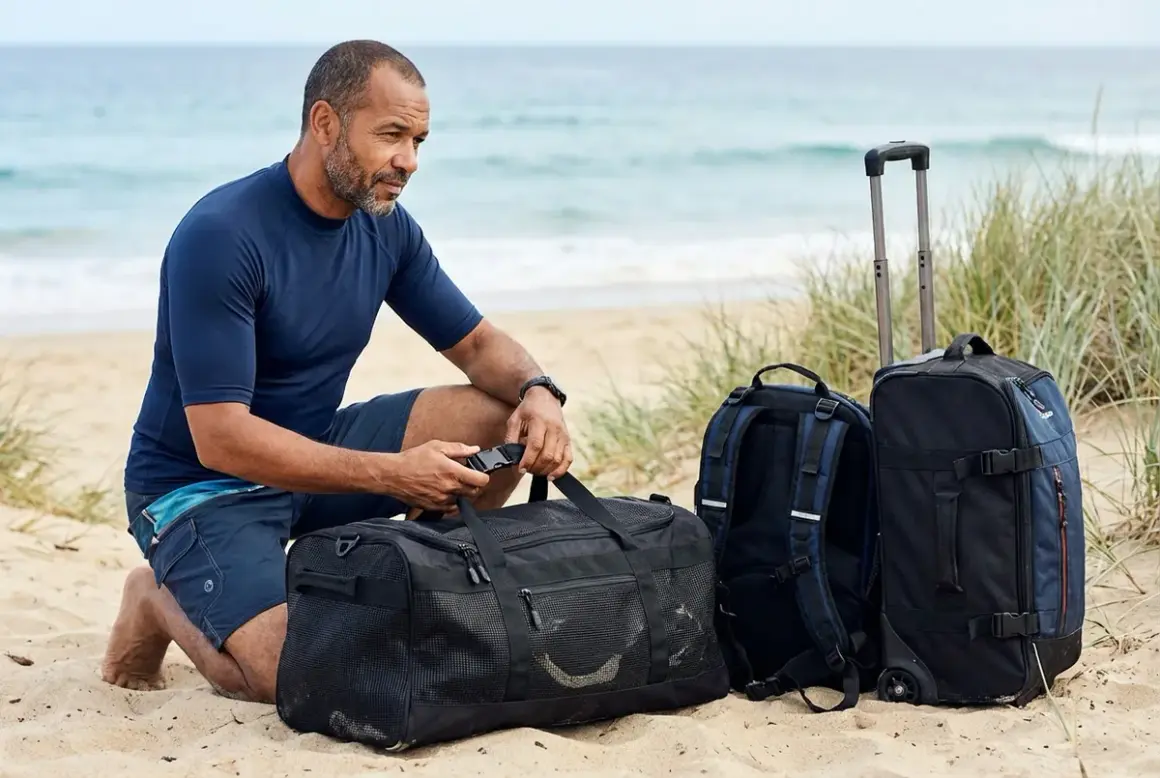

I've watched too many divers wrestle with garbage bags full of wet gear in parking lots, or worse, show up to a liveaboard with a suitcase that turns into mush after one day of saltwater exposure. Learning how to choose a dive bag properly will save you from soggy car interiors, damaged equipment, and the kind of frustration that makes you question your life choices at 5 AM before a boat dive. This guide walks you through the sizing calculations, material considerations, and feature priorities that actually matter when you're standing in front of a wall of bags wondering which one won't fall apart halfway through your trip.
Whether you're a newly certified diver buying your first bag or an instructor replacing your third destroyed roller bag in as many years, you'll learn to match bag capacity to your gear volume, identify materials that survive real saltwater abuse, and recognize which features are genuinely useful versus marketing fluff. Most divers can make a solid bag decision in about 30 minutes once they understand these fundamentals.
What You'll Need
- Complete inventory of your dive gear (laid out or listed with dimensions)
- Tape measure (to measure your longest items—fins, mostly)
- Scale (to weigh your full loadout if traveling by air)
- Knowledge of your typical dive scenarios (day trips, weeklong trips, fly-in travel)
- Understanding of your transportation method (walk to shore, car trunk, airline baggage)
- List of any specialty equipment (camera rigs, reels, stage bottles, drysuit)
Step 1: Calculate Your Actual Gear Volume
Here's what the manufacturer claims: their bag holds "a full set of dive gear." Here's what actually happens: you try to cram in your buoyancy compensator, regulator set, wetsuit, fins, mask, boots, computer, and accessories, and you're suddenly playing a very frustrating game of three-dimensional Tetris.
Start by laying out every piece of equipment you typically dive with. Include your BCD (inflated to see actual volume), regulator with all hoses attached, exposure suit, fins, boots, hood, gloves, mask, snorkel, dive computer, surface marker buoy, reel, knife, slate, spare mask, and whatever random accessories have accumulated in your save-a-dive kit.
Measure your longest rigid item—usually your fins, though some camera systems or reels can be longer. Add three inches to this measurement. That's your minimum internal length requirement. I learned this the hard way when I bought a beautiful roller bag that was exactly as long as my fins, which meant they only fit diagonally, which meant nothing else fit properly, which meant I returned it after one weekend trip.
For volume, use this rough calculation: a recreational diver with a standard jacket BCD, 3mm wetsuit, and full-foot fins needs about 120-140 liters. Add 20-30 liters for a 7mm wetsuit or semi-dry suit. Add another 15-20 liters if you dive a back-inflate BCD (they don't compress as efficiently). Cold water divers with drysuits, hoods, and heavy undergarments should start at 160-180 liters minimum.
If you shoot underwater photography, add 30-50 liters depending on your housing size and strobe configuration. Camera gear is bulky and rigid—it doesn't compress like neoprene does.
Step 2: Match Bag Style to Your Transportation Reality
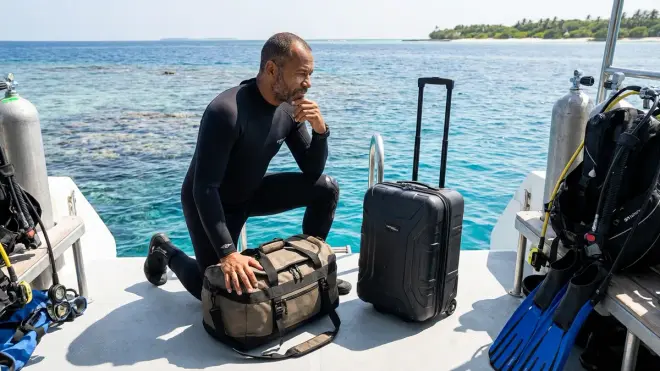
The dive industry loves to show images of divers walking down pristine docks with pristine roller bags. Let me tell you about the boat ramp in Monterey where the pavement ends fifty feet before the water, or the dive resort in Indonesia where you haul gear up three flights of stairs, or the shore entry in Bonaire where you're walking across jagged ironshore.
Roller bags work beautifully when you have continuous hard, flat surfaces from your car to the boat. They're fantastic for commercial dive operators moving gear around docks and dive centers. They fail spectacularly on gravel, sand, stairs, uneven terrain, and anywhere the wheels become a liability instead of an asset.
Backpack-style bags with padded shoulder straps and waist belts distribute weight across your body and work on any terrain. I've hauled mine up volcano trails in Hawaii, through airports across three continents, and down muddy boat ramps in the Pacific Northwest. The downside? Once you load 60-80 pounds of gear, you need reasonable back and shoulder strength to carry it more than short distances.
Mesh bags are purpose-built for gear that's already wet and needs to drain and dry. They're not your primary travel bag—they're what you use for day trips after you've already transported your gear to the destination. Check out our guide to mesh dive bags if this matches your use case.
Hybrid bags with both backpack straps and wheels sound perfect in theory. In practice, the wheel mechanisms often add 3-5 pounds to the empty bag weight, and the backpack straps on roller bags are usually afterthoughts—thin, unpadded, and miserable to actually use. I've seen exactly two models that did this well, and they both cost around $400. For a detailed comparison of different bag categories, see our complete guide to scuba diving gear bags.
Step 3: Evaluate Material Durability and Water Resistance
Marketing departments love phrases like "military-grade ballistic nylon" and "ultra-heavy-duty construction." Let me translate: most dive bags use 420-1200 denier nylon or polyester, with higher numbers indicating thicker, more abrasion-resistant fabric. But denier alone doesn't tell the whole story.
The coating matters more than the base fabric thickness. Look for polyurethane (PU) or polyvinyl chloride (PVC) coatings with actual thickness specifications. A 600D polyester with a heavy PU coating will outlast 1000D uncoated nylon in saltwater environments. The coating provides the water resistance and protects the fabric from UV degradation.
I've killed three dive bags in my career. The first failed when the bottom seam split after a year of being dragged across boat decks—the stitching was fine, but the fabric tore at the stress point. The second developed a zipper failure after repeated saltwater exposure without rinsing (entirely my fault). The third simply delaminated after two years of tropical sun exposure because it used cheap PVC that became brittle.
Fully waterproof bags (the kind that roll down and seal) protect gear from rain and splash during transport, but they trap moisture inside. Unless you're paddling a kayak to your dive site, you probably don't need this. Most divers benefit more from water-resistant materials that shed rain and splash but allow some air circulation for drying.
Bottom panel reinforcement is non-negotiable. Whether it's thick PVC, rubberized coating, or a separate rigid plate, your bag bottom will spend its life on boat decks, concrete, gravel, and whatever else. Reinforced corners are almost as important. When I evaluate a bag, I literally grab the bottom corners and pull—if they feel flimsy or the stitching looks light-duty, I move on.
Step 4: Assess Compartment Layout and Organization
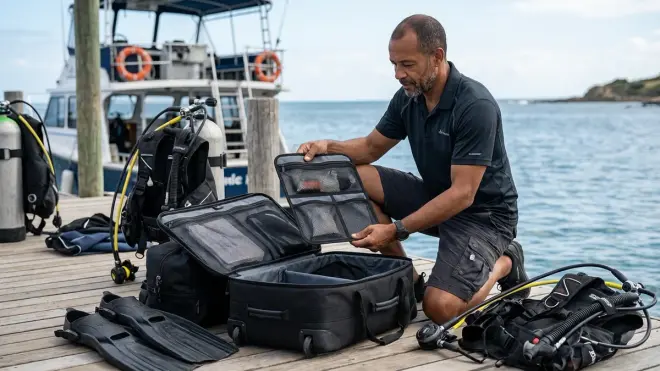
This is where personal diving style diverges wildly. I dive with photographers who need rigid camera compartments with foam inserts. I know technical divers who need specific pockets for stage regulators and backup computers. I dive with instructors who carry teaching slates, spare masks, and enough spare parts to rebuild a regulator underwater.
Start with these baseline requirements: at least one large main compartment that fits your BCD without excessive folding. Repeatedly creasing your bladder at sharp angles will eventually cause stress failures at the fold lines. A separate wet/dry compartment or pocket keeps your already-soaked wetsuit away from dry items like your logbook, certification cards, and the clothes you're wearing home. External mesh pockets for wet boots and gloves allow drainage and drying without contaminating the main compartment.
Internal compression straps seem like a small feature until you're trying to keep your gear from shifting during transport. I've opened bags to find my regulator first stage had punched through my mask box because everything shifted during a rough boat ride. Straps prevent that chaos.
Padded dividers matter if you're carrying computers, cameras, or anything with screens and electronics. But be honest about whether you'll actually use them. I've seen elaborate bags with full divider systems that users immediately removed because they reduced usable volume by 25%.
One specific callout: if you travel with your regulator in your dive bag (rather than carry-on), look for dedicated regulator pockets with soft lining or at least reinforced protection. First stages with exposed ports can damage other gear, and they're vulnerable to impact damage themselves. For more context on regulator configurations and what you're protecting, check out our complete guide to scuba regulators.
Step 5: Verify Strap and Handle Quality Under Load
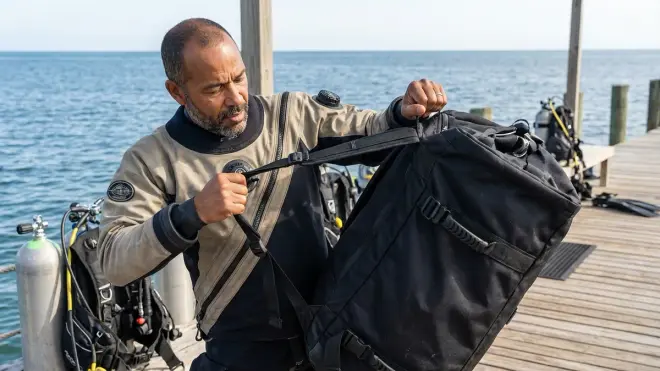
I once watched a diver's bag handle separate from the bag body as he lifted it onto a boat. Forty pounds of gear hit the dock, his mask shattered, and his dive computer took a hard impact that required factory service. The bag was three months old.
Grab the bag's handles and look at the attachment points. Are they sewn with bar-tacks (those small rectangular reinforcement stitches)? Is there backing material distributing the load? Or are they just sewn into a seam with light stitching?
Load the bag with your actual gear and lift it by each handle and strap. Do it multiple times. Listen for stitching sounds. Feel for flex or separation at attachment points. This sounds paranoid until you've seen a failure, and then it sounds like basic due diligence.
Padded shoulder straps should be at least 2 inches wide with 1/2 inch of closed-cell foam or equivalent. Webbing straps work fine for 30 pounds. For 60-80 pounds, you need actual padding. Sternum straps and waist belts aren't just comfort features—they transfer load from your shoulders to your hips and stabilize the bag. If you're considering a backpack-style bag, treat it like buying a hiking backpack: proper weight distribution isn't optional.
Zipper quality determines whether your bag lasts two years or ten. YKK brand zippers are the gold standard—if a manufacturer bothers mentioning them, it's usually a good sign. More important than brand is tooth size: look for #10 or larger coil zippers on main compartments. The numbers refer to the width in millimeters when closed. #8 or smaller zippers work fine for accessory pockets but will fail prematurely on heavily loaded main compartments.
Step 6: Consider Airline Weight Limits If Flying
The math is brutal: a typical recreational dive gear set weighs 50-65 pounds without the bag. Add a quality bag at 5-8 pounds, and you're already over most airline checked bag limits of 50 pounds. Factor in any underwater camera equipment, and you're well into overweight fees or multiple bag territory.
Weigh your complete packed bag before the airport. I learned this after paying $150 in overweight fees on a dive trip to Cozumel. Now I have a luggage scale permanently stored with my dive bags.
Consider wearing some gear on the plane: boots, your dive computer, and even your wetsuit (awkward, but I've done it). Pack dense, heavy items like weights and regulators in carry-on if airline policy allows. Some divers split gear across two checked bags to stay under per-bag limits. Others invest in ultralight travel BCDs and leave weights home to rent at the destination.
Bag weight matters significantly when traveling. A 9-pound roller bag versus a 4-pound backpack bag gives you 5 pounds more available for gear before hitting overweight charges. For divers who routinely fly to dive destinations, bag weight is a legitimate purchasing factor.
Measure your bag's external dimensions, not just the internal volume. Airlines enforce both weight and size limits. That beautiful 180-liter roller might exceed linear dimension limits (length + width + height) even if you're under weight.
Step 7: Evaluate Special Features Against Your Actual Needs
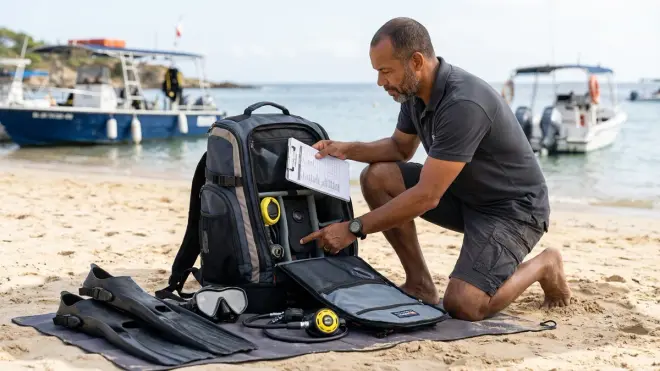
Every bag manufacturer tries to differentiate with unique features. Some are genuinely useful. Most are solutions to problems you don't have.
ID windows or pockets: Actually useful. Liveaboards and dive boats often have dozens of identical black bags. Having your name visible without digging through luggage tags saves time and confusion.
Removable regulator bags: Useful if you carry your reg as a carry-on (smart) but want the option to pack it in checked baggage occasionally. Useless if you always pack the same way.
Changing mat that folds into the bag: Sounds brilliant until you realize you're standing on a mat that's been on gas station bathrooms floors and boat decks for six months. I tried this feature once and never used it again.
Boot compartments with drainage: Genuinely excellent. Wet boots in a sealed compartment develop smells that could violate international chemical weapons conventions. Drainage grommets or mesh panels prevent biological warfare in your car trunk.
Lash points and D-rings on the exterior: Useful for securing extra items—fins that don't fit inside, a mesh bag, a gear drying line. I clip my surface marker buoy and reel externally because they're wet after every dive anyway.
TSA-approved locks: If you're flying in the US, these allow TSA to inspect your bag without destroying your lock. For international travel, check destination country requirements—some recommend not locking bags at all.
Padded bottom panels: Not the same as reinforced bottoms. These add cushioning to protect gear during transport, especially useful if you're checking the bag on flights where baggage handlers aren't gentle (which is most flights).
Pro Tips & Common Mistakes
Don't buy the smallest bag that technically fits your gear. I see this constantly with new divers trying to minimize bag size. You need breathing room to pack efficiently, space for accessories that accumulate over time, and volume for that rental drysuit when you take a cold-water trip. Going one size larger than your minimum calculated volume is almost always the right choice.
Rinse both the bag interior and exterior after saltwater exposure, not just your gear. Salt crystals accumulate in seams and zippers, accelerating corrosion and fabric breakdown. I hose down my bags after every dive trip and let them dry fully open in a garage or covered patio. The five minutes this takes has extended my current bag's life to seven years and counting.
Don't store gear in your bag long-term. Bags trap moisture, and neoprene and rubber seals stored in humid environments deteriorate faster. Use your bag for transport, then remove and properly store your equipment. Your BCD bladder and regulator will thank you.
Test the bag with your gear before any major trip. The week before a liveaboard is not the time to discover your fins don't actually fit, or that your camera housing is too tall for the compartment, or that the shoulder straps dig into your collarbones under load.
Common mistake: assuming "dive bag" means "waterproof bag." Most dive bags are water-resistant, not waterproof. They'll handle rain and splash, but they won't protect electronics if the bag ends up submerged. Keep sensitive items in dry bags or waterproof cases inside your dive bag. I learned this when my gear bag rolled into a flooded boat bilge. The bag manufacturers claim water-resistance, and they're right, but water-resistance isn't the same as submersible.
Don't cheap out on a bag expecting to upgrade later. A quality dive bag costs around $150-300 and lasts 5-10 years with proper care. A cheap bag costs around $50 and fails within 18 months, usually at the worst possible time—like the morning of a trip. Your dive gear represents thousands of dollars in equipment. Protecting it with a bag that costs 5% of your total gear investment is reasonable.
Frequently Asked Questions
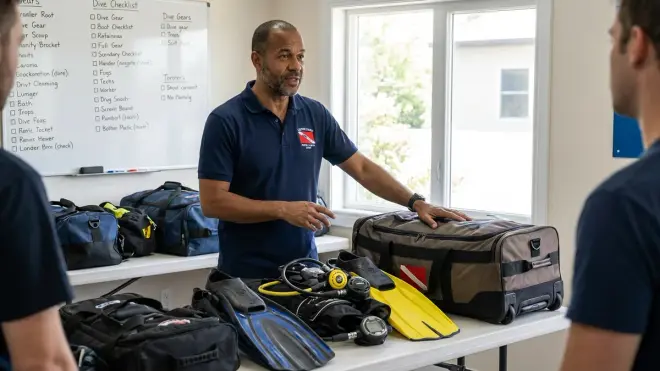
How large of a dive bag do I need for recreational diving?
For recreational diving with a standard BCD, 3-5mm wetsuit, and accessories, you need a dive bag with 120-140 liters of capacity. If you dive with a 7mm wetsuit, back-inflate BCD, or bulky cold-water gear, increase that to 160-180 liters. Measure your fins and ensure the bag's internal length is at least three inches longer than your longest fin to allow proper packing. The most common mistake is buying too small—gear needs space to pack efficiently, and you'll accumulate accessories over time.
What material should a dive bag be made from?
The best dive bags use 600-1200 denier polyester or nylon with polyurethane or PVC coating for water resistance and UV protection. The coating matters more than fabric thickness alone—a coated 600D fabric will outlast uncoated 1000D material in saltwater environments. Look for reinforced bottom panels (thick PVC or rubberized coating) and bar-tack stitching at stress points like handles and straps. YKK #10 or larger coil zippers on main compartments resist saltwater corrosion and handle repeated heavy use.
Should I get a roller bag or backpack-style dive bag?
Choose a roller dive bag if you travel primarily on paved surfaces from car to boat dock or between airports and hotels. Roller bags excel with 60-80 pound loads on smooth, flat terrain. Choose a backpack-style bag if you encounter stairs, gravel, sand, unpaved boat ramps, or need to walk significant distances. Backpack bags work on any terrain but require reasonable back strength for heavy loads. Hybrid bags with both wheels and backpack straps typically compromise on both functions unless you spend around $400 on higher-end models.
Can I use a regular duffel bag for dive gear?
Standard duffel bags lack the reinforced bottoms, water-resistant coatings, drainage features, and heavy-duty zippers that protect dive gear from saltwater damage and rough handling. Regular duffels also lack organization features like wet/dry compartments and dedicated regulator protection. While a duffel might work for occasional tropical diving with minimal gear, it won't survive repeated saltwater exposure or the weight of full cold-water setups, and it provides no protection for sensitive equipment like dive computers or regulators.
Summary
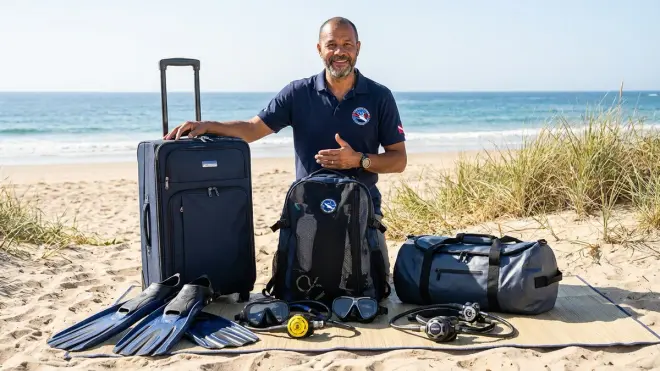
Learning how to choose a dive bag comes down to honestly assessing your gear volume, matching bag style to your transportation reality, and prioritizing material durability over marketing features. Calculate your actual capacity needs by laying out your complete gear set—most recreational divers need 120-180 liters depending on exposure suit thickness and specialty equipment. Choose roller bags for paved surfaces and vehicle-to-dock transport, backpack styles for varied terrain and shore diving, and verify material coatings and reinforced construction that survive saltwater exposure. For our complete gear organization strategy, see our dive gear bag packing checklist.
Check strap attachment points under load, confirm your longest items fit with room to spare, and buy quality zippers and reinforced bottom panels that last beyond one season. The right bag disappears into the background—you won't think about it because it works. The wrong bag announces itself constantly through failures, frustrations, and that sinking feeling when you realize your gear is damaged because you bought based on price instead of actual construction quality.