
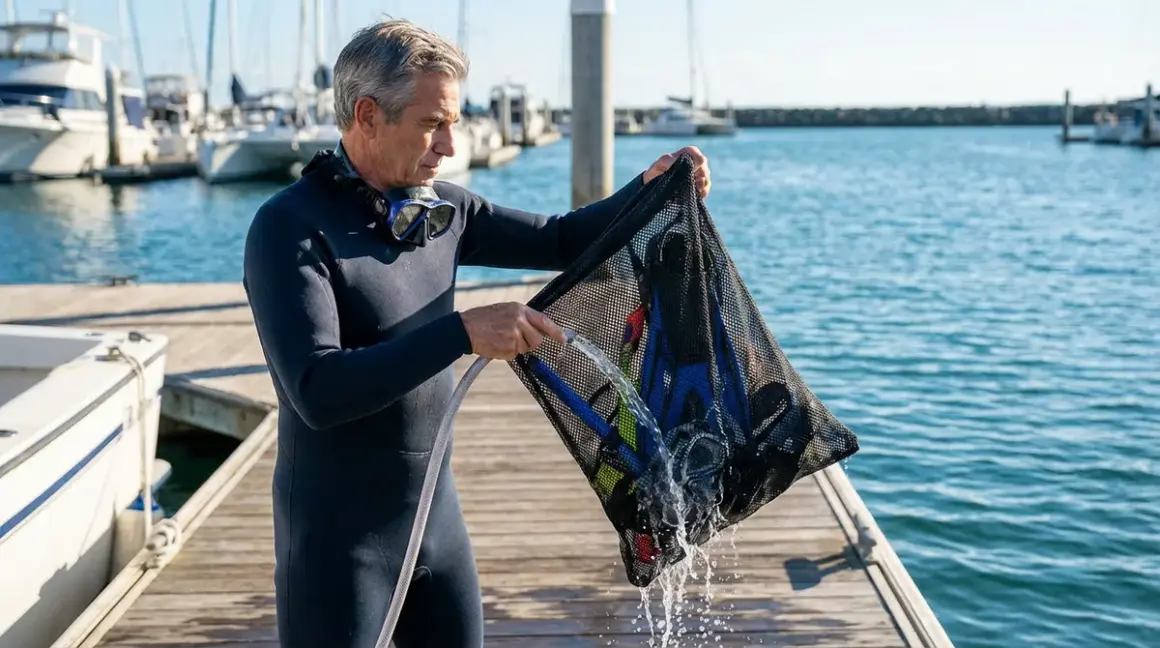

I've hauled wet gear off boats in every corner of Florida for forty years, and I can tell you the fastest way to ruin your day after a perfect dive is wrestling with a soaked, heavy bag that refuses to drain. A proper mesh dive bag isn't glamorous, but it's the workhorse that keeps your gear organized, your car dry, and your wetsuit from turning into a science experiment. After field-testing dozens of these bags across everything from week-long liveaboard trips to daily shore dives, I've learned exactly what separates the bags that last a decade from the ones that fall apart in six months.
Here's the thing: most divers grab whatever mesh bag looks cheap at the dive shop, then replace it every season when the zipper fails or the bottom seams give out. That's throwing money away. The right mesh dive bag will outlive most of your other gear if you know what construction details actually matter.

What to Look For in a Mesh Dive Bag
Material Construction and Mesh Gauge
The mesh fabric itself determines whether your bag drains in minutes or stays waterlogged for hours. I've seen everything from fine nylon mesh that clogs with sand to heavy-duty polyester with openings large enough to lose fin straps through.
Heavy-duty polyester mesh in the 400-600 denier range hits the sweet spot—thick enough to resist abrasion from tank valves and weight pockets, but with openings large enough for proper water flow. Anything lighter than 300 denier won't survive repeated contact with metal gear. I tell people to look for reinforced mesh at high-stress points: the bottom panel, where your tank sits, and the side panels that take impact when you drop the bag on a dive deck.
The weave pattern matters more than most manufacturers admit. Hexagonal mesh distributes load better than simple square weaves, especially when you're hauling 40-50 pounds of wet gear up a boat ladder. I've watched cheap square-weave bags develop permanent stretch marks after a single dive season.
Coated vs. uncoated mesh is a real consideration. PVC-coated polyester resists UV degradation better in tropical sun, but adds weight and can trap moisture if the coating starts to delaminate. I prefer uncoated heavy-gauge mesh for Florida conditions—it dries faster and doesn't develop that mildewy smell that coated bags get after a few years.
Strap Design and Load Distribution
This is where I see the most design failures. A mesh dive bag loaded with wet gear can hit 60-70 pounds easily. Thin webbing straps cutting into your shoulders after a long dive day isn't just uncomfortable—it's dangerous when you're tired and trying to navigate a rocking boat.
Look for shoulder straps at least 2 inches wide with padding that doesn't absorb water. Closed-cell foam padding works; open-cell foam turns into a soggy sponge. I've had good experiences with EVA foam padding and rubberized padding materials that shed water.
The attachment points where straps connect to the bag body fail more often than the straps themselves. Box-stitched reinforcement with bartack stitching at stress points is non-negotiable. I've seen bags with straps literally rip off the body after a dozen uses because some manufacturer saved three cents by skipping proper reinforcement stitching.
Adjustable vs. fixed-length straps is personal preference, but I lean toward adjustable. Being able to shorten straps for a backpack carry or lengthen them for shoulder-sling carry makes a difference when you're hauling gear across a marina parking lot.
Drainage Performance and Drying Speed
The whole point of a mesh dive bag is quick drainage, but not all mesh drains equally. I've tested this obsessively—weighing bags before and after submersion, timing drainage rates, tracking how long gear stays wet inside different bag designs.
Bottom panel construction determines drainage speed more than side mesh. Bags with a solid vinyl or rubber bottom panel drain slower than full-mesh bottoms, but they protect gear better on rough surfaces. It's a trade-off. For boat diving where you're setting your bag on fiberglass decks, I prefer full mesh. For shore diving over rocks and coral rubble, a small reinforced bottom panel (6-8 inches) makes sense.
The internal organization also affects drying. Bags with internal dividers or pockets can trap water if those features aren't also mesh. I've seen bags with solid nylon pockets that stay wet for days. If a bag has organization features, they need to be mesh too—or you need to accept longer drying times.
Capacity and Gear Organization
Mesh dive bags run from 40-liter models for minimalist tropical divers to 150-liter monsters that swallow everything including your drysuit. I tell people to calculate based on actual gear volume, not wishful thinking.
A full recreational rig—BCD, regulator, wetsuit, fins, mask, boots, accessories—fills about 80-100 liters when loosely packed. Cold water gear with a 7mm wetsuit, hood, and gloves pushes that to 120+ liters. Don't buy a bag that forces you to compress everything tight; wet neoprene needs air circulation to dry.
Internal organization divides opinion. Some divers want dedicated compartments for everything. I'm skeptical of over-organization in a mesh bag—too many internal dividers add weight, cost, and failure points. A single large main compartment with one or two external pockets for small items makes more sense. If you need serious organization, that's what a structured dive gear bag is for.
Hardware and Closure Systems
Zippers on mesh bags fail constantly because people try to use lightweight plastic coil zippers on heavy-duty applications. Marine-grade #10 zippers with rustproof teeth (plastic or coated metal) are the minimum. I've had good experiences with YKK and similar quality brands. No-name zippers from budget bags corrode in saltwater within months.
Here's my honest take: I prefer drawstring closures over zippers for the main compartment. Drawstrings don't corrode, don't jam with sand, and don't fail catastrophically at 6 AM before a dive charter. A good reinforced drawstring with a cord lock is bulletproof. Save zippers for external accessory pockets where they're useful for keeping small items contained.
Buckles and clips need to be non-corrosive. Delrin plastic buckles or anodized aluminum work; uncoated steel or cheap pot metal corrodes. I've seen cheap side-release buckles fail after a single saltwater exposure.
Our Top Picks
Phantom Aquatics Mesh Backpack Gear Bag
The Phantom Aquatics Mesh Backpack Gear Bag🛒 Amazon has been my go-to recommendation for recreational divers for the past several years, and it's still earning that spot in 2026. The 420-denier polyester mesh strikes the right balance between durability and drainage, and the reinforced bottom panel has held up through hundreds of cycles of being dropped on boat decks, concrete piers, and rocky shore entry points.
The shoulder straps are properly padded with 2.5-inch wide webbing and closed-cell foam that actually stays dry. I've loaded this bag with a full cold-water rig including a 7mm wetsuit, BCD, and regulator setup, and the straps distribute weight well enough for reasonable carries. It's not a hiking backpack, but it does the job.
Pros:
- Heavy-duty mesh withstands repeated contact with tank valves and metal hardware
- Reinforced bottom panel protects gear on rough surfaces without compromising drainage
- Wide padded straps with proper load distribution for heavy wet gear
- Large main compartment (110 liters) handles full recreational cold-water rigs
- External zippered pocket with quality YKK zipper for accessories and small items
- Priced reasonably for the construction quality you're getting
Cons:
- The drawstring closure on the main compartment can be fiddly with cold or wet hands
- Bottom panel reinforcement adds about 8 ounces compared to full-mesh alternatives
- No internal organization beyond the single external pocket
Stahlsac Bonaire Mesh Backpack
The Stahlsac Bonaire Mesh Backpack🛒 Amazon has been making dive gear since before most of my students were born, and the Bonaire shows that experience. This is a full-mesh design with no solid bottom panel—every surface drains. I've timed this bag: it drops 90% of water weight within two minutes of lifting it out of a rinse tank.
The hexagonal mesh weave is noticeably more abrasion-resistant than cheaper square-weave alternatives. I've dragged this bag across coral rubble during shore dives in the Keys, and the mesh hasn't developed the stretched-out weak spots I see in lesser bags.
The main compartment uses a heavy-duty drawstring rather than a zipper, which I appreciate. Two external mesh pockets give you options for separating wet booties or organizing smaller items. At 120 liters, this bag swallows everything including my drysuit when I'm diving in the winter months.
Pros:
- Full-mesh construction provides fastest drainage I've tested
- Hexagonal weave pattern distributes load and resists stretching
- Generous 120-liter capacity handles full cold-water gear loads
- Two external mesh pockets for organization without compromising drainage
- Reinforced bartack stitching at all strap attachment points
- Lightweight at just over one pound when dry
Cons:
- No bottom panel protection means you'll feel every rock and edge through the bag
- The completely open mesh makes it easy to lose small items if you're not careful
- External pockets are unzippered mesh, so items can fall out during transport
Promate Scuba Diving Mesh Duffel Bag
The Promate Scuba Diving Mesh Duffel Bag🛒 Amazon converts between backpack and shoulder carry, which makes it useful for dive travel when you're moving through airports and then heading to the dock. The 600-denier reinforced mesh is legitimately tough—I've watched this bag take abuse that would have destroyed lighter options.
The hybrid bottom design combines mesh drainage with a reinforced perimeter that protects gear from point impacts. It's heavier than pure mesh designs, but that's the trade-off for versatility. The U-shaped zipper opening gives you better access to packed gear than top-loading backpack styles.
I've used this bag on liveaboards where I needed something that could sit on a wet deck for a week straight without developing issues. The marine-grade #10 zipper is the real deal—corrosion-resistant and smooth operation even after saltwater exposure.
Pros:
- Convertible backpack/duffel design adapts to different carry scenarios
- Heavy 600-denier mesh handles serious abrasion and repeated impacts
- Large U-shaped zipper provides wide access to packed gear
- Hybrid bottom combines drainage with impact protection
- Reinforced carry handles complement the backpack straps
- 100-liter capacity fits full recreational tropical and temperate gear
Cons:
- Heavier than pure backpack designs due to dual carrying system and reinforced construction
- The U-shaped zipper, while convenient, adds a failure point that drawstring bags don't have
- At 1.8 pounds dry weight, it's not the choice for weight-conscious travelers
Innovative Scuba Concepts Heavy Duty Mesh Bag
The Innovative Scuba Concepts Heavy Duty Mesh Bag🛒 Amazon is the budget pick that doesn't sacrifice the fundamentals. ISC makes no-frills gear that works, and this mesh bag delivers exactly what you need without charging for features you don't. The 400-denier mesh is adequate for recreational use, and the basic construction is solid enough to last several seasons if you're not abusing it daily.
The simple backpack design with basic webbing straps and a drawstring closure means there's less to fail. I've seen these bags survive years of weekend diving in Florida waters. They're not as refined as the premium options, but they drain well and hold your gear.
At 90 liters, this is sized right for tropical diving and lighter gear loads. If you're diving warm water with a 3mm suit and a lightweight travel BCD, this bag handles it fine. Push it beyond that, and you'll notice the thinner straps and less robust construction.
Pros:
- Straightforward design with fewer components to fail
- Adequate 400-denier mesh for recreational diving frequency
- Lightweight at under one pound dry
- Budget-friendly price point for divers who don't need premium features
- Proper drainage performance for the price range
- Compact 90-liter size packs easily for travel
Cons:
- Thin shoulder straps become uncomfortable with heavy or cold-water gear loads
- No bottom panel reinforcement means vulnerable to punctures on rough surfaces
- Basic stitching at stress points won't hold up to daily professional use
Mares Cruise Mesh Backpack Deluxe
The Mares Cruise Mesh Backpack Deluxe🛒 Amazon was built for serious divers who need professional-grade durability. The mesh is noticeably heavier gauge than recreational alternatives, and the reinforcement at stress points is extensive—not just at strap attachments, but around the entire perimeter of the bag opening.
The standout feature is the removable rigid bottom panel. Pull it out for maximum drainage and minimal weight, or leave it in for gear protection on rough surfaces. That flexibility makes this bag useful across a wider range of dive scenarios than single-purpose designs.
I appreciate the attention to organization without compromising the mesh concept. Multiple external pockets are all mesh construction, so they drain as fast as the main compartment. The main opening uses both a zipper and a drawstring—you can cinch it closed quickly with the drawstring for basic security, or fully zip it when you need weather protection during transport.
Pros:
- Professional-grade mesh construction handles daily commercial use
- Removable bottom panel provides flexibility for different dive scenarios
- Multiple mesh external pockets maintain drainage while adding organization
- Dual closure system (zipper and drawstring) offers options
- Wide padded straps with load-lifter adjustment points
- 135-liter capacity handles full technical or cold-water configurations
Cons:
- Premium construction comes with premium pricing that recreational divers may not need
- Heavier than simpler designs even with bottom panel removed
- The dual closure system, while versatile, adds complexity that some divers won't use
XS Scuba Large Mesh Duffel
The XS Scuba Large Mesh Duffel🛒 Amazon is the no-nonsense workhorse for dive professionals and instructors who cycle through multiple dives daily. XS Scuba built this for durability over features—heavy mesh, minimal zippers, maximum drainage. I've watched instructors abuse these bags for entire seasons without significant wear.
The pure duffel design with dual handles and a removable shoulder strap gives you carrying options without the weight and complexity of a backpack system. The wide-mouth opening with a simple drawstring closure means you can throw gear in quickly between dives without fighting zippers or buckles.
At 140 liters, this is sized for volume. I've fit two complete recreational rigs in this bag when running training courses with spare equipment. The mesh is thick enough that I don't worry about fin edges or tank valves tearing through.
Pros:
- Bombproof construction designed for daily professional abuse
- Minimal closure hardware reduces failure points
- Massive 140-liter capacity handles multiple gear sets or bulky equipment
- Pure mesh design provides fastest possible drainage and drying
- Dual carrying handles plus removable shoulder strap offer flexibility
- Reinforced bottom corners prevent wear-through on high-contact points
Cons:
- Duffel design without backpack straps is less comfortable for long carries
- The wide-mouth opening, while convenient, provides less security during transport
- Large capacity can tempt you to overload the bag beyond comfortable carrying weight
Frequently Asked Questions
How do I clean and maintain a mesh dive bag?
Rinse your mesh dive bag thoroughly with fresh water after every saltwater dive—this isn't optional. I hang mine upside down on a deck hook or tree branch to let gravity help drainage, then leave it in a shaded area with good airflow. Never stuff a wet mesh bag into a confined space or car trunk; that's how you develop mildew and that distinctive "forgot my gear in the bag for a week" smell.
Every few months, I run my mesh bags through a proper cleaning cycle: soak in warm fresh water with a mild detergent (I use regular unscented laundry detergent, nothing fancy), scrub any stubborn spots with a soft brush, rinse thoroughly, and hang dry. Pay attention to the strap attachment points and any reinforced areas where salt and grit accumulate. If you're diving in particularly murky or polluted water, clean after each trip rather than waiting months. The mesh construction makes cleaning easy—you can literally see when the bag is clean because dirty water stops running out. Store dry bags in a cool, dry location away from direct sunlight; UV degradation is real even on heavy-duty mesh.
Can I use a mesh dive bag as carry-on luggage for air travel?
Technically yes, but practically it's complicated. Most mesh dive bags, even smaller 90-liter models, exceed standard carry-on dimension limits when loaded with gear. I've had mixed experiences with airlines—some gate agents don't care if your soft mesh bag compresses to fit the sizing bin, others are sticklers for policy.
More importantly, mesh bags offer zero security for checked or carry-on luggage. Anyone can see exactly what's inside, and small items can fall through the mesh openings during baggage handling. I've heard too many stories about regulators, dive computers, and camera equipment disappearing from mesh bags during air travel.
My honest advice: use a proper scuba travel bag with solid construction and locking zippers for flights, then pack a collapsible mesh bag inside for use at your destination. That gives you security during transit and proper drainage for daily diving. If you're absolutely committed to carrying everything onto the plane, choose the smallest mesh bag that fits your core gear and prepare to potentially gate-check it. Keep your regulator, dive computer, and other expensive items in a smaller personal item bag that definitely fits under the seat.
What size mesh dive bag do I need for a full set of scuba gear?
Here's what actually fits: a basic tropical recreational setup—3mm wetsuit, jacket-style BCD, regulator with octopus and gauges, fins, mask, snorkel, boots—occupies roughly 75-85 liters when loosely packed. Add a 5mm wetsuit, hood, and gloves, and you're pushing 95-100 liters. Full cold-water gear with a 7mm wetsuit or drysuit, undergarments, and heavier accessories needs 120+ liters.
I tell people to add 20-30% capacity beyond your calculated minimum. Wet neoprene expands slightly, and gear needs airflow to dry properly—cramming everything tight into an undersized bag defeats the drainage purpose. A 100-liter bag handles tropical diving comfortably, a 120-liter bag covers most temperate and cold-water scenarios, and 140+ liter bags are for professionals carrying spare equipment or technical divers with redundant systems.
One consideration most people miss: larger bags become difficult to manage when fully loaded with wet gear. A 140-liter bag filled with wet cold-water equipment can hit 70-80 pounds. Make sure you can actually lift and carry whatever size you're considering. I've seen divers buy massive bags they can barely move when loaded. If you're traveling to dive operations with good rinse facilities and daily gear storage, a smaller bag that you can actually carry comfortably makes more sense than maximum capacity you'll struggle with.
How long does a mesh dive bag typically last?
That depends entirely on usage frequency and how you treat it. I've seen quality mesh bags from Stahlsac, Mares, and similar manufacturers last 8-10 years of weekend recreational diving—that's 50-100 dive days per year with proper rinsing and care. Push that to daily professional use on a dive boat, and even premium bags show significant wear after 2-3 years. The mesh fabric itself is usually fine; failures happen at stress points: strap attachments, zipper teeth, and bottom panel seams.
Budget mesh bags in the around $20–$30 range typically survive 1-2 seasons of regular use before developing problems. I've watched cheap bags lose stitching at strap attachment points, develop holes in high-wear areas, and have zippers fail within months. That's not universal—I've seen some budget bags last surprisingly long with light use—but it's common enough that I consider them semi-disposable.
The real longevity factor is rinse discipline. A mesh bag that's properly rinsed after every saltwater exposure and dried thoroughly between uses will outlast one that's stuffed wet into a garage corner by a factor of three or more. Saltwater crystallization breaks down stitching and degrades mesh fibers over time. UV exposure accelerates deterioration. If you're storing your bag outdoors in Florida sun like I see some divers do, expect half the service life of properly stored bags. Treat a quality mesh bag right, and it'll be the last piece of gear you need to replace—ignore basic care, and you'll be shopping for replacements every season regardless of what you spend initially.
Do mesh bags protect gear from damage during transport?
Not really, and that's not what they're designed for. Mesh bags excel at drainage and organization, but they offer minimal impact protection compared to hard-sided cases or padded gear bags. The mesh fabric itself provides essentially zero padding—if you drop a mesh bag loaded with regulators and dive computers onto concrete, you're trusting the gear's own durability, not the bag.
I've seen first stages get dinged, lens on dive masks crack, and computer screens scratched because people assumed a mesh bag provided protection it doesn't. If you're transporting expensive or fragile equipment—regulators, cameras, electronics—wrap sensitive items in a wetsuit or towel inside the mesh bag, or use dedicated protective cases. Some divers use a mesh bag inside a larger padded roller bag for travel; that combines drainage benefits with actual protection.
Where mesh bags do help is preventing scratching and abrasion during normal use. The mesh keeps your fins from directly rubbing against your mask, your weight pockets from gouging your BCD, that kind of thing. It's organization protection, not impact protection. For boat diving where you're moving gear around a deck, mesh bags work fine—the risks are saltwater exposure and UV damage, not hard impacts. For shore diving over rocks, loading gear into vehicles, or any scenario involving repeated drops or rough handling, understand that you're relying on your gear's construction, not the bag. If you're hauling delicate items, especially camera housings or strobes, use appropriate protective cases and treat the mesh bag as a secondary container.
The Verdict
A mesh dive bag is unglamorous gear that makes every dive day better when you get it right. After testing dozens of options across four decades of Florida diving, my top recommendation for most recreational divers is the Stahlsac Bonaire for its drainage performance and proven durability, or the Phantom Aquatics if you want a balance of features and value. Professional divers and instructors should look at the XS Scuba Large Mesh Duffel for bombproof construction that survives daily abuse.
Don't overthink this. Buy a bag with proper mesh weight (400+ denier), reinforced stitching at stress points, comfortable straps, and a capacity that fits your actual gear with room for airflow. Rinse it after every dive, let it dry completely, and it'll serve you reliably for years. Skip the gimmicks, avoid bottom-tier construction, and invest in one quality bag rather than replacing cheap ones every season.