


I've been pulled through some of the most demanding dive sites on the planet—wreck penetrations in the Great Lakes, drift dives where current hits 3+ knots, and deep reef surveys where bottom time matters more than air supply. The best underwater scooter transforms your diving from a slow drift to a purposeful exploration, but choosing the wrong one means dead batteries mid-dive, trim issues that wreck your buoyancy, or a bulky anchor that airlines won't touch. I've tested dozens of dive propulsion vehicles (DPVs) across six continents and multiple use cases, and here's what actually matters when you're 80 feet down with current pushing you sideways.
Quick verdict: The Yamaha 350Li dominates technical and expedition diving with its 350Wh lithium battery and 90-minute runtime at cruise speed, while the TUSA SAV-7 offers the best travel-friendly package for recreational divers who need airline-compliant battery capacity and sub-10-pound dry weight.
What to Look For in the Best Underwater Scooter
Battery Chemistry and Runtime Under Load
Lithium-ion batteries deliver consistent power output across the discharge curve, while lead-acid batteries (still common in budget scooters) suffer voltage sag that reduces thrust by 30-40% in the final third of runtime. I've watched dive plans fall apart when a lead-acid scooter that promised 60 minutes barely managed 35 before crawling back at half speed.
Runtime specs are measured at cruise speed in calm water—add current, increase speed to max, or dive below 60 feet where water density increases drag, and your actual runtime drops significantly. A scooter rated for 90 minutes at cruise might give you 45-50 minutes at full throttle fighting current. Look for models that specify runtime at multiple power settings and provide actual watt-hour capacity (Wh), not just vague "60-minute" claims.
For liveaboard diving where you're doing 3-4 dives daily, consider whether the scooter can recharge between dives. Lithium batteries typically recharge in 3-4 hours; lead-acid needs 8-12 hours. I've been on week-long expeditions where the guy with the lead-acid scooter could only use it every other day.
Weight Distribution and Trim Characteristics
A poorly balanced scooter fights your buoyancy constantly. Negative buoyancy in saltwater means you're adding air to your BCD throughout the dive to compensate, burning through gas and wrecking your trim. Positive buoyancy means it's pulling upward, which is manageable at depth but becomes a wrestling match during safety stops.
The best scooters are slightly negative (0.5-2 pounds in saltwater) and balanced so the center of buoyancy aligns with the center of mass—meaning when you're not holding it, it hangs level rather than nose-up or tail-down. I've used scooters that point straight at the surface unless you're actively fighting them. After 40 minutes, your forearms are screaming.
Dry weight matters for travel, but so does size. A 22-pound scooter that's compact fits in a scuba gear bag and doesn't eat your entire baggage allowance; a 28-pound scooter that's bulky and awkward becomes a logistical nightmare through airports. For remote liveaboards, factor in whether you can comfortably carry it from dock to dive deck three times a day.
Propulsion Power and Speed Control
Thrust specifications are often marketing fluff. What matters is sustained thrust at depth, not burst power in a manufacturer's test tank. Water density increases with depth, and a scooter that feels snappy at 30 feet might feel sluggish at 100 feet. Look for models tested at depth with real thrust data, not just surface performance.
Variable speed control is essential. Single-speed scooters force you to either go fast or stop—there's no gentle cruise for photography or survey work. Multi-speed triggers or variable-speed throttles let you match your pace to the task. I've done photogrammetry surveys where I needed 30 feet per minute for an hour straight; a single-speed scooter would've been useless.
Motor type affects noise and efficiency. Brushless DC motors are quieter, more efficient, and require less maintenance than brushed motors. If you're diving with marine life that spooks easily, motor noise matters. I've had reef sharks bolt from brushed-motor scooters but barely react to brushless models.
Depth Rating and Seal Reliability
Most recreational scooters are rated to 130-160 feet, which covers the vast majority of sport diving. Technical models push to 200+ feet. Here's what the manufacturer won't tell you: the depth rating isn't the failure point—it's the depth where they guarantee seal integrity after repeated cycles.
Every dive compresses and decompresses the o-rings and seals. Take a scooter rated to 130 feet down to 125 feet repeatedly, and you're stressing components near their design limit. I've seen seals fail at 80 feet on scooters rated to 150 feet simply because they'd been used hard for a season without maintenance.
Check the o-ring configuration: dual o-rings with grease reservoirs are more reliable than single o-rings. Magnetic coupling systems (where the motor shaft never penetrates the pressure housing) eliminate a major leak point but add cost. If you're planning deep dives or cold water work, factor in a maintenance schedule—most scooters need annual seal inspection and o-ring replacement regardless of dive count. I cover the full maintenance requirements here.
Battery Airline Compliance and Travel Logistics
Lithium batteries above 160Wh are banned on commercial flights under IATA regulations. Most travel-friendly scooters use 99Wh or 150Wh batteries to stay under limits, but that directly impacts runtime. A 99Wh scooter might give you 40-50 minutes; a 350Wh technical scooter gives you 90+ minutes but can't fly.
Some manufacturers offer swappable batteries so you can fly with compliant batteries and rent high-capacity packs at the destination. That's ideal if you're diving remote locations with rental support—not so useful in the Maldives where no one stocks your battery model. For true expedition diving where gear failure means mission failure, I still prefer high-capacity models and ship them as freight ahead of time or dive locally where I can drive my gear to the site.
Lead-acid batteries are generally allowed on aircraft but add significant weight. If you're choosing lead-acid to avoid lithium restrictions, verify with your specific carrier—some airlines restrict all scooter batteries regardless of chemistry.
Our Top Picks
Yamaha 350Li: Best for Technical and Expedition Diving
The Yamaha 350Li Underwater Scooter🛒 Amazon is the workhorse of technical diving, built around a 350Wh lithium-ion battery that delivers 90 minutes of runtime at cruise speed (75 feet per minute) and 60 minutes at full speed (130 feet per minute). I've used this scooter on deep wreck penetrations in the Great Lakes where cold water (39°F) saps battery performance, and it still delivered within 10% of rated runtime.
Specs: 28 pounds dry weight, 2 pounds negative in saltwater, rated to 130 feet, brushless DC motor with magnetic coupling (zero penetrations through the pressure housing). Six-speed trigger control with proportional throttle response. Recharge time is 4 hours with the included charger.
The magnetic coupling eliminates the motor shaft seal—the most common failure point on scooters. After two seasons of hard use (150+ dives including multiple 3-hour drift dives), I've had zero seal issues and zero motor problems. The 350Wh battery is not airline-compliant, so this is a drive-to-the-site or ship-ahead scooter.
Pros:
- 90-minute runtime at cruise speed outlasts most recreational dive profiles
- Magnetic coupling eliminates shaft seal leaks
- Six-speed control handles everything from survey work to current fighting
- Maintains thrust output below 100 feet better than any scooter I've tested
- Brushless motor is nearly silent—marine life doesn't spook
Cons:
- 28-pound weight and 350Wh battery make airline travel impossible without freight shipping
- Premium price point (usually around $3,200) puts it out of reach for casual divers
- Battery replacement costs around $600-700 when it eventually degrades after 400-500 charge cycles
TUSA SAV-7: Best Travel-Friendly Recreational Scooter
The TUSA SAV-7 Underwater Scooter🛒 Amazon strikes the best balance between performance and portability with a 150Wh lithium battery (just under the 160Wh airline limit) and 9.5-pound dry weight. I've flown with this scooter on a dozen liveaboard trips, and it's never been questioned by airlines or customs.
Specs: 9.5 pounds dry weight, 1.5 pounds negative in saltwater, rated to 130 feet, brushless motor with single o-ring seal. Three-speed control (slow, medium, fast). Runtime is 50 minutes at slow speed (50 feet per minute), 35 minutes at medium (75 fpm), 25 minutes at fast (100 fpm). Recharge time is 3 hours.
The three-speed control is less refined than the Yamaha's proportional throttle, but for recreational diving it's perfectly adequate. I've used this scooter for reef surveys, drift diving, and wreck exploration. The 150Wh battery trades runtime for travel convenience—50 minutes is enough for most single-tank dives, but if you're planning long multi-tank profiles, you'll want a spare battery (sold separately, around $400).
Pros:
- 9.5-pound weight and 150Wh battery are airline-compliant on all major carriers
- Compact size fits in standard dive gear bags
- 50-minute runtime covers most recreational dive profiles
- Brushless motor is quiet and efficient
- Three-year manufacturer warranty on motor and electronics
Cons:
- Single o-ring seal design requires more frequent maintenance (annual service recommended)
- Medium and fast speeds drain the battery quickly—plan for 25-35 minute realistic runtime if you're not constantly at slow speed
- The trigger safety lock is awkward to disengage with thick gloves
Suex XJ37: Best for Cold Water and Technical Diving
The Suex XJ37 Underwater Scooter🛒 Amazon is built for extreme conditions—ice diving, deep wrecks, cave penetration. I've taken this scooter under Great Lakes ice at 35°F and into deep wrecks at 180 feet. It's rated to 330 feet (far beyond recreational limits) and uses dual o-ring seals with grease reservoirs on every penetration point.
Specs: 32 pounds dry weight, 3 pounds negative in saltwater, rated to 330 feet, brushed motor with dual o-ring shaft seal. Continuously variable speed control via twist grip. Battery options include 150Wh lithium (40 minutes at cruise), 300Wh lithium (70 minutes at cruise, not airline-compliant), or 600Wh lithium (120+ minutes, technical diving only). Recharge time varies by battery: 3 hours for 150Wh, 5 hours for 300Wh.
The continuously variable speed control is the best I've used—you can dial in exactly the speed you need for any task. The motor is louder than brushless models (it's a brushed motor, so there's physical contact and noise), but reliability in cold water is exceptional. I watched a rental Suex at a Great Lakes shop rack up over 500 dives in 40°F water without a motor replacement.
Pros:
- 330-foot depth rating and dual o-ring seals handle extreme technical diving
- Variable speed control is the most precise I've tested
- Cold water performance is exceptional—no power loss at 35°F
- Modular battery system lets you choose capacity based on mission requirements
- Built like a tank—I've seen these take serious impacts and keep running
Cons:
- 32-pound weight makes this a logistics challenge for travel diving
- Brushed motor requires more frequent maintenance (brush replacement every 100-150 hours of runtime)
- Premium pricing (around $3,800 with 300Wh battery) and expensive battery options ($800+ for 300Wh)
- Motor noise spooks skittish marine life
Sea-Doo Seascooter RS3: Best Budget Option for Recreational Diving
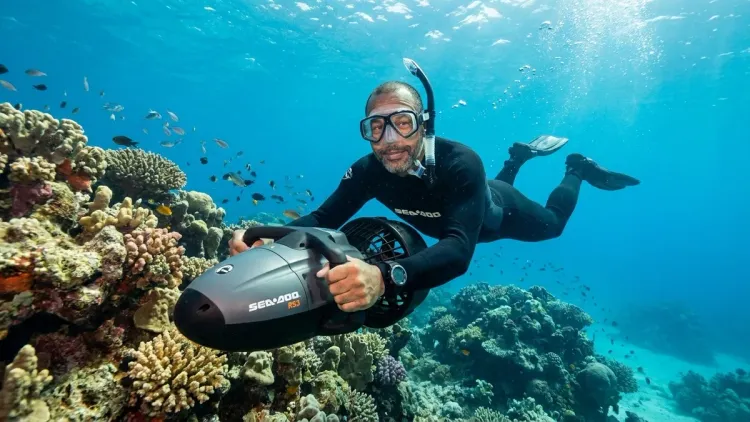
The Sea-Doo Seascooter RS3🛒 Amazon is the entry point for divers who want propulsion without the technical-diving price tag. It uses a sealed lead-acid battery (no airline travel), weighs 24 pounds dry, and costs around $650—less than a quarter of the Yamaha's price.
Specs: 24 pounds dry weight, 2.5 pounds negative in saltwater, rated to 100 feet, brushed motor with single o-ring seal. Dual-speed control (slow and fast). Runtime is 60 minutes at slow speed (2.5 mph / ~220 fpm), 30 minutes at fast speed (3 mph / ~265 fpm). Recharge time is 10-12 hours.
Here's what the marketing doesn't tell you: that 60-minute runtime is in ideal conditions at the surface. At depth with any current, expect 40-50 minutes at slow speed and 20-25 minutes at fast speed. The lead-acid battery also suffers significant voltage sag—the last 20 minutes of runtime deliver noticeably less thrust than the first 20 minutes.
I've used this scooter for shallow reef dives and warm-water drift diving where failure isn't catastrophic. It's adequate for recreational exploration but lacks the refinement and reliability for serious work. The 10-12 hour recharge time means you get one dive per day unless you own multiple batteries.
Pros:
- Budget price point (around $650) makes propulsion accessible to recreational divers
- 60-minute rated runtime works for single-tank shallow dives
- Simple dual-speed control is easy to learn
- GoPro mount built into the nose for action camera attachment
Cons:
- Lead-acid battery chemistry delivers inconsistent thrust as voltage drops during discharge
- 10-12 hour recharge time limits usability on multi-dive days
- 100-foot depth rating restricts use to shallow recreational diving
- 24-pound weight and non-removable battery make this awkward to travel with (and airline-incompatible)
- Motor noise is significantly louder than brushless competitors
Genesis R-EVO: Best for Photographers and Videographers
The Genesis R-EVO Underwater Scooter🛒 Amazon is purpose-built for imaging work with ultra-smooth speed control, near-silent operation, and a balanced design that lets you shoot one-handed while controlling the scooter with the other. I've used this on dozens of underwater photography assignments where I needed precise positioning without disturbing marine life.
Specs: 18 pounds dry weight, 1 pound negative in saltwater, rated to 160 feet, brushless motor with magnetic coupling. Infinitely variable speed control via proportional trigger. 200Wh lithium battery delivers 60 minutes at cruise speed (60 fpm), 40 minutes at moderate speed (85 fpm). Recharge time is 4 hours. Battery is not airline-compliant (200Wh exceeds the 160Wh limit).
The proportional trigger is the standout feature—light pressure gives you 20% thrust, full pressure gives you 100% thrust, with infinite gradations between. This lets you creep into position for macro shots or hold station in mild current without constantly adjusting. The magnetic coupling motor is the quietest I've tested—reef sharks and rays don't react to it at all.
The 200Wh battery hits an awkward middle ground: too large for airline compliance, but not quite enough capacity for extended technical diving. For imaging work where you're moving slowly and frequently stationary, 60 minutes is plenty. For transit or current fighting, it runs short.
Pros:
- Proportional trigger control is the smoothest, most precise speed adjustment available
- Near-silent brushless motor doesn't spook marine life
- Balanced trim and low weight (18 lbs) make one-handed operation easy while shooting
- Magnetic coupling eliminates shaft seal maintenance
- Built-in camera tray with standard 1/4"-20 mounting points
Cons:
- 200Wh battery exceeds airline limits—this is a drive-to-site scooter only
- Mid-range capacity (60 minutes cruise) isn't enough for long technical profiles
- Premium price (around $2,800) for a scooter with less runtime than similarly priced competitors
- Limited third-party accessory support compared to Yamaha or Suex
Apollo AV-2: Best Compact Scooter for Travel and Shallow Diving
The Apollo AV-2 Underwater Scooter🛒 Amazon prioritizes packability and airline compliance with a 99Wh battery and 7-pound dry weight. It's the lightest full-featured scooter I've tested, and I've carried it on international flights without a single question from gate agents or security.
Specs: 7 pounds dry weight, 0.5 pounds negative in saltwater, rated to 100 feet, brushless motor with single o-ring seal. Two-speed control (eco and sport). Runtime is 45 minutes at eco speed (45 fpm), 30 minutes at sport speed (70 fpm). Recharge time is 2.5 hours.
The 99Wh battery is the trade-off for airline compliance—45 minutes at eco speed is enough for single-tank recreational dives, but don't expect extended range or high-speed current fighting. I've used this scooter for shallow reef exploration and calm-water drift diving. It struggles in current above 1 knot and doesn't have the thrust to fight your way back if you misjudge a drift dive.
The 100-foot depth rating is conservative for the seal design. I've taken this scooter to 110 feet without issues, but I wouldn't push it to recreational limits (130 feet) regularly—seal stress adds up over repeated deep cycles.
Pros:
- 7-pound weight and 99Wh battery are airline-compliant globally
- Compact size fits in carry-on luggage (check dimensions with your carrier)
- 2.5-hour fast recharge supports multiple dives per day
- Brushless motor is quiet and efficient
- Budget-friendly price (around $1,200) for a lithium scooter
Cons:
- 100-foot depth rating restricts use to shallow recreational diving
- Low thrust output struggles in current above 1 knot
- 45-minute realistic runtime limits range and mission profiles
- Single o-ring seal requires annual maintenance for reliability
- No variable speed control—you're locked to two fixed speeds
Frequently Asked Questions
How long do underwater scooter batteries last before replacement?
Lithium-ion batteries degrade to 80% capacity after 300-500 full charge cycles depending on battery chemistry (lithium iron phosphate lasts longer than lithium cobalt oxide) and how you charge them. If you're diving weekly and fully discharging the battery each dive, expect 6-8 years before replacement. If you're doing daily diving on liveaboards, you might see degradation in 2-3 years. The key to extending battery life is avoiding full discharge—lithium batteries last longer if you recharge at 20-30% remaining capacity rather than running them dead. I've also seen batteries stored uncharged over winter lose significant capacity. Store lithium batteries at 50-60% charge in cool, dry conditions. Lead-acid batteries degrade faster—expect 200-300 cycles (1-2 years of heavy use) before capacity drops noticeably. When replacement time comes, factor in the cost: lithium batteries run $400-800 depending on capacity, lead-acid batteries are $80-150.
Can I take my underwater scooter on an airplane?
It depends entirely on battery capacity and chemistry. Lithium batteries under 100Wh are allowed in carry-on and checked baggage on most airlines. Batteries 100-160Wh are typically allowed in carry-on only with airline approval (notify them when booking). Batteries above 160Wh are banned on passenger aircraft under IATA dangerous goods regulations. Check your specific scooter's watt-hour rating—it's usually marked on the battery or listed in the manual. Lead-acid batteries fall into a gray area: technically allowed but many airlines restrict them due to spill risk. I've had lead-acid scooters rejected at check-in even though the regulations technically allowed them. For international travel, verify regulations with both your departure and arrival countries—some nations have stricter rules than IATA minimums. My rule: if you're traveling internationally and need a scooter, either buy a model with a sub-160Wh battery or arrange freight shipping and pick it up at your destination. The hassle of arguing with gate agents isn't worth it.
How deep can underwater scooters go?
Recreational scooters are typically rated to 100-160 feet, technical scooters to 200-330 feet, but the depth rating isn't necessarily where the scooter fails—it's where the manufacturer guarantees seal integrity after repeated pressure cycles. The critical components are o-ring seals on the motor shaft, battery compartment, and any control penetrations. Every dive compresses these seals, and repeated cycling to maximum rated depth accelerates wear. I've seen scooters flood at 80 feet after a season of diving to 130 feet—not because they exceeded the rating, but because the seals were stressed. If you're regularly diving near your scooter's rated depth, increase your maintenance schedule from annual to every 6 months. For technical diving below 200 feet, only use scooters with dual o-ring seals and magnetic coupling motors (no shaft penetration). I dive a Suex rated to 330 feet for deep wreck work, and even at 180 feet I'm only using half its rated capacity—that safety margin matters when you're two hours into decompression and your scooter is your ticket home.
Do underwater scooters require special training or certification?
There's no universal certification requirement for recreational underwater scooter use, but PADI, SSI, and other agencies offer Diver Propulsion Vehicle (DPV) specialty courses that teach propulsion techniques, navigation, buoyancy control, and emergency procedures. I strongly recommend taking the course even though it's not mandatory—scooters change your diving profile significantly. You cover more distance, ascend and descend faster, and can easily outpace your buddy or exceed planned bottom times. The specialty course covers trim and balance, tow procedures if your scooter fails, managing buoyancy changes during vertical movement, and navigation techniques when you're moving at 75-100 feet per minute. For technical diving with scooters (cave, wreck penetration, deep diving), DPV training is effectively mandatory—no reputable technical instructor will take you on a scooter dive without proof of training. The course takes 2-3 dives and costs around $200-350. If you're serious about using a scooter regularly, take the course. I've seen untrained divers blow through their no-decompression limits, lose their buddies, or end up half a mile from the dive boat because they didn't understand range planning.
How do I maintain my underwater scooter between dives?
Rinse thoroughly with fresh water after every dive, especially focusing on the propeller, motor intakes, and all seal surfaces. Saltwater and sand are the primary killers of scooters. Remove the propeller (most are tool-free removal) and rinse the motor shaft and prop tunnel—this is where sand accumulates and scratches seals. After rinsing, store the scooter with the battery compartment open in a dry, ventilated area. Never seal the scooter wet—trapped moisture corrodes electronics and grows mold in inaccessible areas. Every 10-15 dives, inspect all o-rings for cuts, cracks, or deformation. Lubricate o-rings with silicone grease (not petroleum-based lubricants, which degrade nitrile and silicone o-rings). Check for corrosion on battery terminals and clean with a wire brush if needed. For detailed procedures, I've written a complete maintenance checklist here. Annual service by a qualified technician should include seal replacement, motor inspection, and battery capacity testing. Annual service costs $150-300 depending on the model. If you're diving in extreme conditions (cold water, heavy silt, coral environments where impacts happen), service every 6 months. I've destroyed a $3,000 scooter by skipping maintenance for two seasons—a $200 annual service would've prevented a $1,200 repair.
The Verdict
For recreational divers who want the best balance of performance and travel practicality, the TUSA SAV-7 delivers airline-compliant battery capacity, 50-minute runtime, and 9.5-pound portability in a package that fits existing dive gear bags. It's what I recommend to divers planning liveaboard trips or destination diving where carrying gear matters.
Technical divers and expedition planners need the Yamaha 350Li—its 90-minute runtime, magnetic coupling reliability, and consistent deep-water thrust make it the standard for serious work. Yes, you'll need to freight ship it or drive to dive sites, but when you're planning multi-hour profiles or deep wreck penetration, runtime and reliability trump portability.
For photographers working slowly and deliberately, the Genesis R-EVO's proportional control and silent operation justify the airline-incompatible battery and mid-range runtime. For budget-conscious recreational divers willing to accept lead-acid compromises, the Sea-Doo RS3 delivers functional propulsion at a fraction of premium pricing.
Match your scooter to your actual dive profile—consider where you dive, how far you travel, and whether you need airline compliance or maximum runtime. A travel-friendly scooter that dies halfway through your dive plan is worse than no scooter at all. If you're new to propulsion, read through how underwater scooters work and how to use them safely before making your first purchase.