
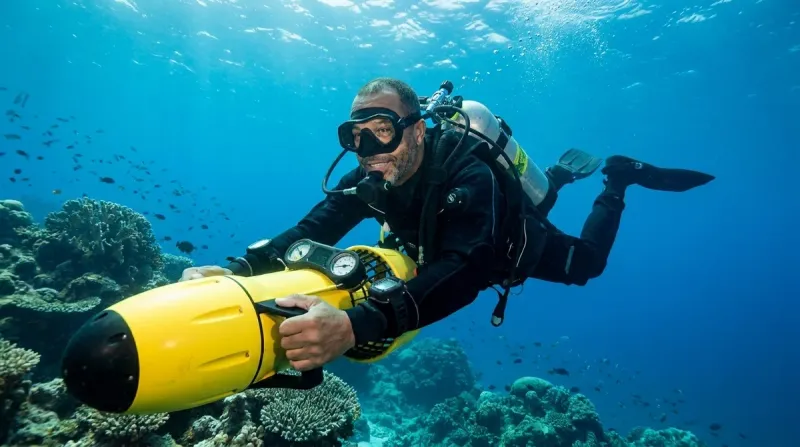

Learning how to use an underwater scooter—also called a Dive Propulsion Vehicle (DPV)—transforms your diving from slow, leg-powered exploration into effortless gliding that covers more reef, more wrecks, and more territory in a single tank. But the first time you squeeze that trigger and feel the pull, it's disorienting. Your trim goes to hell, you're fighting the machine instead of working with it, and suddenly you're burning through air faster than you did finning. I've watched dozens of divers struggle through their first scooter dives, and the difference between frustration and flow comes down to understanding three core skills: propulsion control, navigation while moving faster than you're used to, and maintaining proper trim under thrust.
This guide walks you through the actual technique—how to hold the scooter, position your body, manage speed and buoyancy simultaneously, navigate accurately, and avoid the mistakes that eat your battery and ruin your dive. We'll cover both recreational tow-behind models and technical side-mount configurations. Skill level: Advanced Open Water or equivalent, with solid buoyancy control. Time to basic proficiency: 2-3 practice dives.
What You'll Need
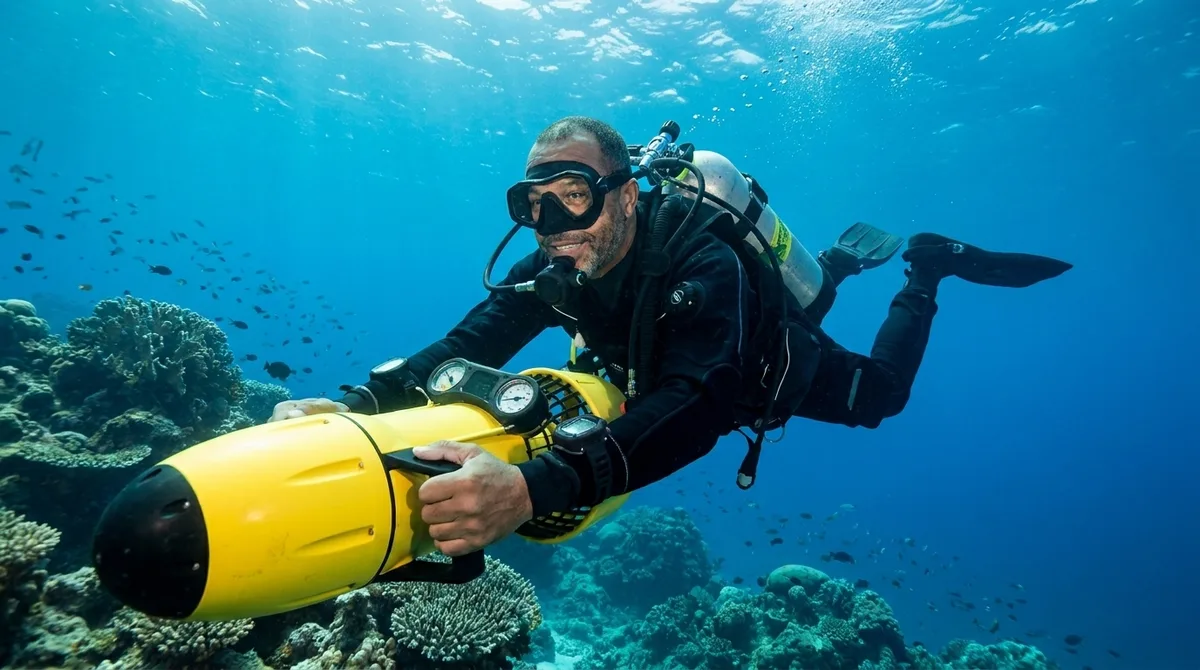
- DPV/underwater scooter with fully charged battery (check manufacturer service interval—most require annual pressure testing and o-ring replacement)
- Dive computer with remaining bottom time and ascent rate monitoring (essential when moving faster underwater)
- Buoyancy compensator adjusted for neutral buoyancy at your planned depth
- Exposure suit appropriate for your environment (you'll cover more water and feel colder from increased water flow)
- Dive plan with waypoints, turnaround pressure, and emergency procedures for DPV failure
- Buddy familiar with DPV operations and hand signals for scooter communication
- Wrist compass or dive computer with digital compass for navigation
- Optional: GoPro mount or camera system if you're documenting (but master the basics first)
Before you splash, verify your scooter has no water intrusion (shake it—do you hear sloshing?), check the battery indicator shows full charge, and confirm the trigger responds smoothly. I've had a rental scooter flood on me at 60 feet in Cozumel because I skipped the pre-dive inspection—learned that lesson the expensive way.
Step 1: Establish Neutral Buoyancy Before Engaging Propulsion
Before you even think about squeezing that trigger, you need to be perfectly neutrally buoyant at your working depth. This is non-negotiable. An underwater scooter doesn't fix bad buoyancy—it amplifies it. If you're heavy and sinking, the scooter will drive you into the sand or reef at speed. If you're light and rising, you'll angle upward and blow through your ascent rate before you realize what's happening.
Descend to your planned cruise depth (usually 15-25 feet for reef cruising, deeper for wreck penetration), release all air from your BCD, and hang motionless. You should neither sink nor rise. Add or dump small amounts of air until you achieve true neutral—no finning, no sculling, just floating. Now take three normal breaths and watch what happens. You'll rise slightly on inhale, sink slightly on exhale, but stay within a two-foot vertical range. That's your baseline.
Why this matters at speed: When you're moving at 2-3 knots (typical recreational DPV speed), even slight negative buoyancy becomes a downward trajectory. The scooter's thrust vector combines with your buoyancy state, and small errors become big problems fast. I've seen divers crash into the bottom repeatedly because they started 2 pounds heavy and thought the scooter would compensate. It won't.
Most recreational scooters like the Sublue WhiteShark Mix Underwater Scooter are slightly negative, adding 2-4 pounds to your total system weight. Account for this when you're doing your initial weight check. Technical scooters are typically neutral to slightly positive, but verify with your specific model.
Step 2: Position Your Body and Grip the Scooter Correctly
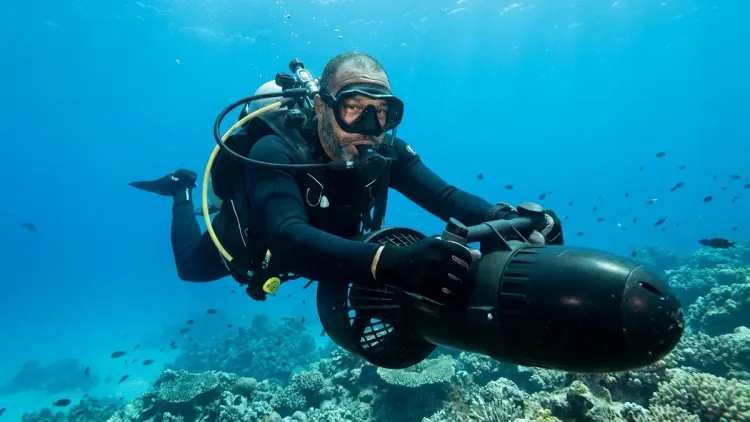
Recreational tow-behind configuration: Grip the scooter handles with both hands, arms extended but not locked. Your body should form a straight line from head to fins—horizontal trim, stomach facing down toward the bottom. The scooter sits in front of you at chest height, and you're essentially being towed like water-skiing. Keep your legs together, fins parallel to each other (not scissoring), and avoid the temptation to start kicking. Your fins are now dead weight—they create drag, nothing more.
The most common mistake here is bending at the waist. Divers instinctively tuck their knees up or let their legs drift apart, which creates massive drag and kills your battery life. I watched my buddy's runtime drop from 45 minutes to 25 minutes on the same scooter just because his fins were scissoring the whole dive. Keep everything streamlined.
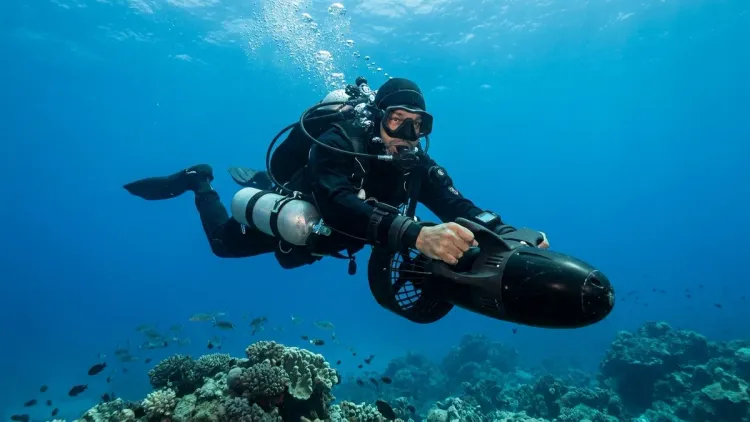
Technical side-mount configuration: Used primarily for cave and wreck penetration, you mount the scooter alongside your body on a quick-release tow leash, typically on your left hip. Your right hand operates the trigger while your left maintains neutral position or handles navigation. This leaves you more maneuverable in tight spaces but requires practice to avoid spinning or corkscrewing. The scooter's thrust is now offset from your centerline, so you're managing rotational forces.
Body angle relative to thrust: The scooter pushes straight ahead. If you want to maintain level depth, your body must be perfectly horizontal. If you angle your head down even 10 degrees, you're now descending. Angle up, you're ascending. There's no "power through it" with more thrust—physics wins. Adjust your body angle, not the throttle.
Step 3: Start with Partial Throttle and Establish Trim
Most DPVs have variable speed triggers or multiple speed settings. Do not start at full throttle. Squeeze gently to about 30-40% power and feel what happens. You'll start moving forward—slowly at first, maybe 1 knot. Watch your depth gauge on your dive computer. Are you maintaining depth, or are you ascending/descending?
If you're ascending: Tilt your head down slightly, angle your body into a gentle dive position. The scooter will follow. If needed, dump a tiny puff of air from your BCD—but try body angle first.
If you're descending: Tilt your head up, angle into a slight climb. Add a quick burst of air to your BCD if body position alone doesn't correct it. This is where breathing becomes crucial—inhale to help yourself rise, exhale to help yourself sink. Use your lungs as fine-tuning for depth control.
Once you're moving in a straight, level line at partial throttle with no depth change over 30 seconds, that's your trim established. Now you can gradually increase speed. I usually run at 60-70% throttle for reef cruising—it's fast enough to cover ground but slow enough to react to obstacles, check air pressure, and communicate with my buddy. Full throttle is for open water transit or strong current bucking.
The breathing drill: Once you're cruising straight and level, practice exaggerated breathing cycles. Big inhale (you'll rise 1-2 feet), big exhale (you'll sink 1-2 feet). Get comfortable correcting this with body angle and tiny BCD adjustments while maintaining forward motion. This skill becomes critical when you're navigating through structure or approaching photo subjects—you need to control depth changes from breathing without breaking your cruise pattern.
Step 4: Navigate Using Reference Points and Compass Headings
Underwater navigation while scootering is fundamentally different from finning navigation because you're covering distance so much faster. A slight heading error at 2.5 knots means you're 150 feet off course in just one minute. You can't rely on "I'll just correct it later"—later comes fast.
Visual reference navigation (best for reef cruising): Pick prominent features—a large coral head, a distinctive rock formation, a specific section of wall—and drive toward them. As you approach, pick your next landmark. This works beautifully in clear water with high-relief reefs but falls apart in poor visibility or over sand flats where everything looks the same.
Compass navigation (essential for open water, wreck approaches, or search patterns): Before you start moving, take a precise heading to your target using your wrist compass or dive computer's integrated compass. Note your outbound heading. While cruising, glance at your compass every 10-15 seconds—you should be within 5-10 degrees of your intended heading. If you've drifted off course, make small corrections. Don't overcorrect with dramatic turns—you'll fishtail all over the place and waste energy.
The 30-second navigation check: Every 30 seconds of scooter time, do a mental reset: Check depth (am I at my planned depth?), check compass heading (am I going where I intended?), check air pressure (am I on track for turnaround?), check buddy position (are they with me?). This becomes automatic with practice, but you need to drill it consciously at first.
When you're approaching a target—a mooring line, a wreck opening, a specific coral formation—slow down at 30 feet out. Drop to 30-40% throttle. This gives you reaction time and prevents overshoot. I've watched divers blow past their intended mooring line entry point because they were running full throttle until the last second and couldn't stop in time.
Step 5: Manage Speed, Battery Life, and Environmental Awareness
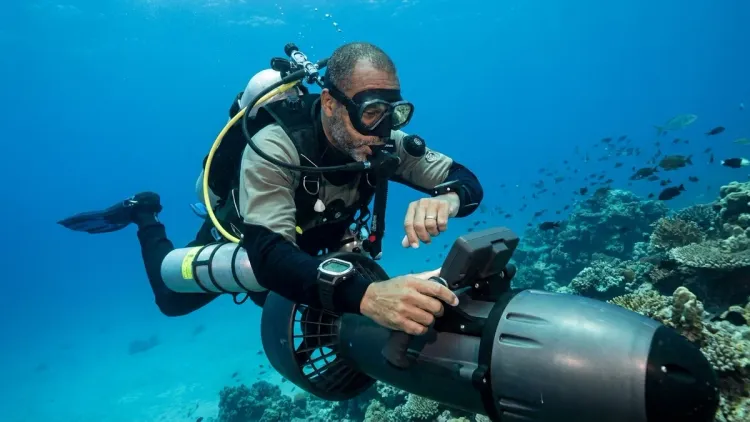
Speed selection isn't just about how fast you want to go—it's about efficiency, safety, and task. Here's how I think about it:
- 30-40% throttle (0.5-1 knot): Maneuvering in tight spaces, approaching structures, searching for small subjects. Maximum control, minimal battery drain.
- 60-70% throttle (1.5-2 knots): Standard reef cruising, wildlife observation, photography setups. Good balance of coverage and control. This is where I spend 80% of my scooter time.
- 80-100% throttle (2.5-3+ knots): Open water transit, fighting current, emergency ascent to buddy or surface. Maximum battery drain—expect 30-40% shorter runtime at full throttle compared to mid-range cruising.
Battery capacity varies wildly. Small recreational units like the Sublue models give you 30-45 minutes of runtime at cruise speed. Technical DPVs like the SUEX XJoy 37 can push 120+ minutes depending on speed settings and battery configuration. Always plan your turnaround at 50% battery capacity—never less. You need reserve for fighting unexpected current, buddy assistance, or navigation errors.
Environmental scanning while moving: This is hard and requires practice. You're moving faster than finning speed, so the reef/wreck/wall is flowing past you quicker. Force yourself to look ahead (obstacle avoidance), side to side (wildlife, buddy position), and occasionally up (boat traffic, overhangs) and down (depth, bottom proximity). New DPV users get tunnel vision—they stare straight ahead at where the scooter is pointed and miss everything else. Set a mental rhythm: ahead, left, ahead, right, ahead, computer check, ahead, buddy check.
Air consumption: You're exerting less energy than finning, so theoretically you should breathe slower. But in practice, many divers (me included) breathe faster on scooters because they're task-loaded and excited. Monitor your SPG more frequently than you would finning—every 5-10 minutes at minimum. Plan your turnaround pressure based on distance traveled, not just time elapsed. If you've covered half a mile on the outbound leg, you need enough gas to cover half a mile back, plus reserve.
Step 6: Execute Turns, Stops, and Emergency Procedures
Turning while under power: Small course corrections happen with body rotation—twist your torso and hips slightly in the direction you want to turn, and the scooter will follow. For sharper turns (90 degrees or more), reduce throttle to 40-50%, rotate your body aggressively, and let momentum carry you through the arc. Don't try to muscle it with locked arms—you'll strain your shoulders and waste energy.
Stopping: Release the trigger and coast. You'll drift forward for 10-20 feet depending on your speed, body drag, and water movement. If you need to stop faster, flare your body—spread your arms wide, arch your back slightly, and let your legs drift apart. This dramatically increases drag and you'll stop within 5-10 feet. I use this technique constantly when approaching photo subjects or navigating narrow passages.
Emergency procedures for DPV failure: The scooter dies (battery exhaustion or flood). What now? You're neutrally buoyant, so you're not sinking—good. Clip off the scooter if you have a tether point, or set it on the bottom if you're shallow and the substrate allows. Switch immediately to finning. Reevaluate your dive plan—can you complete the dive and return to exit point on fins, or do you need to abort? If you're far from your entry point and fatigued, abort. Signal your buddy, establish a finning pace you can sustain, and navigate back. This is why buddy separation during DPV dives is dangerous—if you have a failure and they're 200 feet ahead at full throttle, they won't know for several minutes.
Buddy separation protocol: Establish signals before the dive. If you become separated, stop immediately, do a slow 360-degree rotation for 30 seconds while looking for your buddy's bubbles or lights. If no contact, ascend slowly to a pre-briefed depth (usually 15 feet) and wait 1 minute. Still no contact? Surface using normal ascent rates, establish visual contact, descend together, and continue or abort based on remaining gas and bottom time.
Step 7: Ascend Safely and Manage Gas Expansion
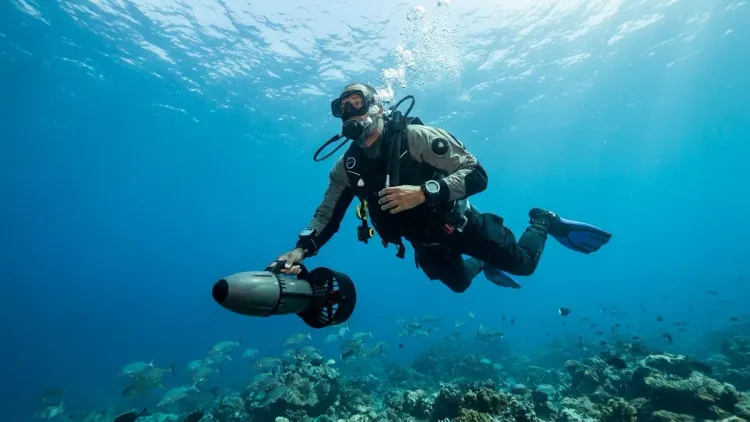
Ascending with a DPV is where people screw up their dive computers' ascent rate warnings. The scooter wants to keep pulling you horizontally, but you need to go up. If you just angle your body upward and maintain throttle, you're now ascending at a steep angle and moving forward at 2 knots—your actual vertical ascent rate might hit 60-80 feet per minute, which will trigger every alarm on your dive computer.
The proper technique: Reduce throttle to 30-40%. Angle your body into a gentle climb—maybe 15-20 degrees from horizontal. Monitor your depth gauge continuously. Target 30 feet per minute ascent or slower. If you're climbing too fast, level off, let your computer settle, then resume the climb. It takes longer, but you're not juggling decompression stress.
Alternatively, many divers (me included) simply release the trigger entirely for the final ascent, clip off the scooter or let it hang from a tether, and fin up normally. This gives you maximum control over ascent rate and lets you focus on expanding gas management in your BCD. As you ascend, the air in your BCD expands—you'll need to dump air progressively or you'll start rocketing upward. This is basic open water stuff, but it's harder when you're managing a scooter simultaneously.
Safety stop with a DPV: When you reach your safety stop depth (15 feet for recreational dives), establish neutral buoyancy, release the trigger, and hold position. You can hover with the scooter in front of you, or clip it off and fin gently to maintain depth. I prefer releasing the scooter and hovering normally—it reduces task loading during the safety stop, which should be a calm, low-stress phase of the dive.
Step 8: Surface Procedures and Post-Dive DPV Care
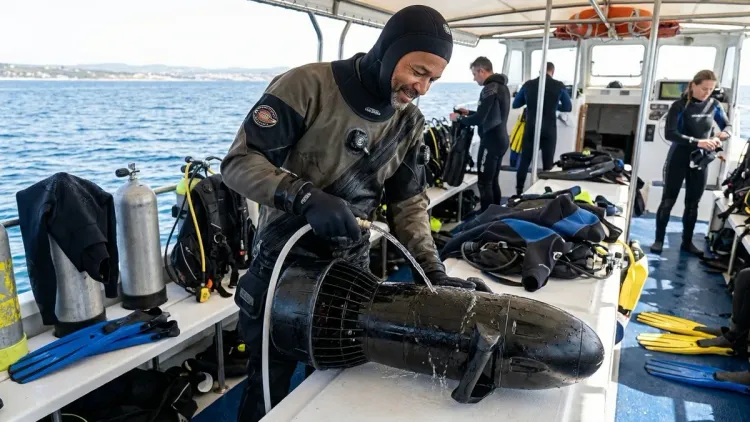
Surfacing: When you break the surface with a DPV, establish positive buoyancy immediately by inflating your BCD fully. The scooter is now heavy and awkward—it wants to pull you back down if you're still gripping it. Most recreational scooters are 10-20 pounds negatively buoyant in salt water (less in fresh). Get air in your BCD, establish a comfortable floating position, then deal with the scooter.
Handing up the DPV: If you're climbing back into a boat, pass the scooter up first—don't try to board while holding it. It's bulky, and most dive ladders aren't designed for one-handed climbing with a 30-pound scooter in your other hand. If you're doing a shore exit, hold the scooter by the handles with one hand while finning sideways or backward to keep your regulator in place.
Immediate post-dive care: Rinse the scooter in fresh water within 30 minutes of surfacing if possible. Salt crystals form fast and can jam trigger mechanisms or corrode external fittings. Shake out any water from the trigger housing, dry the exterior, and crack open the battery compartment (following manufacturer procedures) to verify no water intrusion. Even a few drops means you've got an o-ring failure that needs attention before the next dive. For detailed maintenance procedures, see our underwater scooter maintenance checklist.
Store the scooter in a cool, dry location. Don't leave it in direct sunlight or a hot car—lithium battery packs degrade faster in heat, and you'll see capacity drops over time. If you're not diving for more than a month, store the battery at 50-60% charge per manufacturer guidelines. Full charge storage accelerates degradation.
Pro Tips & Common Mistakes
Pro tip: Practice scooter skills in a swimming pool or shallow, benign environment first. Your local dive shop might offer a confined water DPV specialty course—take it. The open ocean is not the place to learn throttle control and emergency procedures for the first time.
Pro tip: Mount a small strobe or light on the scooter's tail section if you're doing dusk or night dives. This makes you visible to your buddy from behind and helps boats spot your position from above.
Common mistake: Gripping the handles too tightly. Your hands will cramp after 10 minutes, your forearms will burn, and you'll be miserable. Hold the scooter gently—it's pulling you, not the other way around. Relax your grip.
Common mistake: Trying to power through bad trim with more throttle. If you're angled wrong and descending, going faster just makes you descend faster. Fix the trim issue (body position, buoyancy) before you increase speed.
Common mistake: Separating from your buddy by 50+ feet because one of you is running faster than the other. Establish a target speed during the dive brief and stick to it. If you're faster, throttle back and wait. If you're slower, increase your speed or abort the DPV dive and fin instead. Buddy separation incidents increase dramatically during DPV diving because the speed differential is so much greater than finning.
Pro tip: Keep your head on a swivel when you're near structure. I've seen divers get so focused on what's directly ahead that they don't notice the boat hull above them, the mooring line next to them, or the reef outcropping to their right. Spatial awareness is harder at speed—compensate by forcing yourself to scan constantly.
Common mistake: Ignoring current. If you burn up the reef at full throttle for 20 minutes with a 1-knot current, you'll discover on the return leg that you're now fighting that current and your battery (and gas supply) won't get you home. Always check current direction before departure and plan your route to work with it, not against it.
Frequently Asked Questions
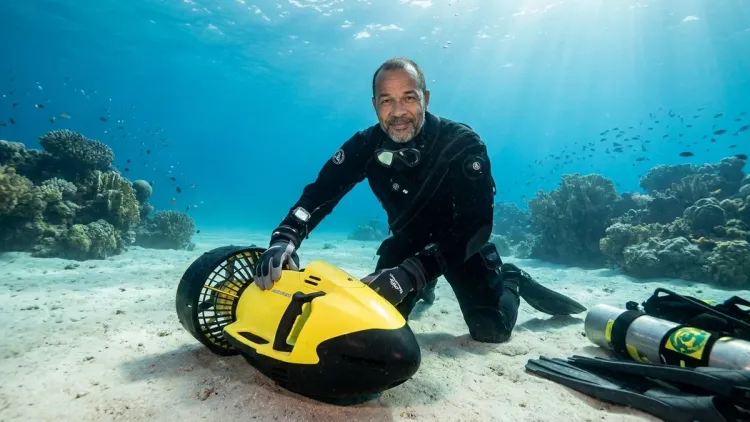
Do I need special certification to use an underwater scooter?
No specific certification is legally required for recreational DPV use in most locations, but PADI, SSI, and other agencies offer DPV/scooter specialty courses that teach proper technique, navigation, buoyancy management, and emergency procedures. I strongly recommend taking the course—it's typically 2-3 dives with an instructor and will save you from expensive mistakes like flooding your scooter, damaging reef with poor control, or running out of battery far from your exit point. Technical divers planning cave or wreck penetration with DPVs should complete advanced DPV training specific to overhead environments.
How much does an underwater scooter affect my air consumption?
It varies by diver, but most people see 20-30% lower air consumption during steady cruising compared to finning at the same speed, because you're exerting less physical effort. However, task loading, stress, and excitement during your first few scooter dives often increase breathing rates, negating the efficiency gain. Once you're comfortable and relaxed on a scooter, you'll breathe slower and extend your bottom time. Monitor your SPG closely during early dives to understand your personal consumption rate with the scooter.
Can I use a scooter during drift diving or in strong current?
Yes, but it requires planning. A typical recreational scooter generates 2-3 knots of thrust. If you're drifting in a 2-knot current and you need to move perpendicular to the current, the scooter has enough power to move you across the flow. Fighting directly against a 2-knot current at full throttle will drain your battery in 15-20 minutes and accomplish very little. The best technique in strong current is to drift with it (scooter off) and use the DPV only for cross-current positioning to stay near features or adjust your drift line. For technical diving in overhead environments where current is present, you need a higher-thrust scooter (100+ lbs of thrust) and advanced training.
What should I do if my underwater scooter starts making unusual sounds or vibrations?
Stop using it immediately and surface following normal ascent procedures. Unusual sounds—grinding, clicking, high-pitched whining—indicate mechanical failure, bearing damage, or debris in the prop shroud. Vibrations suggest an unbalanced propeller or loose mounting hardware. Continuing to use a malfunctioning scooter risks catastrophic failure (loss of thrust when you need it most), personal injury from prop blade separation, or electrical issues. Once you surface, power down the unit, rinse it in fresh water, and have it inspected by the manufacturer or authorized service center before your next dive. Most DPV failures are progressive—a small sound becomes a big problem over 2-3 more dives. Don't ignore early warning signs.
Summary
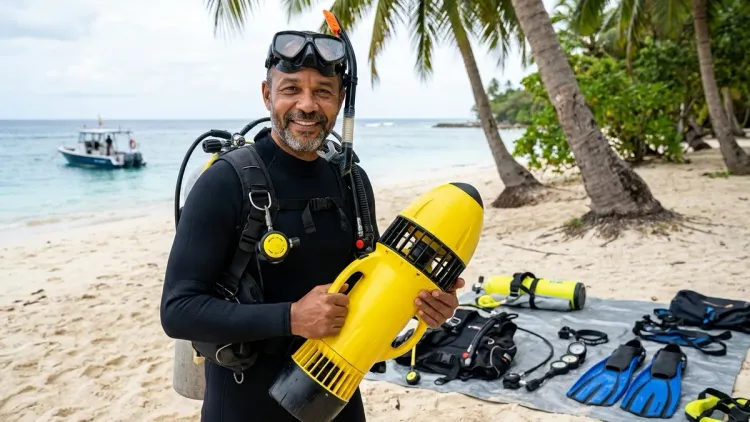
Learning how to use an underwater scooter properly—establishing neutral buoyancy before engaging thrust, maintaining perfect horizontal trim, navigating accurately at speed, and managing battery life—transforms your diving efficiency and exploration range. The skills take practice, but once you're comfortable with throttle control and body positioning, you'll wonder how you ever covered large reef systems or reached distant wrecks without one. Start in benign conditions, practice emergency procedures with your buddy, and gradually increase complexity as your confidence builds.
For a deeper understanding of how DPV systems work—battery chemistry, motor configurations, and thrust-to-weight ratios—check out our guide on how dive scooters work. Before your first dive, review our pre-dive DPV safety checklist to catch potential failures before they happen underwater. And if you're researching which scooter to buy, our best underwater scooters guide breaks down lab-tested performance metrics across recreational and technical models.
Now get wet, keep your trim tight, and remember: the scooter amplifies both good technique and bad. Master the fundamentals, and you'll cover more reef in a single dive than most divers see in a weekend.