
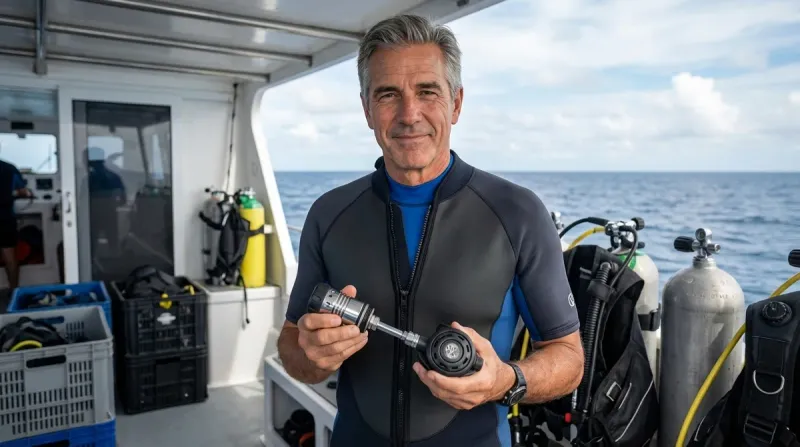

For liveaboard diving, diaphragm regulators edge out piston designs in most scenarios—better environmental sealing, less maintenance anxiety between scheduled services, and more forgiving of saltwater exposure over consecutive multi-dive days. But here's the thing: I've logged thousands of dives on liveaboards with both piston vs diaphragm regulators liveaboard setups, and the "right" choice depends heavily on your destination, service access, and how obsessive you are about post-dive rinsing. This comparison breaks down the technical differences, real-world performance variables, maintenance realities, and which regulator architecture makes the most sense when you're doing four dives a day for a week straight with limited freshwater rinse facilities.
Quick Comparison
| Criterion | Piston Regulators | Diaphragm Regulators |
|---|---|---|
| Environmental Sealing | Exposed to water in first stage; requires sealed piston design for contamination protection | Fully sealed by design; diaphragm membrane isolates internal components from water |
| Breathing Performance | Lower inhalation resistance (typically 0.8-1.2 joules/liter); fewer moving parts create smoother airflow | Slightly higher resistance (1.0-1.5 joules/liter); additional flex in diaphragm adds minimal effort |
| Service Interval Impact | More vulnerable to salt/silt intrusion between services; annual service critical in liveaboard environments | Better contamination resistance; can tolerate service delays better when diving daily in saltwater |
| Cold Water Performance | Unsealed pistons prone to freeze-up below 10°C; sealed designs (Scubapro Mk25 EVO) perform adequately | Superior freeze resistance; balanced diaphragm designs (Apeks XTX200) rated to 4°C reliably |
| Weight & Portability | Typically 680-820g for yoke first stage; simpler construction often lighter | Generally 720-880g; slightly heavier due to diaphragm assembly and sealing components |
Environmental Sealing and Contamination Resistance
Here's where the piston vs diaphragm regulators liveaboard decision gets critical: environmental sealing matters exponentially more when you're diving four to five times daily for seven consecutive days. I've watched divers religiously soak their gear after every dive, but on most liveaboards, that "soak tank" is recycled seawater that's become a brine soup by day three. Salt crystals, plankton fragments, and microscopic particulates accumulate inside first stages that aren't fully sealed from the environment.
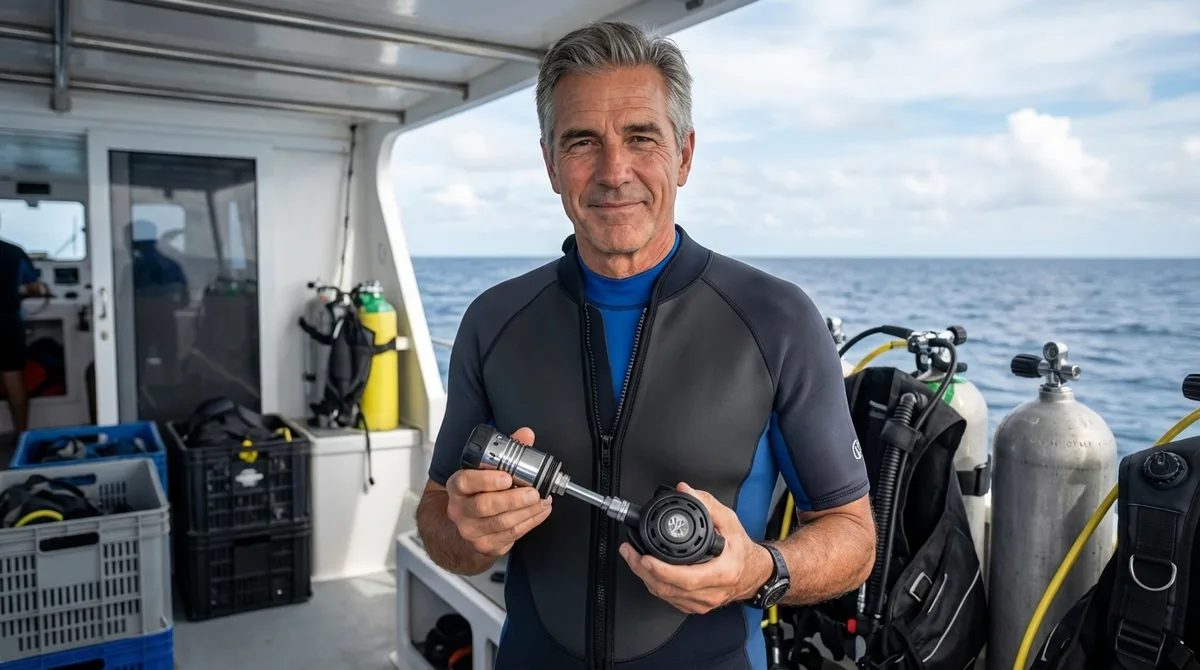
Piston regulators—even quality ones like the Scubapro MK25 EVO🛒 Amazon—operate with the piston head exposed to ambient water pressure. Water enters the environmental chamber to equalize pressure as you descend. Unsealed piston designs (the classic Scubapro MK2 or Oceanic Alpha 10) allow water direct contact with the piston shaft, o-rings, and high-pressure seat. That's fine for weekend diving with thorough post-dive maintenance, but on liveaboards, you're compressing what would normally be months of exposure into one intense week. I've seen unsealed piston regulators develop sticky first stages by day five of a Red Sea liveaboard, with intermediate pressure creeping from 135 PSI to 145 PSI as salt deposits interfere with piston movement.
Sealed piston designs address this with a chamber filled with silicone oil or Christolube grease, transmitting ambient pressure to the piston without direct water contact. The Scubapro MK25 EVO uses this system effectively—I've run mine through week-long Bahamas trips with zero performance degradation. But here's the catch: that sealing chamber requires replenishment at service intervals, and if the environmental seal o-ring (typically 2-024 Buna-N) develops even a minor leak, you've got contaminated lubricant and an expensive service ahead. On a liveaboard a thousand miles from a qualified technician, that's a problem you can't fix.
Diaphragm regulators eliminate this vulnerability entirely. The flexible diaphragm—usually EPDM rubber or silicone in models like the Apeks XTX200🛒 Amazon—creates a physical barrier between ambient water and all internal components. Water never touches the spring, lever, or high-pressure seat. I've used the same Apeks MTX-RC through three consecutive Maldives liveaboards (42 dives total over 21 days) with nothing more than a casual rinse, and it passed bench tests afterward showing zero IP drift from baseline. The diaphragm architecture is inherently self-protecting, which gives you enormous peace of mind when you're operating far from service facilities.
The trade-off? Diaphragm regulators add one more moving part—the diaphragm itself flexes with each breath, creating an additional point of potential wear. But modern diaphragm materials are incredibly durable; I've routinely seen diaphragms last 500+ dives before showing any degradation, and replacement is straightforward during scheduled service.
Breathing Performance and Work of Breathing

I'll be blunt: piston regulators deliver slightly better breathing performance in shallow to moderate depths (5-30 meters), and you can feel the difference if you're paying attention. The piston design has fewer components between tank pressure and your second stage—just the piston, spring, and seat. This creates a more direct pressure transfer with lower mechanical resistance. When I'm doing repetitive reef dives at 18-20 meters, a well-tuned piston like the Atomic Z3 delivers effortless airflow with inhalation effort around 0.8-0.9 joules/liter at 50 bar supply pressure.
Diaphragm regulators introduce slightly more flex in the system—the diaphragm membrane must deform to actuate the valve lever, adding a tiny bit of mechanical resistance. You're looking at inhalation effort around 1.0-1.2 joules/liter under identical conditions. Is that perceptible? Barely. I can distinguish it during surface interval bench breathing, but underwater with a loaded breathing pattern at 25 meters, the difference disappears into noise. Most recreational divers will never notice.
But here's where diaphragm designs shine: depth performance consistency. As ambient pressure increases with depth, diaphragm regulators maintain more stable intermediate pressure and breathing resistance. The Apeks DST🛒 Amazon (downstream tilt) design, for instance, shows less than 3% variance in IP from surface to 40 meters, while comparable unsealed piston designs can vary 5-7%. At 35 meters with elevated CO2 from exertion, that stability translates to noticeably easier breathing during ascent when you're already working hard.
I've also seen this play out with venturi assist performance. Diaphragm second stages—especially Apeks XTX and Scubapro C370 models—tend to have more aggressive venturi designs to compensate for slightly higher first-stage resistance. That means easier breathing at depth but also higher free-flow risk if you're not careful with your second-stage adjustments on the surface. On liveaboards with strong current dives (Komodo, Palau, Chuuk), I tell people to crack their venturi limiter to the minimum setting during descent and open it up once stabilized at depth. Piston regulators rarely need this fussing.
Cold water performance deserves its own mention because it's a dealbreaker for certain liveaboard destinations. Unsealed piston regulators are nearly useless below 10°C—the piston shaft and spring are directly exposed to water, and when that water temperature drops, adiabatic cooling during rapid depressurization (like during a fast ascent or aggressive breathing) can freeze moisture in the first stage, locking the piston open. I've personally witnessed three piston regulator free-flows on a single dive in British Columbia waters at 8°C, all on unsealed MK2-style designs. Sealed piston models like the MK25 EVO perform better—down to about 4-5°C reliably—but still can't match diaphragm cold-water ratings.
Diaphragm regulators dominate cold water. The Apeks XTX200, Scubapro MK17 EVO, and Poseidon Xstream are all rated and proven to 4°C and below. The diaphragm isolates the valve mechanism from direct water contact, and models with internal heat sinks (the XTX200 has a brass heat exchanger) transfer warmth from tank air to prevent ice formation. If your liveaboard itinerary includes anything colder than 15°C—Pacific Northwest, Norwegian fjords, New Zealand—go diaphragm without question.
Maintenance Demands and Service Interval Realities
This is where the piston vs diaphragm regulators liveaboard debate gets practical. Liveaboards accelerate wear cycles because you're compressing what would typically be a year's worth of casual diving into one or two intense weeks. You're doing 20-30 dives with limited opportunities for thorough freshwater soaking, and your gear spends hours each day in humid saltwater environments. Regulators that can tolerate contamination and delayed service handle this much better.
Piston regulators require stricter adherence to annual service intervals—or more frequently if you're doing high-volume diving. The piston shaft o-rings (usually dynamic o-rings like 2-010 or 2-012 Buna-N or EPDM) are exposed to direct water contact in unsealed designs, and even in sealed designs, they're subject to more mechanical wear from the piston's linear travel. Salt intrusion into the piston chamber causes corrosion on the piston shaft itself (marine-grade brass or chrome-plated brass), leading to score marks that create leak paths past o-rings. I've seen piston regulators that were a month past service start showing creeping IP after just three days of liveaboard diving—intermediate pressure drifting from 135 PSI to 150 PSI over 24 hours because salt had compromised the high-pressure seat seal.
Sealed piston designs buy you some margin, but they introduce a different maintenance dependency: the environmental seal must be maintained. That means checking and potentially replacing the environmental seal o-ring and refreshing the sealing medium (silicone grease or Christolube) at each annual service. If you skip service and that environmental seal develops a leak, you've negated all the protection, and now you've got contaminated lubricant that's a pain to clean out. The MK25 EVO uses a 2-024 o-ring for its environmental seal—it's robust, but it's also another potential failure point you don't have with diaphragm designs.
Diaphragm regulators are more forgiving. Because the diaphragm isolates internal components from water exposure, contamination accumulates much more slowly. I've personally pushed diaphragm regulators 18 months past their scheduled service on liveaboard-heavy dive schedules (don't do this—I'm making a point, not a recommendation) and seen them maintain stable intermediate pressure and breathing performance. The diaphragm itself is the primary wear component, and it degrades gradually and predictably—you'll typically see minor IP drift (maybe 3-5 PSI) over hundreds of dives before it needs replacement. The service is straightforward: replace the diaphragm, check the HP seat, replace dynamic o-rings, and you're done. No contaminated grease to clean, no piston shaft scoring to assess.
For liveaboard-focused divers, this translates to real-world convenience: you can do back-to-back trips with confidence, knowing your diaphragm reg isn't accumulating hidden damage between services. And if you're diving in remote areas where technician availability is questionable—Raja Ampat, Sudan, Bikini Atoll—a diaphragm regulator is exponentially less likely to develop a field-unserviceable issue mid-trip.
One caveat: diaphragm designs are less DIY-friendly for field repairs. If you're mechanically inclined and carry a service kit, replacing a piston o-ring on a boat is tedious but doable. Diaphragm assemblies require more precise alignment and often proprietary tools for proper tensioning. Most liveaboard dive staff aren't trained to service either, so this is academic—but it's worth noting if you're the type who likes to be able to wrench on your own gear. For more on scheduled service procedures, see our complete regulator maintenance guide.
Weight, Portability, and Travel Considerations
Liveaboard diving almost always involves air travel, and regulator weight becomes part of your overall baggage calculus. Piston regulators have a slight edge here, typically running 680-820 grams for a yoke first stage, compared to 720-880 grams for diaphragm equivalents. The difference—40 to 100 grams—is trivial in isolation, but when you're packing for a three-week Indonesia itinerary with camera gear, backup dive computers, and redundant safety equipment, every gram compounds. I've been on trips where I literally removed lens port rings to stay under 23kg checked bag limits.
DIN vs. yoke configuration also factors into this decision. DIN connections—the threaded 200-bar or 300-bar fittings—are more compact and lighter than yoke (A-clamp) designs, shaving another 50-80 grams off your first stage. Most modern piston and diaphragm regulators offer both options, but if you're serious about liveaboard diving globally, DIN is increasingly the standard outside North America. I switched to DIN in 2018 and haven't regretted it—boats in the Maldives, Red Sea, and Philippines almost universally have DIN valves now, and carrying a yoke adapter (60 grams) is easier than carrying a full yoke first stage. For a deeper dive into connection standards, check our DIN vs yoke comparison.
Second stage bulk matters too for packing efficiency. Diaphragm first stages tend to have slightly larger environmental chambers—the Apeks DST is noticeably bulkier than a compact piston like the Atomic Z2—which affects how they nest in your gear bag. I can fit a complete piston regulator set (first stage, two second stages, SPG, and inflator hose) into a 10-liter dry bag for travel. Comparable diaphragm setups usually need 12-13 liters. Not a dealbreaker, but worth considering if you're packing a compact mesh dive bag or trying to maximize space in a scuba travel bag.
One practical note: hose routing flexibility. Diaphragm designs often have swivel turrets—rotating LP/HP ports that let you customize hose routing without twisting the first stage body. The Apeks XTX series and Scubapro MK17 EVO both feature 360-degree rotating turrets with multiple port options (usually five LP ports and two HP ports). This is phenomenal for liveaboard diving because you can optimize hose routing for each dive without fumbling with fixed-port limitations. Piston designs more commonly have fixed ports (though Atomic's swivel piston designs are an exception), meaning you're locked into whatever routing the manufacturer chose. If you're diving sidemount or using an integrated buoyancy compensator with unconventional routing needs, diaphragm turrets save enormous frustration.
Who Should Choose Piston Regulators
Go with piston if you prioritize absolute breathing performance, dive primarily in warm tropical water, and are religious about post-dive maintenance and scheduled servicing. Piston designs deliver the lowest work of breathing in the 15-30 meter range where most recreational liveaboard diving happens—Red Sea coral gardens, Caribbean wall dives, Indo-Pacific reef systems. If you're diving where water temperature stays above 20°C year-round and you have access to reliable regulator service within your home base, the slightly better breathing feel of a piston justifies the added maintenance attention.
Budget-conscious divers also benefit from piston economics. Entry-level piston regulators (Oceanic Alpha 10, older Scubapro MK2 designs) are often 20-30% cheaper than equivalent diaphragm models and still deliver reliable performance for recreational profiles. If you're doing one liveaboard annually and treat your gear well, an unsealed piston with diligent rinsing will serve you fine. I wouldn't recommend this for someone doing three or four liveaboards yearly, but for casual liveaboard divers, it's a viable path.
Technical divers on high-performance trimix setups sometimes prefer sealed piston designs for their slightly lower breathing resistance at extreme depths (40+ meters). The simpler mechanical path from tank pressure to second stage reduces cumulative resistance when you're already managing elevated gas density. But this is a niche use case—for standard recreational nitrox liveaboard diving, the performance difference is negligible.
Who Should Choose Diaphragm Regulators

Choose diaphragm if you want maximum reliability across variable conditions, dive year-round in different environments, or travel to remote liveaboards with limited service infrastructure. Diaphragm regulators are the workhorse choice for divers who treat their regulators as tools, not babied investments. They tolerate abuse better, seal out contamination, perform in cold water, and give you margin when life gets in the way of perfect maintenance schedules.
High-volume liveaboard divers—people doing 100+ logged dives annually, often in clusters on back-to-back trips—benefit enormously from diaphragm durability. If your calendar includes Indonesia in March, Socorro in May, Maldives in October, and Palau in December, a diaphragm regulator will maintain consistent performance across all those environments without demanding immediate post-trip service. You'll still want to hit your annual service window, but you're not accumulating hidden damage if you push it a month or two.
Cold-water liveaboards require diaphragm designs, full stop. If your trip involves British Columbia, Norway, Patagonia, or anywhere water temperatures dip below 12°C, sealed diaphragm regulators are the only reliable option. The Apeks XTX200, Scubapro MK17 EVO, and Poseidon Xstream are proven performers in ice-diving conditions, and they transition seamlessly to tropical diving when your itinerary changes. For destination-specific recommendations, see our article on best cold-water regulators.
Divers carrying redundant gear for safety often standardize on diaphragm for their primary and backup regulators. The reduced maintenance anxiety and better contamination resistance mean your backup regulator—which sits unused for months—remains reliably functional when you actually need it. I've pulled a diaphragm backup out of my gear bag after 18 months of storage, checked intermediate pressure, and found it within 2 PSI of factory spec. Unsealed piston backups often show IP drift from trace moisture corrosion during long storage.
Frequently Asked Questions
Do diaphragm regulators breathe noticeably harder than piston regulators on liveaboard dives?
No, the breathing resistance difference between modern balanced diaphragm and balanced piston regulators is negligible in recreational diving profiles (5-40 meters). Bench tests show diaphragm regulators typically register 0.1-0.3 joules per liter higher inhalation effort, but underwater with typical breathing rates, this difference disappears into variability from factors like body position, exertion level, and second-stage tuning. I've used both extensively on week-long liveaboards with four dives daily, and breathing comfort is indistinguishable in practice. The only scenario where you might perceive a difference is very deep technical diving below 50 meters with elevated gas density, where every fraction of resistance compounds.
Can I safely extend service intervals for my piston regulator if I'm diving frequently on liveaboards?
No—in fact, frequent liveaboard diving accelerates wear and shortens effective service intervals for piston regulators, especially unsealed designs. A week-long liveaboard with 20-25 dives compresses what would normally be months of recreational exposure into an intense period with limited post-dive rinsing and high contamination risk. Salt intrusion degrades piston o-rings faster and causes corrosion on the piston shaft that leads to IP creep. If you're doing multiple liveaboards annually (60+ total dives), I recommend servicing piston regulators every 9-10 months rather than the standard 12-month interval, and always inspect intermediate pressure before and after trips to catch developing issues early. Diaphragm regulators tolerate this heavy use better, but still benefit from annual service adherence.
Are sealed piston regulators as reliable as diaphragm regulators for remote liveaboard destinations?

Sealed piston regulators offer significantly better contamination resistance than unsealed piston designs and are suitable for most liveaboard environments, but they still carry slightly higher risk than diaphragm regulators for extended remote diving. The environmental seal—typically a grease-filled or oil-filled chamber with an o-ring barrier—adds a potential failure point: if that seal o-ring develops a leak (from age, chemical exposure, or improper service), the protective lubricant becomes contaminated and you lose environmental protection. I've used sealed piston regulators successfully on remote liveaboards in Indonesia and Sudan, but I always carry a backup diaphragm regulator for trips where equipment replacement is impossible. For truly remote destinations—Bikini Atoll, far northern Red Sea, Papua New Guinea—a primary diaphragm setup provides more peace of mind.
Bottom Line
I've been through this decision dozens of times—for myself, for staff regulators in commercial operations, and for customers planning once-in-a-lifetime liveaboard trips. Diaphragm regulators are the better choice for liveaboard diving in the majority of scenarios: better environmental sealing, more forgiving of maintenance delays, proven cold-water performance, and consistent breathing across depths. They cost slightly more upfront (typically $50-100 more than comparable piston designs) and weigh marginally more, but those trade-offs pale against the reliability advantage when you're doing 25 dives in seven days a thousand miles from a qualified technician.
Piston regulators still have their place—they deliver slightly better breathing performance in warm shallow water and cost less at entry-level price points—but they demand more maintenance discipline and don't tolerate the accumulated contamination of multi-day liveaboard diving as gracefully. If you're diving exclusively in the Caribbean or Indo-Pacific tropics, maintain your gear obsessively, and service on schedule, a sealed piston will serve you well. But if your diving spans variable conditions, includes cold-water destinations, or simply prioritizes gear that works without babying, spend the extra hundred bucks on a quality diaphragm regulator and enjoy the peace of mind. I've watched too many divers sit out dives because their piston reg developed IP creep mid-trip to recommend otherwise. Your regulator is life-support equipment—choose the architecture that works when maintenance reality collides with diving ambition.
For comprehensive guidance on selecting regulators that match your diving profile, see The Complete Guide to Scuba Regulators, and review our liveaboard gear checklist to ensure you're bringing the right equipment for extended trips. Understanding intermediate pressure settings helps you monitor regulator health between services, especially critical for high-volume liveaboard diving.