
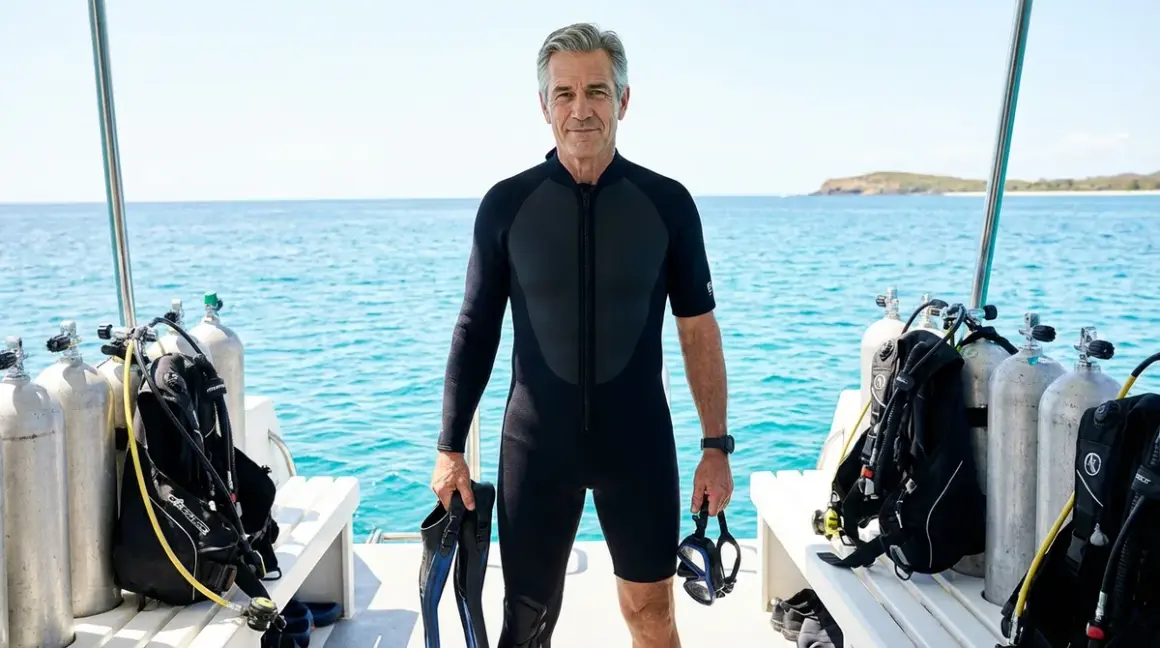

The verdict: Full wetsuits win for any water below 78°F, extended bottom times, or cold-sensitive divers, while shorties excel in 80°F+ tropical shallows where mobility matters more than thermal protection. After 8,000 dives in Florida waters wearing every neoprene configuration imaginable, I've learned that the full wetsuit vs shorty debate boils down to water temperature, dive duration, and your personal cold tolerance—not marketing hype about "four-season versatility."
This comparison covers thermal performance across temperature ranges, mobility and comfort trade-offs, buoyancy compensation requirements, travel logistics, and durability expectations to help you choose the right wetsuit configuration for your diving profile.
Quick Comparison
| Criterion | Full Wetsuit (3mm-7mm) | Shorty (2mm-3mm) |
|---|---|---|
| Ideal Water Temp | 65-78°F (depends on thickness) | 78-86°F+ |
| Thermal Protection | Full-body coverage, 3-7mm neoprene | Torso-only, 2-3mm neoprene |
| Mobility | Restricted shoulder/hip flex | Unrestricted limb movement |
| Weight Required | 6-18 lbs (thickness-dependent) | 2-6 lbs |
| Pack Weight | 4-10 lbs | 1.5-3 lbs |
| Avg. Price Range | around $180–$450 | around $80–$220 |
| Best Use Case | Cold water, extended dives, wreck penetration | Tropical reefs, short dives, snorkeling |
Thermal Protection: Where the Real Differences Show Up
Here's the thing—thermal protection is the entire reason wetsuits exist, and this is where the full wetsuit vs shorty comparison matters most. I've watched too many divers shiver their way through Caribbean reef dives in shorties because some shop told them "80-degree water is warm enough." Water conducts heat 25 times faster than air, and your body loses core temperature long before you feel cold.
A full 3mm wetsuit🛒 Amazon provides continuous neoprene coverage from neck to ankles and wrists, creating a complete thermal barrier. When properly fitted, it traps a thin water layer against your skin that your body heats—that's how neoprene actually works, not through insulation alone. I've done 75-minute dives in 74°F water in a 3mm full and stayed comfortable. The same dive in a shorty would've left me hypothermic by the 40-minute mark.
Shorties expose your limbs entirely—arms below the biceps and legs below mid-thigh get zero neoprene coverage. In 82°F+ water over shallow reefs (30-50 feet), that's perfectly adequate for 45-60 minute recreational dives. But drop the water temp to 76°F or extend your bottom time past an hour, and you'll feel it. Your extremities cool first, then your core temperature starts dropping.
The thickness gradient matters enormously. A 5mm full wetsuit moves your comfortable operating range down to 68-72°F water, while a 7mm full handles 60-65°F before you need a semi-dry or drysuit. Shorties top out around 3mm, and most are 2-2.5mm—they're simply not designed for cold tolerance. I've seen divers wearing shorties in 74°F water abort dives early because they couldn't stop shivering. That's not a comfort issue—that's a safety problem that affects your breathing gas consumption, decision-making, and buoyancy control.
One variable nobody talks about: individual metabolism. I run cold—always have. My dive buddies can wear a 3mm full in 72°F water while I need a 5mm. If you're someone who gets cold easily on land, add 4-6°F to any wetsuit temperature rating. Don't let ego or some arbitrary "guideline" override your actual physiology.
Mobility and Comfort: The Trade-Off Nobody Wants to Admit
Full wetsuits restrict your range of motion—period. Anyone who claims otherwise is selling you something. Neoprene stretches, sure, but when you wrap your shoulders, hips, knees, and ankles in 3-7mm of foam rubber, you're adding resistance to every movement. After four decades of diving, I've accepted that thermal protection and unrestricted mobility are fundamentally incompatible.
Shoulder rotation suffers most. Reaching behind you to adjust a tank valve, managing a camera rig, or just swimming with proper streamlined form—all of it gets harder in a full wetsuit. The thicker the neoprene, the worse the restriction. A 3mm full is manageable; a 7mm full feels like doing calisthenics in a wetsuit-shaped tire. Modern super-stretch neoprene (marketed as "X-stretch" or "Glideskin") helps, but it's still noticeably more restrictive than a shorty or going with just a rash guard.
Shorties eliminate limb restriction entirely. Your arms and legs move through water with minimal resistance, which matters enormously for underwater photography, spearfishing, or any diving that requires precise maneuvering. I've shot thousands of photos in both configurations—when I'm working a macro subject in 82°F water, I'll take a shorty over a full suit every single time. The freedom of movement translates directly to better body position and camera stability.
Zipper placement affects comfort dramatically, and this applies to both styles. Back-zip designs are cheaper and easier to don solo, but they create a neoprene fold across your spine that can cause irritation on long surface swims. Chest-zip configurations distribute stress better and reduce water intrusion, but you need help getting in and out—or the flexibility of a yoga instructor. I've owned both; chest-zips are worth the hassle if you're diving frequently.
Here's something I tell every diver: tight is good, constricting is bad. A properly fitted wetsuit should feel uncomfortably snug on land—like you can't possibly wear it for more than ten minutes. In the water, neoprene compresses and feels perfect. If it's comfortable on land, it's too loose and will flush water constantly, destroying your thermal protection. Shorties follow the same rule, just with less total material to worry about. For guidance on proper fit specifics, check out our detailed article on how to choose a wetsuit.
Buoyancy Impact: Weight System Implications
Every millimeter of neoprene adds positive buoyancy you'll need to counteract with lead. This isn't theoretical—it directly affects your weight system configuration, your BCD's lift capacity requirements, and your gas consumption throughout the dive.
A 3mm full wetsuit typically requires around 6-10 pounds of additional weight compared to diving in just a swimsuit. Move up to a 5mm full and you're looking at around 12-16 pounds; a 7mm full can require around 16-20+ pounds depending on your body composition and the specific neoprene density. That's substantial. I dive a 5mm full in winter Florida water, and I'm wearing around 18 pounds total—compared to around 6 pounds when I'm wearing a shorty in summer.
Shorties add maybe around 2-6 pounds depending on thickness and body coverage. A 2mm shorty might only need around 2-4 pounds, while a thicker 3mm shorty with slightly longer legs could require around 4-6 pounds. The difference between a shorty and a full wetsuit is often 8-12 pounds of lead—enough to change your entire ballast strategy.
Here's what really matters: that extra weight lives on your body the entire dive. It affects your trim, your comfort on surface swims, and your ability to achieve neutral buoyancy at shallow safety stops. I've watched divers struggle to stay down at 15 feet during safety stops because they're over-weighted for their full wetsuit at depth but positively buoyant once that neoprene expands in the shallows. Shorties minimize this buoyancy swing because there's less neoprene to compress and expand.
Neoprene compression with depth also matters. At 60 feet, your wetsuit has lost roughly half its original buoyancy due to compression. At 100 feet, you've lost about 75%. A thicker full wetsuit experiences more dramatic buoyancy changes through your dive profile than a shorty does—which means you're making more frequent BCD adjustments. This isn't a dealbreaker, but it's a real operational consideration if you're doing multi-level dives or working on buoyancy control for underwater photography.
One scenario where this gets genuinely problematic: travel diving with rental gear. You show up in Cozumel with your 5mm full wetsuit, discover the shop only has 10-pound weight belts, and you need around 14 pounds. Now you're either ditching your own wetsuit for a rental or jury-rigging additional weight. A shorty keeps your weight requirements in the range most dive ops expect and accommodate.
Travel and Packing Logistics
If you're diving locally and throwing gear in your truck, this section doesn't matter. But if you're flying to dive destinations—which most recreational divers do multiple times per year—wetsuit bulk and weight become legitimate concerns.
A 5mm full wetsuit weighs around 5-8 pounds dry, depending on size and manufacturer. A 7mm full pushes around 8-10 pounds. Add that to your regulator, BCD, fins, mask, computer, and accessories, and you're easily hitting airline baggage weight limits before you pack a single change of clothes. I've done this dance for decades—every ounce matters when you're trying to stay under 50 pounds for checked baggage.
Shorties weigh around 1.5-3 pounds—light enough that they barely register in your overall gear weight. I can pack a shorty, full mask/snorkel/fins setup, dive computer, and all my camera gear in a single checked bag and still have room for clothing. Try that with a 7mm full wetsuit and you're checking two bags or paying overweight fees.
Bulk is equally problematic. Full wetsuits—especially thicker ones—consume enormous space in dive bags or suitcases. They don't compress well, and you can't really fold them without creating permanent creases in the neoprene. I roll mine loosely and accept that it's eating a third of my bag volume. Shorties fold or roll into a fraction of that space. For more packing strategies, see our dive gear bag packing checklist.
Here's the compromise I see working divers make constantly: ship a full wetsuit to tropical destinations when water temps are borderline. Many Caribbean and Pacific dive resorts sit in that 76-78°F range where a full 3mm would be ideal, but a shorty might work for short dives. If you run cold or plan extended bottom times, the shipping cost beats being hypothermic. If you're warm-blooded and doing standard 45-minute recreational profiles, save the hassle and pack a shorty.
Rinse and dry logistics matter more than people think. A full wetsuit takes 12-24 hours to fully dry in humid tropical climates, even when hung properly on a wide hanger in shade. Shorties dry in around 4-8 hours because there's less material and more surface area relative to volume. If you're diving daily on a liveaboard or multi-day resort trip, you might be donning a still-damp full wetsuit for morning dives. That's cold and uncomfortable—and it accelerates neoprene degradation. For proper care techniques, reference our wetsuit care and maintenance checklist.
Durability and Lifespan: Material Breakdown
Wetsuits degrade—all of them, eventually. Neoprene breaks down from UV exposure, salt accumulation, ozone, compression cycles, and bacterial growth if you don't rinse properly. Understanding how full wetsuits and shorties age differently helps you predict replacement costs over your diving career.
Full wetsuits experience more stress points purely because they have more material and more seams. Shoulder seams, knee panels, and zipper assemblies take repeated flexing stress on every dive. I've blown out shoulder seams on 5mm full wetsuits after 150-200 dives—the stitching just fatigues from constant flexion. Quality construction helps (flatlock vs. glued-and-blind-stitched seams make a huge difference), but physics eventually wins.
Shorties have fewer failure modes because they have less material and fewer seams. No knee panels to blow out, no ankle seals to tear, fewer zipper inches to fail. I've owned shorties that lasted around 300+ dives before the neoprene lost enough elasticity to retire them. That's not a guarantee—cheap shorties with bonded seams will fail fast—but the reduced surface area and simpler construction generally translates to longer service life.
Neoprene thickness affects compression-set degradation. Thicker foam compresses more dramatically under pressure, and repeated compression cycles break down the cell structure faster. A 7mm full wetsuit loses loft and thermal efficiency more rapidly than a 3mm shorty, purely from mechanical fatigue. I've had 7mm suits lose around 20-30% of their thermal performance after two years of frequent use, even with meticulous care.
UV exposure is the silent killer. Neoprene oxidizes under sunlight, becoming brittle and losing elasticity. Full wetsuits hung in direct sun between dives age visibly faster—the exposed back panel fades and stiffens within a season. Shorties suffer the same degradation, but there's less total material to damage. Always dry wetsuits in shade, and store them on wide hangers away from ozone-generating equipment like electric motors.
One often-overlooked factor: body oils and sunscreen. Neoprene absorbs oils from your skin and any lotions or sunscreen you've applied. Over time, this breaks down the foam's cellular structure and causes permanent odor. Full wetsuits have more internal surface area in contact with your skin, so they accumulate more contamination. Rinse thoroughly after every dive—and I mean thoroughly, not a quick spray—and periodically soak in wetsuit-specific cleaner to extract embedded oils.
Who Should Choose a Full Wetsuit
You need a full wetsuit if you're diving in water below 78°F, period. I don't care how warm-blooded you think you are—extended exposure in 72-76°F water will eventually cause hypothermia without proper thermal protection. Full wetsuits are also non-negotiable for deeper dives (80+ feet) where thermoclines can drop temperatures 10-15 degrees below surface readings.
Wreck penetration and cave diving demand full wetsuits regardless of surface temperature. You're moving slower, burning less metabolic heat, and often encountering silty water with suspended sediment that obscures thermoclines. I've done wreck penetrations in the Florida Keys where surface water was 82°F but inside the wreck at 95 feet I hit a 68°F pocket. A shorty would've been dangerous.
If you're a cold-sensitive diver—and there's zero shame in admitting that—wear a full wetsuit even in warmer water. I've dived with plenty of people who wear 3mm full suits in 80°F water and stay comfortable for 60-minute dives. Your comfort and safety matter more than conforming to some arbitrary temperature guideline. Consider a full wetsuit your baseline, especially when comparing wetsuit thickness options like 5mm vs 7mm.
Extended bottom times also favor full wetsuits. Scientific surveys, underwater photography sessions, and technical decompression dives keep you immersed for 90+ minutes. Even in 78°F water, that's enough exposure time for significant heat loss. The longest single dive I've done in warm water was a 140-minute photography session on a reef in 79°F water—I wore a 3mm full and was chilly by the end. A shorty wouldn't have been remotely adequate.
Who Should Choose a Shorty
Tropical diving above 80°F in shallow recreational profiles (45-60 minutes, 30-80 feet) is exactly where shorties excel. If you're diving Caribbean reefs, Red Sea sites, or Indo-Pacific atolls during warm seasons, a 2-3mm shorty provides abrasion protection and modest thermal insulation without the bulk and restriction of a full wetsuit.
Snorkeling-heavy trips strongly favor shorties. If you're spending more time on the surface than underwater—think casual reef tours, family outings, or mixed snorkel/dive itineraries—the unrestricted arm movement and reduced heat retention on the surface make shorties far more comfortable. Full wetsuits overheat fast during surface intervals in tropical sun.
Warm-water freedivers and spearfishers benefit enormously from shorty mobility. The unrestricted shoulder and hip movement translates directly to better streamlining, faster ascents, and reduced fatigue over repeated breath-hold dives. I've shot fish in both configurations—a full wetsuit adds measurable drag and restriction that matters when you're trying to close distance on a skittish grouper.
If you're a frequent tropical traveler doing standard recreational diving, a shorty is your most practical option. It packs light, dries fast, requires minimal weight, and handles 80%+ of warm-water diving scenarios competently. You can supplement with a dive skin or hooded vest for borderline conditions, creating a modular system that travels better than a single thick full wetsuit. For more travel-specific advice, see our guide to the best travel wetsuits.
Frequently Asked Questions
Can you wear a shorty wetsuit in cold water if you add a hooded vest?
No, not safely for extended diving. A hooded vest adds torso and head insulation but leaves your arms and legs exposed to direct water contact, where you'll lose core temperature rapidly in water below 75°F. While adding a vest to a shorty provides more protection than the shorty alone, it's still fundamentally inadequate compared to a proper full wetsuit designed for cold water. I've seen divers try this combination in 70°F water and they're always cold and miserable by the end of the dive—it's a compromise that doesn't actually work. If you need a hooded vest, you need a full wetsuit.
How much weight difference is there between a full wetsuit and shorty?
You'll typically need around 8-12 pounds less weight with a shorty compared to a full wetsuit of similar thickness, though this varies based on neoprene type and your body composition. A 3mm full wetsuit generally requires around 6-10 pounds of weight, while a 3mm shorty needs around 2-6 pounds. Thicker full wetsuits (5mm or 7mm) can require around 12-20 pounds, which is dramatically more than any shorty configuration. This weight difference affects your BCD's required lift capacity, your trim in the water, and your overall comfort—particularly during long surface swims or safety stops where excessive weight becomes fatiguing.
Is a 3mm shorty warm enough for 75-degree water?
For most divers, no—a 3mm shorty in 75°F water will leave you cold on dives longer than around 45 minutes. Water at that temperature is right on the borderline where exposed limbs lose heat faster than your core can compensate, even with torso protection. If you run warm and you're doing short, active dives in 75°F water, you might tolerate it, but I'd never recommend it as standard practice. A 3mm full wetsuit is the appropriate minimum for that temperature range on recreational-length dives. Save the shorty for water 78°F and warmer, where it actually provides adequate thermal protection for typical bottom times.
Bottom Line
The full wetsuit vs shorty debate resolves simply when you match the tool to the job. If you're diving in water below 78°F, doing extended bottom times, penetrating wrecks, or you run cold, you need a full wetsuit—probably 3mm minimum, possibly 5-7mm depending on specific conditions. Shorties work beautifully for warm tropical diving above 80°F with standard recreational profiles, and they're unbeatable for travel weight, pack size, and unrestricted mobility.
I own both. My 5mm full wetsuit handles Florida winter diving and any destination where water temps drop into the low 70s. My 2mm shorty lives in my travel bag for Caribbean and Pacific trips where I know I'm diving consistently warm, shallow reefs. Neither is "better"—they're different tools for different environments.
Don't let anyone tell you a shorty is "versatile enough" for four-season diving. It's not, and believing that marketing nonsense will leave you hypothermic. Equally, don't convince yourself you need a 7mm full wetsuit for 78°F water just because thicker seems safer. Match your thermal protection to actual water temperature, dive duration, and your personal cold tolerance. Everything else is overthinking it.