
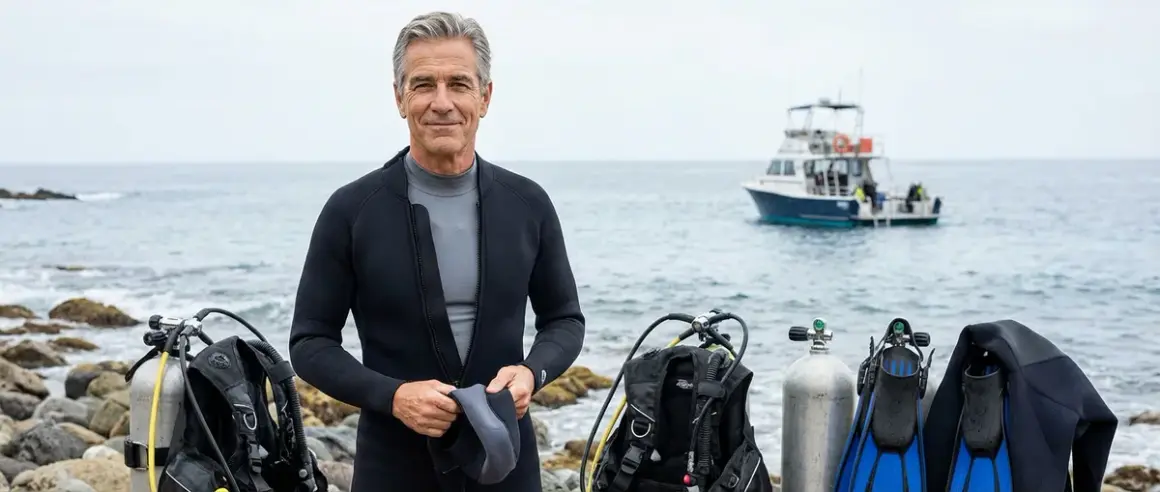

The verdict: Choose a 5mm wetsuit for water temps 70-80°F where mobility matters, and a 7mm for temps below 70°F where cold protection trumps flexibility. I've logged over 8,000 dives across four decades, and here's what I've learned about the 5mm vs 7mm wetsuit debate: most divers get this decision wrong by chasing comfort instead of matching suit thickness to actual thermal protection needs and dive profiles. This article breaks down the technical differences, real-world performance variables, and use-case scenarios so you can pick the right neoprene thickness without wasting money on gear that doesn't match your diving conditions.
Quick Comparison: 5mm vs 7mm Wetsuit
| Factor | 5mm Wetsuit | 7mm Wetsuit |
|---|---|---|
| Water Temp Range | 70-80°F (21-27°C) | 50-70°F (10-21°C) |
| Material Thickness | 5mm neoprene (single or dual-density) | 7mm neoprene (often dual-density with sealed seams) |
| Thermal Protection | Moderate (1-2 hour comfort window) | High (2-4 hour comfort window) |
| Mobility/Flexibility | Excellent range of motion | Restricted movement, especially shoulders |
| Buoyancy Impact | +6-8 lbs additional lead typically needed | +10-14 lbs additional lead typically needed |
| Weight (dry) | 3-4.5 lbs depending on size | 5-7 lbs depending on size |
| Compression at Depth | Loses ~60% thermal protection at 100 feet | Loses ~60% thermal protection at 100 feet |
| Travel Practicality | Packs smaller, dries faster | Bulky, slow to dry, eats luggage space |
| Price Range | Around $200-450 for quality brands | Around $250-550 for quality brands |
| Best Use Case | Tropical/subtropical diving, multi-dive days | Cold water, extended bottom times, night dives |
Thermal Protection: The Real Performance Numbers
Here's the thing nobody tells you at the dive shop: neoprene thickness is only half the equation. I've seen divers shivering in brand-new 7mm suits in 68°F water because they bought cheap open-cell neoprene with poorly sealed seams, while others stayed comfortable for 90-minute dives in 5mm suits with proper fit and quality construction.

Neoprene works by trapping a thin layer of water against your skin, which your body heats. The thicker the neoprene, the more insulation you get—until you descend. At 33 feet (one atmosphere), your wetsuit compresses to roughly 50% of its surface volume. At 99 feet (three atmospheres), it's down to about 25%. That 7mm suit providing toasty warmth at the surface becomes a 3.5mm equivalent at recreational depth limits. This compression is why drysuit divers laugh at anyone doing serious cold-water work in any wetsuit thickness.
The practical difference between 5mm and 7mm translates to about 30-45 minutes of extended comfort in my experience. In 72°F water, a properly fitted 5mm keeps most divers comfortable for 60-75 minutes. A 7mm extends that to 90-120 minutes before you start feeling the chill creep into your core. Below 65°F, the 5mm becomes marginal even for short dives—you'll finish the dive, but you won't enjoy it.
Sealed seams make a bigger difference than most divers realize. Blind-stitched and glued seams reduce water exchange by about 40% compared to flatlock stitching. I've tested dozens of suits over the years, and a well-sealed 5mm outperforms a cheap 7mm every time in the 68-75°F range. Pay attention to seam construction—if the manufacturer doesn't specify blind-stitch or liquid-seal technology, it's probably flatlock, which means cold water pumping through with every movement.
One variable nobody talks about: individual metabolism matters as much as suit thickness. I've guided lean divers who need 7mm suits in 76°F water and stocky cold-water veterans comfortable in 5mm at 62°F. Your body composition, age, and conditioning affect your personal thermal tolerance more than any gear spec sheet admits.
Mobility and Range of Motion: Where You Feel the Penalty
Every millimeter of neoprene costs you flexibility. It's physics, and no amount of "super-stretch" marketing changes the fundamental trade-off. A 5mm suit lets you reach valve knobs, adjust your BCD comfortably, and kick efficiently without fighting the material. A 7mm suit turns simple tasks into cardio workouts.
I tell people the 5mm vs 7mm wetsuit mobility difference shows up most in three areas: shoulder rotation, hip flexion, and ankle range. That extra 2mm across major joint areas creates noticeable restriction. Reaching back to operate a valve, deploying an SMB, or getting into position for underwater photography all require more effort in thicker neoprene. For newer divers still working on buoyancy control, the reduced flexibility of 7mm can make learning proper trim and positioning genuinely harder.
Here's a concrete example from my own diving: During a week-long trip to the Carolinas wrecks, I switched from my usual 5mm to a 7mm for the 64°F bottom temps. First dive on the U-352, I spent twice as much air as normal just managing my gear—the suit fought every movement. By day three I'd adjusted, but I was still working harder than necessary. Meanwhile, the diver next to me in a drysuit looked like she was floating through zero-G. The 7mm worked, but it was never comfortable.
Modern neoprene formulations help—premium suits use limestone-based neoprene with higher stretch ratios (250-300% elongation) compared to cheaper petroleum-based stuff (150-200%). Brands like Scubapro Everflex Wetsuit🛒 Amazon and Henderson Hyperstretch Wetsuit🛒 Amazon actually deliver on flexibility claims. But even the stretchiest 7mm can't match a basic 5mm for unrestricted movement.
The mobility penalty directly affects your air consumption rate. In twenty years of running dive ops, I've watched countless divers surface early in 7mm suits simply because they burned through their gas fighting the neoprene. The extra work increases your breathing rate by 10-20% compared to a properly fitted 5mm in conditions where either would provide adequate thermal protection. If you're diving in the overlap zone (68-72°F), going thinner often extends your bottom time by improving your SAC rate enough to offset the minor thermal trade-off.
Buoyancy Management and Weight Requirements
Nobody warns you about this until you're overweighted and struggling at your safety stop: thicker wetsuits demand substantially more lead, which affects everything from your trim to your BCD lift capacity requirements. The 5mm vs 7mm wetsuit buoyancy difference isn't subtle—it's typically an additional 4-6 pounds of lead on your weight belt or integrated pockets.
A diver properly weighted for a 5mm suit in an aluminum 80 might carry 12-14 lbs of lead. That same diver in a 7mm suit for colder water needs 16-20 lbs to achieve neutral buoyancy. The extra weight affects more than just your gear bag—it changes how your BCD performs, how quickly you can arrest an ascent, and how much you fight to stay down during your safety stop when the tank gets light.
The real pain point comes during descent and at depth. That 7mm suit provides significant positive buoyancy near the surface—you'll struggle to get under initially, which is why you need the extra lead. But as the neoprene compresses with depth, that buoyancy advantage disappears. By 80-100 feet, you're lugging around dead weight (literally) that's no longer providing flotation. I've seen newer divers so overweighted in 7mm suits that they can't maintain neutral buoyancy in the water column without constant finning—that's a buoyancy control disaster and an air consumption killer.
Smart divers conduct proper buoyancy checks in each wetsuit configuration. The standard check—floating at eye level with an empty BCD and normal breath—changes dramatically between 5mm and 7mm. Do not trust your old weight settings when switching suit thickness. I've rescued enough underweighted divers rocketing toward the surface and overweighted divers cratered on the bottom to know that this step gets skipped constantly.
For travel divers, the weight requirement difference creates logistical headaches. Airlines don't care that you need an extra 6 pounds of lead for your 7mm suit—it's still 6 pounds eating into your baggage allowance. A quality travel wetsuit in 5mm packs smaller, weighs less, and requires less additional ballast. The total weight savings (suit plus reduced lead requirement) often hits 8-10 pounds, which is the difference between one checked bag and two on many carriers.
Use Case Scenarios: Matching Thickness to Real Diving Conditions
The 5mm vs 7mm wetsuit decision comes down to honest assessment of your actual diving conditions, not where you wish you were diving. I've met too many divers who bought 7mm suits for "just in case" cold water trips they never take, then suffered through every tropical dive in excessive neoprene.
Choose 5mm if you're diving:
- Florida Atlantic coast, Keys, Gulf waters (typical 74-82°F surface temps)
- Caribbean and tropical Pacific destinations where water rarely drops below 76°F
- Multiple dives per day where mobility and quick surface intervals matter
- Warm-water photography work where you need unrestricted arm movement
- Travel diving where luggage space and weight are premium concerns
- Summer conditions in California, Mediterranean, or other subtropical zones
Choose 7mm if you're diving:
- Pacific Northwest waters (typical 45-55°F year-round)
- North Atlantic coast outside summer months
- California cold water except peak summer
- Night dives or extended bottom times where core temp preservation is critical
- Deeper recreational profiles (80-130 feet) where compression happens faster
- Any condition where you've been consistently cold in thinner neoprene
Here's what I tell customers at the shop: if water temperature is consistently above 72°F, 5mm is the correct choice for most divers. Between 65-72°F, your personal cold tolerance, dive duration, and activity level determine the right thickness. Below 65°F, you need either a well-fitted 7mm or you should be considering a drysuit instead.
The gray zone causes the most confusion. I dive North Florida springs that hold steady at 68-72°F year-round. In my younger years, I'd do two-tank morning dives in a 5mm without issue. Now in my sixties, my metabolism has shifted—I reach for the 7mm for anything below 70°F and bottom times over an hour. Your mileage will vary based on age, body composition, and how hard you're working underwater.
One scenario where 7mm consistently wins: any diving involving limited movement. If you're doing scientific survey work, underwater archaeology, or any activity requiring you to hold position in current or hover motionless for extended periods, the extra thermal protection becomes essential. Your body generates far less heat when you're not actively swimming, and the neoprene thickness difference matters significantly.
Who Should Choose 5mm Wetsuit
Buy a 5mm wetsuit if you're primarily a warm-water recreational diver who values mobility, travel convenience, and comfort during multi-dive days. This is the sweet-spot thickness for Caribbean dive vacations, Florida diving, summer California diving, and most liveaboard destinations. The 5mm delivers adequate thermal protection in the 70-82°F range where most sport diving happens, while maintaining the flexibility you need for comfortable diving and good buoyancy control.
Travel divers especially benefit from 5mm suits—they pack smaller in your dive gear bag, dry faster between dive days, and require less lead, reducing your total baggage weight. If you're flying to dive destinations more than twice a year, the 5mm pays for itself in reduced airline hassles.
Who Should Choose 7mm Wetsuit
Invest in a 7mm wetsuit if you regularly dive in water temperatures below 70°F, do extended bottom times, or dive locally in cold-water regions. Pacific Northwest divers, New England cold-water enthusiasts, and anyone doing serious California diving outside peak summer needs the extra thermal protection. The 7mm is also the right choice for night diving, deep profiles where you're descending quickly into colder thermoclines, or any situation where being cold will end your dive early and waste the boat fee you paid.
Larger divers and those who naturally run cold should consider 7mm even in moderate temperatures. If you're consistently the first person on the boat complaining about being cold in conditions where others seem fine, thicker neoprene is a legitimate solution. Better to have the protection and not need it than to suffer through cold dives in inadequate gear.
Frequently Asked Questions
Can you wear a 7mm wetsuit in warm water, or will you overheat?
Yes, you can wear a 7mm wetsuit in warm water, but you'll be uncomfortably hot on the surface and during shallow portions of the dive. In water above 78°F, a 7mm suit causes most divers to overheat during entries, safety stops, and surface swims—you'll feel flushed, breathe harder, and potentially increase your risk of dehydration. The only scenario where 7mm makes sense in warm water is if you're doing repetitive deep dives with very short surface intervals where you're spending minimal time in the warm surface layer.
How much does neoprene compress at depth, and does that affect the 5mm vs 7mm decision?
Neoprene loses approximately 50% of its thickness at 33 feet (one atmosphere) and about 75% at 99 feet (three atmospheres) due to water pressure compressing the gas bubbles that provide insulation. This means your 7mm suit performs like a 3.5mm at 33 feet and roughly a 1.75mm at 100 feet. The compression affects both thicknesses equally in percentage terms, so the 7mm still provides more absolute insulation at depth than a 5mm—it just provides less protection than you'd expect based on surface performance. For deep diving below 80 feet in cold water, this compression factor is why many experienced divers skip wetsuits entirely and use drysuits instead.
What water temperature is the crossover point where you should switch from 5mm to 7mm?
The crossover temperature is 68-72°F for most divers, but personal factors like body composition, metabolism, age, and planned dive duration matter more than a single magic number. If you run cold, make the switch at 72°F; if you have good natural insulation and stay active underwater, you can stretch a 5mm down to 65°F comfortably. The best approach is to track your actual thermal comfort across different conditions—if you're ending dives early because you're cold, or if you're shivering during safety stops, you need thicker neoprene regardless of what the thermometer says.
Bottom Line
The 5mm vs 7mm wetsuit choice isn't about which is "better"—it's about honest matching of neoprene thickness to your actual diving conditions. I've watched four decades of divers make this decision, and the pattern is clear: most recreational divers are better served by a quality 5mm suit for the 70-80°F waters where they actually dive, rather than suffering through a bulky 7mm they bought "just in case." The 5mm provides adequate thermal protection for the majority of warm-water diving worldwide, with significantly better mobility, easier buoyancy management, and genuine travel practicality.
But if you're genuinely diving cold water—Pacific Northwest, North Atlantic, California outside summer, or anywhere you've been consistently cold in thinner neoprene—the 7mm is absolutely the right call. Cold ruins dives faster than any other equipment factor. Don't let anyone shame you into inadequate thermal protection because they think you should be "tough enough" for thinner neoprene.
Here's my real-world advice after thousands of dives in both: own the suit that matches where you actually dive 80% of the time, not where you dream about diving someday. For most sport divers reading this, that's a 5mm. For more information on selecting the right wetsuit for your specific needs, check out our complete guide on how to choose a wetsuit for scuba diving.
The water doesn't care about your ego—it'll steal your core temperature at a predictable rate based on physics and neoprene thickness. Match your gear to the conditions, conduct proper buoyancy checks when switching between suits, and maintain your wetsuit properly following our wetsuit maintenance checklist to maximize thermal performance regardless of which thickness you choose.