
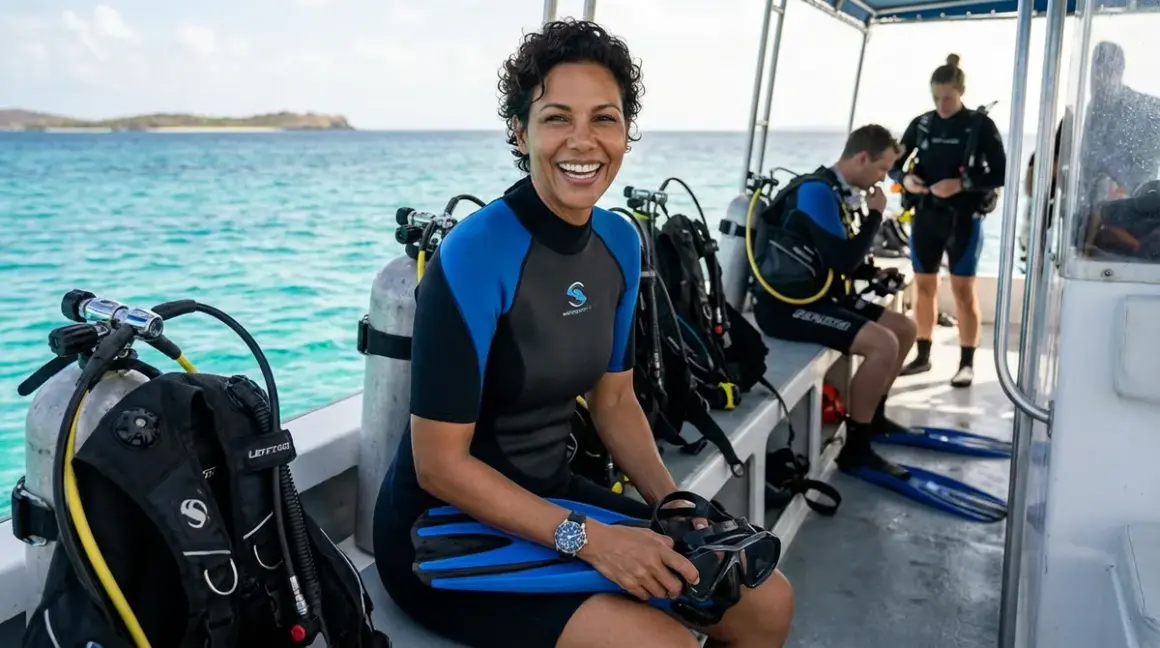

I still remember the panic I felt trying to cram my 7mm wetsuit into my already-overweight dive bag for my first international dive trip. The thing took up half my suitcase, and I ended up paying overweight baggage fees that cost almost as much as the flight itself. That's when I learned the hard way that having a proper best travel wetsuit isn't just about convenience—it's about making your dive trips actually enjoyable from the moment you pack to the second you slip into the water.
After three years of diving across Central America and the Caribbean, I've tested enough wetsuits to know what separates a genuine travel-friendly suit from one that just claims to be packable. The best travel wetsuit needs to fold down small, dry quickly between dives, provide adequate thermal protection, and still feel comfortable enough that you're not wrestling with it on a rocking boat. In this guide, I'm sharing the suits that actually deliver on those promises, along with what I wish someone had told me before I bought my first (very wrong) wetsuit for travel.

What to Look For in a Travel Wetsuit
When I first started looking for a travel wetsuit, I thought "thin equals travel-friendly" and bought the lightest thing I could find. I froze on my first dive in it. Turns out, choosing a travel wetsuit is way more nuanced than just grabbing the thinnest option and calling it a day.
Neoprene Thickness and Material Type
The sweet spot for most tropical travel diving is 3mm thickness, but here's what confused me at first—not all 3mm neoprene is created equal. Standard neoprene is bulkier and takes longer to dry, while newer super-stretch materials compress better and pack smaller. I learned to look for Yamamoto neoprene or similar high-grade materials that offer the same warmth with less bulk.
For water temperatures between 78-84°F (which covers most of the Caribbean and Southeast Asia), a 3mm suit works perfectly. If you're diving somewhere like the Maldives where water temps sit above 84°F, you can get away with a 2mm or even a 1.5mm suit. But if you're like me and tend to get cold easily, or if you're planning multiple dives per day, stick with 3mm—hypothermia is not worth the few ounces you'll save.
The material construction matters more than I initially realized. Limestone-based neoprene is more eco-friendly and often more flexible than petroleum-based options, and it tends to compress better for packing. I also look for suits with minimal glued-and-blind-stitched seams rather than flatlock stitching, because they're warmer without adding bulk.
Packability and Weight
This is the make-or-break factor for travel wetsuits. A suit that "packs down" but still takes up a quarter of your luggage isn't really travel-friendly. I learned to actually measure—a good travel wetsuit should fold down to roughly the size of a sweatshirt, maybe slightly larger.
Dry weight is crucial. My current travel suit weighs around 2.2 pounds, while my old 5mm suit was over 5 pounds. That difference adds up fast when you're trying to stay under airline weight limits, especially when you're also packing camera equipment like I usually am.
The cut and design affect packability too. Full suits with back zippers tend to compress better than suits with chest zippers because there's less thick zipper material. Also, suits without excessive panels and seams fold more easily. I once had a suit with reinforced knee pads that seemed great until I realized those stiff panels made it impossible to fold compactly.
Drying Speed
Nothing is worse than packing a damp wetsuit for a flight, then opening your bag to find everything smells like a marine biology lab. Quick-dry linings are non-negotiable for travel suits. Look for materials labeled as "fast-dry" or "quick-dry interior"—they're usually made from smooth or plush nylon linings that wick moisture away.
The exterior finish matters too. Smooth-skin neoprene dries faster than standard textured neoprene, but it's also more delicate and prone to tearing. I prefer a nylon-covered exterior that's durable enough to handle being stuffed in bags while still drying relatively quickly—usually within 3-4 hours if you hang it properly.
Thickness affects drying time more than most people realize. A 5mm suit might take overnight or longer to fully dry, while my 3mm travel suit is usually dry within a few hours, even in humid climates. That means I can do a morning dive, rinse my suit, and have it dry enough to pack by evening if needed.
Fit and Flexibility
I made the mistake of ordering my first travel wetsuit online without trying it on, thinking "small should fit." Wrong. A travel wetsuit needs to fit snugly without restricting movement, and different brands fit completely differently. Stretch zones in the shoulders, knees, and lower back are essential—especially if you're doing any underwater photography work where you need full range of motion.
The seam construction affects both comfort and durability. Flatlock seams are less bulky but allow some water flushing, which makes them better for warmer water where you don't need maximum warmth. Glued-and-blind-stitched (GBS) seams are warmer but slightly bulkier. For tropical travel, I prefer flatlock or minimal GBS.
Pay attention to the zipper placement and quality. Back zippers are easier to pack but harder to get into by yourself. Chest zippers are more convenient for solo travel but add bulk. I've settled on back zippers with a long pull cord—they pack better, and I can manage them myself with practice.
Durability for Regular Travel
Travel is rough on gear. Your wetsuit will get stuffed in bags, potentially sat on, dragged across boats, and generally abused more than if it lived in your garage at home. I learned this when my first "ultra-lightweight" travel suit developed a tear after just three trips.
Look for reinforced stress points at the shoulders, knees, and seat. These areas take the most abuse when you're kneeling on boat decks or adjusting your BCD repeatedly. The reinforcement should be tough but not so thick that it affects packability.
The zipper quality is critical. A broken zipper on a dive trip basically means you're renting a wetsuit for the rest of your vacation. YKK zippers are the gold standard—they cost more but they don't fail. I also check that zipper sliders are metal rather than plastic, and that there's a protective flap over the zipper to prevent snags.
Additional Features Worth Considering
Ankle and wrist seals might seem like a minor detail, but they make a huge difference in water flushing. I prefer suits with adjustable ankle closures—they keep water out better and are easier to get on and off than super-tight non-adjustable cuffs.
Integrated hood vs. separate hood is a personal choice. For tropical travel, I almost never need a hood, so I prefer suits without them—it's one less thing to pack. If you dive somewhere that occasionally requires a hood, bringing a separate thin hood is usually more versatile than having an integrated one you can't remove.
Some suits come with key pockets or small storage pockets, which can be handy but also add bulk and potential weak points. I skip these on travel suits—I'd rather have a simpler, more packable design.
Our Top Picks
Patagonia R2 Yulex Front-Zip Full Wetsuit (2mm)
The Patagonia R2 Yulex Front-Zip Full Wetsuit (2mm)🛒 Amazon completely changed how I think about eco-friendly diving gear. Made from 85% natural Yulex rubber instead of petroleum-based neoprene, it's surprisingly warm for its 2mm thickness and packs down smaller than any other suit I've used. The front-zip design makes it easy to get in and out of by yourself, and the stretch is phenomenal—I honestly forget I'm wearing it sometimes.
Pros:
- Incredibly packable—folds down to about the size of a rolled t-shirt
- Fast-drying recycled polyester lining gets completely dry in 2-3 hours
- Front zip is easy to manage solo and doesn't create a pressure point when wearing a BCD
- Surprisingly warm for 2mm; I've used it comfortably in 80°F water for 3-4 dives per day
- Environmentally conscious construction without compromising performance
Cons:
- The thinner material shows wear faster than standard neoprene—I've noticed some pilling after around 60 dives
- Front zipper adds slight bulk to the chest area, though it's minimal
- Price point is higher than synthetic options, which hurt when I was starting out on a budget
- Sizing runs smaller than average; I had to size up from my usual
Scubapro Everflex Steamer 3/2mm
The Scubapro Everflex Steamer 3/2mm🛒 Amazon is the suit I actually travel with most often now. It's that perfect balance between warmth, packability, and durability that's hard to find. The S-Foam neoprene is lighter and more compressible than standard neoprene, and the 3mm body with 2mm arms gives you warmth where you need it without excess bulk in your shoulders.
Pros:
- Excellent warmth-to-weight ratio—stays comfortable in water from 75-82°F
- Reinforced knee pads are genuinely useful without being bulky
- Back zipper with long pull cord makes solo donning manageable
- Dries faster than similar 3mm suits, usually within 4 hours
- X-Foam panels in high-stretch areas provide great mobility for photography work
Cons:
- The neck seal is pretty snug—it took me a few dives to get used to it
- Back zipper can be tricky if you're traveling completely solo and have no one to help
- Slightly heavier than 2mm options at around 2.8 pounds dry weight
BARE Velocity Ultra 3mm Full Suit
The BARE Velocity Ultra 3mm Full Suit🛒 Amazon I borrowed from a dive buddy for a trip to Cozumel impressed me enough to add it to my own collection. The Elastek full-stretch neoprene means you don't feel restricted even during long dive days, and the progressive stretch design puts the most flexibility exactly where you need it—shoulders, lower back, and knees.
Pros:
- Phenomenal stretch and mobility—best I've tried for underwater photography positioning
- Flatlock seams lie completely flat under a BCD with no pressure points
- Form-fitting cut eliminates excess water retention that adds weight
- Durable construction has held up well to frequent packing and travel abuse
- Neutral buoyancy characteristics mean less weight adjustment when switching between this and a thicker suit
Cons:
- Flatlock seams mean slightly more water circulation, which some divers might find too cool
- The super-tight fit makes it challenging to get into when it's dry—I've learned to use a bit of wetsuit conditioner
- Smooth skin panels on the chest and back dry fast but are prone to fingernail tears during donning
Cressi Lido Lady 2mm Wetsuit
As someone who struggled to find women's-specific suits that actually fit properly, the Cressi Lido Lady 2mm Wetsuit🛒 Amazon had to be included. The anatomically correct cut for women makes a huge difference in comfort, and at 2mm it's ideal for warm-water destinations where you just need a bit of sun and sting protection.
Pros:
- True women's-specific fit through the chest, waist, and hips—no gapping or binding
- Ultra-lightweight at around 1.8 pounds dry; barely noticeable in your bag
- Budget-friendly price point perfect for newer divers building their travel kit
- High-quality YKK back zipper has been completely reliable through 40+ dives
- Available in multiple colorways so you can spot your gear easily
Cons:
- 2mm is legitimately too thin for anything below 78°F or for divers who get cold easily
- Material quality is decent but not premium—I've had to repair a small seam separation after heavy use
- Shorter torso length might not work for taller women; check measurements carefully
Aqua Lung HydroFlex 3mm Jumpsuit
The Aqua Lung HydroFlex 3mm Jumpsuit🛒 Amazon keeps showing up in dive shops across Central America, and there's a good reason for that—it just works. The Aqua Lung 4-way stretch fabric combined with their Powertex kneepads creates something durable enough for dive professionals while still being packable enough for traveling recreational divers.
Pros:
- Exceptional durability—this suit takes a beating and keeps performing
- Glideskin chest panel significantly reduces wind chill on surface intervals
- Solid 3mm thickness provides reliable warmth for most tropical diving
- Good quality-to-price ratio; not the cheapest but delivers strong value
- Unisex sizing works well for a wide range of body types
Cons:
- Heavier than some competitors at around 3.2 pounds dry weight
- Glideskin panels, while functional, require more care to avoid damage
- Takes longer to dry than fast-dry competitors—plan on 5-6 hours minimum
- Some users find the ankle zippers a bit finicky; I've had to wiggle mine more than I'd like
Scubapro Hybrid 2.5mm Women's Wetsuit
The Scubapro Hybrid 2.5mm Women's Wetsuit🛒 Amazon is a newer addition that caught my attention because of its hybrid thickness design—3mm in the core, 2mm in the limbs. It's a smart compromise that gives you warmth where hypothermia actually happens (your torso) while maintaining flexibility and packability in your arms and legs.
Pros:
- Hybrid thickness concept works brilliantly for variable tropical conditions
- Excellent shoulder mobility for camera work and equipment management
- Smooth skin back panel dries incredibly fast compared to standard neoprene
- Women's cut is well-designed without weird proportions
- Packs down smaller than uniform 3mm suits due to thinner arm sections
Cons:
- Smooth skin back panel is delicate—I put a small tear in mine within the first month
- Fit is very specific; size carefully or try before buying if possible
- Higher price point than some competitors with similar specs
- Limited availability in some regions; I had to order mine online
Frequently Asked Questions
What thickness wetsuit do I need for travel diving?
For most tropical travel destinations with water temperatures between 78-84°F, a 3mm wetsuit provides the best balance of thermal protection and packability. If you're diving consistently warm locations above 84°F like the Maldives or summer Red Sea diving, you can comfortably use a 2mm suit. I personally get cold easily, so even in 82°F water I prefer 3mm for multiple dives per day—hypothermia sneaks up on you when you're doing 3-4 dives daily. If you're traveling to destinations with more variable temperatures or doing deep dives where thermoclines drop the temperature significantly, consider a 5mm suit, though you'll sacrifice some packability. The key is knowing your own cold tolerance and the specific conditions where you'll be diving.
How do I pack a wetsuit to save luggage space?
The trick I learned after too many overweight baggage fees is to fold your wetsuit in thirds lengthwise first, then roll it tightly from the feet up, squeezing air out as you go. This creates a compact cylinder that fits easily along the edge of your dive bag. Never try to fold a wetsuit into a square—rolling is always more compact. If your suit is slightly damp, put it in a plastic bag to protect other gear, but try to get it as dry as possible before packing. I also pack my wetsuit last, using it to fill irregular spaces around hard items like my dive computer and regulators. Some travel wetsuits come with compression stuff sacks, but honestly, a regular packing cube works just as well and costs way less. For really tight packing situations, you can even wear your wetsuit as a layer during travel, though that looks pretty weird at the airport.
Can I use a travel wetsuit for cold water diving?
Travel wetsuits are specifically designed for tropical and warm temperate diving, so using one for actual cold water diving below 65°F isn't a great idea—you'll be uncomfortable at best and dangerously hypothermic at worst. Most travel suits are 2-3mm thickness, which simply doesn't provide adequate insulation in cold conditions. If you need genuine cold water capability, you need at least a 5mm suit or should consider a drysuit. That said, I've successfully used my 3mm travel suit in 70-75°F water that some people might consider "cool"—it depends on your personal cold tolerance, dive duration, and activity level. If you're doing photography work where you're stationary underwater, you'll get cold faster than someone swimming actively. For borderline temperatures, adding a thin hooded vest under your 3mm travel suit can extend its usable range by 5-10°F without completely sacrificing packability.
How long does a travel wetsuit typically last?
With proper care, a quality travel wetsuit should last anywhere from 100-150 dives or about 3-5 years of regular recreational diving, though this varies significantly based on how well you maintain it and how often you're stuffing it in luggage. Travel suits typically wear out faster than suits that stay at home because of the extra stress from frequent packing, but that's the trade-off for portability. I've found that zipper failure is usually the first problem, followed by seam separation or material thinning in high-wear areas like knees and elbows. UV exposure and chlorine from post-dive pool sessions also degrade neoprene faster than saltwater alone. To maximize longevity, rinse your suit thoroughly in fresh water after every dive day, dry it completely in shade (never direct sun), and store it on a wide hanger rather than folded. Check out our wetsuit maintenance guide for specific care instructions that can easily double your suit's lifespan. I also avoid using the same suit for multiple dive trips in quick succession if possible—giving neoprene time to fully dry and decompress between trips helps maintain its elasticity.
Should I buy a full suit or shorty for travel?
For most tropical travel diving, a full 3mm suit is more versatile than a shorty, even though a shorty packs slightly smaller. Full suits protect your entire body from sun exposure, stings, and scrapes, which matters more than I initially realized—especially after I got a jellyfish sting on my calf during a dive in a shorty. Full suits also provide better thermal protection for morning dives, deeper dives, or when you're doing 3+ dives daily and your body temperature drops cumulatively. That said, if you're exclusively diving in extremely warm water above 84°F, doing single-tank shallow reef dives, or diving somewhere like Hawaii where many locals wear only board shorts, a shorty or even a spring suit makes sense. I personally travel with a full 3mm suit because the versatility is worth the slightly larger packed size—I'd rather have too much thermal protection than not enough, since you can always vent a full suit if you're warm, but you can't add coverage to a shorty if you're cold. Weight and space savings between a quality full suit and shorty are minimal anyway, maybe half a pound and a couple inches of packing space.
The Verdict
Finding the best travel wetsuit completely transformed my dive trips—I went from dreading the packing process to actually enjoying the convenience of having gear that works with my travel style instead of against it. After testing numerous options across dozens of dive trips throughout Central America and the Caribbean, my top recommendation for most traveling recreational divers is the Scubapro Everflex Steamer 3/2mm. It hits that sweet spot of adequate warmth, excellent packability, and real durability that justifies its mid-range price point.
If you're diving exclusively in warm water above 80°F and want the absolute most packable option, the Patagonia R2 Yulex is worth the investment despite its higher cost. For newer divers on a budget who are just starting to build their travel kit, the Cressi Lido Lady (or men's equivalent) offers solid performance without a huge financial commitment.
The honest truth is that your ideal travel wetsuit depends on your specific body type, cold tolerance, and where you're actually diving—not just marketing claims about "travel-friendly" features. Take the time to figure out your actual needs using the buying criteria I outlined, and don't be afraid to ask to try on suits at your local dive shop before committing. Your wetsuit should feel like a second skin, not a stuffed sausage casing or a loose bag. When you find the right one, travel diving becomes so much more enjoyable that you'll wonder why you waited so long to upgrade.