
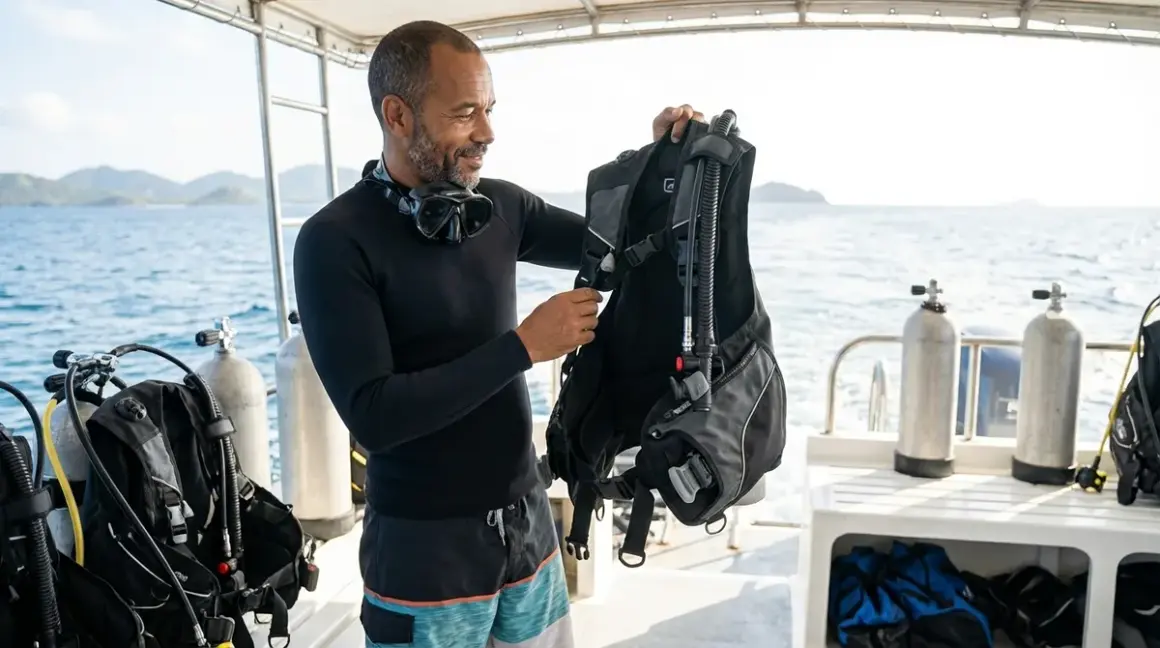

I've watched too many divers haul 40-pound BCDs onto liveaboards only to realize they're doing four dives a day for a week straight. By day three, their shoulders are screaming, their gear takes forever to dry in humid cabin quarters, and they're eyeing everyone else's streamlined travel setups with envy. Finding the best travel BCD liveaboard setup isn't just about saving baggage fees—it's about diving comfortably when you're logging 20+ dives over seven days in remote locations where equipment failure means sitting out the rest of your trip.
Quick verdict: The best travel BCDs for liveaboard diving weigh under 6 pounds, pack into carry-on luggage, maintain full lift capacity (22-30 lbs), and dry quickly between dives. Back-inflate designs dominate this category for their streamlined profiles and reduced bulk, though a few hybrid models earn their weight for divers who prefer jacket-style stability.

What to Look For in a Travel BCD for Liveaboard Diving
Packed Weight and Dimensions
Here's what actually matters: your BCD needs to fit in a scuba travel bag without eating your entire weight allowance. Most liveaboards run from remote ports—Raja Ampat, the Maldives, Socorro—where you're dealing with multiple connecting flights and strict baggage limits. I target BCDs under 5.5 pounds that roll into a 12x8-inch bundle.
The construction material drives this metric. Look for 420-denier nylon or Cordura variants rather than thick 1000-denier materials. Some manufacturers use thermoplastic laminate bladders instead of traditional polyurethane, shaving 8-12 ounces. The Scubapro Hydros series, for example, uses injection-molded components that collapse almost flat.
Weight savings can't compromise lift capacity—you still need 22-30 pounds of lift depending on your exposure suit and tank configuration. A 3mm wetsuit and aluminum 80 needs less compensation than a 5mm suit with a steel tank. Calculate your actual buoyancy requirements before prioritizing ultralight designs that might leave you struggling at the surface. I've seen divers buy 18-pound-lift travel BCDs for tropical diving, then get stuck when the liveaboard only offers steel 12-liter tanks.
Drying Speed and Material Drainage
Four dives a day means your BCD lives in a perpetual damp state. Traditional BCDs with thick padding and closed-cell foam can stay wet for 18+ hours in humid tropical conditions—exactly the environment where bacteria and salt crystallization destroy internal bladders.
Quick-dry mesh backing and perforated padding are non-negotiable for liveaboard use. Some designs use 3D spacer mesh that allows airflow against your back, cutting dry time from overnight to 4-6 hours. The bladder material also matters: modern 210-denier ripstop nylon with urethane coating dries 30-40% faster than older polyurethane designs.
After each dive day, you need to rinse internally and externally. BCDs with large-diameter inflator openings (12mm+) drain faster and allow better freshwater flushing. I religiously hang mine upside down with the inflator disconnected—salt crystal buildup in the oral inflator mechanism is how most inflator buttons fail mid-trip. Check our BCD maintenance checklist for detailed cleaning protocols that matter even more on multi-day liveaboards.
Modularity and Redundancy Features
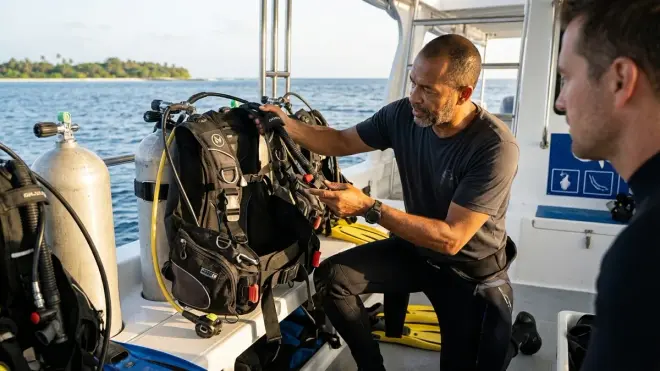
Liveaboards operate far from dive shops. If your integrated weight pocket releases underwater or your shoulder buckle snaps, you're done diving until the next port—which might be five days away. The best travel BCD liveaboard configurations include:
- Replaceable buckles (standard release clips, not proprietary designs)
- Dual bladder systems or easy field repair patches
- Weight integration with secure locking mechanisms (look for Cam-lok or Sure-Lock style retention)
- Accessible dump valves (minimum three: shoulder, rear, and hip)
I carry a redundancy kit with spare D-rings, a backup oral inflator mouthpiece, and marine-grade adhesive. But your BCD should use common hardware that's repairable with basic tools. Scubapro and Zeagle use standard marine-grade brass and stainless steel components; some budget brands use injection-molded plastic that's impossible to fix at sea.
Trim and Stability Across Dive Profiles
Liveaboards often feature diverse diving—deep walls, shallow reefs, strong currents, night dives—sometimes all on the same day. Your BCD needs to maintain horizontal trim whether you're drifting at 15 feet in a 3mm shorty or descending to 100 feet in a 5mm wetsuit.
Back-inflate BCDs dominate travel categories because they position lift behind your center of gravity, promoting face-down trim without constant finning. But they require good buoyancy control skills—overinflate at the surface and you'll tip forward. If you're a newer diver (under 50 logged dives), consider hybrid designs with small front lift cells (3-5 lbs) that provide surface stability without the bulk of full jacket BCDs.
D-ring placement affects how you carry accessories—cameras, lights, SMBs, spare masks. Look for at least two stainless steel shoulder D-rings, two hip D-rings, and one rear butt D-ring for stage rigging if you're doing any light technical diving. Some liveaboards in places like Palau or Bikini Atoll cater to mixed recreational and technical groups, so extra attachment points add versatility without weight.
Travel-Specific Engineering Details
This is where manufacturers either nail it or completely miss the point. The best designs include:
Tool-free adjustability: Shoulder straps and cummerbunds that adjust without buckle threading—critical when you're sharing cabin space with three other divers and changing in semi-darkness pre-dawn.
Corrosion resistance: Marine-grade anodized aluminum or titanium for any metal components. I've seen chrome-plated brass corrode through on week-long Red Sea trips.
Compact bladder design: Internal bungee systems that compress the bladder against your back when deflated, reducing drag and the "winged" look that catches current.
Integrated trim pockets: Secure locations for 1-2 pounds of non-ditchable ballast, useful for fine-tuning when you're stuck with unfamiliar rental tanks.
For more context on how different BCD styles affect diving posture and control, see our guide on jacket BCD vs back inflate BCD designs.
Our Top Picks
Scubapro Hydros Pro
The Scubapro Hydros Pro BCD🛒 Amazon remains the benchmark for travel BCDs five years after its radical redesign. It uses a gel-padded backplate system with injection-molded Monprene components that flex with your body, then return to shape. Packed weight is 4.8 pounds for a size medium, with 24 pounds of lift from a 210-denier nylon bladder that dries in under six hours.
Pros:
- Gender-specific sizing with independently adjustable shoulder/waist sections eliminates the "one size fits nobody" problem
- Modular weight system accepts standard pockets, integrated trim pockets, and belt slots simultaneously
- Tool-free adjustment system works with wet, cold hands
- Five heavy-duty D-rings (two shoulder, two hip, one rear) in marine-grade stainless steel
- Neutrally buoyant design adds zero weight at depth
Cons:
- The injection-molded components look futuristic, which apparently means "expensive"—you're paying a premium for the engineering
- Some divers find the gel padding too firm during the first 10-15 dives before it conforms to their body shape
- The modular system means more pieces to track if you remove components for ultra-light packing
I've used the Hydros Pro on liveaboards from Indonesia to Egypt. The quick-dry capability is legitimate—after a night dive, it's genuinely dry by morning. The adjustability matters more than I expected; I loaned it to a divemaster who's 40 pounds lighter than me, and she had it properly fitted in under two minutes.
Zeagle Zena
The Zeagle Zena BCD🛒 Amazon took a different approach to travel BCD design: wraparound bladder construction that integrates the weight system directly into the structure. At 4.2 pounds with 24-pound lift capacity, it's one of the lightest full-featured BCDs available. The Soft Touch system uses hook-and-loop adjustment panels rather than traditional buckles.
Pros:
- Exceptional packed-to-performance ratio: 4.2 lbs delivers the same lift as BCDs twice its weight
- Wraparound bladder eliminates shoulder pressure points and distributes squeeze evenly
- Made in Florida using 420-denier packcloth with reinforced wear points—replacement parts ship globally
- Three-position lumbar adjustment system actually works for different torso lengths
- Includes dedicated knife attachment point and multiple low-profile D-rings
Cons:
- The hook-and-loop adjustment system requires more initial setup time than buckles
- The wraparound design makes oral inflation slightly awkward compared to traditional shoulder inflators
- Not ideal for cold-water diving with thick exposure suits—the wraparound bladder provides less insulation gap
I watched a photographer use this BCD through 28 dives over six days in Raja Ampat. She'd stuff it in her carry-on with her strobes, and it actually dried fully overnight even in 85% humidity. The wraparound design surprised me—it maintains horizontal trim better than I expected, though you need decent buoyancy skills to avoid the face-plant tendency at the surface.
Cressi Travelight
The Cressi Travelight BCD🛒 Amazon is the budget option that doesn't dive like one. At 4.6 pounds with 22-pound lift capacity, it targets tropical liveaboard divers who don't need heavy-duty cold-water capability. The back-inflate design uses a single-bladder construction with nylon ripstop fabric that packs down to roughly the size of a wetsuit.
Pros:
- Genuinely affordable without sacrificing core functionality—usually around half the price of premium travel BCDs
- Simple mechanical design means fewer failure points and easier field repairs
- Quick-release weight pockets accommodate up to 20 pounds total (10 per pocket)
- Shoulder dump valve placement actually makes sense for your natural arm position
- Color options beyond basic black (matters if you're trying to spot your gear on a crowded liveaboard deck)
Cons:
- The minimal padding means you feel tank weight more directly on your shoulders and hips
- Single bladder offers no redundancy—bring a proper repair kit
- Integrated weight pockets use a basic loop system that's less secure than cam-lock designs on premium BCDs
- D-ring placement is functional but not optimal for heavy accessory loads
This is the BCD I recommend to newer divers planning their first liveaboard who aren't ready to invest in premium gear. It does everything you need in tropical water with aluminum tanks and 3mm exposure suits. I wouldn't trust it for week-long Socorro trips with steel tanks and 5mm suits, but for Maldives or Caribbean liveaboards, it's entirely adequate.
Apeks Black Ice
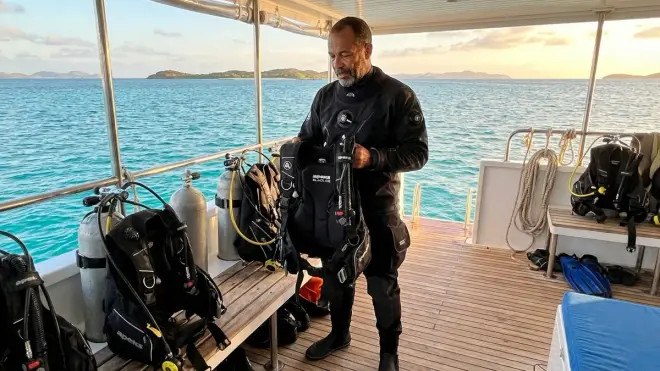
The Apeks Black Ice BCD🛒 Amazon is technically a cold-water BCD, but its construction makes it an exceptional travel option for divers who hit both tropical and temperate destinations. At 5.8 pounds with 32-pound lift capacity, it's heavier than pure travel designs but offers capabilities the others don't. The 420D Nylontek Pro Cordura construction uses ballistic-grade materials with Kevlar reinforcement at stress points.
Pros:
- 32-pound lift handles heavy steel tanks and thick exposure suits without struggle
- Wrapture harness system (like Zeagle's) but with cold-water padding that's removable for tropical diving
- Seven stainless steel D-rings support serious camera rigs and technical configurations
- The bladder uses RF welding (radio frequency) rather than gluing—virtually eliminates seam failures
- True cold-water capability with materials rated to 38°F without bladder stiffening
Cons:
- At 5.8 pounds, it pushes the upper boundary of "travel" weight
- The removable padding adds packing complexity if you're frequently switching between tropical and cold-water destinations
- Premium UK engineering means premium pricing—this costs more than most travel BCDs
- More BCD than most warm-water-only divers need
I use this when I'm booking back-to-back liveaboards with different conditions—say, Socorro followed by Sea of Cortez. The lift capacity matters when you're diving 7mm wetsuits and steel 100s. It's overkill for pure tropical diving, but if your liveaboard portfolio includes cold-water destinations, the versatility justifies the extra pound.
Scubapro GO BCD
The Scubapro GO BCD🛒 Amazon is Scubapro's answer to the "travel BCD that doesn't look like a travel BCD" question. At 5.1 pounds with 27-pound lift, it splits the difference between minimalist travel rigs and full-featured recreational BCDs. The back-inflate design uses a reduced-profile bladder with integrated elastic bungees that automatically collapse it when deflated.
Pros:
- 27-pound lift handles a wider range of tank and exposure suit combinations than 22-24 lb models
- Cushioned back pad is removable—take it off for pure travel mode, keep it on for comfort with heavy tanks
- Weight integration uses Scubapro's proven Balanced Weight System with secure cam-lock retention
- Multiple trim configurations via moveable tank band attachment points
- Compatible with Scubapro's modular accessory system (pockets, knife mounts, accessory clips)
Cons:
- The bungee bladder system adds internal components that can't be easily repaired in the field
- Heavier than pure travel BCDs but without the full feature set of their premium models—feels like a compromise
- Slightly slower to dry than mesh-backed designs due to cushioned back pad (even when removed, the attachment points trap moisture)
This is for divers who do maybe three liveaboards per year mixed with local weekend diving. It's travel-capable without being travel-optimized. I've seen it perform well on Red Sea liveaboards where the diving ranges from shallow reefs to deeper wrecks—the extra lift matters when you're doing 110-foot dives on Thistlegorm with a 5mm wetsuit.
Aqualung Rogue
The Aqualung Rogue BCD🛒 Amazon takes minimalism seriously—at 3.9 pounds with 24-pound lift, it's the lightest full-featured BCD in this lineup. The design uses ModLock weight integration (up to 18 pounds) with a skeletal harness system that's more like a technical wing than a traditional BCD. The SureLock II weight pocket system provides triple-lock security that's released via pull handle.
Pros:
- 3.9 pounds makes it the weight champion—genuinely fits in carry-on with room for regulators and computers
- Rolls into an 8-inch cylinder that slides into mesh gear bags effortlessly
- Multiple bladder dump valve positions (four total) make fine-tuning buoyancy faster
- Corrosion-resistant components throughout use marine-grade anodized aluminum
- Comes with integrated knife mount and three stainless D-rings positioned for actual use rather than aesthetics
Cons:
- The minimalist harness lacks padding—fine for warm-water diving with light exposure, uncomfortable with heavy gear
- 18-pound weight pocket capacity is limiting if you need serious ballast with unfamiliar rental equipment
- The skeletal design means less redundancy—if the shoulder strap breaks, you're improvising with webbing
This is the BCD for divers who prioritize packability above comfort. I see it most on photographers who need every ounce of baggage allowance for camera gear. It dives well in tropical water with aluminum tanks, but I wouldn't choose it for situations where I'm carrying heavy equipment or dealing with strong currents that require more substantial harness structure. For divers doing lightweight tropical liveaboards—Maldives, Philippines, Palau in summer—it's hard to beat.
For complete guidance on selecting BCDs based on your specific dive profile, see our article on how to choose a buoyancy compensator.
Frequently Asked Questions
What is the ideal weight for a travel BCD for liveaboard diving?
The ideal travel BCD weighs between 4 and 5.5 pounds while still providing 22-30 pounds of lift capacity, which handles most tropical to temperate liveaboard diving with aluminum or steel tanks up to 100 cubic feet. Below 4 pounds, manufacturers typically sacrifice durability or features; above 6 pounds, you're carrying unnecessary material that eats into baggage allowances and takes longer to dry between dives. I aim for 5 pounds as the sweet spot—light enough to pack easily, substantial enough to last through demanding liveaboard schedules without failure.
Do I need integrated weights on a travel BCD or should I use a weight belt?
Integrated weight pockets are superior for liveaboard diving because they reduce the gear you need to pack and speed up your dive setup when you're doing four dives per day, but the pocket system must use secure cam-lock or lever-release retention—simple hook-and-loop or elastic designs have released underwater on me in current. Look for travel BCDs with 16-20 pound weight pocket capacity and ensure the release mechanism requires two deliberate actions to dump weights, not a single accidental pull. I still carry a small emergency weight belt (around 4 pounds) for fine-tuning with unfamiliar rental tanks, but integrated pockets handle my primary ballast. For more on BCD weight systems and lift requirements, read our guide on understanding BCD lift capacity.
How much lift capacity do I need in a travel BCD for liveaboard diving?
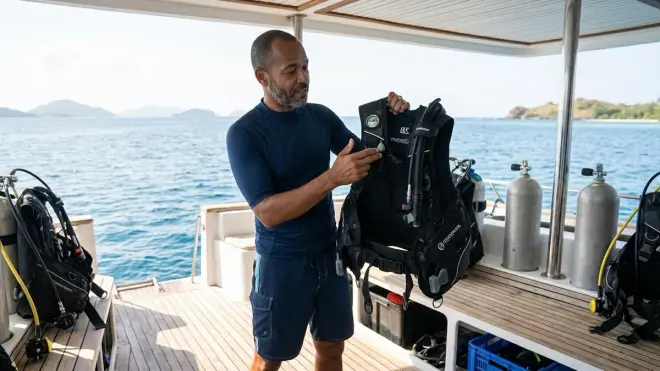
You need enough lift to float the total weight of your exposure suit, tank, and any additional gear at the surface, which typically means 22-24 pounds for tropical diving with 3mm wetsuits and aluminum 80s, 26-28 pounds for 5mm suits and aluminum tanks, and 30-32 pounds for cold-water liveaboards with 7mm suits or drysuits and steel tanks. Calculate by adding your exposure suit buoyancy at depth (a 5mm wetsuit is roughly -8 to -10 pounds at depth, a 3mm is -4 to -5 pounds), tank type (aluminum 80s are approximately +4 pounds positive when empty, steel tanks vary from -2 to -10 pounds), plus any camera gear or accessories. I recommend choosing a BCD with 2-4 pounds more lift than your calculation shows—that safety margin matters when you're exhausted after dive four and just need to rest at the surface.
Can I use a back-inflate travel BCD if I'm a beginner diver with under 50 dives?
You can absolutely use a back-inflate travel BCD as a beginner, but expect a learning curve with surface positioning because back-inflate designs tip you forward at the surface when fully inflated, requiring you to either swim slightly backward or keep your inflator partially deflated, which feels counterintuitive when you're still building confidence. I recommend practicing in a pool or on shallow checkout dives before your liveaboard to develop the habit of controlling your inflator responsibly—over-inflation with back-inflate BCDs leads to face-plants that are embarrassing but harmless. Many newer divers prefer hybrid designs with small front lift cells (3-5 pounds) that provide surface stability while maintaining horizontal trim underwater, though these typically weigh 0.5-1 pound more than pure back-inflate models. Your buoyancy control skills matter more than the BCD style—if you're constantly adding and dumping air rather than achieving neutral buoyancy and holding it, spend time on skills practice before investing in expensive travel gear. Check our guide on best buoyancy control devices for beginners for more context.
How do I maintain my travel BCD during a week-long liveaboard?
After every dive day, thoroughly rinse your BCD inside and out with fresh water, focusing on the inflator mechanism, dump valves, and weight pockets where salt crystals accumulate fastest and cause failures mid-trip. Disconnect the inflator hose, fill the bladder partially with fresh water through the oral inflator, shake vigorously to distribute the rinse, then drain completely by holding the BCD upside down with all dump valves open. Hang it to dry in shade with the bladder inflated slightly (helps prevent internal surface adhesion) and all pockets open, rotating it every few hours if possible so different sections get airflow. Every third day on longer liveaboards, I add a capful of mild detergent to the internal rinse to prevent bacteria growth that causes the distinctive "old BCD smell." For complete maintenance protocols that extend beyond the liveaboard itself, see our BCD maintenance checklist and tips on maintaining dive equipment during multi-day liveaboards.
The Verdict
The Scubapro Hydros Pro remains my top recommendation for the best travel BCD liveaboard use—it balances weight, durability, and real-world usability better than anything else I've tested across dozens of liveaboards. But if you're doing pure tropical diving with minimal gear, the Aqualung Rogue saves precious baggage weight without sacrificing functionality. For divers who mix warm and cold-water liveaboards, spend the extra money on the Apeks Black Ice and accept the slight weight penalty—you'll appreciate the versatility when your itinerary includes both Socorro and Sea of Cortez in the same year.
Whatever you choose, prioritize quick-dry capability and corrosion resistance over marginal weight differences. I've seen too many divers obsess over saving 8 ounces only to deal with stuck inflators and corroded buckles by day five. Your travel BCD will spend hundreds of hours wet, salty, and crammed into humid cabin spaces—build your decision around durability, not marketing specs. The best liveaboard experiences happen when your gear disappears from your consciousness because it just works, dive after dive, day after day.