
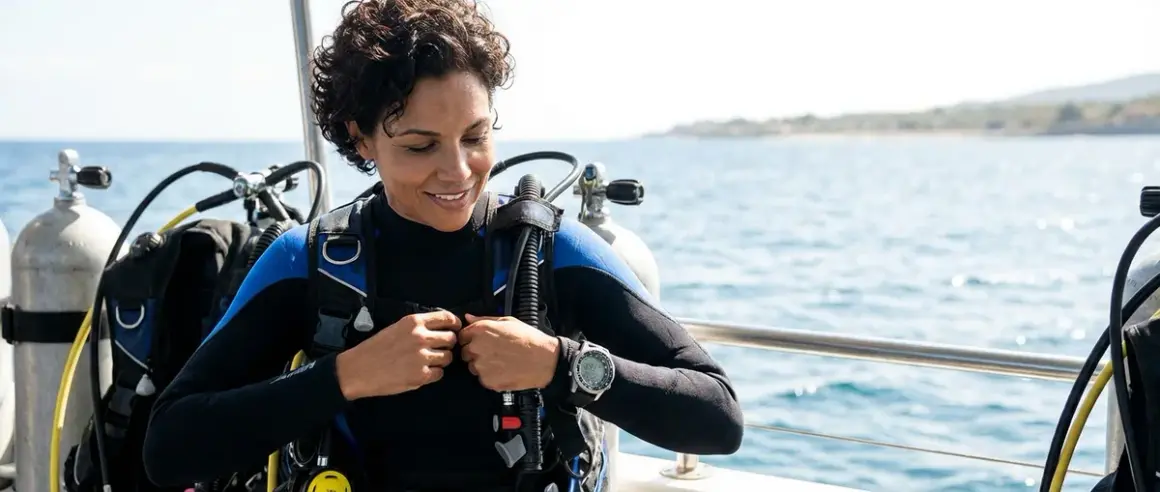

I still remember my first dive after Open Water certification—hovering three feet above the reef one second, then accidentally crashing into the sand the next. My instructor kept saying "use your BCD," but honestly, I was so overwhelmed by everything happening at once that I just kept gulping air and sinking like a rock. If you're reading this, you probably know that feeling. Finding the best buoyancy control device matters way more than I realized back then, because it's literally what keeps you stable, comfortable, and in control underwater.
After trying rental BCDs across a dozen dive shops and finally investing in my own gear, I've learned that the right BCD makes buoyancy feel natural instead of like a constant mental battle. For beginner divers, you want something forgiving, intuitive, and comfortable enough that you can focus on the actual diving instead of fighting with your equipment.

What to Look For in a Buoyancy Control Device
When I first started researching BCDs, the sheer number of options made my head spin. Back-inflate, jacket-style, wing systems, weight-integrated—it all sounded like a different language. After making some mistakes (like buying a BCD that was way too big because I didn't understand sizing) and talking to more experienced divers, I figured out what actually matters for beginners.
BCD style is your first big decision, and honestly, this confused me for months. Jacket-style BCDs wrap around you like a vest and squeeze you in a hug when inflated—they feel stable and keep you upright on the surface, which is reassuring when you're new. Back-inflate BCDs put all the air behind you, which some people say gives better trim underwater but can pitch you face-forward on the surface if you're not careful. I started with a jacket style because it felt more intuitive, and I'm glad I did. The stability at the surface made me way more comfortable during those early dives when I was still building confidence. If you want to dive deeper into this choice, our guide on jacket BCD vs back inflate breaks down the differences in detail.
Weight integration is non-negotiable for beginners, in my opinion. The first few times I dove with a separate weight belt, I was constantly adjusting it, and it dug into my hips uncomfortably. BCDs with integrated weight pockets let you slide weight pouches right into the BCD itself, which distributes the weight better and means one less piece of gear to worry about. Most modern BCDs designed for recreational divers have this feature, and the quick-release system means you can ditch weights in an emergency. Just make sure the pockets are actually easy to access—I've tried some where the Velcro closures were so tight I could barely get them open on land, let alone underwater with gloves.
Lift capacity determines how much air the BCD can hold, which needs to match your body weight plus all your gear. I didn't understand this at first and nearly bought a travel BCD with only 15 pounds of lift, which would've been way too little for me in a 5mm wetsuit with a steel tank. As a general rule, beginners diving in tropical conditions with aluminum tanks need around 25-30 pounds of lift capacity, while those diving in colder water with thicker exposure suits and heavier tanks should look for 30-40 pounds. The math basically works out to your total underwater weight (you plus gear) minus the buoyancy your wetsuit provides. I know that sounds complicated, but dive shops can help you figure it out, and our article on BCD lift capacity explains it way better than I can.
Fit and adjustability matter more than you'd think. A BCD that's too loose will shift around underwater and make trim harder to control, while one that's too tight restricts your breathing and gets exhausting fast. I'm 5'4" and about 130 pounds, and I've learned I need a small or extra-small in most brands, but sizing isn't standardized—what fits in one brand might be completely different in another. Look for BCDs with multiple adjustment points: shoulder straps, chest straps, waist straps, and crotch straps (yes, they look weird, but they keep the BCD from riding up). When you try one on, wear it with weights loaded and actually inflate it to see how it feels under pressure. Our guide on how to fit a BCD walks through the whole fitting process step by step.
Dump valves and inflation controls are something I took for granted until I tried a BCD with poorly placed valves. You need at least three dump valves—shoulder, rear, and lower—so you can release air no matter what position you're in. The inflator hose should be easy to reach with your left hand (that's standard positioning) and the buttons should be distinct enough that you can tell inflate from deflate by touch. I once accidentally hit the wrong button during a descent and shot up a few feet—not dangerous, but embarrassing and a little scary. The best BCDs have dump valves with pull cords that are long enough to reach easily but not so long they dangle and catch on things.
D-rings and attachment points are essential if you plan to add any accessories, which you probably will. Even as a beginner, I needed somewhere to clip my dive light, surface marker buoy, and eventually my camera. Most BCDs come with four to six D-rings, but check that they're stainless steel (not plastic) and positioned where you can actually reach them. I have one BCD with a D-ring on the lower back that I literally cannot access while wearing it—completely useless placement.
Our Top Picks for Best Buoyancy Control Devices
Scubapro Hydros Pro
The Scubapro Hydros Pro BCD🛒 Amazon is one of those BCDs that experienced divers rave about, and after borrowing one from a dive buddy for a week in Roatán, I totally get why. It's modular, meaning you can adjust or replace individual components instead of buying a whole new BCD when something wears out, and the gel harness system molds to your body in a way that traditional fabric never does. I'm still figuring out all the customization options, but even using it stock, the fit was incredible—like it was built specifically for my torso.
Pros:
- Modular design means you can replace or upgrade individual components as your diving progresses
- Gel backpack and harness system provides a custom-molded fit after a few dives
- 36 pounds of lift capacity handles cold water diving and heavy gear configurations
- Five stainless steel D-rings in smart positions for accessory attachment
- Weight pockets hold up to 20 pounds total and release cleanly with one pull
Cons:
- Premium price point around $950 makes it a serious investment for beginners
- The modular system has a learning curve—it took me 20 minutes just to figure out how to adjust the shoulder straps the first time
- Heavier than travel-focused BCDs at 7.2 pounds, so not ideal if you're counting ounces for airline weight limits
Cressi Travelight
The Cressi Travelight BCD🛒 Amazon is the BCD I actually own, and I bought it specifically because I was flying to Belize every few months and couldn't justify paying overweight baggage fees. The Travelight lives up to its name—it weighs just 4.4 pounds and folds down small enough to fit in my carry-on mesh dive bag along with my regulator and mask. It's a back-inflate design, which took some getting used to (I kept tipping forward at the surface), but underwater it helps with photography because I can get into a horizontal trim position more easily.
Pros:
- Extremely lightweight at 4.4 pounds for the small size—game-changer for travel diving
- Packs down to about the size of a folded sweatshirt in your luggage
- 28 pounds of lift capacity is plenty for recreational tropical diving with aluminum tanks
- Integrated weight pockets hold 12 pounds and sit comfortably on the hips
- More affordable than most quality BCDs at around $450
Cons:
- Back-inflate design can feel tippy on the surface when you're still learning—I had to practice staying upright during surface intervals
- Minimal padding means less cushioning between you and your tank
- Only two D-rings limit attachment options if you're carrying lots of accessories
Aqualung Axiom i3
The Aqualung Axiom i3 BCD🛒 Amazon i3 system was honestly confusing to me at first—instead of traditional inflate and deflate buttons, it uses a single lever that you push up to inflate and pull down to deflate. I was skeptical because it seemed gimmicky, but after trying one during a dive trip in Cozumel, I understood the appeal. It's genuinely easier to operate, especially when you're task-loaded or a little stressed. For beginners who are already overwhelmed trying to remember what every button does, this simplification is actually really helpful.
Pros:
- Single-lever inflation system is incredibly intuitive—up for air, down to release
- Jacket-style design provides stable, upright positioning at the surface
- 32 pounds of lift capacity handles a range of diving conditions
- SureLock weight system makes loading and removing weights super easy
- Six D-rings and multiple accessory attachment points
Cons:
- The i3 system requires proprietary parts, so if something breaks on a dive trip to a remote area, you might be stuck
- Slightly bulkier than back-inflate designs when packed for travel
- Higher price around $800 might stretch a beginner's budget
Zeagle Covert
I tried the Zeagle Covert BCD🛒 Amazon during my Advanced Open Water course, and what struck me immediately was how streamlined it felt. It's a back-inflate BCD designed specifically for travel, which means it balances weight (5.8 pounds) with enough structure to feel secure. The Ripcord weight system is brilliant—instead of fumbling with pockets, you just pull a handle and the entire weight system releases. I haven't had to ditch weights in an emergency (thankfully), but knowing I could do it that easily gave me confidence.
Pros:
- Ripcord integrated weight release is the easiest quick-ditch system I've tested
- 24 pounds of lift works well for warm-water recreational diving
- Back-inflate design with enough structure to avoid the floppy feeling some travel BCDs have
- BCD/weight combo system centers weight distribution nicely
- Compact enough for airline travel without being flimsy
Cons:
- 24 pounds of lift is too little for cold water diving with thick wetsuits or drysuits
- Back padding is minimal—I could feel every edge of my tank valve
- Limited to 16 pounds of integrated weight, which wasn't enough for me in a 7mm wetsuit
Mares Hybrid
The Mares Hybrid BCD🛒 Amazon tries to give you the best of both worlds—jacket-style stability with back-inflate trim underwater. It does this through a unique air bladder design that wraps partially around your sides but keeps most air on your back. I tested one during a photography-focused dive, and I liked how it kept me stable during safety stops while still letting me get horizontal near the reef. It's not perfect at either jacket or back-inflate characteristics, but that compromise works well for beginners who aren't sure which style they prefer yet.
Pros:
- Hybrid bladder design offers more stability than pure back-inflate without the squeeze of traditional jackets
- 31 pounds of lift capacity handles diverse diving scenarios
- Trim weight system lets you fine-tune weight distribution for better balance
- Six D-rings positioned where you can actually reach them
- Comfortable shoulder padding distributes tank weight well
Cons:
- The hybrid design means it's slightly bulkier than dedicated back-inflate or jacket BCDs
- At 7.5 pounds, it's too heavy for minimalist travel packing
- Some divers find the partial wrap doesn't provide enough squeeze for their preference—it's truly in the middle
Aqua Lung Zuma
The Aqua Lung Zuma BCD🛒 Amazon is the BCD I'd recommend if someone asked me for the most beginner-friendly option on a tight budget. The Zuma is a straightforward jacket-style BCD without fancy features or complicated systems—just solid, reliable buoyancy control. I borrowed one for a week when my own BCD was being serviced, and honestly, it did everything I needed without any fuss. It's not exciting, but sometimes basic is exactly what you want when you're still learning the fundamentals.
Pros:
- Budget-friendly at around $350 without sacrificing essential features
- Jacket design keeps you upright and stable at the surface—great for nervous beginners
- 28 pounds of lift handles typical recreational diving needs
- SureLock II weight system is simple and secure
- Durable 420-denier nylon construction stands up to rental-level abuse
Cons:
- Basic feature set means no fancy trim pockets or modular components
- Jacket design can feel constricting around your ribs when fully inflated
- Only four D-rings limit how much gear you can attach as your diving progresses
Frequently Asked Questions
What is the difference between a BCD and a buoyancy control device?
They're the same thing—BCD literally stands for Buoyancy Control Device. Some manufacturers also call them buoyancy compensators or BCs, and you might hear technical divers refer to wing systems, but they all serve the same basic function: controlling your buoyancy underwater by adding or releasing air. The terminology confused me at first because I thought they were different pieces of equipment, but nope, just different names for the same thing. If you want to understand how all the components work together, check out our explanation of what is a buoyancy compensator device.
Should beginners get a jacket or back-inflate BCD?
I started with a jacket-style BCD, and I'm honestly glad I did. Jacket BCDs wrap around you and keep you upright at the surface, which feels more natural and stable when you're still building water confidence. Back-inflate BCDs put all the air behind you, which can tip you face-forward at the surface if you're not careful, though they do help you achieve better horizontal trim underwater once you develop those skills. For absolute beginners, I'd say go jacket-style unless you're specifically working toward technical diving or underwater photography where trim really matters. You can always switch later—lots of divers do.
How much should I spend on my first BCD?
I spent around $450 on my first BCD, which felt like a lot at the time, but three years later it's still going strong. You can find decent entry-level BCDs for around $300-400, mid-range options around $500-700, and premium models that top $1,000. I'd aim for the $400-600 range if you're serious about diving regularly—cheaper than that and you're often sacrificing durability or comfort, more expensive and you're paying for features you might not need yet. Remember that you'll also need a regulator, dive computer, and other gear, so budget for your whole setup, not just the BCD. I wish I'd done that instead of blowing my entire gear budget on one piece of equipment.
Do I need integrated weights or can I use a weight belt?
You can absolutely use a weight belt with any BCD, but integrated weights make your life so much easier. Weight belts tend to shift around, dig into your hips, and add one more thing to remember during pre-dive setup. Integrated weight pockets distribute weight more comfortably and keep everything streamlined. The only reason I'd choose a belt is if you're diving somewhere extremely remote where you can't guarantee the BCD will have weight pockets, or if you need to carry more weight than the integrated system allows. For 90% of recreational diving as a beginner, integrated weights are the way to go.
How do I know if my BCD fits properly?
When I tried on my first BCD, I thought it fit, but it actually rode up every time I inflated it underwater. A properly fitted BCD should sit snugly when deflated and stay in place when inflated. The shoulder straps shouldn't dig in or slip off, the waist strap should cinch comfortably without leaving gaps, and the crotch strap (if there is one) should prevent the whole thing from riding up toward your armpits. Load it with weights and inflate it fully while standing—if it shifts more than an inch or two, it's not fitted right. Our detailed guide on how to fit a BCD covers the whole process with specific adjustment tips I wish I'd known earlier.
The Verdict
Choosing the best buoyancy control device as a beginner is less about finding the single "perfect" BCD and more about matching features to your specific diving plans. If you're traveling frequently, the Cressi Travelight's packability is hard to beat. If you want long-term versatility and don't mind investing upfront, the Scubapro Hydros Pro grows with your skills. For pure beginner-friendliness on a reasonable budget, the Aqua Lung Zuma delivers everything you need without overwhelming you with options.
Whatever you choose, make sure you actually try it on with weights and a tank before committing—sizing varies wildly between brands, and what works for your dive buddy might feel completely wrong on you. Before every dive, run through a BCD pre-dive safety check to catch any issues, and follow a proper BCD maintenance schedule to keep your investment in good shape. The right BCD transforms diving from a constant battle with buoyancy into the effortless floating experience it's supposed to be, and that's when the real fun begins.