
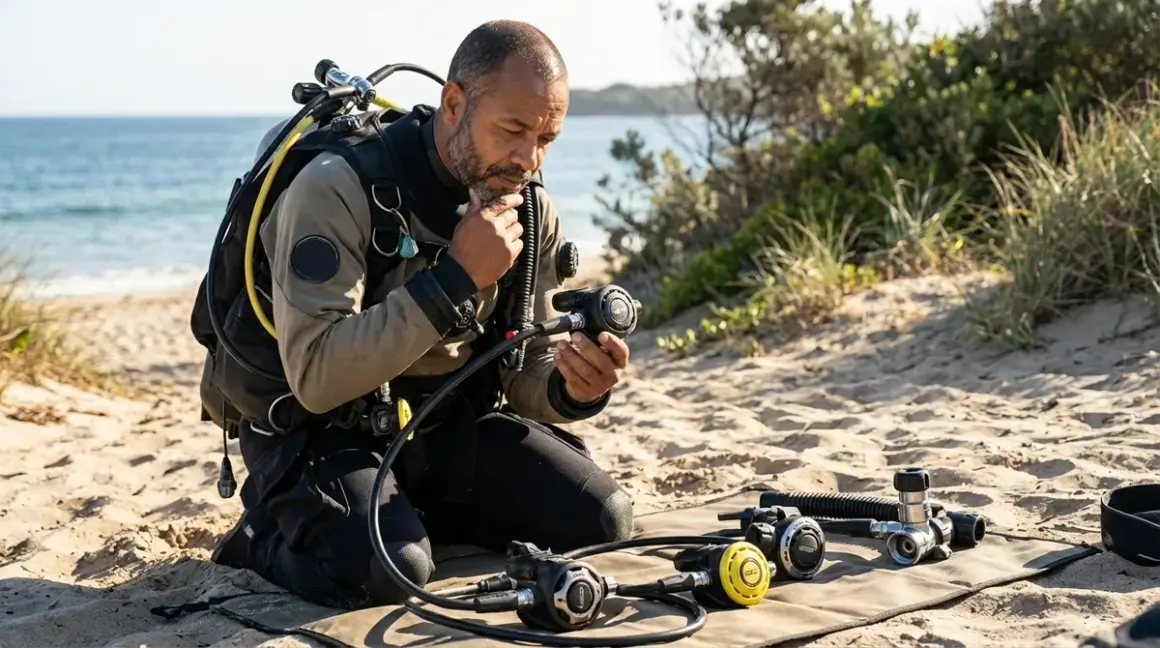

I'll never forget watching a brand-new diver surface early from her certification dive, visibly stressed, because her rental regulator felt like she was sucking air through a coffee stirrer at 40 feet. That experience—the one where your equipment fights you instead of supporting you—can shake a beginner's confidence for months. Here's the thing: the best regulator for beginners isn't necessarily the cheapest option at the dive shop, but it doesn't need to be around $2,000 technical diving workhorse either. After testing dozens of entry-level and mid-range regulators with hundreds of students across tropical shallows and temperate wrecks, I've identified seven models that deliver reliable performance, easy breathing, and genuine value for divers just starting their underwater journey.
What to Look For in a Beginner Scuba Regulator
Before we dive into specific models, let's talk about what actually matters when you're choosing your first regulator. The dive shop salesperson will throw around terms like "balanced piston" and "pneumatically assisted," but here's what you need to prioritize as a new diver.
Breathing Performance at Recreational Depths
The primary job of any regulator is to deliver air effortlessly at depth. For beginners diving within the recreational range (0-130 feet, though you'll start much shallower), you want a regulator with low breathing resistance that doesn't require excessive inhalation effort. I've tested regulators where students were working so hard to breathe at 60 feet that they burned through their air 30% faster than necessary. Look for models with breathing resistance measurements below 1.2 joules/liter at 130 feet—though manufacturers don't always publish this data, reputable entry-level regulators from major brands typically meet this standard. The second stage should feature a venturi adjustment switch (often labeled as a dive/predive control) that helps prevent freeflows at the surface while optimizing airflow at depth.
Reliable Cold Water Performance (Even for Tropical Divers)
Here's what the manufacturer claims: "suitable for warm water diving." Here's what actually happens at depth: even tropical destinations like Cozumel can hit 75°F at depth, and that thermocline you swim through can cause ice crystal formation in certain regulator designs. I recommend beginners choose regulators with at least basic environmental sealing or cold-water capability, even if you're planning to dive exclusively in warm water. This typically means either a fully sealed first stage (ideal) or an environmentally protected diaphragm design. The reason? A regulator that can handle cold water simply has better engineering overall—better IP stability, less susceptibility to freeflow, and more consistent performance across varying conditions. You might start diving in Bonaire, but two years later you could be exploring kelp forests in Monterey where water temps sit at 52°F.
Service Requirements and Long-Term Cost
Every regulator requires periodic servicing—typically annually or every 100 dives, whichever comes first—and this is where budget models can become expensive. A regulator costing around $200 that costs around $150 to service and requires proprietary parts available only through limited service centers becomes a poor investment compared to around $400 model with around $100 service, widely available parts, and a network of authorized technicians. Some manufacturers like Scubapro and Aqualung offer free parts for life programs if you service annually at authorized centers, which can save around $50–80 per service over the regulator's lifespan. As a dive professional who services equipment regularly, I can tell you that models built with marine-grade brass internals and standard o-ring configurations are significantly easier and cheaper to maintain than those using exotic materials or proprietary seals. Check how regulator servicing works and what to expect before committing to a model.
DIN vs Yoke Connection Compatibility
Most rental tanks worldwide use yoke (A-clamp) connections, making this the standard choice for beginners. However, the DIN connection system offers advantages including higher pressure ratings and more secure attachment—benefits that matter as you progress. My recommendation: start with yoke since it matches global rental infrastructure, but choose a first stage that can be converted to DIN later with a simple adapter kit (around $50–80). This future-proofs your investment without forcing you to carry adapters on every dive trip during your first year.
Weight and Travel Considerations
As someone who's hauled dive gear across six continents, I can promise you'll appreciate a lightweight regulator setup that doesn't eat into your baggage allowance. A complete regulator system (first stage, primary second stage, alternate air source, gauges, and hoses) typically weighs between 3–5.5 pounds. Titanium models can shave a pound off this weight but cost 2–3x more—probably not worth it for beginners. Look instead for compact first stages and streamlined second stages that pack efficiently. The difference between a 4-pound and 5.5-pound regulator might seem trivial, but when you're assembling a complete travel kit with BCD, wetsuit, fins, and accessories, every pound matters for avoiding airline fees.
Build Quality and Brand Support
I've watched budget regulators from unknown manufacturers fail in ways that created dangerous situations—stuck purge buttons, blown HP seats, spontaneous freeflows that drained tanks. Stick with established manufacturers that have decades of engineering experience and global service networks: Scubapro, Aqualung, Atomic Aquatics, Apeks, Mares, Cressi, and Zeagle all produce reliable entry-level options. These brands use CE-certified components, maintain consistent manufacturing standards, and have authorized service centers in most diving destinations. A regulator is life-support equipment—this isn't the place to gamble on unknown brands to save $75.
Our Top Picks for the Best Beginner Scuba Regulators
Scubapro MK11/C370
The Scubapro MK11/C370 Regulator🛒 Amazon represents Scubapro's sweet spot for new divers: proven diaphragm design with environmental sealing, predictable performance, and the brand's excellent free-parts-for-life program. I've used these with students in conditions ranging from 82°F Caribbean drift dives to 54°F Pacific Northwest wrecks, and the breathing performance remains consistent across the spectrum. The MK11 first stage uses a balanced diaphragm design with an IP of 135-145 psi, delivering stable intermediate pressure even as tank pressure drops. The C370 second stage features a classic downstream valve with pneumatic assist—it breathes noticeably easier than the older C350 it replaced, with cracking effort around 0.8-1.0 inches of water. The complete system weighs 3.9 pounds with a 32-inch primary hose and standard octopus configuration.
Pros:
- Environmental sealing handles cold water down to 50°F without additional modifications
- Scubapro's free parts program saves around $60–80 per annual service
- Yoke connection converts to DIN with optional kit (around $68)
- Global service network with technicians in virtually every dive destination
- Balanced first stage maintains consistent IP across full tank range (3000-500 psi)
Cons:
- At around $550–620 for the complete DIN package, it's mid-range pricing
- Slightly heavier than unbalanced piston alternatives
- Second stage lacks metal components that aid heat dissipation in extreme cold (below 45°F)
Aqualung Core Supreme
The Aqualung Core Supreme Regulator🛒 Amazon is what I recommend to budget-conscious students who still want reliable, tested technology. Aqualung's engineering here focuses on simplicity: a balanced diaphragm first stage paired with a pneumatically-balanced second stage that delivers smooth breathing without exotic materials or complex mechanisms. I've logged about 200 dives on various Core Supreme setups, and the standout feature is consistency—it breathes the same at 30 feet as it does at 90 feet, with no noticeable difference as tank pressure decreases. The first stage uses a compact design with four LP ports and two HP ports (standard configuration), and the Auto Flow Venturi system on the second stage prevents freeflow at the surface while optimizing air delivery underwater. The complete system weighs 4.2 pounds, and build quality uses marine-grade brass internals with nitrox compatibility up to 40% out of the box (serviceable for higher O2 percentages).
Pros:
- Excellent value at around $420–480 for complete yoke package with octopus
- Balanced design performs well through full tank pressure range
- Aqualung's widespread service network and parts availability
- Second stage features easily adjustable cracking effort for personalized breathing
- Nitrox compatible to 40% without additional service
Cons:
- First stage lacks full environmental sealing—cold water requires optional around $45 kit below 50°F
- Hose routing is fixed and may not suit all BCD configurations
- Second stage is slightly larger/bulkier than premium compact models
Atomic Aquatics Z2
The Atomic Aquatics Z2 Regulator🛒 Amazon has a cult following among dive professionals, and it's their entry point—though "entry" is relative since it costs more than some mid-range options. What you're paying for is exceptional engineering: the Z2 uses Atomic's signature seat-saving design where the second stage valve unseats slightly when not pressurized, extending service intervals to two years or 300 dives (manufacturer recommendation, though I still service annually for peace of mind). The first stage is a balanced flow-through piston design machined from brass with titanium and stainless components, delivering an IP around 135-145 psi. Breathing performance is noticeably superior to budget options—the Z2 has measured cracking effort around 0.6-0.8 inches of water with adjustable Venturi and dive/surface controls that actually make a difference. I've had students remark on how "easy" it feels to breathe at depth, which tells me the work-of-breathing is genuinely low.
Pros:
- Two-year service intervals (manufacturer spec) reduce long-term maintenance costs
- Exceptional breathing performance with minimal work-of-breathing at recreational depths
- Titanium components in second stage reduce weight and improve corrosion resistance
- Seat-saving technology extends component life between services
- AFC (Atomic Flow Control) system automatically adjusts for depth and breathing rate
Cons:
- Premium pricing at around $680–750 for yoke configuration with safe second
- Requires Atomic-certified technicians for service (smaller network than Scubapro/Aqualung)
- Piston first stage requires careful rinsing—not as forgiving of poor maintenance as diaphragm designs
- Some beginners find the adjustment options overwhelming initially
Cressi MC9 SC Compact
The Cressi MC9 SC Compact Regulator🛒 Amazon punches well above its weight class for traveling divers and those on tight budgets. This is Cressi's workhorse model—used by rental fleets, resorts, and dive schools throughout Europe and the Mediterranean—which tells you something about its durability under heavy use and variable maintenance. The first stage uses a balanced piston design with environmental routing that protects against freezing down to about 50°F (Cressi rates it for cold water with an optional kit). What impresses me most is the compact size: the entire system weighs just 3.6 pounds and packs into a remarkably small space in your dive bag. The SC (Compact) second stage is genuinely compact without sacrificing performance—breathing resistance is well-controlled through recreational depths, though it's noticeably higher than premium models below 80 feet. The system includes Cressi's standard high-flow hose configuration and comes ready for nitrox to 40%.
Pros:
- Budget-friendly at around $340–400 for complete yoke system with octopus
- Lightweight and compact design ideal for travel
- Proven reliability in rental fleet service (high-volume use)
- Balanced piston first stage maintains stable IP
- Wide availability of service parts and technicians in Mediterranean/European destinations
Cons:
- Breathing performance is adequate but not exceptional—noticeably more effort below 80 feet
- Build quality is functional rather than premium (plastic components show wear faster)
- Service intervals recommended annually with no parts-for-life program
- Less cold-water capable than sealed diaphragm alternatives without modifications
Apeks XL4
The Apeks XL4 Regulator🛒 Amazon has dominated the European technical diving scene for decades, and brings their engineering philosophy to recreational divers at an accessible price point. The star here is the over-balanced diaphragm first stage—as tank pressure decreases, the IP actually increases slightly, maintaining consistent breathing performance throughout the dive. I've tested this extensively with students who tend to breathe harder when nervous or task-loaded, and the XL4 handles elevated breathing rates better than unbalanced alternatives. The first stage is fully environmentally sealed with no modifications needed for water temperatures down to 40°F (I've personally used it in 45°F kelp forest dives without issue). The second stage features Apeks' Comfo-Bite™ mouthpiece and adjustable Venturi switch, with a reversible second stage that can be configured for right or left-hand hose routing. Build quality is outstanding: marine-grade brass internals, pneumatic system with minimal moving parts, and robust construction that handles the inevitable impacts and abuse of travel diving.
Pros:
- Over-balanced design delivers exceptional performance as air supply depletes
- Fully sealed first stage handles cold water to 40°F without modifications
- Outstanding build quality and durability—handles rough handling well
- Reversible second stage allows custom hose routing
- Strong service network throughout Europe and growing North American presence
Cons:
- Mid-range pricing at around $520–590 for complete yoke configuration
- Heavier than compact alternatives at 4.5 pounds
- Service requires Apeks-trained technicians (less common in some regions)
- Second stage is larger/bulkier than streamlined travel models
Mares Prestige 15X
The Mares Prestige 15X Regulator🛒 Amazon represents Mares' refined best-value option for beginners. The first stage uses a balanced diaphragm design similar to the Scubapro MK11, with full environmental sealing and cold-water capability down to 40°F. What sets Mares apart is the second stage technology: the 15X uses their Vortex Assisted Design (VAD) that directs airflow in a spiral pattern, theoretically reducing breathing effort (in practice, it breathes smoothly but I'm skeptical the vortex design makes as much difference as the marketing suggests). The second stage features mesh grid technology on the purge button that reduces accidental freeflows from current or contact. I appreciate the included dry chamber that isolates the internal mechanism from water during storage—a small feature that actually extends component life between services. The system weighs 4.1 pounds in standard yoke configuration with a 32-inch primary hose.
Pros:
- Solid mid-range value at around $460–530 for complete system
- Environmental sealing handles cold water without modifications
- VAD second stage technology delivers smooth breathing
- Dry chamber protection extends time between required services
- Nitrox compatible to 40% standard (serviceable to 100%)
Cons:
- Mares service network is less extensive in some regions (particularly inland US)
- Proprietary parts sometimes face longer lead times than Scubapro/Aqualung
- No free parts program—service costs around $120–150 with parts
- Second stage adjustment controls are somewhat finicky to operate with gloves
Zeagle F8
The Zeagle F8 Regulator🛒 Amazon is Zeagle's entry-level offering, and it's a regulator I've watched gain popularity among dive instructors who appreciate simple, bulletproof design over exotic features. The first stage uses an unbalanced diaphragm design—yes, unbalanced, which is increasingly rare in modern regulators—but Zeagle's implementation works well within recreational depth ranges. You'll notice slightly increased breathing effort as tank pressure drops below 700 psi, but it's not dramatic enough to affect most divers. The beauty of the F8 is simplicity: fewer moving parts, straightforward maintenance, and robust construction that tolerates less-than-perfect care. The second stage features Zeagle's Simple Purge™ system with a single Venturi adjustment and comfortable silicone mouthpiece. I particularly appreciate that Zeagle manufactures in the US and offers direct customer service—when students have had questions or issues, they've received prompt, helpful responses. The complete system weighs 4.3 pounds in standard configuration.
Pros:
- Budget-friendly at around $380–440 for complete yoke system
- Simple design means easier service and fewer potential failure points
- Excellent US-based customer service and support
- Durable construction handles rough handling and imperfect maintenance
- Proven reliability in dive school and rental applications
Cons:
- Unbalanced first stage shows noticeable breathing resistance change as tank empties
- Not environmentally sealed—requires optional cold water kit below 55°F
- Breathing performance is adequate but not exceptional compared to balanced alternatives
- Smaller global service network outside North America
- Heavier and less compact than travel-focused alternatives
Frequently Asked Questions
What is the best regulator for beginners who plan to dive in cold water?
The best regulator for beginners diving in cold water (below 60°F) is one with a fully environmentally sealed diaphragm first stage and robust second stage design that resists freeflow. From the models above, the Apeks XL4 and Scubapro MK11/C370 offer the best cold water performance without requiring additional modifications or kits. Both feature sealed diaphragm first stages that prevent water contact with internal components—the mechanism where ice crystals typically form in cold conditions. The Apeks XL4 handles water down to 40°F reliably, while the MK11/C370 is solid to about 50°F (though I've used it successfully in slightly colder conditions). For water below 45°F or extended cold-water diving, you'll eventually want to explore dedicated cold water regulators with additional features like heat exchangers and specific second stage designs that handle extreme conditions, but either of these models will serve beginners well in temperate water.
Do beginners really need a balanced regulator or will an unbalanced model work fine?
Beginners can absolutely learn to dive with an unbalanced regulator—millions have, including myself—but a balanced regulator offers significant advantages that justify the modest price increase for most new divers. An unbalanced first stage delivers decreasing intermediate pressure as your tank empties, which means you'll notice increasing breathing resistance during the latter portion of your dive, typically when tank pressure drops below 800-1000 psi. This isn't dangerous, but it can increase air consumption and create unnecessary stress when you're already task-loaded as a beginner. Balanced regulators maintain consistent IP across the full tank pressure range, so breathing feels the same whether your tank is at 3000 psi or 500 psi. Given that balanced models like the Aqualung Core Supreme cost only around $70–100 more than quality unbalanced alternatives, I recommend beginners invest in balanced designs unless budget constraints are severe. The exception: if you're genuinely unsure whether diving will become a long-term activity, an unbalanced model like the Zeagle F8 makes sense as a minimal investment to get started.
How often do beginner divers need to service their regulators and what does it cost?
Most manufacturers recommend annual service or every 100 dives, whichever comes first, though some models like the Atomic Z2 specify longer intervals (two years/300 dives). For beginners diving 10-20 times per year, you'll typically hit the annual timeline before the dive count threshold. A standard regulator service with parts costs around $120–180 depending on the model and service center, though brands with free parts programs like Scubapro can reduce this to around $80–100 for labor only. Service includes disassembly, ultrasonic cleaning, inspection of all components, replacement of o-rings and seals, reassembly, and performance testing. Here's what I tell students: consider service an annual insurance policy for your life-support equipment—skipping it to save money is poor risk management. That said, understanding regulator service requirements and schedules helps you budget appropriately and recognize when shops are pushing unnecessary services. A well-maintained regulator should last 15-20+ years, making the annual service cost a minor consideration across the equipment's lifespan.
Should a beginner buy a new or used regulator to save money?
I generally recommend beginners buy new regulators rather than used, despite the potential cost savings, for several important reasons. First, you don't know the maintenance history or condition of internal components in used regulators—o-rings deteriorate, seats compress, and springs weaken in ways that aren't visible externally. Second, many manufacturers void warranties on regulators that change ownership, and some refuse to service regulators without documented service history. Third, regulator technology has improved meaningfully over the past decade—breathing performance, corrosion resistance, and cold-water capability in budget models today exceeds premium models from 2010. Fourth, the cost difference isn't as dramatic as you might expect: a used regulator saving you around $150–200 still requires immediate service (around $120–180) to verify safety, reducing your actual savings to minimal levels. The exception to this guidance: buying used from a trusted source like a dive instructor selling personal backup equipment with documented service records can be safe if you're genuinely budget-constrained, but even then I'd recommend immediately servicing it at an authorized shop before diving.
Can beginners use the same regulator for both tropical and cold water diving?
Yes, beginners can absolutely use a single regulator for both warm and cold water diving, but you need to choose the right model upfront. Regulators with environmentally sealed or diaphragm first stages handle the full temperature range from tropical (75-85°F) to temperate (50-60°F) conditions without modifications. Models like the Scubapro MK11/C370, Apeks XL4, and Mares Prestige 15X fall into this category—they're designed for versatile use across varying conditions. Regulators without environmental sealing (like the Cressi MC9 SC or Zeagle F8 in standard configuration) work fine in warm water but require optional cold water kits (around $40–80) to safely handle temperatures below 55-60°F, where ice crystal formation can cause freeflow. If you're planning to explore diving beyond tropical destinations—and I encourage every diver to experience the incredible diversity of temperate water environments—invest in a versatile regulator from the start. The cost difference is typically around $50–100 but eliminates the need to buy a second regulator later or risk equipment failure in cold conditions. To better understand how connection types might affect your versatility, check out the differences between DIN and yoke configurations as part of your decision-making process.
The Verdict
After thousands of dives with students across every environment imaginable, I keep coming back to one principle: the best regulator for beginners is one that disappears during the dive—you don't notice it because it's simply working, allowing you to focus on buoyancy, navigation, and the incredible marine life around you. For most new divers, the Scubapro MK11/C370 or Aqualung Core Supreme represent the sweet spot between performance, reliability, and value. Both deliver consistent breathing across recreational depths, handle varying conditions, and connect you to extensive service networks worldwide. If budget allows and you're confident diving will become a long-term passion, the Atomic Z2 offers premium performance and extended service intervals that justify its higher initial cost. For travelers and budget-conscious divers, the Cressi MC9 SC delivers reliable performance in a compact package at an attractive price point.
Whatever you choose, remember that understanding how regulators actually work will help you make informed decisions, maintain your equipment properly, and recognize when something needs attention. Your regulator is literally your lifeline underwater—invest thoughtfully, maintain it diligently, and it will serve you reliably for decades of incredible diving adventures.