
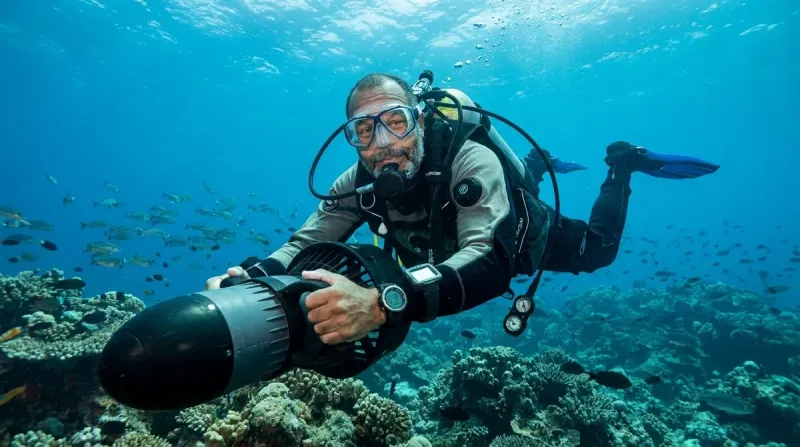

I remember the first time I clipped into an underwater scooter on a drift dive in Cozumel—suddenly I wasn't fighting the current anymore, I was riding it, covering three times the reef distance in half the bottom time. That single dive fundamentally changed how I think about underwater mobility. An underwater scooter (also called a dive propulsion vehicle or DPV) is a battery-powered device that pulls you through the water, extending your range, conserving your air, and opening up dive sites that would otherwise be inaccessible. Whether you're covering distance on a wall dive, fighting current to reach a wreck, or just want to glide effortlessly across a reef, understanding how these machines work—and what they demand from you as a diver—matters more than most people realize.
What Is an Underwater Scooter?
An underwater scooter is a battery-powered propulsion device designed to tow a diver through the water at speeds ranging from 2 to 5+ knots, depending on the model and power configuration. The term encompasses everything from compact recreational units weighing 10–15 lbs in air to technical cave scooters pushing 40+ lbs with lithium-ion battery packs rated for 200+ minute run times.
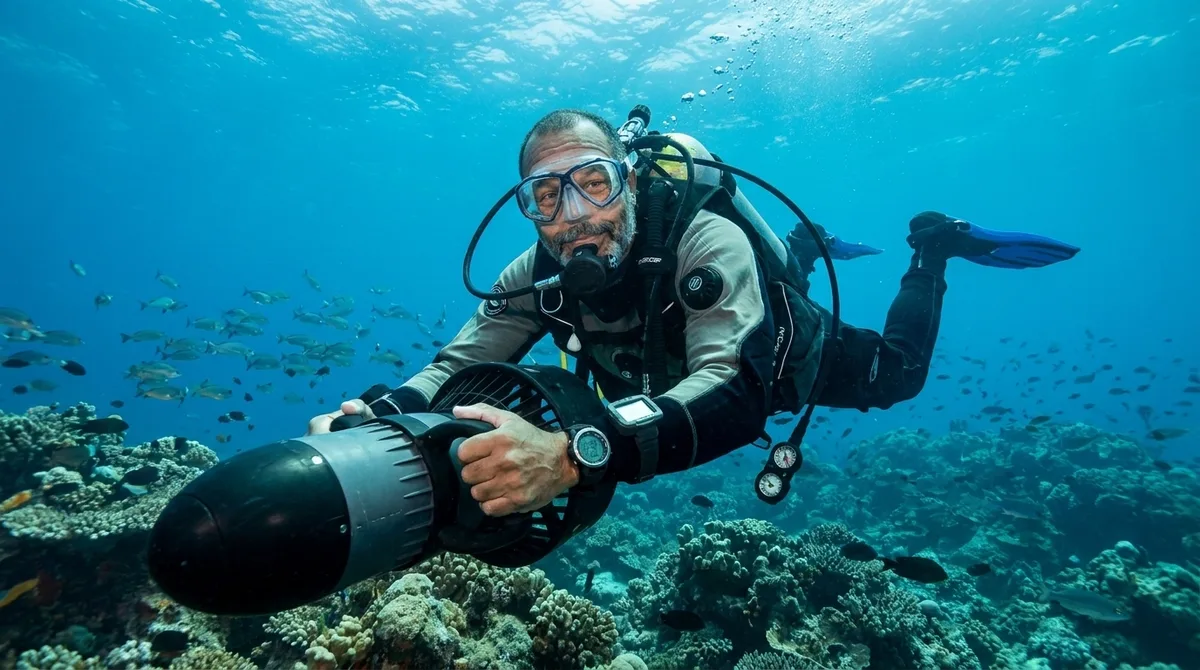
Most recreational models use sealed brushless DC motors powered by lithium-ion or lead-acid batteries housed in a waterproof pressure hull. The propulsion system consists of a shrouded propeller (to protect fingers and marine life) mounted at the stern, with controls typically located on handgrips or a trigger assembly. The diver grips the scooter and is pulled horizontally through the water column—the device doesn't push you, it tows you, which fundamentally changes your trim and buoyancy requirements.
You'll see underwater scooters categorized by battery chemistry, thrust output (measured in pounds or kilograms of force), depth rating (typically 100 feet for recreational units, 300+ feet for technical models), and run time at cruising speed. A typical recreational scooter like the Yamaha RDS250 delivers around 50 lbs of thrust with a 60-minute run time at full speed, depth-rated to 100 feet. Technical models incorporate redundant battery systems, variable speed controls, and depth ratings exceeding 400 feet—these are purpose-built tools for cave penetration and wreck exploration, not casual reef cruising.
The physical design varies, but most scooters share a torpedo-like profile with positive buoyancy (1–3 lbs) to prevent them from sinking if you release your grip. That slight positive buoyancy is deliberate—it keeps the scooter from plummeting to the bottom if you drop it, but it also means you need to compensate with your own buoyancy and trim to maintain horizontal travel. I've watched too many new DPV users angle upward unintentionally because they didn't adjust their BCD inflation to account for the scooter's positive lift.
How It Works
The core mechanism is straightforward: an electric motor spins a propeller inside a shrouded duct, generating thrust that pulls the diver forward through the water. What's not straightforward is how that simple system interacts with your body position, buoyancy control, and gas consumption underwater.
Propulsion System
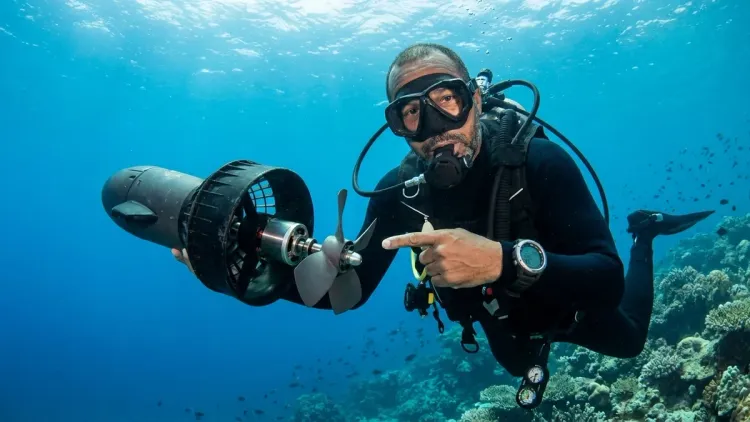
Most modern underwater scooters use brushless DC motors for reliability and efficiency. These motors have no internal brushes to wear out (a critical advantage in a sealed system you can't easily service mid-dive), and they deliver consistent torque across a wide RPM range. The motor drives a three- or four-blade propeller enclosed in a protective shroud—the shroud prevents entanglement with kelp, mooring lines, or fingers, and it also improves hydrodynamic efficiency by reducing tip vortex losses.
Power delivery varies by design. Recreational models typically offer on/off trigger control or two- to three-speed settings (slow cruise, medium, full throttle). Technical scooters often feature variable-speed triggers with proportional control—squeeze harder, go faster—which gives you finer control when navigating tight restrictions in wrecks or caves. The Suex XJOY 7 is a good example of a recreational scooter with variable speed control built in, though you'll pay more for that precision.
The propeller thrust needs to overcome hydrodynamic drag, which increases exponentially with speed. That's why you feel such a dramatic difference between 2 knots and 4 knots—you're not just moving twice as fast, you're fighting four times the drag. Battery consumption spikes accordingly. Most manufacturers rate run time at cruising speed (typically 70–80% throttle), but if you pin it at full speed, expect 30–40% less run time than advertised. I've burned through a battery in 35 minutes on a technical scooter rated for 90 minutes because I was running full throttle into current the entire dive.
Battery and Power Management
Battery chemistry determines weight, run time, depth performance, and maintenance burden. Lithium-ion batteries dominate the modern market—they're lighter, longer-lasting, and hold charge better than older lead-acid designs. A lithium pack delivering 500 watt-hours might weigh 6–8 lbs compared to 15+ lbs for an equivalent lead-acid pack. But lithium batteries require careful charging protocols and temperature management—overcharge them or let them drain completely, and you'll permanently reduce capacity.
Lead-acid batteries are still found in budget models. They're cheaper upfront, but they're heavier, have shorter run times, and suffer voltage sag at depth (cold water and pressure both reduce effective capacity). I've used lead-acid scooters in tropical water with no issues, but take one into 50°F water at 80 feet and you'll notice the thrust drop as the battery struggles to maintain voltage under load.
Depth ratings on scooters reflect the pressure hull's ability to prevent water ingress and the battery's ability to function under compression. Recreational models are typically rated to 100–130 feet, while technical units go to 300+ feet. The depth limit isn't about the motor—it's about seals, o-rings, and battery performance. At depth, pressure compresses o-rings and stresses housing seams. If a seal fails, water floods the electronics and the scooter becomes an expensive boat anchor. This is why pre-dive o-ring inspection on a DPV is non-negotiable, just like on a dive computer or regulator.
Hydrodynamic Interaction and Trim
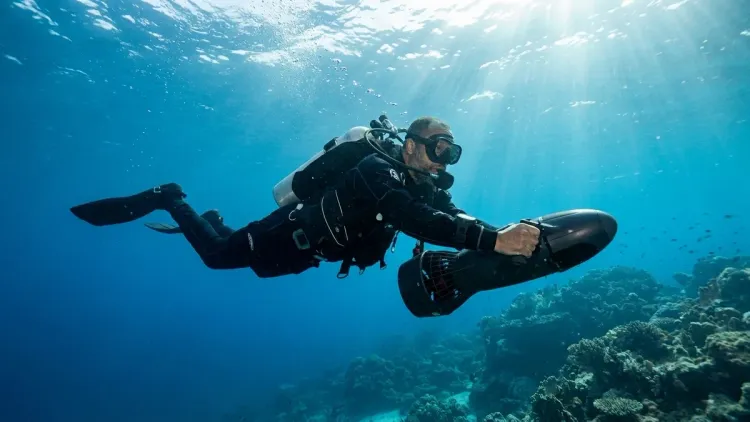
Here's what the manufacturer brochures won't tell you: an underwater scooter doesn't just pull you forward, it changes your entire dive profile. When you're being towed horizontally, your body becomes a hydrofoil. If you're not perfectly neutral and trimmed horizontal, the scooter will pull you up or down depending on your angle. Too much air in your BCD, and the scooter drags you toward the surface. Too little, and you're plowing into the sand.
The faster you go, the more exaggerated this effect becomes. At 2 knots, you can get away with sloppy trim. At 4 knots, even a 5-degree body angle translates into rapid depth changes. I've had students ascend 15 feet in thirty seconds because they were riding the scooter with their hips low and fins angled down—the water flow over their body created lift, and the scooter amplified it. This is why DPV training emphasizes streamlining and horizontal trim even more than standard buoyancy control instruction.
Your gear configuration matters too. Dangling hoses, console gauges swinging on retractors, poorly secured accessories—all of that creates drag and turbulence. On a DPV dive, I tuck everything tight, clip off my octopus and gauges, and run a streamlined setup that mimics technical sidemount or backmount configurations. It's not just about speed; it's about control and gas efficiency.
Why It Matters
The practical significance of underwater scooters isn't about going fast—it's about expanding your accessible dive territory while conserving gas and physical energy. Every dive has a turn-around point determined by your air supply and fatigue level. With a scooter, you can cover two to three times the distance in the same bottom time, reaching sites that would be unrealistic on a swim-out dive.
I've done wall dives in Grand Cayman where the current runs 2–3 knots. Without a scooter, you drift with the current and the boat picks you up a mile downcurrent. With a scooter, you can fight back into the current, explore a specific section of wall, and return to your anchor line—turning a one-way drift into a targeted exploration dive. That changes everything about how you plan and execute the dive.
Gas consumption is the other major factor. Swimming against current or covering long distances burns through your gas supply rapidly because your respiratory rate climbs with exertion. A scooter does the work for you. I've measured my own gas consumption on identical dive profiles—same depth, same bottom time—and used 30% less gas when scootering compared to swimming. That's the difference between a 35-minute dive and a 50-minute dive on the same tank. For technical divers doing long penetrations or deep wrecks, that gas savings translates directly into safety margins and bottom time.
Scooters also matter for accessibility. Divers with physical limitations—knee injuries, reduced stamina, age-related fitness concerns—can use a DPV to participate in dives that would otherwise be off-limits. I've taught students in their sixties who struggle with long surface swims but absolutely crush it underwater with a scooter because the device eliminates the cardio demand. It's not about laziness; it's about removing barriers and extending dive careers.
The flip side: underwater scooters introduce new failure modes and task loading. You're managing a piece of electronic equipment underwater, monitoring battery life, maintaining trim under propulsion, and navigating with one hand occupied. If the scooter floods, dies, or develops a runaway trigger (yes, that happens), you need to know how to handle it without panicking or making a rapid ascent. This is why DPV-specific training exists, and why you shouldn't just rent a scooter and figure it out as you go. For a structured approach to pre-dive checks and emergency procedures, see our Pre-Dive DPV Safety Checklist.
Types & Variations
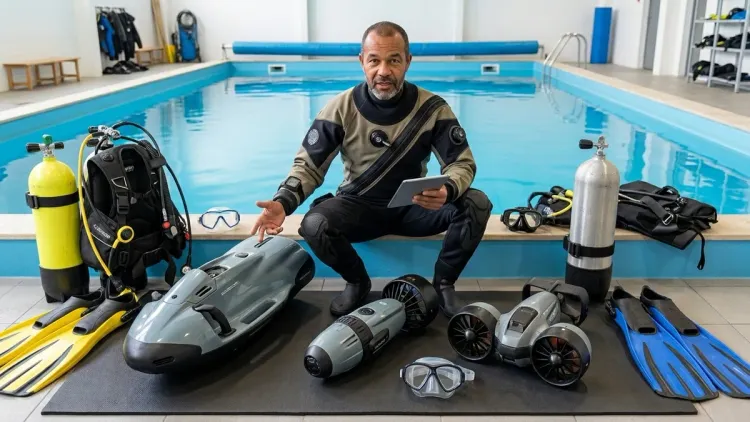
Underwater scooters break down into recreational models (depth ratings under 150 feet, run times 30–90 minutes, positive buoyancy) and technical models (depth ratings 300+ feet, run times exceeding 120 minutes, redundant systems, variable speed control). Within those categories, you'll find variations based on battery chemistry, thrust output, and intended use case.
Recreational scooters are designed for tropical reef diving, shore dives, and casual wreck exploration. They're typically compact, easy to travel with (though "easy" is relative—they still weigh 10–20 lbs), and priced for individual ownership. These units prioritize simplicity: on/off triggers, single-speed or two-speed operation, and sealed battery packs you charge between dives. The Sublue WhiteShark Mix Pro is a popular entry-level recreational scooter with dual motors, 40-minute run time, and compact dimensions—great for travel, less ideal for serious current work.
Technical scooters are built for cave diving, deep wreck penetration, and extended-range diving. They feature larger battery packs (lithium-ion with 100+ minute run times), variable-speed triggers, neutral to slightly negative buoyancy, and depth ratings to 400+ feet. Many incorporate redundant battery systems so you can swap packs mid-dive or carry spares. These scooters are heavy (30–50 lbs in air), expensive (often $3,000–$7,000+), and require rigorous maintenance. I've used technical DPVs in Florida cave systems where the scooter is the only way to reach certain passages—swim time would exceed safe gas limits, so the scooter isn't optional, it's life-support equipment.
Towable vs. rideable configurations also exist, though "rideable" is a bit of a misnomer. Some scooters feature foot pegs or sit-on designs where you straddle the device—these are popular in recreational vacation settings but impractical for serious diving because they destroy your trim and create massive drag. Most experienced divers prefer the traditional tow-behind design where you grip handles and the scooter pulls you horizontally in a streamlined position.
Battery-swappable vs. sealed units: Some scooters allow you to swap battery packs underwater or between dives, extending your total range on multi-dive days or long penetrations. Others use sealed battery compartments that require dockside charging. Swappable systems offer flexibility but introduce more o-ring seals and potential flood points. Sealed systems are simpler and more reliable, but you're limited by a single charge cycle. For liveaboard diving where you might do four dives a day, battery capacity becomes a real logistical constraint—see our guide on maintaining dive equipment during multi-day liveaboards for charging and care strategies in remote locations.
For a detailed performance comparison of specific models, including thrust measurements and real-world run time data, check out our Yamaha 350Li vs TUSA SAV-7 technical dive scooter comparison.
Frequently Asked Questions
Do I need special certification to use an underwater scooter?
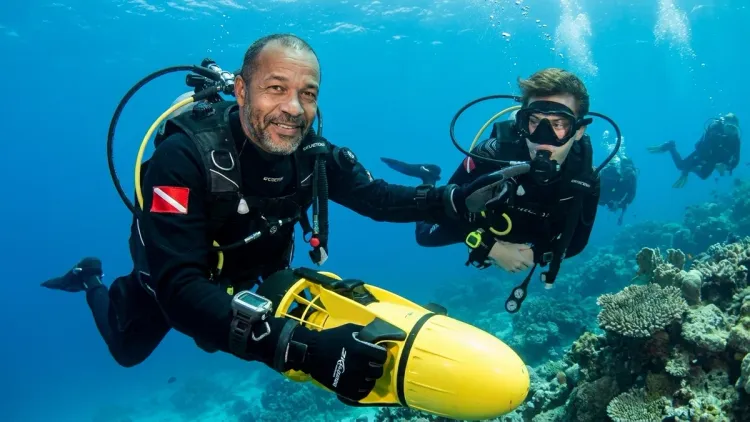
You don't legally need a DPV certification to use an underwater scooter, but most dive operators require proof of DPV training before renting one, and you absolutely should get trained before using one in real dive conditions. DPV-specific courses (offered by PADI, TDI, and other agencies) teach trim control under propulsion, emergency procedures for flooded or runaway scooters, battery management, and navigation while towing. A scooter amplifies every trim and buoyancy mistake you make, and without training, you're likely to waste gas, damage the environment, or create a safety hazard for yourself and your buddy. I've seen untrained divers rocket to the surface because they didn't understand how body angle affects ascent rate under tow—it's not something to learn by trial and error at 60 feet.
How long does an underwater scooter battery last on a single charge?
Run time depends on battery capacity, motor efficiency, speed setting, and environmental conditions, but expect 30–90 minutes for recreational models and 90–180+ minutes for technical scooters at cruising speed. Manufacturers rate run time at 70–80% throttle in calm water, so real-world performance varies. Running full throttle cuts run time by 30–40%, and cold water reduces battery efficiency by another 10–20%. A recreational scooter with a 400 watt-hour lithium-ion battery might give you 60 minutes at cruising speed in 75°F water, but only 40 minutes if you're running full speed in 50°F water fighting current. Always plan your dive with a 30–40% battery reserve—you don't want to burn the pack down to zero and have to swim back against current with a dead scooter in tow.
Can I take an underwater scooter on a plane?
You can travel with some underwater scooters, but lithium-ion battery regulations make it complicated, and you'll often need to ship the battery separately or rent one at your destination. Airlines restrict lithium-ion batteries over 100 watt-hours in checked luggage and often prohibit them entirely over 160 watt-hours. Most recreational scooters fall into the 300–600 watt-hour range, which means you can't fly with the battery. Some manufacturers offer airline-compliant battery packs under 100 watt-hours, but those reduce run time significantly. The scooter body itself can be checked (it's just plastic and a motor without the battery), but you're looking at 15–25 lbs of additional checked baggage. For detailed packing strategies, see our guide on how to pack scuba gear for remote liveaboard trips. Many divers rent DPVs at the destination rather than deal with the travel logistics.
How fast do underwater scooters go?
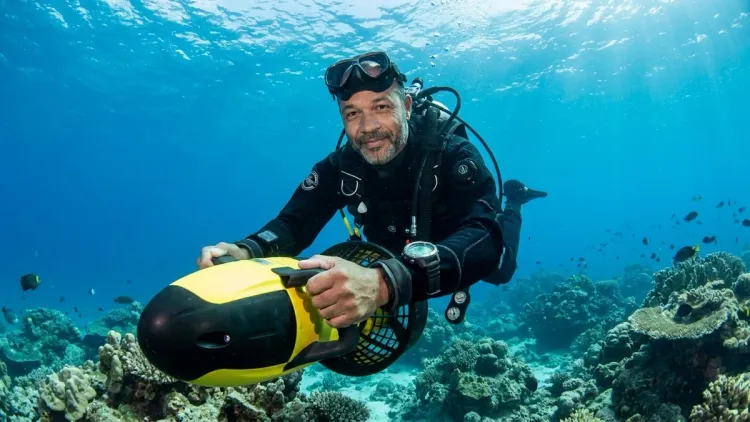
Recreational underwater scooters typically cruise at 2–3 knots (2.3–3.5 mph) with maximum speeds around 4–5 knots, while high-performance technical models can exceed 6 knots under ideal conditions. That might not sound fast compared to surface speeds, but underwater, 3 knots feels brisk and 5 knots is genuinely aggressive. Hydrodynamic drag increases exponentially with speed, so moving from 3 knots to 5 knots requires dramatically more battery power and creates much stronger forces on your body and gear. Most divers cruise at 2.5–3 knots for efficiency and control. I rarely run a scooter above 3.5 knots unless I'm fighting serious current, because the battery drain and trim demands just aren't worth the speed increase for recreational diving.
How deep can you dive with an underwater scooter?
Recreational scooters are typically depth-rated to 100–130 feet, while technical models are rated to 300–400+ feet depending on housing materials and seal design. The depth limit is determined by the pressure hull's ability to resist water ingress and the battery's performance under pressure and temperature stress. Exceeding the depth rating risks seal failure and flooding, which turns your scooter into dead weight. Cold water at depth exacerbates the problem by reducing battery voltage and shrinking o-rings. If you're diving deeper than 100 feet regularly, invest in a technical-rated scooter with appropriate depth certification. And just like with regulators and BCDs, depth ratings aren't suggestions—they're engineering limits based on material strength and seal integrity.
Summary
Underwater scooters transform what's possible on a single dive, extending your range, conserving gas, and turning physically demanding swim-outs into controlled cruises. They're not toys, though—they're complex pieces of equipment that demand training, maintenance, and respect for their failure modes. Whether you're considering a compact recreational model for reef diving or a technical DPV for cave penetration, understanding the propulsion mechanics, battery chemistry, trim implications, and depth ratings matters as much as knowing how your regulator delivers air. I've logged hundreds of dives with scooters across six continents, and the single biggest lesson I can share is this: the scooter doesn't make you a better diver, it amplifies what you already are. If your buoyancy and trim are solid, a DPV is a force multiplier. If they're not, the scooter will expose every weakness in your fundamental skills at three times the speed. Get trained, practice in controlled conditions, maintain your equipment rigorously, and the underwater scooter becomes one of the most capable tools in your dive kit.
For product-specific recommendations and lab-tested performance data, see our best underwater scooters guide, and for operational guidance, check out how to use an underwater scooter for trim control and navigation techniques.