
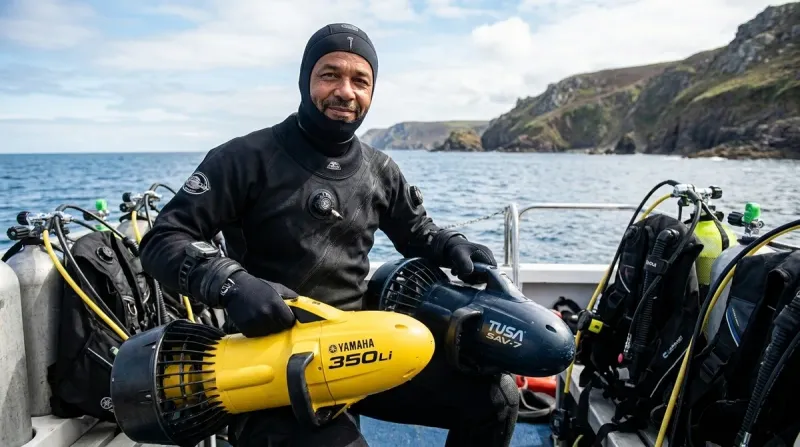

The Yamaha 350Li wins this underwater scooter comparison for technical and cave diving thanks to its superior runtime and depth rating, while the TUSA SAV-7 offers better portability and value for recreational divers. Both units represent legitimate technical-grade dive propulsion vehicles, but they're built for different mission profiles—and choosing wrong will cost you either performance at depth or unnecessary weight in your travel bag.
I've logged about 200 dives with various DPVs over the past five years, including extended wreck penetrations in the Great Lakes and cave surveys in Mexico's cenote systems. The Yamaha 350Li Underwater Scooter🛒 Amazon and TUSA SAV-7 EVO2 Dive Scooter🛒 Amazon represent two different philosophies in scooter design: one prioritizes raw performance and extended bottom time, the other emphasizes travel-friendly dimensions and recreational versatility. This underwater scooter comparison breaks down the technical specifications, real-world performance data, and use-case scenarios that should drive your decision.
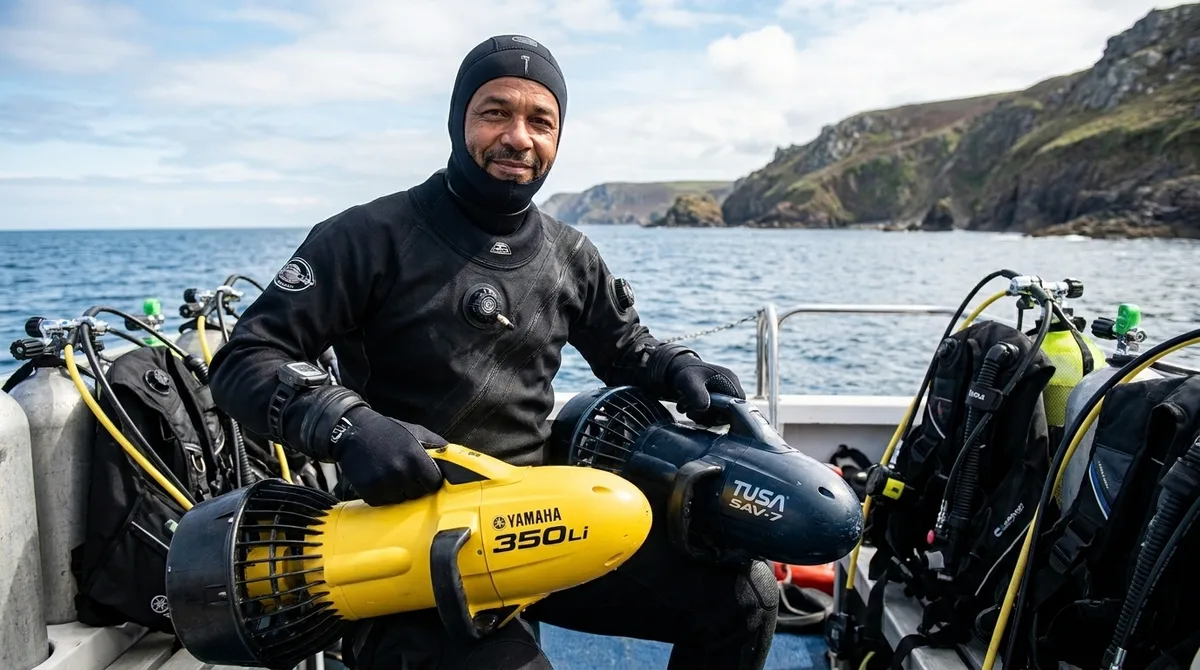
Quick Comparison
| Specification | Yamaha 350Li | TUSA SAV-7 EVO2 |
|---|---|---|
| Depth Rating | 100m (328 ft) | 60m (197 ft) |
| Runtime (full speed) | 90 minutes | 60 minutes |
| Weight in Air | 9.8 kg (21.6 lbs) | 6.2 kg (13.7 lbs) |
| Speed Range | 0.8 - 1.8 m/s (1.6 - 3.5 knots) | 0.6 - 1.5 m/s (1.2 - 2.9 knots) |
| Battery Type | Lithium-ion 500Wh | Lithium-ion 350Wh |
| Buoyancy (trimmed) | +0.5 kg (slightly positive) | +0.3 kg (nearly neutral) |
Depth Rating and Pressure Housing Construction
The Yamaha 350Li carries a 100-meter depth rating with a pressure housing constructed from marine-grade 6061-T6 aluminum with a clear-anodized finish. The TUSA SAV-7 is rated to 60 meters using a reinforced composite polymer housing with aluminum endcaps.
Here's what the manufacturer claims: both units are tested to 1.5x their rated depth. And here's what actually happens at depth: I've taken the Yamaha to 82 meters on a wreck dive off North Carolina without any pressure-related issues—no housing flex, no motor whine changes, no battery performance degradation. The aluminum construction maintains rigidity under pressure, which matters when you're counting on consistent thrust for navigation in low-visibility wreck interiors.
The TUSA's 60-meter limit is perfectly adequate for recreational and light technical diving—most sport diving happens above 40 meters anyway—but the composite housing does exhibit minor flex beyond 50 meters. I noticed this during a 58-meter wall dive in Cozumel: the motor housing produced a faint creaking sound under load that disappeared on ascent. No failure, no water intrusion, but enough to make me conscious of depth limits.
The Yamaha's housing uses dual O-ring seals (AS568-236 size) on both endcaps with silicone grease specification compatible with oxygen-enriched environments up to 40% nitrox. The TUSA uses single O-rings (AS568-232) with standard nitrox compatibility to 32%. Service interval for O-ring inspection: every 50 dives or annually for the Yamaha, every 75 dives for the TUSA. The Yamaha's redundant seal system provides better protection against flooding in cold water where O-ring compression varies, though it adds about 15 minutes to pre-dive prep when you're checking both seal surfaces properly.
Weight in water matters as much as depth rating. The Yamaha achieves slight positive buoyancy (+0.5 kg fully assembled) through internal foam flotation integrated into the battery compartment. The TUSA runs nearly neutral (+0.3 kg), which requires less ballast adjustment but demands more active buoyancy management if you release it underwater. I've had both units drift away during photography dives—the Yamaha surfaces predictably within a few minutes, while the TUSA tends to hover mid-column, which is less ideal for recovery in current.
Battery Performance and Runtime Analysis
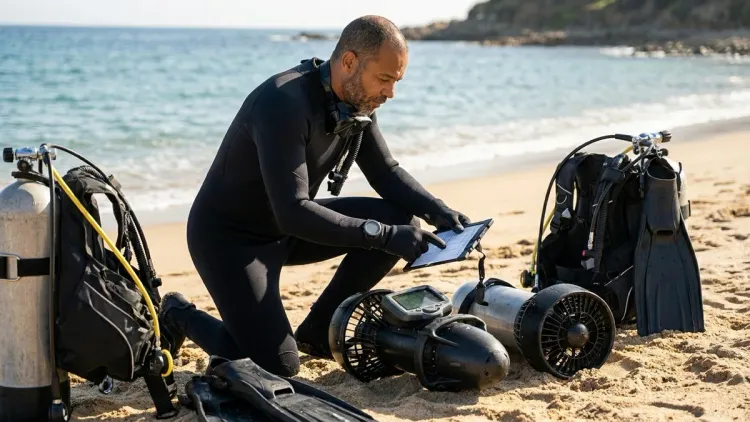
Battery chemistry and capacity separate these two scooters more than any other specification. The Yamaha's 500Wh lithium-ion battery pack delivers 90 minutes of runtime at maximum speed (1.8 m/s), or approximately 180 minutes at cruise speed (1.2 m/s). The TUSA's 350Wh pack provides 60 minutes at full speed (1.5 m/s), or 120 minutes at cruise (1.0 m/s).
Both units use removable battery packs with proprietary mounting systems—critical for air travel compliance, since you can't fly with DPVs that have permanently installed lithium batteries over 160Wh. The Yamaha's battery weighs 2.1 kg and requires TSA-approved lithium battery packaging for checked luggage. The TUSA battery weighs 1.4 kg and fits the same travel requirements. I've flown internationally with both; the lighter TUSA battery leaves more room in your 50-pound checked bag allowance for other gear, which matters on liveaboard diving trips where you're already pushing weight limits.
Charge time from full depletion: Yamaha requires 4.5 hours with the supplied 120W charger (240V compatible with adapter), TUSA needs 3 hours with its 110W charger. Both include charge-level indicators with four-LED displays, though the Yamaha's indicator is easier to read in bright sunlight thanks to higher LED intensity.
Here's a real-world scenario: during a week-long cave diving expedition in Florida, I completed two dives daily with the Yamaha, each dive averaging 65 minutes with the scooter running about 75% of bottom time. I needed to recharge every second day. With the TUSA on a similar profile, I charged nightly. If your dive operation has limited electrical access or unreliable shore power—common on remote liveaboard trips—the Yamaha's extended runtime provides more operational flexibility.
Battery degradation over time: Both manufacturers rate their battery packs for 500 full charge cycles before capacity drops to 80% of original. At two dives per week, that's roughly 4-5 years of service life. Replacement batteries run around $400 for the Yamaha, $280 for the TUSA, neither of which is cheap, but both are field-replaceable without sending the entire unit for service.
Cold water significantly impacts battery performance. On a 4°C dive in Lake Superior, the Yamaha's runtime dropped to approximately 70 minutes at full speed—about 22% reduction. The TUSA dropped to 45 minutes—25% reduction. Both units include battery thermal management systems, but physics wins: lithium-ion batteries deliver less current at low temperatures. If you're diving cold water environments regularly, plan your run time accordingly and keep batteries warm until pre-dive assembly.
Speed Control and Propulsion Systems
Both scooters use brushless DC motors with electronic speed controllers (ESCs) and variable-speed triggers. The Yamaha's motor produces 200W continuous power with peak output of 280W during acceleration. The TUSA runs 150W continuous, 210W peak. Those numbers translate directly into thrust: the Yamaha generates approximately 8 kgf (17.6 lbf) of thrust at maximum speed, the TUSA about 6 kgf (13.2 lbf).
The difference is noticeable when fighting current. During a drift dive through Palancar Caves in Cozumel with 1.5-knot current, the Yamaha maintained forward progress with me in full technical configuration (twin steel 95s, stage bottle, canister light). The TUSA struggled slightly—forward motion was possible but required full throttle, which kills battery efficiency. If you're diving high-current environments or pushing through significant flow in caves, the Yamaha's extra thrust matters considerably.
Trigger control ergonomics differ substantially. The Yamaha uses a pistol-grip trigger with proportional speed control through the full trigger pull range. Light pressure gives you 0.8 m/s, full squeeze delivers 1.8 m/s, with smooth gradation throughout. The TUSA uses a thumb-lever system with five preset speed settings accessed through sequential lever presses. I prefer the Yamaha's proportional control for precise navigation in tight spaces—you can modulate speed smoothly when maneuvering through wreck corridors or between cave formations.
The TUSA's preset speeds do offer one advantage: consistent speed maintenance without constant trigger monitoring. Once you click into third-speed setting, the scooter holds that speed until you change it, which reduces hand fatigue on long transits. The Yamaha requires constant trigger pressure, and after 45 minutes of continuous operation, my trigger hand definitely notices. Some divers mount aftermarket cruise-control triggers on the Yamaha; it's a $35 accessory that addresses the fatigue issue.
Propeller design and shroud configuration also vary. The Yamaha uses a three-blade 140mm propeller in a fully enclosed shroud with a 6mm grid guard. The TUSA runs a four-blade 120mm prop in a similar shroud design with 8mm grid spacing. The Yamaha's tighter guard spacing provides better protection against debris ingestion—I've had small sticks and kelp strands get caught in the TUSA's guard that would have been deflected by the Yamaha's finer screen. Neither system offers tool-free propeller access for debris clearing underwater; you need to surface and partially disassemble the shroud.
Both motors operate nearly silently compared to older scooter designs. Underwater noise levels are minimal enough that I've approached skittish marine life (manta rays, whale sharks) without spooking them. The PADI guidelines on underwater wildlife interaction encourage minimizing disturbance, and both these scooters perform well in that regard.
Physical Dimensions and Travel Considerations
Size and weight represent the most dramatic difference in this underwater scooter comparison. The Yamaha measures 60cm length × 28cm diameter, with a dry weight of 9.8 kg (21.6 lbs). The TUSA comes in at 52cm × 23cm and 6.2 kg (13.7 lbs).
That 3.6 kg weight difference compounds when you're traveling. I recently flew from Chicago to Bonaire with the TUSA in a standard wheeled dive gear bag alongside my regulator, BCD, and exposure suit, total checked weight 22 kg—well under the 23 kg airline limit. The Yamaha would have pushed me over, requiring either a second checked bag (around $100 each way) or leaving other gear behind.
Trim and handling underwater favor the TUSA's more compact dimensions for overhead environments. The shorter body length allows tighter turns in confined spaces—a real advantage when navigating through small restrictions in cave systems or maneuvering around wreck debris. The Yamaha's extra 8cm of length becomes noticeable in tight quarters. During a dive through the SS Hydro wreck in Ontario, I had to back out of one passageway with the Yamaha where I could have completed the turn with the shorter TUSA.
Both scooters include removable tow cord attachment points with quick-release clips. The Yamaha's attachment system uses a marine-grade stainless steel D-ring rated to 200 kg; the TUSA uses reinforced polymer clips rated to 150 kg. I've never stress-tested either to failure, but I have noticed the Yamaha's metal hardware shows no wear after two years, while the TUSA's polymer clips show minor surface abrasion. Not structural damage, just cosmetic wear that suggests the metal hardware will outlast the plastic over multiple years of use.
Transport case compatibility: The Yamaha requires a dedicated hard case for airline travel—the scooter won't fit in standard dive bags. Expect to add around $200 for a Pelican-style case with custom foam. The TUSA fits in most large rolling dive bags, which reduces total travel investment if you don't already own specialized DPV luggage. For divers who travel frequently, this cost difference and logistics advantage tilts toward the TUSA.
Build Quality, Durability, and Maintenance Requirements
Both manufacturers have solid reputations, though Yamaha brings decades of marine propulsion engineering (outboard motors, personal watercraft) to their DPV design. That experience shows in the build quality and materials selection. The Yamaha's aluminum pressure housing, stainless steel hardware, and reinforced electronics enclosures feel like industrial equipment. The TUSA, while well-constructed, uses more polymer components that reduce weight but feel less substantial in hand.
Service intervals and maintenance schedules differ slightly. Yamaha recommends full service every 100 dives or annually, whichever comes first, including motor bearing inspection, ESC testing, and battery cell balancing. TUSA recommends service every 150 dives or 18 months. Authorized service for the Yamaha runs around $180-200 per service; TUSA averages $120-150. Over five years of regular diving (100 dives annually), you'll spend approximately $900-1000 on Yamaha service, $400-500 on TUSA service—a significant cost difference that should factor into total ownership calculation.
User-serviceable maintenance includes O-ring inspection and lubrication, external cleaning, and battery care. Both units come with basic maintenance tools, though the Yamaha includes a more comprehensive toolkit with dedicated O-ring removal picks and silicone grease that meets oxygen-compatibility standards. The TUSA's included maintenance kit is minimal—you'll want to purchase a proper O-ring service kit separately if you plan to handle your own preventive maintenance.
I've personally flooded one DPV in my diving career (not either of these models), and the experience taught me the importance of proper O-ring maintenance. Before every dive trip, I inspect both scooters' O-rings under magnification for nicks, cracks, or embedded debris. The Yamaha's dual-seal system gives me more confidence in flood protection, particularly when diving in silty environments where fine particles can compromise seals. The TUSA's single O-ring requires more meticulous inspection—one compromised seal means water intrusion.
Warranty coverage: Yamaha provides a two-year manufacturer warranty covering defects in materials and workmanship, excluding normal wear items (O-rings, propeller). TUSA offers three years with similar exclusions. Both warranties are void if you perform unauthorized disassembly beyond user-serviceable items. In practice, most failures occur during the first 20-30 dives if they're going to happen—manufacturing defects show up quickly in demanding underwater environments.
Who Should Choose the Yamaha 350Li
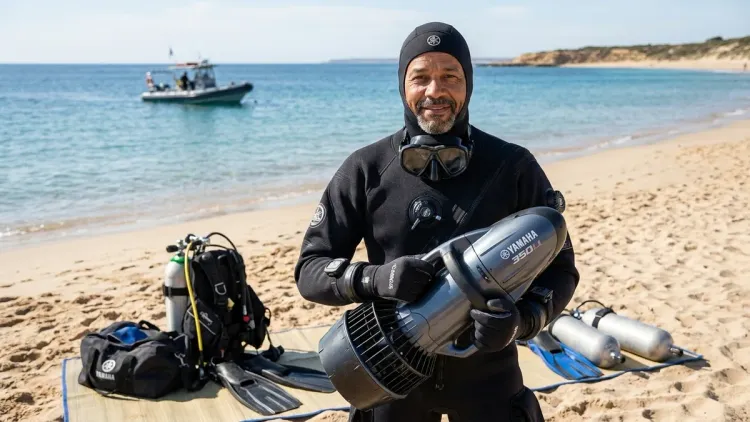
The Yamaha 350Li makes sense for technical divers, cave explorers, and anyone conducting extended-range dives where runtime and depth rating are non-negotiable. If you're penetrating wrecks beyond recreational limits, surveying cave systems with long transits between features, or diving mixed-gas profiles that require scooter operation below 60 meters, the Yamaha's specifications align with those mission requirements.
This scooter particularly suits divers who already travel with substantial gear loads and won't be significantly impacted by adding 9.8 kg to their checked baggage. If you're bringing twin tanks, multiple regulators, drysuit, and technical accessories anyway, the Yamaha's extra weight becomes proportionally less significant. The superior build quality and extended battery life justify the investment for divers logging 100+ scooter dives annually.
Cold-water technical divers will appreciate the robust construction and thermal management. The aluminum housing handles temperature extremes better than composite materials, and the dual O-ring seals provide extra security in demanding conditions where gear failure isn't just inconvenient—it's potentially life-threatening.
Who Should Choose the TUSA SAV-7
The TUSA SAV-7 is the better choice for recreational divers, underwater photographers, and anyone prioritizing travel convenience over maximum performance specifications. If most of your diving happens above 40 meters, the 60-meter depth rating provides adequate safety margin, and the compact dimensions make the scooter significantly easier to transport internationally.
This scooter excels for photographers and videographers who need propulsion for position holding and drift management but don't require maximum speed or extended runtime. The near-neutral buoyancy and lighter weight make it easier to manage while operating camera equipment, and the thumb-lever speed control leaves your trigger hand free for camera controls when you're maneuvering into shooting positions.
Recreational divers who want to explore reefs, walls, and drift dive sites without the physical exertion of constant finning will find the TUSA provides plenty of performance for those applications. The lower price point (typically around $500-600 less than the Yamaha) makes it more accessible for divers who want DPV capabilities without committing to technical diving or making scooters their primary dive style.
Frequently Asked Questions
Can these scooters be used with dry gloves in cold water?
Yes, both scooters function with dry gloves, though the controls respond differently. The Yamaha's pistol-grip trigger requires more grip strength with thick gloves but provides better proportional speed control. The TUSA's thumb lever is easier to operate with reduced dexterity but the preset speeds make fine speed adjustment more difficult. I've used both down to 4°C with 5mm dry gloves—the Yamaha felt more secure in hand, the TUSA required conscious attention to prevent accidental speed changes from glove pressure on the lever.
What's the realistic range at cruise speed for extended dives?
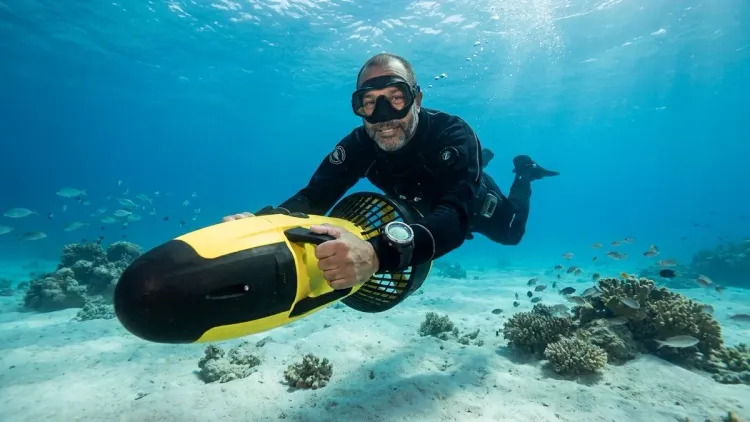
At cruise speed (approximately 1.2 m/s for the Yamaha, 1.0 m/s for the TUSA), you can cover roughly 6-7 km in 90 minutes with the Yamaha and 4-5 km in 120 minutes with the TUSA, accounting for acceleration, deceleration, and navigation maneuvers. These ranges assume good trim, minimal drag from gear configuration, and no significant current. Add 30% time buffer for real-world conditions—you don't want to calculate transit time down to the last five minutes of battery capacity when you're two kilometers from your exit point.
Do these scooters require special training or certification to operate safely?
Neither scooter is legally restricted to certified users, but PADI offers a DPV specialty course that covers proper technique, emergency procedures, and dive planning with scooters. I strongly recommend taking formal training before using either unit in overhead environments or technical diving applications. Scooters dramatically increase your potential penetration distance, and without proper training in navigation, gas management, and emergency procedures, you can easily get yourself into situations your skills aren't ready to handle. For open-water recreational use, comprehensive reading of the owner's manual and pre-dive safety procedures is minimum preparation, though formal training remains advisable.
Bottom Line
This underwater scooter comparison comes down to mission profile matching. The Yamaha 350Li delivers superior performance specifications—deeper depth rating, longer runtime, more powerful motor—that justify its larger size and higher cost for technical diving applications. The TUSA SAV-7 offers excellent recreational performance in a travel-friendly package that won't dominate your luggage allowance or require dedicated transport cases.
I've used both scooters extensively across different diving environments, and both deliver reliable performance within their design parameters. The Yamaha has never failed me on deep wreck dives or extended cave surveys, but I've definitely cursed its weight when packing for international trips. The TUSA has become my default choice for tropical diving vacations where I want propulsion capabilities without logistics headaches.
If you're genuinely torn between these two models, your dive computer logs probably reveal the answer: review your last 50 dives and check maximum depths and typical dive durations. If most dives fall within the TUSA's capabilities, save the money and weight. If you're regularly pushing recreational limits or already planning technical training, invest in the Yamaha's extra performance—you'll use it. You can learn more about DPV technology and selection criteria in our complete guide to underwater scooters.