
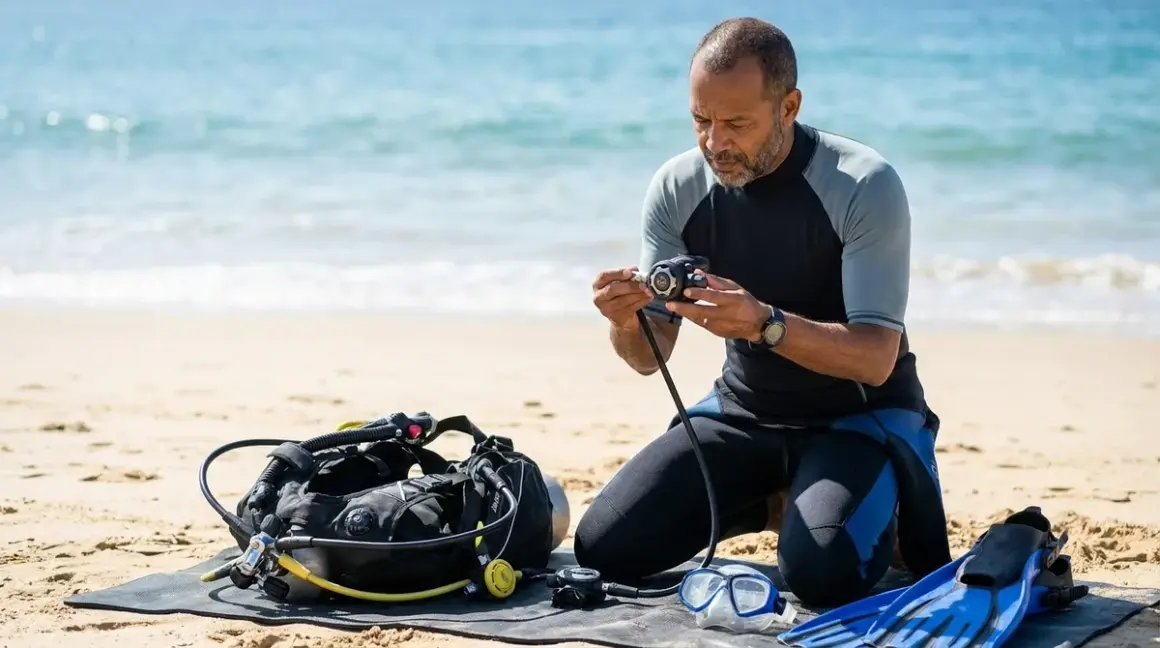

I learned the hard way about regulator safety checks in Cozumel back in 2018. Skipped my usual pre-dive inspection because I was running late for a drift dive, got to 70 feet, and my second stage started breathing wet. Not a full freeflow, just enough moisture with each breath to make me question every decision I'd made that morning. Turned out a tiny grain of sand had lodged in the exhaust valve. Five seconds of inspection topside would have caught it.
A thorough regulator safety check before every dive isn't paranoia—it's basic risk management. This checklist covers the twelve inspection points I run through on every single dive, whether it's my first of the trip or my fourth of the day. These aren't manufacturer-mandated service intervals or annual overhauls—this is the stuff you check yourself, every time, before you put that regulator in your mouth at depth.

This applies whether you're diving a brand-new Scubapro MK25 EVO/S620 Ti or a rental reg you've never seen before. The principles don't change.
Visual Inspection Points
1. Hose Condition and Routing
Check every inch of every hose for cracks, abrasion, or bulging. I run my fingers along the full length of the LP hose from first stage to second stage, paying special attention to the areas right where the hose meets the fittings—that's where stress concentrations cause most failures. Look for any discoloration, stiffness, or that telltale crackling texture that means the outer rubber is degrading.
The intermediate pressure hose on your primary second stage sees constant flexing. If you spot any bubbling under the surface (feels like Rice Krispies when you squeeze it), that hose is done. I've seen catastrophic hose failures at depth exactly twice in 3,000 dives, and both times there were visible warning signs that got ignored during the pre-dive check.
2. Mouthpiece Integrity
Inspect the mouthpiece for tears, especially at the bite tabs. Those little nubbins you clamp down on take incredible stress, particularly if you're someone who bites hard when task-loaded. A torn mouthpiece won't kill you, but it makes breathing uncomfortable and can distract you from more important things—like the eagle ray that just cruised past while you were fiddling with your reg.
Check that the mouthpiece is actually secured to the second stage properly. The zip tie or retaining ring should be tight. I carry spare mouthpieces in my save-a-dive kit because they weigh nothing and take 30 seconds to swap.
3. First Stage Attachment and O-Ring
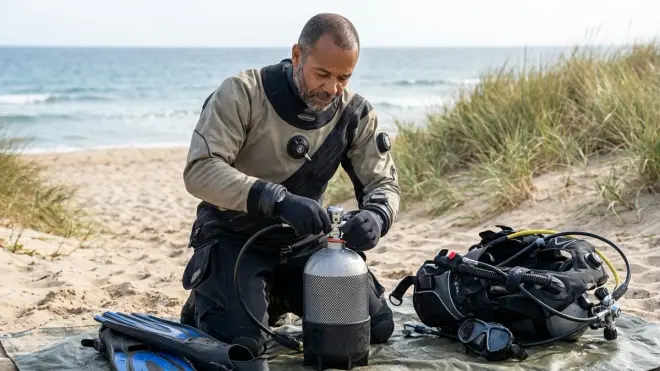
Verify your first stage is hand-tight on the valve—not wrench-tight, not finger-loose. Open the dust cap (if you're using yoke) or inspect the filter (if you're on DIN) and look at that little green or black o-ring that seals the connection. Any visible nicks, flattening, or debris stuck to it means you need to replace it or clean it before pressurizing.
For DIN connections, make sure the threads are clean and the o-ring isn't pinched or extruded. A proper DIN-to-yoke adapter should be treated the same way. I've watched divers blow o-rings on the boat because they rushed this step and cross-threaded the connection. If you hear a leak when you pressurize, shut it down immediately—don't try to "tighten through it."
If you're diving in environments where silty sediment is common, this check matters even more. A single grain of sand between the o-ring and the tank valve can cause a slow leak that wastes your gas and potentially strands you on a remote site. Understanding how scuba regulators work helps you grasp why this seal is so critical.
4. Purge Button Movement
Press the purge button on both your primary and alternate second stages. It should move smoothly with no sticking, and it should spring back immediately when you release it. A sticky purge usually means salt buildup or a failing spring, both of which can lead to freeflows at depth.
When you purge, the airflow should be strong and consistent—no sputtering, no delays. If the purge feels mushy or takes a second to engage, something's wrong with the lever or the poppet inside the second stage.
Pressure and Function Tests
5. Pressurization and Initial Leak Check
Open the tank valve slowly while watching and listening for leaks. I open it about a quarter turn initially, listen for any hissing, then open it fully. Check every connection point: first stage to tank, first stage to hoses, hoses to second stages. Any steady stream of bubbles means you've got a leak that needs addressing before you get wet.
Don't just listen—look. Tiny leaks sometimes show up as visual distortion (like heat shimmer) before you can hear them, especially in noisy environments like a dive boat with a running compressor.
6. Static Intermediate Pressure Hold
After pressurizing, wait 30 seconds and watch your SPG. The needle shouldn't be moving. If it's slowly creeping down, you've got a leak somewhere in the system. Could be a failing HP seat in the first stage, could be a pinched o-ring, could be a dozen other things—but whatever it is, you don't want to discover it at the safety stop.
I've caught slow IP creep on rental regs more times than I can count. It's usually not dramatic enough for the shop to notice between dives, but over a 45-minute dive it can cost you 200-300 psi you were counting on.
7. Breathing Resistance at Surface
Take several deep breaths through your primary second stage while it's pressurized. Inhale and exhale should both feel smooth and unrestricted. Now do the same with your alternate (octopus). If either one feels noticeably harder to breathe than normal, or if you hear any clicking or rattling during inhalation, something's off with the internal mechanism.
Pay attention to exhale resistance too. If you have to push hard to exhale, the exhaust valve might be stuck or there might be debris blocking it. That's exactly what happened to me in Cozumel—the exhaust valve was partially obstructed, so exhaled air was backfilling around the diaphragm and mixing with my next inhale.
8. Freeflow Test (Controlled)
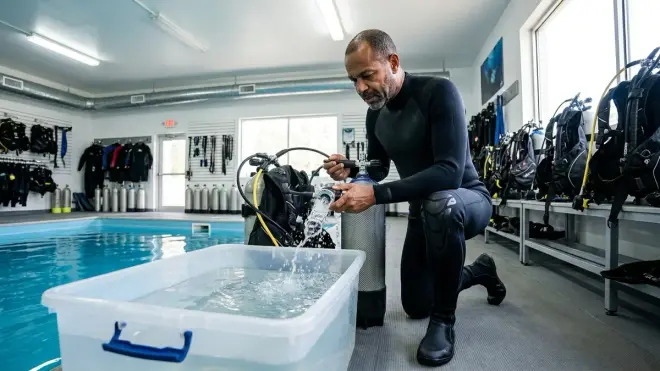
While the reg is pressurized but not in your mouth, press and release the purge button sharply. The airflow should stop immediately when you release. If it continues to freeflow, you've got a problem with the second stage poppet or lever adjustment.
Now tip the second stage upside down and purge it briefly. Some regs are more sensitive to orientation than others, but a well-maintained second stage shouldn't freeflow just from being inverted. If yours does, it needs adjustment—and if you're headed for cold water (anything below 50°F), that sensitivity will get dramatically worse at depth.
Cold water diving demands regulators specifically designed for thermal stability, but even cold-rated regs need this basic freeflow check.
Control and Safety Systems
9. Alternate Air Source Accessibility
Can you reach your octopus in one smooth motion with your right hand? Time yourself. It should take less than two seconds from decision to reg in hand. If it's tucked into a BCD pocket, clipped somewhere awkward, or dangling behind your tank, you're introducing unnecessary task loading into an emergency scenario.
I use a magnetic breakaway holder that keeps my alternate secured to my right chest D-ring. Triangle of accessibility: it should be somewhere in the zone from your chin to your lower ribs, clearly visible, and impossible to miss by feel alone.
Also check that your alternate's mouthpiece cover (if you use one) actually comes off easily. I've seen divers fumble with stuck mouthpiece caps during out-of-air drills. Not the time to discover that the little rubber keeper has dry-rotted into concrete.
10. SPG Accuracy Verification
Cross-check your submersible pressure gauge against the tank's known fill pressure if possible. Most tanks get filled to 3000 psi (207 bar) or 3300 psi (228 bar) depending on rating. If your gauge is reading 2700 psi on a tank that was just filled, either the tank is short or your gauge is reading low.
SPGs drift over time, usually reading progressively lower than actual pressure. That's a safety margin in your favor, but it's still good to know how accurate your gauge is. I replace SPGs every 3-4 years regardless of whether they "seem" fine, because depth accuracy matters more than age.
If you're diving with an air-integrated computer, verify that the wireless transmitter is reading within 100 psi of your analog SPG. For more on how AI systems work and their reliability considerations, see our comparison of AI dive computers versus traditional dive computers.
11. Low-Pressure Inflator Connection
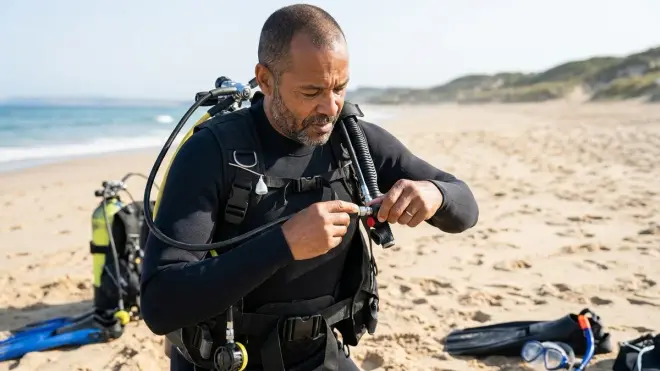
Disconnect and reconnect your BCD's LP inflator hose. Make sure the quick-disconnect coupling clicks positively and doesn't pull off with light tension. A loose LP hose connection will auto-disconnect mid-dive, leaving you without power inflation—manageable, but annoying.
While it's connected, press the inflate button and verify smooth airflow. Then press the deflate button and check that it's not sticky. A stuck inflator button causes runaway inflation, which is both terrifying and embarrassing. I know because it happened to me during an Open Water student checkout dive in Monterey. My students got a live demonstration of emergency procedure—I got a story I'm never living down.
This connects directly to your BCD pre-dive safety check, which covers the inflator mechanism and buoyancy system in more detail.
12. Final Breathing Test with Tank Valve Manipulation
Close your tank valve completely while breathing from the regulator. You should get 3-4 full breaths before the air runs out (you're drawing down the intermediate pressure in the hoses and first stage). This confirms that you're actually breathing from the tank and not from some residual pressure in the system.
Now open the valve fully and verify that breathing returns to normal. This test sounds paranoid until you meet someone who spent an entire dive breathing down their IP because they never opened their valve past a quarter turn. It happens more than you'd think, especially with new divers or anyone using an unfamiliar tank valve.
Final Check Before You Go
Here's the condensed version I run through in my head while I'm gearing up:
- Visual sweep: Hoses intact, mouthpieces good, first stage secure, o-rings clean
- Pressurize and listen: No leaks at any connection point
- Breathe it: Primary and alternate both smooth, no wet breathing, no freeflow
- Accessibility: Octopus where I can find it, SPG readable, inflator connected
- Tank valve: Fully open, confirmed by breathing test
The entire regulator safety check takes maybe 90 seconds if you're methodical. That's 90 seconds that has saved me from wet breathing, freeflows, stuck inflators, and at least one near-emergency that would have been a real emergency if I hadn't caught it topside.
Every dive. Every single one. Doesn't matter if I just dove this same gear two hours ago on the previous site. Conditions change, connections loosen, debris gets into places it wasn't before. The check stays the same.
Frequently Asked Questions
How often should I perform a regulator safety check?
Before every single dive, without exception. A regulator safety check isn't a once-per-day or once-per-trip procedure—it's a pre-dive ritual that happens each time you gear up, even if you're doing multiple dives with the same equipment on the same day. Connections can loosen between dives, debris can enter second stages during surface intervals, and conditions change. I've caught equipment issues on dive four of the day that weren't present on dive three, specifically because I ran through the full check each time. Beyond pre-dive checks, your regulator needs professional service according to the manufacturer's schedule, typically annually or every 100 dives, whichever comes first, as detailed in our guide to how to service a scuba regulator.
What's the difference between a pre-dive safety check and regular regulator maintenance?
A pre-dive safety check is a user-level inspection you perform yourself before every dive to catch immediate, visible problems like leaks, damaged hoses, or functional issues with purge buttons and breathing resistance. Regular maintenance is professional servicing performed by a trained technician, which involves disassembly, internal inspection of diaphragms and poppets, o-ring replacement, IP adjustment, and pressure testing—tasks that require specialized tools and knowledge. The pre-dive check catches problems you can see and feel; professional maintenance addresses wear you can't detect without disassembling the regulator. Both are essential, and neither replaces the other. Think of the pre-dive check as your daily responsibility and annual service as your long-term insurance policy.
Can I dive if my regulator fails one of these inspection points?
Absolutely not—if your regulator fails any critical inspection point, you don't dive until the issue is resolved. A failed check isn't a suggestion or a yellow flag; it's a hard stop. Leaks, freeflows, wet breathing, stuck purge buttons, or damaged hoses are all safety-critical failures that can escalate into life-threatening emergencies at depth. I've watched divers try to "make it work" with a slightly sticky purge or a slow leak, and I've watched those same divers surface early, frustrated and sometimes scared, because the problem got worse underwater. If you're on a liveaboard or remote dive site without repair facilities, this is exactly why carrying redundant dive gear or having a backup regulator in your kit matters. Your safety is worth more than missing one dive.
Final Thoughts
I still remember that Cozumel drift dive—not because it was dangerous (it wasn't, really), but because it was completely preventable. Every breath tasted like salt water and regret. Since then, the regulator safety check has been as automatic as checking my mask strap or verifying my tank pressure.
Here's what the dive industry doesn't always tell you: most regulator "failures" aren't actually failures. They're predictable problems that announced themselves during the inspection you skipped. A cracked hose doesn't explode without warning. A sticky purge doesn't suddenly appear at 80 feet. A leaking first stage connection gives you bubbles topside before it gives you an emergency below.
The 90 seconds you spend on this checklist is your cheapest insurance policy. Use it.