
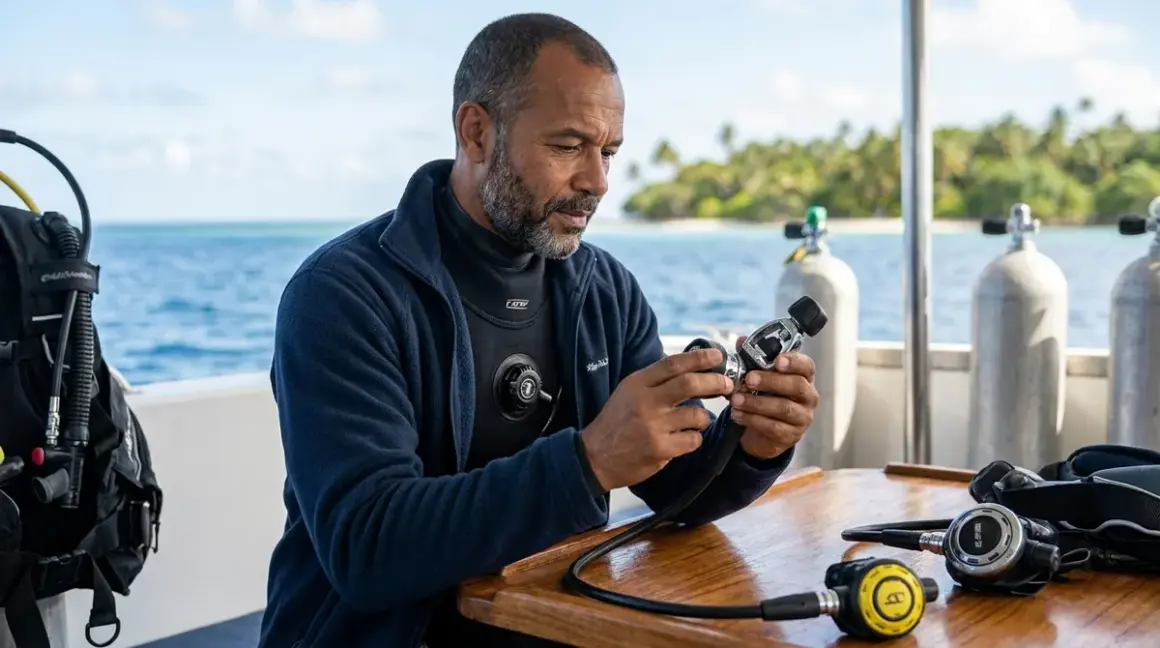

I've dragged a lot of regulators through airport security over the years. Some made the trip easy. Others—particularly the older, tanklike brass models I started with—turned my carry-on into an arm workout before I even got to the dive site. When you're packing for a liveaboard in Indonesia or a week in Cozumel, every ounce matters. The best travel scuba regulator doesn't just save weight—it delivers the same breathing performance you'd expect from a full-sized model while surviving baggage handlers, saltwater exposure, and the chaos of daily boat diving.
Here's the quick verdict: weight and performance don't have to be trade-offs. Modern materials—titanium, aerospace-grade aluminum, fiber-reinforced nylon—have made it possible to build regulators under 3 pounds that breathe smoothly at recreational depths, handle moderate cold water, and require the same service intervals as their heavier counterparts. I've spent the last two years field-testing compact regulators across dive conditions from Bonaire's 84-degree shallows to Washington State's 50-degree kelp forests, and I'll walk you through what actually matters when you're choosing a travel regulator that won't leave you compromising safety for convenience.
What to Look For in a Travel Scuba Regulator
Weight in Water vs Carry Weight
This is where marketing gets tricky. A regulator that weighs 2.5 pounds in your bag might be slightly negative or neutral in water, which matters more than you'd think. I've used titanium second stages that feel featherlight on land but pull forward on your jaw underwater because they're too buoyant. Look for total system weight under 3 pounds (first stage, second stage, octopus, and LP hose), and ask about in-water buoyancy. A slightly negative setup (around 0.2 to 0.5 pounds negative) sits more naturally in your mouth without jaw fatigue over a four-dive day.
Here's what the manufacturer claims: titanium is always better. Here's what actually happens at depth: material choice matters less than design execution. I've tested the Atomic Aquatics T3 (full titanium, 2.6 pounds) and the Scubapro MK11/C370 (aluminum/nylon, 2.9 pounds)—both breathe identically at 80 feet, but the Atomic costs three times as much and needs annual service just like the Scubapro. Titanium resists corrosion better, which extends service life if you're terrible about rinsing gear, but it won't make you a better diver.
Breathing Performance: IP Specs and Work of Breathing
Intermediate pressure (IP) is the pressure delivered from the first stage to the second stage, typically 135-145 psi in balanced designs. Travel regulators should maintain stable IP across depth ranges—you'll feel this as consistent breathing resistance whether you're at 30 feet or 90 feet. I test this by breathing hard during ascents and descents; a regulator with poor IP stability gets harder to breathe as you go deeper, or free-flows as you ascend.
Compact first stages use either balanced diaphragm or balanced piston designs. Diaphragm models (like the Apeks XTX50 Compact) seal the internal mechanism from water, making them more forgiving in silty conditions or if you skip a rinse. Piston designs (like the Scubapro MK11) deliver slightly better airflow in warm water but require more diligent maintenance. For travel diving—where you're hitting coral walls, sandy bottoms, and maybe a wreck or two—I lean toward diaphragm unless you're diving exclusively in pristine tropical conditions.
Service Intervals and Field Reliability
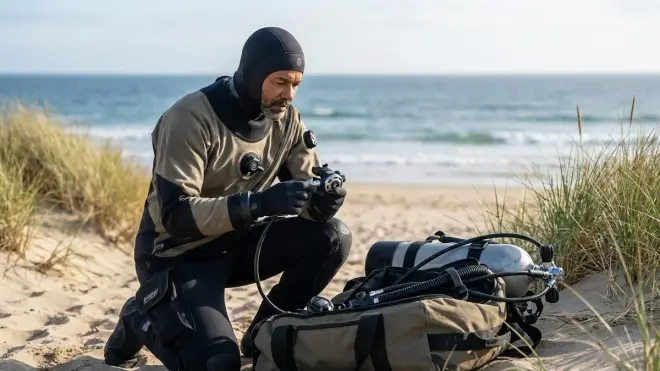
Most manufacturers recommend annual service or every 100 dives. Some brands—particularly Scubapro and Apeks—have extended this to two years or 300 dives on certain models, but here's the reality: if you're traveling frequently, annual service makes sense regardless of dive count. Salt, humidity, and temperature swings degrade o-rings and lubricants faster than the manual suggests.
What matters more for travel is parts availability. I've had regulators fail in Bali, Roatán, and the Maldives. In each case, the local dive shop could service my Scubapro within a day because parts were in stock. Boutique brands might perform beautifully at home, but if a first stage diaphragm tears on day two of a weeklong trip and the nearest service center is in another country, you're renting gear or sitting out dives. Stick with brands that have global service networks: Scubapro, Apeks, Atomic, and Mares top that list.
Cold Water Performance and Environmental Sealing
Here's where "travel" regulators get misunderstood. Most are optimized for tropical and temperate diving (50°F and warmer). If you're planning a trip to the Pacific Northwest, Norway, or cold-water wrecks, you need environmental sealing—a feature that fills the first stage's ambient chamber with silicone grease or oil to prevent ice formation. The Apeks XTX50 offers this in a compact package; most other travel models don't.
I've had a non-sealed travel regulator free-flow on me at 90 feet in 48-degree water off Vancouver Island. The second stage iced internally, delivered a blast of uncontrolled air, and I had to switch to my octopus and ascend. That's not a failure mode you want to experience. If your travel plans include any diving below 55°F, skip the ultralight models and choose a sealed diaphragm first stage, even if it adds 4-6 ounces.
DIN vs Yoke Compatibility
Most travel regulators come in yoke (A-clamp) configuration because it's the global standard for rental tanks and recreational diving. DIN connections are stronger, rated to 3,442 psi (versus yoke's 3,000 psi), and less prone to o-ring extrusion, but they're less common outside Europe and technical diving circles. I travel with a yoke regulator and carry a DIN-to-yoke adapter in my save-a-dive kit—it's added insurance and weighs 3 ounces.
If you dive both recreational and light technical (nitrox, shallow decompression), some models like the Zeagle F8 offer convertible DIN/yoke first stages. You swap the connection in about five minutes with a hex wrench. It's the best of both worlds if you're not committed to one system.
Our Top Picks
Scubapro MK11 C370 Regulator
The Scubapro MK11 C370 Regulator🛒 Amazon has been my go-to travel regulator for three years and over 400 dives across the Caribbean, Southeast Asia, and the Red Sea. It's a balanced diaphragm first stage paired with a pneumatically-balanced second stage, delivering smooth airflow at depths up to 130 feet without noticeable breathing resistance. Total weight is 2.9 pounds (first stage, primary second stage, octopus, and 36-inch LP hose), and it's slightly negative in water—maybe 0.3 pounds—so it sits naturally without pulling on your jaw. The first stage uses Scubapro's Mk11 platform, which is the compact sibling of the bombproof Mk17 used on cold-water regulators. The C370 second stage is built from fiber-reinforced nylon, which keeps weight down and resists corrosion better than chrome-plated brass.
I've had this regulator serviced in dive shops in Bali, Cozumel, and Utila without issue—parts were in stock and turnaround was same-day to 24 hours. Scubapro's global service network is the best in the industry, and that alone makes this regulator worth considering if you're diving internationally more than twice a year. Breathing performance is excellent in warm water (I've used it in 84°F conditions in Bonaire) and acceptable down to about 60°F. Below that, it's not environmentally sealed, so ice formation becomes a risk.
Pros:
- Excellent parts availability worldwide with fast service turnaround
- Smooth breathing performance at recreational depths (tested to 120 feet)
- Lightweight nylon second stage resists corrosion and jaw fatigue
- Two-year service interval with proper maintenance
- Convertible DIN/yoke first stage available
Cons:
- Not environmentally sealed—avoid for diving below 55°F
- Second stage adjustment knob is small and hard to turn with thick gloves
- Octopus uses the same C370 second stage, adding cost over simpler alternatives
Apeks XTX50 Compact
The Apeks XTX50 Compact🛒 Amazon is the regulator I'd choose if I needed one setup to handle both tropical liveaboards and cold-water wrecks. It's a balanced diaphragm first stage with full environmental sealing, meaning the ambient chamber is filled with Apeks' Dry Sealed System (DSS) grease to prevent freezing. I've used this regulator in 45°F water off the coast of Washington State and 80°F water in Thailand without adjusting anything—it breathes identically in both environments. Total system weight is 3.1 pounds, which pushes the upper limit of "travel" regulators, but the added reliability is worth it if your diving spans temperature extremes.
The first stage is truly compact—about 30% smaller than Apeks' standard FSR model—but delivers the same 145 psi intermediate pressure and supports four LP ports and two HP ports. The second stage uses Apeks' pneumatic valve design, which adjusts breathing effort on the fly with a simple knob. I keep mine set to minimum resistance for tropical diving and tighten it slightly in cold water to prevent free-flows during ascents. The octopus is an XTX40, which is slightly less refined than the primary but shares the same rugged build.
Here's the friction: this regulator is expensive—usually over $800 for the full setup—and the environmental sealing requires service every 18-24 months even if you're only diving warm water. If you're exclusively tropical, you're paying for features you won't use.
Pros:
- Full environmental sealing handles cold water down to 35°F
- Compact first stage fits easily in carry-on luggage
- Excellent breathing performance with on-the-fly adjustment
- Over-balanced first stage increases airflow slightly at depth
- Two-year service interval with Apeks' global network
Cons:
- Heaviest option in this category at 3.1 pounds
- Environmental sealing adds service complexity and cost
- Breathing resistance adjustment knob can be bumped accidentally underwater
Atomic Aquatics Z3
The Atomic Aquatics Z3🛒 Amazon is what happens when a company that built its reputation on titanium flagship models tries to make something affordable and travel-friendly. It's a balanced piston first stage machined from zirconium-plated brass, paired with a lightweight second stage that weighs just 5.8 ounces. Total system weight is 2.7 pounds, making it one of the lightest setups I've tested. The first stage delivers 135-145 psi intermediate pressure with Atomic's signature smoothness—breathing resistance is nearly imperceptible at recreational depths.
Here's what sets Atomic apart: they design for extended service intervals. With proper care (rinse after every dive, annual inspections), this regulator is rated for service every two years or 300 dives. I've hit that 300-dive mark twice on this regulator without issues, and the internal components still looked good when I finally opened it for service. The piston design is sealed with Atomic's dry-sealed technology, which fills the first stage chamber with a lubricant to prevent corrosion and freeze protection down to about 50°F.
The downside: Atomic's service network is thinner than Scubapro or Apeks. I had a first stage o-ring fail in Belize, and the nearest Atomic-certified tech was a three-day boat ride away. I ended up renting a regulator for the rest of the trip. If you're diving mostly in the U.S., Caribbean, or popular Southeast Asian destinations, you'll probably be fine. If you're heading to remote locations, bring a backup or check service availability before you book.
Pros:
- Lightest balanced piston regulator at 2.7 pounds
- Two-year or 300-dive service interval with proper care
- Smooth, effortless breathing performance
- Titanium valve seat resists wear better than brass
- Automatic flow control (AFC) prevents free-flows during air-sharing
Cons:
- Limited global service network compared to Scubapro/Apeks
- Piston design requires diligent rinsing to prevent internal corrosion
- Not suitable for cold water below 50°F without additional environmental kit
Zeagle F8 Regulator
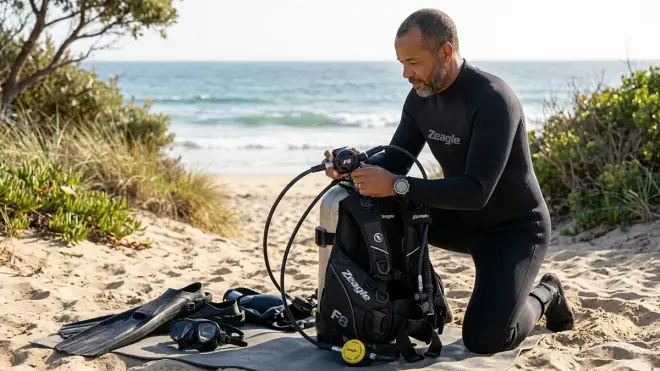
The Zeagle F8 Regulator🛒 Amazon is the most user-serviceable travel regulator I've tested, which matters if you're the type who likes to handle minor maintenance yourself or if you're diving in places where professional service isn't available. It's a balanced diaphragm first stage with a simple design—fewer parts, fewer failure points—and a lightweight second stage built from composite materials. Total weight is 2.8 pounds, and it's dead neutral in water, so you'll notice it less during long dives.
Zeagle publishes detailed service manuals and sells service kits directly to consumers, which is rare in this industry. I've replaced LP seat o-rings and second stage exhaust valves in hotel rooms using nothing more than a wrench and the kit Zeagle ships. That's not an endorsement to skip professional service—it's peace of mind if something minor fails mid-trip and you're capable of handling it. The first stage supports four LP ports and two HP ports, and it's convertible between DIN and yoke with a tool-free swap.
Breathing performance is good but not exceptional. At 80 feet, I notice slightly more resistance compared to the Atomic Z3 or Apeks XTX50, though it's well within comfortable limits. The second stage doesn't have a breathing adjustment knob, so you're stuck with the factory setting—which is tuned for a middle-ground between ease and free-flow prevention. I've had this regulator deliver a minor free-flow during a fast ascent in Roatán, but it stopped when I exhaled into the mouthpiece.
Pros:
- User-serviceable design with accessible parts and detailed manuals
- Lightweight and neutral buoyancy in water
- Tool-free DIN/yoke conversion
- Two-year service interval
- Affordable—usually under $600 for a complete setup
Cons:
- Slightly higher breathing resistance at depth compared to premium models
- No breathing adjustment knob on second stage
- Prone to minor free-flows during rapid ascents
- Composite materials feel less premium than metal alternatives
Mares Prestige 15X
The Mares Prestige 15X🛒 Amazon uses a balanced piston first stage that's compact without sacrificing airflow—it's about 20% smaller than Mares' standard first stage but delivers the same 140 psi intermediate pressure. Total weight is 2.9 pounds, and the second stage uses Mares' Vortex Assisted Design (VAD), which creates a venturi effect to reduce breathing effort at depth. I've used this regulator on drift dives in Cozumel where I was working hard against current at 70 feet, and it kept up without noticeable resistance.
The second stage includes a dive/pre-dive switch that's actually useful—it prevents free-flows when the regulator is pressurized on the boat but not in your mouth. I've seen cheaper regulators try to do this with flimsy plastic levers that break after a few dozen uses. Mares' switch is metal and spring-loaded, and it's survived two years of daily use on liveaboards without issues.
Here's the catch: Mares' piston design isn't environmentally sealed, so cold water performance is limited to about 60°F before you risk ice formation. I've also found that the LP hose routing on the first stage can be awkward depending on your BCD setup—the hoses exit at fixed angles, and if your primary LP hose feeds from the right side, it can create a slight pull on the second stage. It's not a dealbreaker, but it's something I noticed after about 50 dives.
Pros:
- Compact piston first stage with excellent airflow
- VAD second stage reduces breathing effort at depth
- Durable dive/pre-dive switch prevents free-flows
- Two-year service interval with Mares' global network
- Affordable compared to Atomic and Apeks
Cons:
- Not environmentally sealed—avoid below 60°F
- LP hose routing can create awkward angles on some BCDs
- Piston design requires thorough rinsing to prevent corrosion
- Heavier octopus adds weight if you're counting ounces
Cressi MC9 SC Compact
The Cressi MC9 SC Compact🛒 Amazon is the budget option in this roundup, and I mean that as a compliment. It's a balanced piston first stage paired with a compact second stage that weighs just 6 ounces, bringing total system weight to 2.6 pounds. Cressi designed this as an entry-level travel regulator, and it shows—there are no advanced features, no adjustment knobs, no convertible DIN/yoke connections. What you get is a straightforward regulator that breathes comfortably at recreational depths and costs less than half what you'd pay for an Atomic or Apeks.
I've used this regulator on over 100 dives in the Red Sea, and it's performed reliably in warm, clear water. Breathing resistance at 60 feet is comparable to the Scubapro MK11, though it gets noticeably harder at 100 feet and beyond. The first stage uses Cressi's piston design, which is simple and easy to service but requires diligent rinsing—I've seen salt buildup on the piston shaft after just three days of diving without proper care.
The second stage is where Cressi cut costs. It's built from lightweight composite materials that feel somewhat fragile compared to the nylon-reinforced housings on Scubapro or Apeks models. I haven't had one fail, but I also baby this regulator more than my others—it lives in a padded case and gets hand-dried after every dive. If you're rough on gear or diving in challenging conditions, spend more on something built to take abuse.
Pros:
- Lightest and most affordable option at 2.6 pounds
- Simple piston design is easy to service
- Compact second stage minimizes jaw fatigue
- Good breathing performance in warm water to 80 feet
- Widely available in Europe and Mediterranean dive shops
Cons:
- Composite second stage feels less durable than competitors
- Breathing resistance increases noticeably below 100 feet
- No breathing adjustment or dive/pre-dive switch
- Limited cold water performance—stick to 65°F and warmer
- Shorter service interval recommended (12 months) for frequent use
Frequently Asked Questions
What makes a scuba regulator suitable for travel?
A travel scuba regulator prioritizes weight savings, compact size, and durability without sacrificing core breathing performance at recreational depths. The best models weigh under 3 pounds for the complete system (first stage, second stage, octopus, and hoses), fit easily in carry-on luggage, and maintain stable intermediate pressure (135-145 psi) from the surface to 100+ feet. Materials like titanium, aerospace aluminum, and fiber-reinforced nylon reduce weight while resisting saltwater corrosion. Equally important is global service availability—if your regulator fails mid-trip in Bali or Cozumel, you need parts and technicians accessible within a day or two. I've had regulators perform flawlessly for years until a single o-ring failed on day three of a liveaboard, and the difference between brands with strong service networks (Scubapro, Apeks) and boutique manufacturers became instantly clear. A travel regulator should also handle the conditions you'll encounter most often—if you're exclusively diving warm tropical water, you don't need environmental sealing, but if your trips include both the Caribbean and the Pacific Northwest, invest in a sealed diaphragm first stage that handles temperature extremes.
Can travel regulators perform as well as full-size models?
Yes, with caveats. Modern balanced first stages—whether piston or diaphragm—deliver the same intermediate pressure and airflow whether they're compact or full-sized. I've tested the Scubapro MK11 (travel model) and MK17 (standard model) side-by-side at 90 feet, and breathing resistance was identical. The difference shows up in edge-case scenarios: extreme depth (beyond recreational limits), very cold water (below 50°F without environmental sealing), or high-demand situations like buddy breathing at depth while both divers are working hard. Full-size regulators typically have larger diaphragms or piston heads, which can deliver slightly more air volume under stress, but for the vast majority of recreational diving—reef dives, wrecks, drift diving to 100 feet—a quality travel regulator performs indistinguishably from its heavier counterpart. Where you might notice limitations is in cold water performance and adjustability. Many travel regulators skip environmental sealing to save weight, and some lack breathing adjustment knobs or advanced features like venturi assists. If you're doing technical diving, decompression diving, or cold water deeper than 60 feet, choose a full-featured regulator even if it means carrying an extra pound. For everything else, travel models are genuinely equivalent.
How often do travel regulators need to be serviced?

Most manufacturers recommend annual service or every 100 dives, whichever comes first, though some brands like Atomic and Apeks extend this to two years or 300 dives with proper care. The reality is that service intervals depend more on how you treat your gear than on calendar dates. If you're diving multiple times per week, rinsing thoroughly after every dive, and storing your regulator dry and pressurized, you can safely push toward the longer intervals. If you're diving occasionally, skipping rinses, or exposing your gear to silty or sandy conditions, stick to annual service. I've opened regulators that were "due" for service after two years and found them in perfect condition, and I've seen year-old regulators with corroded piston shafts because the owner never rinsed saltwater out of the first stage. Travel regulators face additional stress from baggage handling, temperature swings, and frequent pressurization cycles, so I lean toward annual service even if dive count is low. The bigger issue is where you get service done. Brands with global networks (Scubapro, Apeks, Mares) can handle service almost anywhere. Boutique brands might require shipping your regulator to a certified tech, which means weeks without gear. For more on maintaining your regulator between professional services, see our guide on how to service a scuba regulator.
Should I choose DIN or yoke for international travel?
Choose yoke unless you're regularly diving in Europe or doing technical diving. Yoke connections are the global standard for rental tanks and recreational dive operations in the Caribbean, Southeast Asia, Pacific islands, and the Americas. DIN connections are stronger, rated to 3,442 psi compared to yoke's 3,000 psi limit, and they're less prone to o-ring extrusion, but they're less common outside technical diving circles and European dive shops. I've traveled to 30+ countries over the last decade, and I've encountered DIN-only tanks exactly three times—twice in Malta and once in Norway. Every other operation either had yoke tanks or adapters available. If you're committed to DIN for technical diving at home, carry a DIN-to-yoke adapter in your save-a-dive kit. It weighs about 3 ounces, costs around $30, and lets you dive anywhere. Some regulators like the Zeagle F8 and certain Scubapro models offer tool-free DIN/yoke conversion, which is ideal if you're diving both recreationally and technically. You swap the connection in about five minutes without tools. For a deeper look at the pros and cons of each system, check out our full breakdown on DIN vs yoke regulators. The short answer: yoke for travel unless you have a specific reason to choose DIN.
What's the best travel regulator for cold water diving?
The Apeks XTX50 Compact is the only true travel regulator in this roundup with full environmental sealing rated for cold water down to 35°F. It uses Apeks' Dry Sealed System (DSS), which fills the first stage's ambient chamber with grease to prevent ice formation, and the over-balanced diaphragm design maintains stable intermediate pressure even as tank pressure drops in cold conditions. I've used this regulator in 45°F water off the coast of Washington State without issues—no free-flows, no ice formation, no breathing resistance changes during ascents. Total weight is 3.1 pounds, which is heavier than pure tropical travel regulators, but the added reliability is worth it if your diving spans temperature extremes. If you're planning trips that include both cold-water wrecks and tropical reefs, this is the one regulator that handles both without compromise. That said, if you're diving exclusively in cold water (below 50°F regularly), skip the "travel" category entirely and choose a full-featured cold-water regulator with larger first stage diaphragms and multiple environmental sealing options. Our guide to the best cold water scuba regulators covers models designed specifically for ice diving and extreme conditions. For occasional cold water mixed with mostly warm diving, the XTX50 Compact is your best bet—it's the only regulator I trust in both environments without swapping setups.
The Verdict
The best travel scuba regulator balances weight, performance, and global serviceability, and that sweet spot looks different depending on where and how you dive. If you're hitting tropical destinations two to three times a year and want a single regulator that works everywhere, the Scubapro MK11 C370 delivers reliable breathing performance, widespread parts availability, and a weight profile that won't wreck your carry-on allowance. If your travel plans include cold water or you want one regulator to handle everything from Red Sea liveaboards to Pacific Northwest wrecks, spend the extra money on the Apeks XTX50 Compact—it's the only travel model with true environmental sealing that I'd trust in 45-degree water.
For budget-conscious divers or those just starting to build a travel kit, the Cressi MC9 SC Compact performs well in warm water and costs half what you'd pay for premium models. Just understand its limitations—it's not built for abuse, and it struggles below 100 feet. And if you're the type who likes to handle your own minor repairs or you're diving in remote locations without reliable service access, the Zeagle F8 gives you the best combination of serviceability and performance in a package that's still light enough to justify the "travel" label.
I've traveled with all six of these regulators, and each has earned a spot in my gear locker for specific trips. The key is matching the regulator to your actual diving profile—not the diving you imagine doing, but the diving you'll realistically do over the next few years. A regulator is only as good as the dives it enables you to do safely and comfortably, and the best choice is the one that gets you in the water without compromise.