
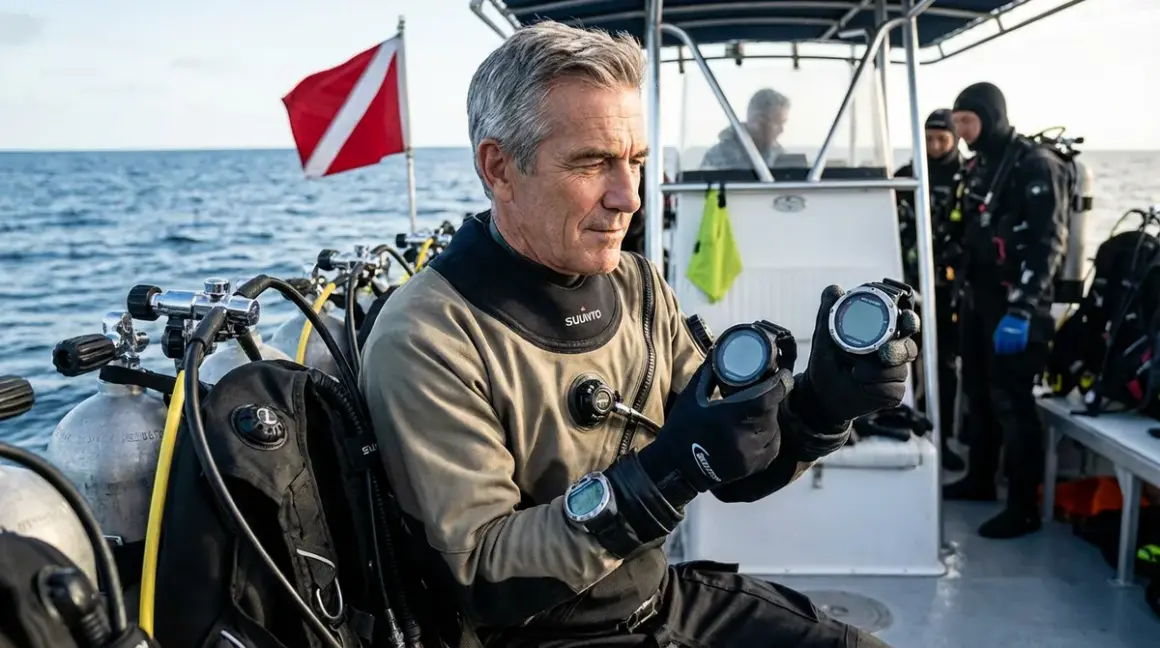

If you're comparing Suunto diving computer vs Shearwater models, here's what four decades of diving has taught me: Shearwater dominates for technical divers and professionals who need bulletproof reliability and full algorithm control, while Suunto offers solid recreational computers at better price points—but with more conservative algorithms that can frustrate multi-dive scenarios. I've watched both brands evolve since the early 2000s, tested dozens of their units across thousands of dives, and I've got strong opinions about where each one belongs on your wrist.
This article breaks down the real differences between Suunto and Shearwater dive computers: algorithm philosophy, display performance in actual water conditions, build quality and materials, user interface design, depth ratings and sensor accuracy, battery systems, and what you're actually getting for your money. No marketing fluff—just what matters when you're planning your next dive.

Quick Comparison: Suunto vs Shearwater Dive Computers
| Criterion | Suunto | Shearwater |
|---|---|---|
| Algorithm Philosophy | Bühlmann ZHL-16C ADT MB (more conservative, limited customization) | Bühlmann ZHL-16C with gradient factors (fully customizable conservatism) |
| Display Technology | Color TFT LCD (various models); OLED on premium units | High-contrast AMOLED or TFT with exceptional backlight (industry-leading readability) |
| Build Materials | Composite cases, mineral crystal or sapphire crystal (premium), silicone straps | Marine-grade aluminum or titanium cases, sapphire crystal standard, user-replaceable batteries |
| Depth Rating | 100-200m (recreational models); 300m (tech models like EON Steel) | 260m standard (Peregrine, Perdix); 300m on Teric and Perdix variants |
| Battery System | Rechargeable lithium-ion (proprietary) on most current models; some use CR2450 cells | User-replaceable AA batteries (Perdix/Petrel) or rechargeable lithium (Teric); 30-60 hour dive time |
| Algorithm Customization | Limited: personal adjustment (+2 to -2), altitude settings | Full gradient factor control (GF High/Low), multiple conservatism presets, custom gas mixes |
| Price Range | Usually around $300–$1,200 (D5 around $1,100; EON Core around $700; D4i around $450 used market) | Usually around $550–$1,500 (Peregrine TX around $650; Perdix AI around $1,350; Teric around $1,500) |
| Best For | Recreational divers, budget-conscious buyers, agency-aligned training programs | Technical divers, dive professionals, anyone wanting maximum control and reliability |
Algorithm Philosophy: Conservative vs Customizable
Here's the thing: when divers debate Suunto diving computer vs Shearwater models, the algorithm conversation dominates—and for good reason. The Suunto Dive Computer🛒 Amazon uses a proprietary modified Bühlmann ZHL-16C ADT MB algorithm that tends conservative, especially on repetitive dives. I've watched groups get separated because the Suunto wearer hit their no-deco limit while Shearwater users still had 10-15 minutes bottom time on identical profiles.
Suunto's algorithm incorporates microbubble theory and penalizes sawtooth profiles, multi-day diving, and rapid ascents more aggressively than straight Bühlmann implementations. You get a "personal adjustment" feature that lets you dial conservatism up or down a couple notches, but you're still locked into Suunto's fundamental calculation philosophy. In my experience running dive operations in the Florida Keys, this works fine for single-tank reef dives where you're surfacing with 700 psi anyway. But run three dives a day for a week? That Suunto will start cutting your bottom time short by day three.
The Shearwater Dive Computer🛒 Amazon runs Bühlmann ZHL-16C with full gradient factor control. This means you set your GF High and GF Low numbers yourself—complete control over how conservative your ascent profile becomes. Want to match PADI tables? Set GF 95/95. Diving deep wrecks and want extra margin? Drop it to 70/85. I typically run 80/95 for recreational work and 40/85 for deco dives, and I can adjust mid-trip based on workload, water temperature, or how my body feels.
The practical difference shows up on multi-dive days. On a typical three-tank day here in Florida—wreck at 90 feet, reef at 60 feet, shallow macro at 40 feet—my Shearwater gives me significantly more no-deco time than students wearing Suunto D4i or EON Core units. The Suunto computers often show 5-8 minutes less bottom time on that second dive, and by the third dive the difference can be 10+ minutes. That's not Shearwater being "less safe"—it's offering more granular control over decompression stress.
Both algorithms are validated and CE-certified, but if you want to understand why your computer is doing what it's doing, Shearwater gives you the tools. Suunto essentially says "trust us." For many recreational divers, that's fine. For anyone running technical profiles, teaching, or diving professionally, it's inadequate. You can learn more about how decompression algorithms work in our dive computer algorithms explained guide.
Display Performance: Readability at Depth
I've logged more than 8,000 dives, and I can tell you this without hesitation: display readability underwater is non-negotiable. Marketing photos don't mean squat when you're at 110 feet in turbid water trying to read your NDL by filtered sunlight or in a wreck penetration with limited viz.
Shearwater's high-contrast displays—particularly the AMOLED screen on the Teric and the backlit TFT on the Perdix—are the benchmark. The Perdix display uses a bright white-on-black layout with configurable backlighting that stays readable in direct tropical sunlight and absolute darkness. I've used my Perdix in zero-visibility night dives on silty wrecks, and the screen never washes out or becomes unreadable. The font size is generous, the contrast ratio is exceptional, and the backlight intensity adjusts in five levels so you're not blinding yourself or draining the battery unnecessarily.
The Teric's AMOLED screen is even sharper—full color with deep blacks and brilliant clarity—but here's a small friction point: AMOLED screens can suffer burn-in over thousands of hours if static elements stay lit constantly. I haven't seen this become a real problem yet on any Teric I've personally tested, but it's a known limitation of the display technology. Still, for sheer wow-factor and readability, the Teric screen is unmatched.
Suunto's displays vary significantly by model. The EON Steel and EON Core use color TFT LCDs that look great on the boat but can wash out in bright sunlight or murky conditions. The D5 has a beautiful full-color display that works well for recreational diving, but the contrast ratio isn't as punchy as Shearwater's implementations. Older models like the D4i and Vyper Novo use segmented LCD displays—functional, but significantly harder to read quickly at depth compared to matrix TFT or AMOLED screens.
I tell newer divers: if your eyesight is anything less than perfect, display quality becomes critical. Task loading underwater is real—you're managing buoyancy, navigation, gas supply, and dive time simultaneously. A screen that requires you to squint or shade it with your hand is a distraction you don't need. Shearwater wins this category decisively, though Suunto's premium models (EON Core, D5) perform adequately in most recreational scenarios.
One more thing: both brands offer configurable data fields, but Shearwater's interface lets you choose exactly what information displays and where. Suunto's layouts are more fixed. If you want to see your current depth, max depth, NDL, gas time remaining, and compass heading all on one screen, Shearwater makes that easy. Suunto usually requires you to cycle through screens.
Build Quality and Materials: What Holds Up
Let me be blunt: I've seen more Suunto computers fail from physical damage—cracked cases, flooded battery compartments, corroded contacts—than Shearwater units. That's not purely a materials issue; it's also a function of market share and how people treat recreational versus technical gear. But the material choices and construction philosophy differ significantly between these brands.
Shearwater uses marine-grade aluminum or titanium cases with sapphire crystal lenses as standard equipment. The Perdix and Petrel housings are machined aluminum with hard-anodized finishes that resist corrosion and impact damage. The Teric case is titanium—lighter, tougher, more scratch-resistant. I've banged my Perdix against tank valves, boat ladders, and wreck bulkheads for years, and the worst it shows is some cosmetic scuffing on the bezel. The sapphire crystal is virtually scratch-proof; after thousands of dives mine still looks new.
Battery compartments on Shearwater computers use thick O-rings (user-replaceable) and fail-safe locking mechanisms. The Perdix and Petrel run on standard AA batteries that you swap yourself—no proprietary battery packs, no need to send the unit in for service. Battery life is 30-60 hours of dive time depending on backlight usage. The Teric uses a rechargeable lithium battery with a magnetic charging system that's sealed completely—no ports to flood—but you do need to remember to charge it, and eventually that battery will degrade and require factory replacement.
Suunto's build quality varies dramatically by price point. The EON Steel is a tank—stainless steel construction, robust, heavy, durable. The EON Core is composite plastic with a decent feel but noticeably less rigid than Shearwater's aluminum. The D5 and mid-range recreational models use composite cases with silicone straps and either mineral crystal or sapphire crystal depending on the variant. They feel more like sport watches than dive instruments.
I've seen Suunto battery compartments flood more often than I'd like, usually due to worn O-rings or users not seating the battery door correctly. Most current Suunto models use rechargeable lithium-ion batteries with proprietary charging cables. That's convenient until you're on a liveaboard and realize you forgot your charger—or the battery degrades after two years and you need to send the unit in for service. Suunto's rechargeable batteries typically give 10-20 hours of dive time per charge, less than Shearwater's AA-powered units.
The EON Steel is the outlier—it's built like a technical computer and priced accordingly (around $1,200 when available). But most recreational divers buy the around $400–$700 Suunto models, and those feel less robust in hand compared to even the entry-level Shearwater Peregrine, which uses a fiberglass-reinforced polymer case and sapphire crystal at around $550.
Weight matters for travel divers: the Perdix weighs around 130 grams with battery, the Teric is around 108 grams, and the Peregrine is around 115 grams. Suunto D5 comes in around 95 grams, the EON Core around 150 grams. If you're trying to stay under airline weight limits, these differences add up across all your gear. Check out our best travel BCDs guide for more weight-saving strategies.
User Interface and Menu Navigation
Good dive computers disappear during the dive—you glance, you process, you continue. Bad ones make you think too hard or hunt for information when task loading is already high. The user interface is where the Suunto diving computer vs Shearwater comparison gets personal, because everyone's brain works a little differently.
Shearwater's two-button interface is legendary for a reason. Everything is organized in logical menus, scrolling is quick and intuitive, and once you learn the system it's muscle memory within a few dives. The main screen shows your critical data (depth, time, NDL, gas), and two buttons let you scroll through additional screens or dive into settings. The Perdix and Petrel use physical push-buttons that work with thick gloves, dry gloves, or cold-numbed fingers. The Teric uses a hybrid system with one button and a touch-sensitive bezel that works underwater—it's slick, but I've had students accidentally change screens when bumping it against gear.
Shearwater's menu structure is deep but never confusing. You want to switch from air to nitrox? Three clicks. Change your gradient factors mid-trip? Five clicks. Review your dive log with full tissue loading graphs? It's all there. The Shearwater website offers complete manuals and simulator software so you can practice on your computer before you splash.
Suunto's interface design varies by model but tends toward more automation and less manual control. The EON Core and EON Steel use a combination of buttons and touch-screen navigation, which works well on the surface but can be finicky underwater, especially with gloves. The D5 uses a rotating bezel and single button—elegant for a sport watch, occasionally frustrating when you want to quickly adjust a setting mid-dive.
Suunto menus prioritize simplicity for recreational divers, which means fewer options and less configurability. That's great if you want a grab-and-go experience where the computer makes most decisions for you. It's limiting if you want to fine-tune settings, review detailed tissue loading data, or customize your display. I've seen experienced divers get frustrated trying to access features buried three menu layers deep on Suunto units, whereas Shearwater keeps everything accessible.
One specific friction point: Suunto's gas switching process (when diving multiple mixes) requires more button presses and confirmation steps than Shearwater's streamlined approach. When you're at 70 feet reaching for your deco gas, you want that switch to happen fast and unambiguously. Shearwater makes it two clicks; Suunto typically needs four or five with confirmations.
Both brands offer smartphone apps for dive logging and firmware updates. Shearwater Cloud is polished, reliable, and syncs seamlessly via Bluetooth. Suunto's DM5 desktop software works, but their mobile app experience has been clunkier in my testing—firmware updates sometimes require multiple attempts, and Bluetooth connectivity can be temperamental depending on your phone.
For basic recreational diving, Suunto's simplified interface is perfectly adequate. For anything more complex—technical diving, gas switches, bailout scenarios—Shearwater's interface is significantly more efficient and less prone to user error under stress.
Battery Life and Serviceability
This is where the Suunto diving computer vs Shearwater comparison reveals fundamentally different design philosophies. Shearwater prioritizes user serviceability and field-replaceable batteries; Suunto leans toward sealed rechargeable systems.
The Shearwater Perdix and Petrel run on a single AA battery (lithium or alkaline)—the same battery you can buy at any gas station worldwide. Battery life is 30 hours on alkaline, 60+ hours on lithium, depending on backlight usage. I carry a spare AA in my save-a-dive kit, and I've never had a Shearwater die mid-trip. Replacing the battery takes 30 seconds: unscrew the battery cap, swap the cell, replace the O-ring if needed (Shearwater includes spares), and you're done. No tools required beyond your fingers.
The Shearwater Teric uses a rechargeable lithium battery with a magnetic charging dock. Battery life is approximately 10 hours per charge for typical recreational diving, less if you're using the brightness maxed out. That's adequate for a weekend of diving but tight on week-long liveaboards where you're doing 3-4 dives daily. The magnetic charger is elegant and waterproof (no exposed contacts), but if you forget it or lose it, you're done diving until you get a replacement. The rechargeable battery will eventually degrade—Shearwater estimates 300-500 charge cycles—and requires factory replacement, typically around $150–$200.
Suunto's current lineup predominantly uses rechargeable lithium-ion batteries with proprietary charging cables. The D5, EON Core, and newer models charge via USB cable (different cable for each model generation, naturally). Battery life ranges from 8-20 hours depending on the model and settings. That's fine for recreational divers doing 5-10 dives before returning home, but it's cutting it close on liveaboards or multi-day dive trips without reliable power.
The bigger issue: when that rechargeable battery eventually degrades—and they all do after 300-500 cycles—you have to send the unit to Suunto for battery replacement. That's a week or more without your computer, plus service fees. Older Suunto models like the D4i and Vyper Novo used user-replaceable CR2450 coin cells, which was a better system in my opinion, but Suunto moved away from that.
I've had students show up for training with dead Suunto computers because they forgot to charge them the night before. That doesn't happen with AA batteries. On the flip side, I've also seen divers running Teric computers forget to charge and have to borrow a backup for day three of a liveaboard. Rechargeable batteries are convenient—until they're not.
Battery indicators on both brands are generally reliable. Shearwater shows a precise voltage readout and percentage remaining. Suunto uses a bar graph that works fine but gives less granular information. Neither brand has a reputation for surprise battery deaths mid-dive, but I trust a fresh AA battery more than a rechargeable system that's seen 400 charge cycles.
For dive professionals, guides, instructors, or anyone logging 100+ dives per year, the user-serviceable battery system on Shearwater Perdix models is a massive advantage. For vacation divers doing 20 dives annually, Suunto's rechargeable approach is probably fine—just remember to charge it before your trip.
Who Should Choose Suunto
If you're a recreational diver doing warm-water vacation diving, single-tank reef tours, or occasional weekend dives with no plans to move into technical territory, a Suunto computer makes perfect sense. The mid-range models like the D5 or EON Core offer solid functionality, good enough displays for tropical diving, and competitive pricing in the around $400–$800 range. You don't need full gradient factor control if you're never pushing no-deco limits, and Suunto's more conservative algorithm arguably provides extra safety margin for casual divers who aren't obsessively tracking profiles.
Suunto computers integrate well with PADI training standards, and many dive shops stock them because they're familiar to instructors who learned on older Suunto models. If you're brand-loyal to Suunto or already own one that's working fine, there's no compelling reason to switch unless you're moving into technical diving or getting frustrated with conservative bottom times.
Budget matters too: you can find used Suunto D4i or Vyper Novo units for around $200–$300, which is reasonable for someone testing the waters before committing to a premium computer. Just understand what you're getting—and what you're giving up compared to Shearwater.
Who Should Choose Shearwater
If you're serious about diving—technical training, professional work, frequent multi-dive trips, cold water diving, wreck penetration, or anything beyond basic recreational profiles—Shearwater is the better investment. The Peregrine costs around $550 and gives you an entry point into the Shearwater ecosystem with a sapphire crystal display, full Bühlmann algorithm with gradient factor control, and a build quality that will outlast most recreational computers.
For technical divers, the Perdix or Teric is essentially mandatory. Full trimix support, multiple gas switching, customizable conservatism, user-replaceable batteries (Perdix), and a display you can read in any conditions. I've watched tech divers try to run complex profiles on Suunto computers and get penalized by the algorithm for normal technical dive behavior—it's frustrating and sometimes unsafe.
Dive professionals should default to Shearwater unless there's a specific reason not to. When you're logging 200-500 dives per year, reliability and user serviceability become critical. I don't want to send my primary computer in for a battery replacement during dive season, and I don't want to be locked into a conservative algorithm that cuts student bottom time short on training dives.
Photographers and videographers benefit from Shearwater's larger, clearer displays and configurable screens that let you monitor depth, time, and NDL without cycling through menus. When you're focused on composition and lighting—our underwater photography guide covers this in detail—you need to absorb dive data instantly. Shearwater delivers that better than anyone.
If you're comparing models within the Shearwater lineup, check out our dive computer watch guide for wrist-mounted options and our complete dive computer guide for broader context on computer selection.
Frequently Asked Questions
Are Shearwater dive computers worth the extra cost compared to Suunto?
Yes, Shearwater dive computers are worth the higher price if you dive frequently, plan to pursue technical diving, or work professionally in the industry, because their customizable algorithms, superior display readability, and user-serviceable batteries provide measurably better performance and lower long-term ownership costs through field-replaceable components rather than proprietary service requirements.
Why do Suunto dive computers give less bottom time than Shearwater on repetitive dives?
Suunto dive computers incorporate a more conservative decompression algorithm based on Bühlmann ZHL-16C ADT MB with microbubble penalties that increasingly restrict no-decompression limits on repetitive dives and multi-day diving compared to Shearwater's straight Bühlmann implementation with user-controlled gradient factors, which allows divers to fine-tune conservatism rather than accepting fixed penalties.
Can you use a Shearwater computer for recreational diving or are they only for technical divers?
Shearwater computers work excellently for recreational diving—the Peregrine model is specifically designed for recreational divers at around $550—and they provide significant advantages in display clarity, battery life, and algorithm transparency even for basic single-tank diving, though their full feature set and customization options become most valuable when advancing to technical profiles or professional dive work.
Bottom Line
After four decades of diving and testing nearly every dive computer that's come to market, here's what I tell people across the counter: the Suunto diving computer vs Shearwater debate really comes down to how seriously you take diving. Suunto makes adequate recreational computers at reasonable prices with a conservative algorithm that keeps casual divers safe, even if it costs you bottom time on repetitive dives. They're fine for vacation diving and occasional weekends—nothing wrong with that.
But Shearwater builds computers for people who view diving as more than a twice-a-year hobby. The display quality, algorithm control, build materials, and user serviceability are simply better across the board. The Peregrine at around $550 competes directly with mid-range Suunto models and wins on almost every metric except perhaps brand familiarity at resort dive shops. Moving up to the Perdix or Teric, you're getting technical capability and professional-grade reliability that Suunto can't match at any price point.
I run a Perdix as my primary and keep a Peregrine as backup. I've watched tech divers switch from Suunto to Shearwater and never look back. I've also seen plenty of recreational divers perfectly happy with their Suunto D5 computers doing reef dives in the Caribbean, and that's completely valid.
Buy for where you're going, not just where you are now. If there's any chance you'll get serious about diving—advanced training, technical courses, professional work, or just frequent multi-dive trips—spend the extra money on Shearwater from the start. You'll save money in the long run and dive with more confidence knowing your computer gives you complete control and visibility into what's happening with your decompression status. For deeper guidance on computer selection, our how to choose a dive computer guide walks through the complete decision framework.