
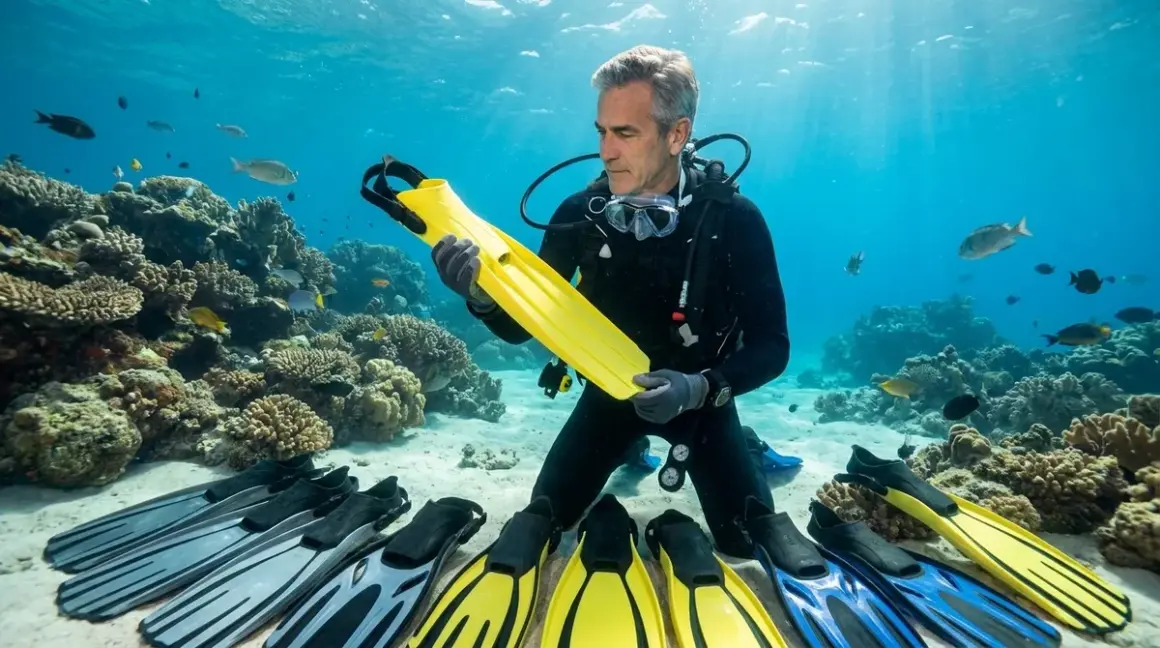

I've watched thousands of divers struggle through dives with fins that don't match what they're actually doing underwater. Last month, a diver showed up for a drift dive in Boca Raton with split fins better suited for a leisurely reef cruise—he spent the entire dive fighting current while everyone else glided past him. Learning how to choose scuba fins isn't about finding the most expensive or newest model; it's about matching blade design, materials, and foot pocket geometry to your actual diving conditions. Here's the thing: the right fins make you more efficient, less fatigued, and safer underwater—the wrong ones turn every dive into an exhausting leg workout that ends with cramps and frustration.
What to Look For When Choosing Scuba Fins
After four decades of watching fins perform (and fail) in real conditions, I've narrowed down what actually matters. Marketing departments love to invent new features every season, but the fundamentals haven't changed since the 1980s.

Blade Design and Propulsion Efficiency
Blade stiffness and geometry determine how much thrust you generate per kick. I tell people to think about their typical diving: if you're mostly doing shallow reef dives with minimal current, a flexible blade or split fin design works fine. But the moment you add current, depth beyond 80 feet, or technical gear configurations, you need a stiffer paddle blade that can move water against resistance.
The split fin design channels water through the blade gap, theoretically reducing effort—and in calm, shallow conditions, they do feel easier on your legs. I've used them for photography dives where I'm hovering in one spot. But I've also seen divers try to use them in the Gulf Stream off Palm Beach and get absolutely worked. The splits don't generate enough thrust when you need to punch through three-knot current or maintain position in surge.
Blade length matters more than most manufacturers admit. Longer blades give you more surface area and leverage, which translates to more power per kick—but they also require stronger legs and more energy. Shorter travel fins sacrifice some efficiency for packability. I've logged probably 500 dives with various blade lengths, and here's what I've learned: if you're diving locally more than traveling, go with the longer blade. Your legs will adapt within a dozen dives, and you'll appreciate the extra power when conditions deteriorate.
Foot Pocket Fit and Retention System
This is where I see the most problems. A fin that shifts or slips during your kick wastes energy and causes blisters. The foot pocket must hold your boot or bare foot firmly without pressure points—and that's harder to achieve than it sounds.
For warm-water diving with booties or barefoot, open-heel fins with adjustable straps are standard. I prefer marine-grade stainless steel or hard polymer buckles over bungee straps. Bungees feel convenient on the surface, but I've watched them stretch out after a season of saltwater exposure and UV degradation. Spring straps made from 316 stainless steel last indefinitely and don't require the grip strength that plastic buckles demand—a real consideration when you're in 3mm gloves trying to don fins from a pitching boat.
Full-foot fins work for tropical diving and snorkeling, but they're useless the moment you need a boot for cold water or rocky entries. The foot pocket on full-foot designs needs to fit like a shoe—not tight enough to restrict circulation, but with zero heel lift when you kick. I've seen divers develop Achilles tendon problems from poorly fitted full-foot fins that allowed their heel to piston up and down inside the pocket.
Check the foot pocket material carefully. Cheaper fins use harder rubber compounds that don't conform to your foot shape and crack after a season in the sun. Quality foot pockets use softer thermoplastic elastomers or natural rubber that mold to your foot over time. If you're serious about how to choose scuba fins, you need to actually try them on with the boots you'll be diving in—not the rental booties at the shop, but your actual gear.
Material Construction and Durability

Blade materials directly affect performance and longevity. I've used fins made from every material that's come to market since the late '70s, and each has trade-offs.
Thermoplastic rubber and polymer composites dominate the mid-range market. They're durable, relatively affordable, and perform well in most conditions. Brands like Scubapro and Mares use proprietary polymer blends that resist UV degradation and maintain stiffness across temperature ranges. I've got a pair of polymer paddle fins that have survived eight years of Florida saltwater with minimal degradation.
Natural rubber still shows up in some traditional paddle fin designs. It's durable and provides excellent propulsion, but it's heavier and more susceptible to UV damage. You'll see rubber cracking and losing elasticity if you leave them in direct sunlight between dives. I learned this the hard way with a pair I left on my boat deck for a summer season in the Keys.
Composite materials with carbon fiber or fiberglass appear in technical and freediving fins. These provide maximum stiffness-to-weight ratios and exceptional power transfer, but they're fragile. I've seen carbon fiber blades snap from boat impacts that would barely scratch a polymer fin. Unless you're doing serious technical diving where every ounce matters, the fragility isn't worth the minor performance gain.
Blade rails and reinforcements matter more than most divers realize. Look for over-molded side rails or reinforcement ribs that prevent the blade from twisting during your kick. When a blade twists, you lose directional control and waste energy pushing water sideways instead of straight back. For more on how different materials perform, check out our detailed breakdown in What Are Scuba Fin Blade Materials: Rubber, Composite, and Carbon Explained.
Weight and Travel Considerations
If you're traveling to dive destinations more than driving to local sites, fin weight and packability become critical selection criteria. I spent years doing Caribbean liveaboards before I finally admitted that my heavy paddle fins weren't worth the baggage hassle.
Split fins and shorter blade designs typically weigh 2-3 pounds per pair versus 4-5 pounds for full-length paddle fins. That matters when you're trying to stay under airline weight limits. More importantly, shorter fins pack into gear bags without dominating all the space. I can fit my travel fins, BCD, and regulator into a single carry-on roller bag—something impossible with full-length blades.
But here's the trade-off I warn people about: don't sacrifice performance for packability if you're diving in challenging conditions. I've made that mistake. I once brought lightweight travel fins to Cozumel and spent the entire week fighting drift current because I prioritized baggage weight over blade efficiency. Now I travel with mid-length blade fins that split the difference—they pack reasonably well and still generate adequate thrust when current picks up. You can see more options in Best Scuba Fins for Travel: Compact and Lightweight Options.
Specialized Features for Specific Conditions
Vented blades, channels, and other hydrodynamic features show up in premium fin designs. Some of these actually work; most are marketing theater. Vents positioned near the blade tip can reduce strain during the recovery phase of your kick by allowing water to flow through—but only if they're properly sized and positioned. I've used vented paddle fins that felt noticeably easier on my knees during repetitive dives, and I've used others where the vents just made noise underwater without any performance benefit.
Cold water performance requires specific consideration. Rubber compounds stiffen in cold water, which can make flexible fins feel like planks below 50°F. If you're diving drysuits in New England or the Pacific Northwest, you want a fin designed with stiffer rubber that maintains its flex characteristics in cold temperatures. The foot pocket also needs to accommodate the thicker boots you'll be wearing with a drysuit—something many warm-water fins simply can't do. The same principles apply to other cold-water gear; we cover regulator considerations in Best Cold Water Scuba Regulators: Performance Testing Down to 35°F.
Our Top Picks for Scuba Fins
I've selected these based on actual dive performance across different scenarios—not manufacturer hype or which company sent me free gear. Each excels in specific conditions.
Scubapro Jet Fins
The Scubapro Jet Fins🛒 Amazon are the legendary workhorses that have been around since the 1960s, and they're still the standard for technical diving and heavy current work. These are dense rubber paddle fins with spring straps and an utterly no-nonsense design that prioritizes power over comfort.
Pros:
- Exceptional thrust generation in current and at depth with heavy gear configurations
- Marine-grade stainless steel spring straps are bulletproof and require no adjustment
- Negative buoyancy helps with trim when wearing drysuits or doubles
- Last indefinitely with minimal maintenance beyond freshwater rinsing
- Foot pocket accommodates thick drysuit boots without pressure points
Cons:
- Heavy at 4.8 pounds per pair—these are baggage nightmares for travel
- Stiff blade requires strong legs and causes fatigue on long shallow dives
- Completely impractical for warm-water vacation diving
- Zero forgiveness for poor kick technique—they'll amplify every mistake
I still use Jets for local wreck diving where I'm fighting Gulf Stream current or working in overhead environments. They're too much fin for casual reef diving, but when conditions get serious, nothing else performs as reliably.
Mares Avanti Quattro Plus
The Mares Avanti Quattro Plus🛒 Amazon represents the sweet spot for recreational divers who want a versatile paddle fin that works across multiple conditions without extreme specialization. The four-channel blade design actually does reduce effort compared to solid paddles, and the thermoplastic construction holds up well to abuse.
Pros:
- Channeled blade provides good thrust without requiring maximum leg strength
- Adjustable straps with large buckles work easily even with 5mm gloves
- Moderate weight around 3.2 pounds per pair balances performance with travel
- Soft foot pocket conforms well to different boot shapes
- Proven durability across thousands of dive center rentals worldwide
Cons:
- Buckle mechanism catches on kelp and line more than spring straps
- Blade flexibility decreases noticeably in water below 60°F
- Not enough power for technical diving or extreme current
- Foot pocket runs slightly narrow for wider feet
These are my go-to recommendation for divers who want one fin that handles most situations competently. They're not the best at anything specific, but they're good enough at everything that matters for recreational diving.
Atomic Aquatics Split Fins
The Atomic Aquatics Split Fins🛒 Amazon represent the premium end of split fin technology, using a composite material blade that's more efficient than cheaper split designs. I was skeptical about split fins for years, but these changed my mind for specific applications.
Pros:
- Genuinely reduce leg fatigue on repetitive multi-dive days in calm conditions
- Excellent for underwater photography where you need fine positioning control
- Lightweight at 2.6 pounds per pair makes them viable travel fins
- Spring strap system is well-engineered and actually stays adjusted
- Blade materials resist UV degradation better than rubber splits
Cons:
- Completely inadequate in current above 1.5 knots—you'll get swept regardless of effort
- Premium pricing around $300 puts them in technical fin territory without technical performance
- Split design catches on monofilament and ghost nets more than solid blades
- Not suitable for frog kick or technical diving techniques
I use these for shallow reef photography dives in the Keys where current is minimal and I'm hovering more than traveling. They're perfect for that specific application and terrible for almost everything else.
Hollis F1 Bat Fins
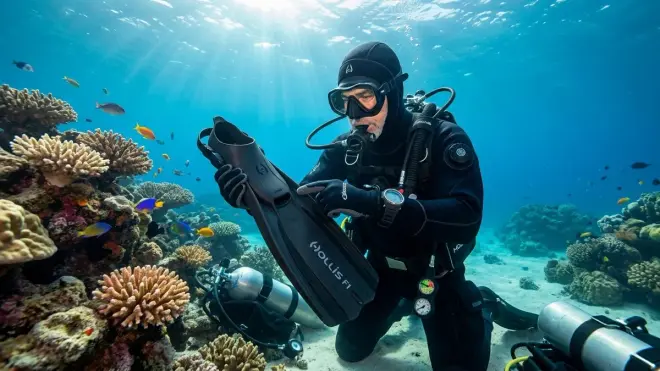
The Hollis F1 Bat Fins🛒 Amazon are designed for technical divers but work brilliantly for anyone doing cold water, drysuit, or heavy gear diving. They're similar philosophy to Jet Fins but with modern materials and slightly more refined hydrodynamics.
Pros:
- Monoprene construction maintains flexibility in cold water better than rubber
- Negative buoyancy aids in proper trim with redundant cylinders or drysuit
- Vented blade design reduces ankle strain without sacrificing power
- Large spring strap openings accommodate thick drysuit boots easily
- Blade stiffness provides exceptional thrust for heavy gear configurations
Cons:
- Heavy at 4.5 pounds per pair—not travel-friendly
- Blade length requires experience to avoid stirring up silt on wrecks
- Overkill for warm-water vacation diving
- Foot pocket runs small; size up if between sizes
These are what I reach for when I'm diving wrecks in 150+ feet or working in cold water with a drysuit. They're specialized tools for specific jobs, not general-purpose fins.
Cressi Frog Plus
The Cressi Frog Plus🛒 Amazon offers solid performance at a mid-range price point that makes sense for divers building their first complete gear setup. They're not exciting, but they work reliably across most recreational diving scenarios.
Pros:
- Affordable pricing around $100 makes them accessible for new divers
- Reliable paddle blade design provides predictable performance
- Moderate stiffness works for most leg strength levels
- Foot pocket fits most boot sizes without excessive looseness
- Available in multiple colors for easy identification
Cons:
- Plastic buckle system feels cheaper than spring straps and requires more maintenance
- Blade materials show UV degradation after heavy sun exposure
- Not enough power for technical diving or serious current
- Foot pocket runs slightly large; smaller divers may experience heel lift
I recommend these to new divers who need dependable fins while they figure out their diving style. They're good enough to learn on without being so expensive that you feel bad replacing them once you've specialized.
Apeks RK3 HD
The Apeks RK3 HD🛒 Amazon represents the modern evolution of the technical diving fin—extremely durable, powerful, and purpose-built for demanding conditions. These are what I'd grab if I were doing cave diving or deep wreck penetrations.
Pros:
- Over-molded rubber construction is nearly indestructible
- Blade stiffness and geometry optimized for frog kick and technical diving techniques
- Spring strap system with large finger loops works with any glove thickness
- Slightly negative buoyancy helps technical divers maintain horizontal trim
- Vented blade design reduces effort on recovery stroke without losing power
Cons:
- Heavy at 5.2 pounds per pair—absolutely impractical for travel
- Requires strong legs and proper technique to avoid cramping
- Price point around $250 is steep for recreational-only diving
- Blade length stirs up sediment if you're not careful with kick technique
These are specialty fins for serious diving. Unless you're regularly diving in overhead environments, strong current, or with technical gear configurations, they're more fin than you need. For getting started with proper fin technique, see our guide New Scuba Diver Fin Setup Checklist: Everything You Need to Know.
Frequently Asked Questions
What's the difference between split fins and paddle fins for scuba diving?
Split fins have a center gap that channels water through the blade, reducing effort but sacrificing power, while paddle fins provide maximum thrust at the cost of increased leg strain. I've used both extensively, and here's what I tell customers: split fins work great for calm-water reef diving where you're cruising along at a relaxed pace, but they fail completely in current or when you need quick bursts of power. Paddle fins generate more thrust per kick but require stronger legs and better technique. If you're primarily diving in protected areas with minimal current, splits will make your legs happier on multi-dive days. If you're doing drift diving, wreck diving, or anything with current, you need paddles. The performance gap becomes obvious the first time you try to hold position against moving water—splits just can't do it. For a detailed comparison, check out Split Fins vs Paddle Fins: Which Is Better for Scuba Diving.
How do I know what size fins to buy?
Measure your boot size for open-heel fins or your bare foot for full-foot fins, then try them on with the actual boots you'll dive in—fin sizing varies wildly between manufacturers and generic size charts are often wrong. I've seen too many divers buy fins based on their shoe size and end up with foot pockets that either squeeze their feet numb or allow their heel to lift with every kick. Here's what works: put on your dive boots, insert your foot into the fin pocket, and check for these specific things—your toes should reach the end without curling, your heel should sit firmly in the pocket without rising when you flex your ankle, and the sides shouldn't pinch or leave gaps. If you're between sizes, I generally recommend sizing up for open-heel fins because a slightly loose pocket can be fixed with thicker socks, but a too-tight pocket causes blisters you can't fix. For complete fitting guidance, see Scuba Fin Sizing and Fit Checklist: Getting the Perfect Fit.
Can I use the same fins for cold water and tropical diving?

You can use the same fins if you choose a moderate-stiffness paddle blade and size the foot pocket to accommodate both thin booties and thick drysuit boots, but specialized fins always perform better in their intended conditions. I've done this for years with mid-range paddle fins—I just swap between 3mm tropical boots and 7mm cold-water boots depending on destination. The limitation is foot pocket size: if it's sized for a thick drysuit boot, it'll feel loose with thin tropical booties, and vice versa. Some divers solve this with neoprene socks to take up space in warm water. The bigger consideration is blade stiffness—rubber compounds that feel perfect in 82°F Caribbean water turn into rigid planks in 45°F Pacific Northwest kelp beds. If you're diving both extremes regularly, you're better off with two specialized pairs, but for most recreational divers doing occasional cold-water trips, one versatile mid-stiffness paddle fin works fine.
Do expensive fins really perform better than budget options?
Premium fins use better materials that last longer and perform more consistently across conditions, but budget fins work fine for recreational diving if you choose the right design—expensive doesn't always mean better for your specific needs. I've watched divers spend $400 on carbon fiber technical fins for Caribbean vacation diving where $120 paddle fins would've performed identically. Here's what you're paying for in premium fins: more durable materials that resist UV degradation and cracking, better foot pocket compounds that conform to your foot shape, spring strap systems that don't corrode or break, and sometimes actual performance improvements like optimized blade geometry. But a $100 pair of Cressi or Mares paddle fins will move you through the water just fine for most recreational diving. The expensive fins show their value after 200+ dives when budget fins are cracking and losing stiffness while premium models still perform like new. If you're diving casually a few times a year, budget fins are perfectly adequate. If you're logging 100+ dives annually, the premium models pay for themselves in longevity.
How do I prevent leg cramps when using new fins?
Start with shorter dives using a relaxed kick tempo, size up if the foot pocket is too tight, and ensure your fins match your leg strength—most cramps come from fins that are too stiff for your current fitness level or poor fit that restricts circulation. I've dealt with this countless times, both personally and helping customers. First, check that your foot pocket isn't cutting off circulation—if you see strap marks or numbness, the fin's too tight. Second, recognize that stiffer blades require stronger legs: if you're switching from splits to paddles or from flexible to stiff blades, your legs need adaptation time. I tell people to do three or four easy 30-minute dives before attempting hour-long efforts with new fins. Third, your kick technique matters more than most divers realize—if you're bicycle kicking or using tiny rapid kicks instead of slow powerful strokes, you'll fatigue faster regardless of fin design. Proper fin technique is covered in How to Break In New Scuba Fins and Prevent Blisters. Also, hydration matters: dehydrated muscles cramp easier, and most divers don't drink enough water before dives. Finally, if you're consistently cramping with properly fitted fins after giving your legs time to adapt, you probably need a more flexible blade.
The Verdict
Learning how to choose scuba fins comes down to matching blade design and materials to your actual diving conditions—not buying whatever looks cool or costs the most. I've seen this pattern repeat for forty years: divers who carefully consider their typical diving environment, fitness level, and travel requirements end up with fins that last for years and make every dive more enjoyable. Divers who chase marketing hype or buy based on brand loyalty alone end up frustrated and often buying a second pair within a season.
If you're primarily doing warm-water vacation diving with minimal current, go with mid-stiffness paddle fins or quality split fins that prioritize comfort and packability. If you're diving locally in cold water or current, invest in stiffer paddle fins with spring straps and foot pockets sized for thick boots. If you're doing technical diving or wreck penetrations, you need specialized fins like Jets or RK3s regardless of weight or travel convenience.
The fins that work best are the ones that match what you're actually doing underwater. Everything else is just marketing noise that disappears the moment you hit the water.