
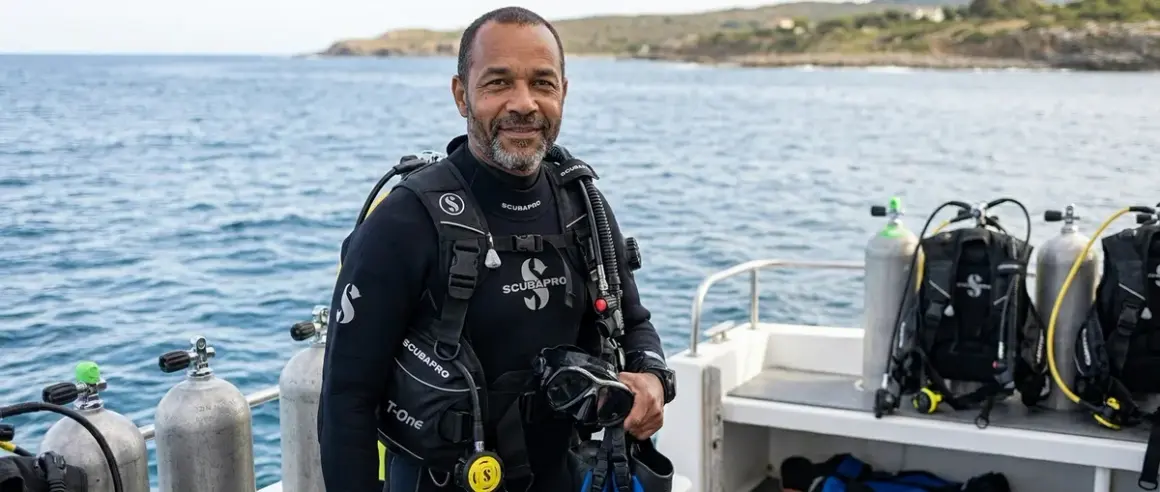

I've watched a lot of divers over the years wrestle with backmount wing systems that just don't fit their body geometry, especially smaller-framed divers who find themselves swimming inside their gear rather than wearing it. The Scubapro T One BCD🛒 Amazon hits the market as Scubapro's answer to the travel-oriented backmount crowd—a minimalist wing system that promises the simplicity of a backplate-and-wing setup without the DIY intimidation factor. After logging about forty dives with this BCD across tropical reef sites in the Philippines and some cooler quarry environments back home, here's my scubapro t one bcd review verdict: it's a well-executed travel wing with some smart design choices, but it's not without compromises that'll matter depending on what kind of diving you do.
What to Look For in a Travel Backmount BCD
Before we get into the specifics of this scubapro t one bcd review, let's talk about what actually separates a capable travel wing from the pack of similar-looking minimalist BCDs flooding the market.

Weight distribution and plate material matter more than most marketing suggests. You'll see aluminum backplates, stainless steel plates, and polymer composite plates—each shifts your buoyancy requirements differently. A stainless steel backplate typically adds 5-6 pounds of negative ballast in saltwater, which is brilliant if you're diving a 3mm wetsuit in warm water and struggling to get down, but it's dead weight in your luggage and overkill if you're already diving thick neoprene. Aluminum plates usually run 1-2 pounds negative, and composite plates float, which sounds terrible until you're in a 7mm suit in cold water and suddenly you're not adding bricks to your pockets. I've tested the T One with its integrated composite plate in both scenarios, and knowing your typical exposure suit thickness before you buy makes all the difference in getting your weighting dialed.
Harness adjustability and fit range separate systems that work for everyone from systems that only work for medium-sized men. The fundamentals of scuba gear sizing and fit become obvious the moment you try to adjust a harness underwater and discover the buckles are positioned where you can't reach them. Look for shoulder strap adjustment points you can reach without contorting, crotch strap length that accommodates different torso lengths, and chest straps that don't dig into your throat or slide off your shoulders. The T One uses a continuous webbing system with sliding D-rings rather than traditional cam buckles, which is lighter and simpler but requires you to get the initial threading right—once you're suited up, major adjustments are a pain.
Wing shape and lift capacity need to match your cylinder configuration and buoyancy requirements, not just look cool in photos. A 30-pound lift wing sounds adequate until you're trying to float a steel HP100 cylinder plus a 7mm wetsuit at the surface while waiting for a boat pickup. I've seen divers struggle with inadequate wing volume, fighting to keep their head above water at the surface because they bought a minimalist travel wing for a cold-water dive trip. The T One sits at 30 pounds of lift, which is genuinely enough for single-tank tropical diving with an aluminum 80 and minimal exposure protection, but it's marginal for steel cylinders or anything beyond a 3mm suit. That's not a flaw—it's a design constraint you need to understand before you commit.
Pack size and travel weight are the entire point of a travel BCD, but the devil lives in the details. A system that compresses to the size of a cantaloupe but requires you to reassemble half of it at your destination isn't actually travel-friendly—it's a disassembled BCD. Look for how many components are permanently integrated versus separate pieces, whether the harness requires re-threading each trip, and the actual packed weight including any required accessories. The T One's integrated plate and harness system means you're packing one unit that weighs about 6.5 pounds total, which compares favorably to most backplate-and-wing setups that clock in closer to 8-10 pounds depending on plate material.
Dump valve configuration and accessibility determine whether you can actually control your buoyancy or whether you're constantly hunting for the right pull-cord. You want a shoulder dump you can reach with your left hand, a butt dump you can activate while horizontal, and an overpressure relief valve that prevents catastrophic wing inflation without needing your input. The T One positions its primary dump on the left shoulder and includes a second dump on the lower right rear—standard enough, though I found the shoulder dump pull-cord shorter than I prefer, which meant reaching across my chest rather than a quick pull at shoulder height.
Our Top Picks for Travel-Oriented Backmount BCDs
Scubapro T One BCD
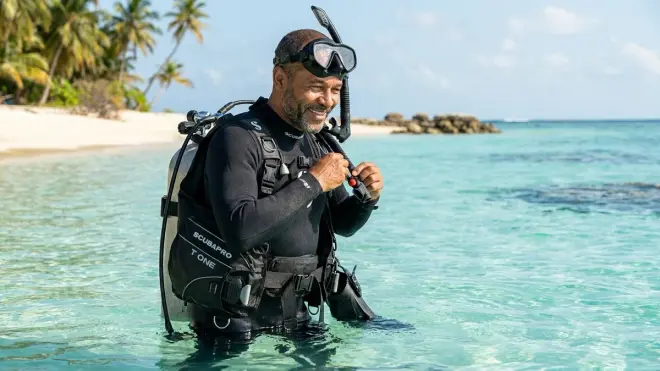
The Scubapro T One BCD🛒 Amazon represents Scubapro's minimalist answer to the travel wing category—a lightweight backmount system built around an integrated composite backplate and streamlined harness. The entire assembly packs down to roughly the size of a football and tips the scale at 6.5 pounds, making it one of the lighter fully-featured travel wings I've tested.
Pros:
- Integrated composite backplate eliminates separate plate assembly while providing near-neutral buoyancy
- Genuine 30-pound lift capacity handles single aluminum tanks plus 3-5mm exposure suits without struggle
- Continuous webbing harness system sheds weight and eliminates bulky hardware
- Elastic bungee wing keepers prevent excessive wing flutter when deflated
- Two large mesh cargo pockets with zippered closures and quick-drain panels
- Multiple attachment points for gauge clips, SMB pockets, and accessories
- Foldable design packs smaller than most traditional jacket BCDs
Cons:
- Shoulder dump pull-cord positions low enough that smaller-handed divers will find it awkward to reach
- Fixed crotch strap length requires harness adjustment to dial in proper torso fit
- 30-pound lift capacity becomes marginal with steel cylinders or exposure suits thicker than 5mm
- Composite backplate lacks the ballast contribution of steel or aluminum, requiring additional lead weight for thin exposure protection
- Premium pricing (typically around $700-750) puts it above several comparable travel wing systems
I dove this BCD for the first time in Anilao, Philippines, paired with an aluminum 80 and a 3mm shorty. Getting the harness dialed took about fifteen minutes of threading and adjusting on the boat—not difficult, but definitely something you want to sort before you're rushing to splash. Once properly fitted, the composite plate sat comfortably against my back without the pressure points I sometimes feel with traditional rigid backplates. The wing itself inflates predictably and dumps smoothly through the shoulder valve, though I did find myself wishing that pull-cord sat an inch or two higher for easier reach.
The real test came during a drift dive along a coral wall where I was shooting macro subjects. The wing stays remarkably flat when deflated, with minimal drag profile—those elastic keepers actually do their job, unlike the loose bungees on cheaper systems that let the wing balloon behind you. The mesh pockets swallowed my SMB, spool, and backup mask without bulging noticeably, and the quick-drain panels cleared the water fast enough that I wasn't hauling around pocket-trapped water when I got back on the boat.
Hollis SMS75 Katana 2 Travel Wing System
The Hollis SMS75 Katana 2 Travel Wing System🛒 Amazon takes a different approach to the travel wing concept with a modular soft-plate design and 38-pound lift wing. This system weighs about 7.2 pounds complete and includes more traditional harness hardware than the T One.
Pros:
- Soft backplate with built-in padding eliminates rigid plate discomfort
- 38-pound lift capacity accommodates steel tanks and thicker exposure suits
- Traditional quick-release shoulder buckles enable fast doffing and donning
- Removable weight pockets integrate into the harness for better trim
- Multiple D-ring configurations for sidemount-style accessory attachment
- Compatible with standard backplate accessories despite soft-plate design
Cons:
- Soft plate lacks the stability of rigid plates during surface swims
- Heavier packed weight than ultralight travel wings
- Shoulder buckles add failure points compared to continuous webbing
- Higher profile when deflated creates more drag than slimmer wings
Dive Rite Nomad XT Sidemount Convertible
The Dive Rite Nomad XT Sidemount🛒 Amazon pushes into hybrid territory with a system that converts between backmount and sidemount configurations. At 5.8 pounds in backmount trim, it's the lightest option here, though that versatility requires compromises.
Pros:
- Dual-configuration design covers both backmount and sidemount diving
- Lightest packed weight in the category
- Adjustable bungee wing system adapts to different cylinder sizes
- Minimalist harness sheds every possible gram
- Includes dedicated sidemount bungees and attachment points
- Compresses to an impressively small pack size
Cons:
- 28-pound backmount lift capacity limits cylinder and exposure suit options
- Minimalist harness lacks padding that makes long surface swims comfortable
- Sidemount conversion requires carrying additional bungees and hardware
- Wing shape optimized for sidemount creates suboptimal profile in backmount configuration
- Less shoulder strap padding than dedicated backmount systems
Apeks WTX-D30 Travel Wing Set
The Apeks WTX-D30 Travel Wing Set🛒 Amazon combines a lightweight aluminum backplate with a 30-pound donut wing and modular harness system. Total weight runs 8.1 pounds with the aluminum plate, positioning it as less of a true travel wing and more of a compact backmount system.
Pros:
- Aluminum backplate provides 1-2 pounds negative ballast contribution
- Donut wing design distributes air symmetrically around the cylinder
- Modular harness accepts standard backplate accessories
- Solid construction quality with Apeks' typical attention to detail
- Multiple dump valve positions including dedicated butt dump
- Compatible with Apeks' full ecosystem of accessories and upgrades
Cons:
- Heavier than composite-plate competitors even in travel configuration
- Requires partial disassembly for optimal packing
- Premium pricing without significant feature advantages over lighter options
- Aluminum plate adds weight without the ballast contribution of steel for cold-water diving
Zeagle Express Tech Deluxe
The Zeagle Express Tech Deluxe🛒 Amazon occupies middle ground between traditional jacket BCDs and minimalist travel wings with an integrated weight system and 30-pound rear inflation bladder. At 7.8 pounds, it sacrifices some travel-friendliness for conventional features.
Pros:
- Integrated weight pockets hold up to 20 pounds total for easy ditching
- Padded backplate provides more comfort than bare rigid plates
- Pull-dump shoulder valve uses Zeagle's reliable pull-cord system
- Rip-cord weight release system enables quick weight ditching
- Single-tank adapter accommodates various cylinder diameters
- Ripcord weight integration eliminates loose weight pockets
Cons:
- Integrated weights shift the concept away from pure minimalist travel design
- Heavier and bulkier packed size than ultralight competitors
- Rear inflation bladder shape creates higher profile than purpose-built wings
- Limited D-ring positions compared to technical-oriented systems
- Less modular than true backplate-and-wing systems for future upgrades
OMS IQ Lite Pack System
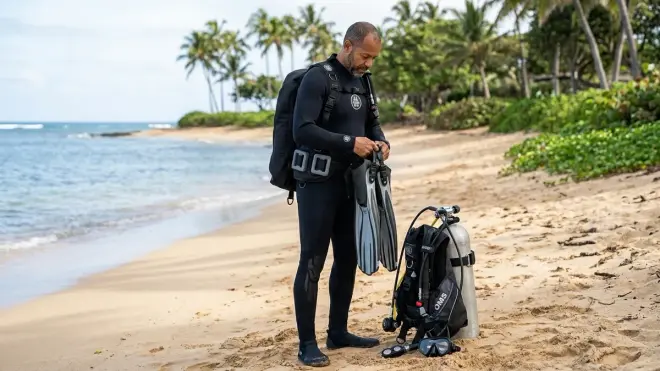
The OMS IQ Lite Pack System🛒 Amazon strips travel wing design to absolute essentials with a skeletal aluminum frame and 32-pound wing. The complete system weighs 6.9 pounds and packs down to a tight bundle.
Pros:
- Skeletal frame reduces weight while maintaining structural rigidity
- 32-pound lift provides slightly more margin than 30-pound competitors
- Continuous webbing harness eliminates buckle hardware
- Single-piece design requires zero assembly at destination
- Compatible with standard cylinder bands and tank sizing
- Quick-adjust shoulder straps enable fitting over different exposure suits
Cons:
- Skeletal frame digs into back without adequate undergarment padding
- Minimal harness padding makes extended surface swims uncomfortable
- Limited accessory attachment points compared to full backplate systems
- Wing material feels thinner than premium competitors
- Shoulder strap adjustment requires more effort than quick-release buckles
Frequently Asked Questions
Is the Scubapro T One BCD worth the premium price compared to budget travel wings?
The T One commands pricing around $700-750, which puts it firmly in premium territory alongside Apeks and high-end Hollis systems. Whether that premium is worth it depends entirely on how much you value integrated design and brand reliability over raw specifications. You can absolutely find travel wings with similar lift capacity and lower weight for $400-500—brands like Dive Rite and XDeep offer capable systems at lower price points. What you're paying for with the T One is Scubapro's build quality, the integrated composite plate design that eliminates assembly headaches, and a harness system that's genuinely refined rather than just functional. I've had the shoulder dump valve on a budget travel wing fail at 60 feet, flooding the wing and turning a simple reef dive into an immediate ascent and surface swim. That's never happened with any Scubapro BCD I've tested. If you're diving this thing six times over three years on vacation, buy whatever fits your budget. If you're logging fifty dives annually and trusting this system in conditions that vary from calm Caribbean reefs to current-swept walls, the reliability premium matters.
Can the T One handle cold water diving with thick wetsuits or drysuits?
The honest answer is that it's marginal for anything beyond a 5mm wetsuit, and it's genuinely inadequate for drysuit diving. That 30-pound lift capacity sounds reasonable until you calculate actual buoyancy requirements. A steel HP100 cylinder runs about 9 pounds negative when full in saltwater. A 7mm two-piece wetsuit adds roughly 14-16 pounds of positive buoyancy at the surface when fully expanded. You're already at 23-25 pounds of lift requirement before accounting for your own body composition, any additional equipment like cameras or lights, and a safety margin for surface flotation while exhausted. The T One will float you—barely—but you'll be using nearly full wing inflation just to maintain comfortable surface position, which means zero reserve capacity if conditions deteriorate or you need to support another diver. For tropical diving with aluminum cylinders and 3-5mm exposure suits, it's perfectly adequate. Beyond that, you're pushing the system past its design intent. If you're planning cold-water diving, understanding how to choose a wetsuit helps you calculate actual buoyancy compensation requirements before you commit to an undersized travel wing.
How does the composite backplate affect weighting compared to aluminum or steel plates?
The composite plate on the T One is essentially neutrally buoyant—it neither adds nor subtracts meaningful ballast from your weighting calculation. By contrast, a stainless steel backplate typically contributes 5-6 pounds of negative ballast in saltwater, and an aluminum plate adds 1-2 pounds negative. What this means practically: if you're diving an aluminum 80 with a 3mm wetsuit in tropical water, you might normally wear 6-8 pounds of lead with a steel backplate system. With the T One's composite plate, you're probably looking at 10-12 pounds of lead to achieve the same neutral buoyancy. That's not inherently bad—it's just different. The advantage is that the composite plate system lets you fine-tune your weighting more precisely rather than starting with a 6-pound anchor on your back. The disadvantage is that you're carrying that lead somewhere else on your body instead of having it integrated into the backplate. I found this setup worked brilliantly in warm water where I needed minimal lead anyway, but it felt inefficient in cooler water with thicker exposure suits where I was adding 14+ pounds of lead and wishing some of that was built into the plate itself.
Does the continuous webbing harness system complicate adjustment compared to traditional buckles?
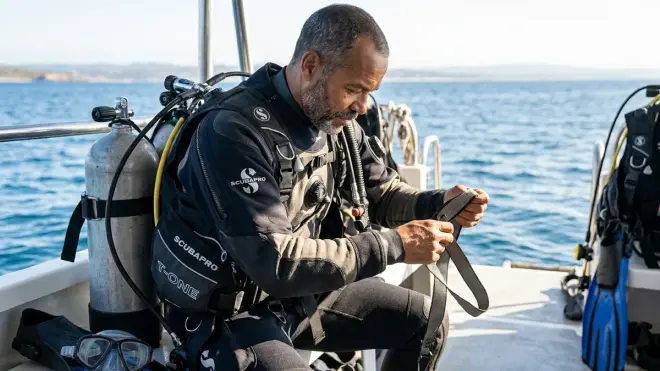
Yes and no. The continuous webbing design definitely requires more time for initial fitting—you're threading webbing through D-rings and adjusting slider positions rather than just clicking buckles open and closed. That first setup on the boat deck took me a solid fifteen minutes of threading, wearing, adjusting, re-threading until I got the shoulder straps and waist band positioned correctly. The upside is that once it's dialed, it stays dialed—there are no buckles to accidentally pop open, no plastic hardware to crack or corrode, and the overall system is lighter and less bulky. Quick adjustments between different exposure suit thicknesses are more involved than with traditional quick-release buckles, though. If you're switching between a 3mm shorty and a 5mm full suit between dives, you'll spend a few minutes loosening or tightening webbing rather than just popping buckles open a notch. I found the system worked best when I was diving similar configurations repeatedly—same cylinder, same exposure suit—where the harness just stayed set for days at a time. For divers who frequently change configurations, traditional buckles offer more convenience even if they add weight and complexity.
How does the T One compare to a full technical backplate-and-wing setup for single-tank recreational diving?
The T One essentially splits the difference between a traditional jacket BCD and a full technical BP/W system. Compared to a proper backplate-and-wing setup—say, a stainless steel plate with a 30-40 pound wing and continuous webbing harness—the T One trades some stability and modularity for lighter weight and integrated design. A technical BP/W gives you the option to swap plates, change wings, adjust harness configurations, and upgrade individual components as your diving evolves. The T One is what it is—you're locked into that composite plate and 30-pound wing. The integrated design means less capability for customization but also less complexity and lighter packed weight. In the water, I found the T One less stable during surface swims than a rigid steel plate—that composite plate flexes slightly under load where steel doesn't budge—but the difference disappeared once I descended past ten feet. For pure single-tank recreational diving, the T One delivers 90% of the performance of a technical BP/W at about 70% of the weight. If you're planning to progress into technical diving, doubles, or sidemount configurations, invest in a proper modular BP/W system. If you're committed to single-tank recreational diving and prioritize travel convenience, the T One makes more sense. The broader context of scuba buoyancy compensators helps clarify where different BCD styles excel and where they compromise.
The Verdict
The Scubapro T One BCD delivers on its core promise: a lightweight, packable backmount wing system that works reliably for single-tank tropical diving. That composite backplate eliminates the assembly headaches of traditional backplate-and-wing setups while keeping weight down to 6.5 pounds, and the 30-pound wing provides adequate lift for aluminum cylinders with exposure suits up to about 5mm. The harness system is genuinely refined once you get it dialed, and build quality matches Scubapro's reputation.
But this scubapro t one bcd review wouldn't be honest without acknowledging the limitations. That 30-pound lift capacity becomes marginal quickly if you move to steel cylinders or thicker exposure suits, the composite plate requires carrying additional lead weight compared to steel plate systems, and the shoulder dump pull-cord positions just awkwardly enough to annoy smaller-handed divers. At around $700-750, you're paying a premium that's justified if you value integrated design and brand reliability, but harder to defend if you're shopping purely on specifications.
I'd recommend the T One for dedicated warm-water divers who rack up significant annual dive counts and need gear that packs light without sacrificing performance. If you're diving quarterly on vacation and want maximum versatility across conditions, a more substantial BP/W system with higher lift capacity makes better sense. If you're budget-constrained and willing to tolerate slightly less refined harness systems, capable alternatives exist at $200-300 less. This isn't the right BCD for everyone, but for the specific niche it targets—frequent tropical divers who prioritize travel convenience and reliable performance—it's a well-executed solution that performs as advertised.