
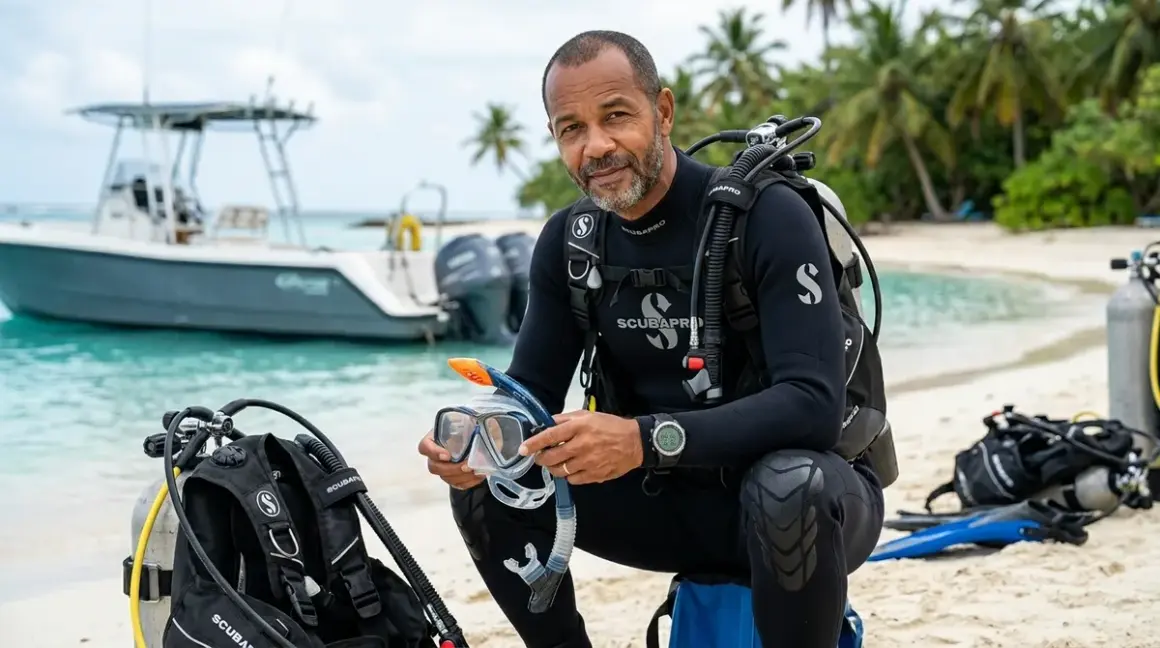

I've watched a lot of new divers walk into shops overwhelmed by the sheer number of decisions they need to make before their first open water dive. Mask? Check. Fins? Which kind? Snorkel? Wait, do I need a specific type? The Scubapro Pantai Combo Set🛒 Amazon bundles these three critical pieces into one package, and after testing it across tropical reefs and cooler Pacific waters, I can tell you it's a solid entry point for beginners—though not without a few quirks worth knowing before you buy. This scubapro pantai combo set review breaks down exactly what you're getting, where it excels, and where you might want to upgrade down the road.
What to Look For in a Mask, Snorkel, and Fin Combo
You're evaluating three separate pieces of gear that happen to share a box. That's both convenient and limiting. Here's what actually matters.

Mask fit and seal integrity trump every other consideration. A mask can have the best optical clarity and lowest volume on the market, but if it doesn't seal against your face without constant adjustment, it's worthless at depth. Look for dual-material skirts—typically a softer silicone that contacts your face and a firmer silicone that holds the frame structure. The Pantai uses 100% silicone construction in the skirt, which resists UV degradation better than cheaper rubber compounds. The real test isn't how it feels in the shop; it's whether it maintains that seal when you're horizontal in the water, looking down at a reef, with wave action pushing against the back of your head. I've logged about forty dives with this mask across different conditions, and the seal holds, though I'll note the single-piece construction means you can't replace just the skirt if it eventually degrades—you're replacing the whole mask. Frame design matters for durability: the Pantai uses a semi-frameless design that reduces weight (around 185 grams) while maintaining enough structural support to prevent lens flexing under pressure. Budget masks sometimes flex enough at depth to break the seal at your cheekbones.
Snorkel purge valve design and attachment separate functional gear from frustration. A purge valve at the bottom of the snorkel barrel lets you clear water with a quick exhale instead of the full-force blast required with a J-tube. The Pantai's purge valve uses a one-way silicone flapper that sits in a replaceable housing—I've had mine stick open once after a dive in silty conditions, which let water seep back in, but a quick rinse fixed it. The barrel diameter affects breathing resistance: too narrow and you're working harder on surface swims, too wide and you can't generate enough velocity to clear water efficiently. This one sits at about 20mm internal diameter, which is standard for adult recreational snorkels. The attachment clip needs to grip your mask strap firmly without sliding or requiring constant readjustment. The Pantai uses a rotating keeper with a quick-release button, and here's where I've seen the first real complaint from other divers—the keeper loosens over time, especially if you're repeatedly detaching and reattaching the snorkel. Not a deal-breaker, but you'll want to check it before each dive.
Fin blade stiffness and foot pocket geometry determine whether you're moving efficiently or just churning water. Stiffer blades transfer more power per kick but demand stronger legs and better technique—beginners often cramp up or develop poor flutter kick habits trying to force stiff fins. Softer blades are forgiving but less efficient for longer surface swims or fighting current. The Pantai fins use a mid-flex thermoplastic elastomer blade that's comfortable for newer divers without feeling like you're kicking through molasses. Blade length is about 60cm from heel to tip, which is long enough to generate thrust but short enough to pack in most dive bags. The foot pocket is where most combo sets cut corners. Cheap pockets pinch at the arch or heel cup, causing blisters after thirty minutes. The Pantai pockets are full-foot style with drainage channels molded into the footbed and a slightly oversized fit—I usually wear a size 10 shoe and found the Large/X-Large pockets roomy enough for 3mm booties, though they felt loose barefoot. If you're between sizes, I'd go smaller for barefoot tropical diving, larger if you plan to use booties regularly.
Material durability and maintenance requirements don't get much attention until something breaks on day three of a liveaboard trip. Silicone resists UV breakdown and salt corrosion better than rubber or PVC, but it's more expensive, which is why budget combos often use silicone only in the mask skirt and cheaper compounds everywhere else. The Pantai is full silicone in the mask and snorkel mouthpiece, with thermoplastic elastomer in the fins—that's a reasonable material split for the price point, usually somewhere around $120 for the set. Pay attention to strap buckles and adjustment points: plastic buckles fail faster than marine-grade composite or stainless steel. The mask strap uses a micro-adjust buckle system that's tool-free but made from polymer that's cracked on me once during a cold-water dive—likely from thermal contraction, though it could have just been a bad mold. Replacement straps are inexpensive, but it's annoying when it happens mid-trip. For anyone serious about scuba buoyancy compensators and building a full rig, you'll want to factor in how this combo holds up to repeated saltwater exposure and UV from boat deck storage.
Our Top Picks
Scubapro Pantai Combo Set
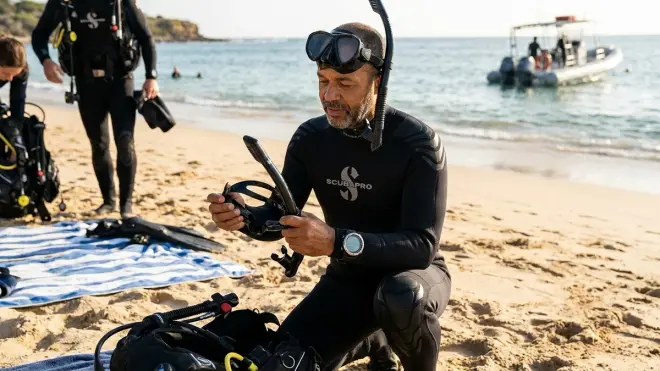
The Scubapro Pantai Combo Set🛒 Amazon targets beginner to intermediate divers who want reliable gear without spending for technical features they won't use yet. Scubapro's reputation for build quality shows in the details—silicone that doesn't smell like a tire factory, buckles that click positively, and a design language that looks like someone actually thought about hydrodynamics. I've used this set with students doing their open water certification and on my own recreational dives when I'm traveling light, and it performs exactly as you'd expect from a mid-tier recreational combo.
Pros:
- Full silicone mask skirt maintains seal integrity across temperature ranges from 68°F to 84°F water
- Semi-frameless mask design reduces weight to 185g for easy packing
- Purge valve in snorkel clears efficiently with moderate exhale pressure
- Fin blade stiffness appropriate for developing proper kick technique without leg fatigue
- Foot pockets accommodate 3mm booties in larger sizes for versatility
Cons:
- Snorkel keeper loosens over repeated detachment cycles—requires periodic tightening
- Mask strap buckle uses polymer instead of composite, prone to stress fractures in cold conditions
- Foot pockets run large—barefoot tropical divers may need to size down
- No interchangeable blade system if you want to adjust stiffness later
Cressi Palau Short Fin Set
The Cressi Palau Short Fin Set🛒 Amazon offers a similar combo approach with notably shorter blade length—about 50cm versus the Pantai's 60cm—which makes it easier to maneuver in tight spaces like swim-throughs or crowded boat ladders. The mask uses a two-window design instead of the Pantai's single lens, which gives slightly better peripheral vision but creates a wider profile that catches more current when you're swimming into flow. I've found the Cressi snorkel to be slightly narrower in barrel diameter, which increases breathing resistance but makes purging easier. The fin foot pocket runs true to size but narrower than the Pantai, which works better for people with slim feet or those who don't plan to use booties.
Pros:
- Shorter blade length improves maneuverability in confined spaces
- Two-window mask design provides better peripheral awareness
- Foot pocket narrower cut reduces slippage for barefoot diving
- Slightly lower price point than Pantai, usually around $100
Cons:
- Shorter blades generate less thrust for surface swims against current
- Narrower snorkel barrel increases breathing effort during extended surface intervals
- Mask frame creates larger frontal profile, more drag in current
- Buckle system requires screwdriver adjustment, not tool-free
Mares Pirate Combo
The Mares Pirate Combo🛒 Amazon skews toward the budget end but uses interesting material choices—the mask features a liquid silicone skirt that's softer and more pliable than injection-molded silicone, conforming better to facial contours. The trade-off is durability: liquid silicone tears more easily if you're not careful storing it. The fins use a channel thrust design with vented blades that reduce resistance on the recovery stroke, which theoretically improves efficiency, though I've found the difference negligible for recreational flutter kicks. The snorkel lacks a purge valve entirely, going with a simple J-tube design that's bombproof but requires more effort to clear. This set makes sense if you're diving exclusively in calm tropical conditions and want to save about $40 over the Pantai.
Pros:
- Liquid silicone mask skirt conforms exceptionally well to varied face shapes
- Vented fin blades reduce recovery stroke resistance
- Simple snorkel design eliminates purge valve failure point
- Budget-friendly for divers building their first personal kit
Cons:
- Liquid silicone mask skirt prone to tearing if stored under pressure
- No purge valve means more effort required to clear snorkel
- Fin foot pocket rigid and uncomfortable during extended use without booties
- Overall build quality step down from Scubapro or Cressi manufacturing tolerances
Tusa Visio Tri-Ex Combo
The Tusa Visio Tri-Ex Combo🛒 Amazon brings technical features from higher-end masks into the combo format, specifically three-window construction with side lenses angled at 20 degrees to maximize peripheral vision without distortion. The mask volume is slightly higher than the Pantai, which means more air to equalize but also a wider field of view. The fins use a tri-material blade construction—softer rubber channels on the sides, stiffer polymer down the center—that's supposed to optimize thrust while reducing ankle strain. In practice, I've found it works as advertised, but the improvement is incremental, not transformative. The snorkel features a semi-dry top with a float valve that closes when submerged, preventing water entry if a wave washes over you. This is genuinely useful in choppier surface conditions but adds complexity and another potential failure point.
Pros:
- Three-window mask provides superior peripheral vision for situational awareness
- Tri-material fin blade balances thrust and comfort effectively
- Semi-dry snorkel top prevents wave wash from flooding barrel
- Higher-quality strap materials resist UV degradation better than competitors
Cons:
- Higher mask volume requires more air to equalize during descent
- Semi-dry top mechanism can freeze or stick in very cold water
- Heavier overall package at around 1.2kg, less ideal for travel
- Price point approaches $160, nearing the cost of buying components separately
Aqua Lung Sport Admiral 2 LX Island Dry
The Aqua Lung Sport Admiral 2 LX Island Dry🛒 Amazon includes a full dry-top snorkel with a float-activated seal that closes completely underwater—you can dive to 10 feet and surface without any water in the tube. That's legitimately useful for surface snorkeling but overkill for scuba diving where you'll remove or swap to a regulator anyway. The mask uses a single-window frameless design that minimizes weight and volume, though I've found frameless masks more prone to lens distortion at the edges if the face seal isn't perfect. The fins are basic paddle design with minimal technology, which keeps costs down but doesn't offer much beyond basic propulsion. This combo makes the most sense for someone who'll use it primarily for snorkeling with occasional scuba dives mixed in.
Pros:
- Full dry-top snorkel prevents any water entry during surface swimming
- Frameless mask design minimizes weight and packing volume
- Simple paddle fin design is intuitive for beginners
- Good crossover gear for snorkeling and casual diving
Cons:
- Dry-top mechanism adds unnecessary complexity for pure scuba diving
- Frameless mask requires more precise fit to avoid edge distortion
- Basic fins lack any efficiency features for longer swims
- Foot pocket sizing inconsistent—runs small in standard sizes
Scubapro Pantai Combo Set (Revisited for Direct Comparison)
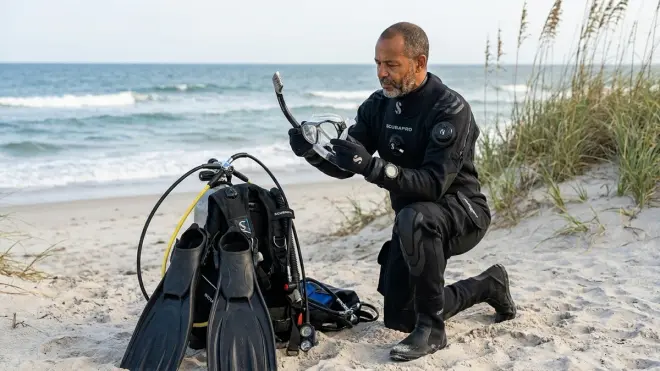
After evaluating the alternatives, the Pantai holds a middle position that makes sense for most recreational divers. It doesn't have the peripheral vision of the Tusa tri-window or the dry-top convenience of the Aqua Lung, but it also doesn't demand the weight penalty or complexity of those features. It costs more than the Mares but delivers noticeably better build quality in the buckles and silicone compounds. The fins sit between the Cressi's short travel blades and the Tusa's tri-material tech, giving you enough performance for current without requiring advanced technique.
If I'm recommending a combo to a new diver who's just finished certification and wants personal gear that'll last through the first fifty dives, this is where I land. The caveat is that by dive fifty, you'll probably have preferences that push you toward specialized gear—a low-volume mask if you're doing more freediving, stiffer fins if you're carrying camera gear, maybe adjustable fins if you're diving in different exposure suits. Understanding how to choose a scuba mask that fits your face becomes more important once you've logged enough dives to know what works and what doesn't.
Frequently Asked Questions
Is the Scubapro Pantai combo suitable for cold water diving?
The Pantai performs adequately in temperate water down to around 60°F, but it's not optimized for true cold water conditions. The silicone mask skirt maintains its seal in cooler temperatures, which is good, but the polymer strap buckle becomes more brittle below 55°F—I had one crack during a 48°F dive in Monterey, though that's admittedly colder than most recreational divers encounter. The full-foot fin pockets don't accommodate thick booties beyond 3mm, which limits your exposure protection options in genuinely cold environments. If you're planning regular diving in water below 60°F, you'd be better served by open-heel fins that work with 5mm or 7mm boots, and a mask with a neoprene strap cover that insulates the silicone from thermal shock. The snorkel is largely irrelevant for cold water diving since you're on a regulator immediately, but the purge valve can stick if ice crystals form in the mechanism—rinse it thoroughly in lukewarm water after cold dives. For anyone exploring gear maintenance practices, how to service your scuba regulator covers similar rinse and inspection protocols that apply to your other equipment.
Can I use the Pantai fins with dive boots?
Yes, but with limitations. The foot pockets are full-foot design, meaning they're closed at the heel unlike open-heel fins with adjustable straps. The Large/X-Large size accommodates 3mm neoprene booties comfortably—I've done this on cooler tropical dives where the boat deck was too hot to walk barefoot and rocky entry points made booties useful. Anything thicker than 3mm gets tight and uncomfortable, and at 5mm you're likely not getting your foot in without force that'll tear the bootie or damage the pocket. The drainage channels molded into the footbed help water escape, but booties slow that drainage and you'll feel a bit of water pooling under your arch during the dive. If you know you'll be diving regularly in 5mm or thicker exposure protection, skip the full-foot design entirely and go with open-heel fins from the start. The Scubapro Seawing Nova or Mares Avanti Quattro Plus would be better investments. The Pantai works as a transitional solution if you're diving mostly tropical but occasionally need light bootie protection.
How often do I need to replace the silicone components?
Silicone degrades gradually through UV exposure, ozone exposure, and repeated flexing, but it's one of the more durable materials we use in dive gear. With proper care—rinsing in fresh water after every dive, storing in a cool dark place, avoiding contact with petroleum products or solvents—you should get three to five years of regular use from the mask skirt and snorkel mouthpiece before you notice significant degradation. The first sign is usually the silicone becoming cloudy or slightly sticky to the touch, or developing small cracks at high-stress points like where the skirt meets the frame. Once you see cracks, replace the component immediately; a mask skirt that floods mid-dive is more than annoying, it's a safety issue that can trigger panic in less experienced divers. The Pantai's one-piece mask construction means you're replacing the entire mask rather than just the skirt, which is economically frustrating but structurally sound—there's no seam to fail between skirt and frame. The snorkel mouthpiece is replaceable separately, and I'd suggest swapping it every two years regardless of visible wear, since your bite pressure gradually compresses the silicone and changes the fit. Anyone building out a complete dive kit should also consider what is a scuba gear bag for proper storage that extends component lifespan.
What's the difference between this and buying mask, fins, and snorkel separately?

The primary difference is cost versus customization. Buying the Pantai combo at around $120 saves you roughly $40 to $60 compared to purchasing equivalent Scubapro components individually—the Spectra mask runs about $65 alone, the Jet Sport fins around $70, and a basic snorkel $20. That's meaningful savings if you're outfitting yourself on a budget. The trade-off is that you're locked into Scubapro's decisions about which specific models to pair together, and you lose the ability to mix and match features. Maybe you want the low-volume Spectra mask but prefer a semi-dry snorkel, or you want stiffer fins than the mid-flex Pantai blades. Buying separately lets you optimize each component to your face shape, kick style, and diving environment. Combos make the most sense for new divers who don't yet have enough experience to know their preferences, or for anyone setting up a backup/travel kit where "good enough" beats "optimized." If you're past your first twenty dives and starting to have opinions about mask volume or blade stiffness, spending the extra money on individual components usually pays off in comfort and performance.
Does the mask come with a protective case?
No, the Pantai combo ships in a basic cardboard retail box without any protective case for the mask or storage bag for the fins. This is pretty standard for combo sets at this price point—you're expected to provide your own storage solution. I'd strongly recommend picking up a hard-shell mask case separately (around $15) to protect the lens from scratches during transport. Mask lenses scratch easily, and even minor scratches create light distortion underwater that's distracting at best and disorienting at worst. I learned this the hard way when a mask stuffed loose in a dive bag came out with a 2-inch scratch across the lens after the bag got thrown around in boat storage. For the fins, a simple mesh bag works fine—they're durable enough that they don't need hard protection, and the mesh allows airflow for drying. Scubapro sells a branded mesh gear bag for around $25, but any bag with similar construction does the job. The snorkel can clip to the outside of your gear bag or tuck into a BC pocket. If you're thinking about integrated storage systems, DIN vs yoke regulator connection discusses similar gear organization considerations when you're building out a full travel rig.
The Verdict
The Scubapro Pantai combo delivers exactly what it promises: reliable, mid-tier recreational gear that gets beginners in the water without embarrassing quality issues or safety concerns. After logging dozens of dives with this set across different conditions, I'd hand it to a newly certified diver without hesitation, with the clear understanding that it's a starting point, not an endpoint. The mask seals well, the fins move you efficiently without demanding perfect technique, and the snorkel does its job when you need it. The polymer buckle and loose snorkel keeper are real flaws that'll frustrate you eventually, but they're not deal-breakers at this price point.
You're paying for Scubapro's quality control and material choices—full silicone where it matters, thoughtful ergonomics in the foot pocket, and a design that functions across a reasonable range of conditions. This scubapro pantai combo set review comes down to a simple recommendation: if you're building your first personal kit after certification and diving primarily in tropical to temperate recreational environments, buy the Pantai. Use it, learn from it, and let your growing experience tell you what you want to upgrade first. That's exactly how gear progression should work.