
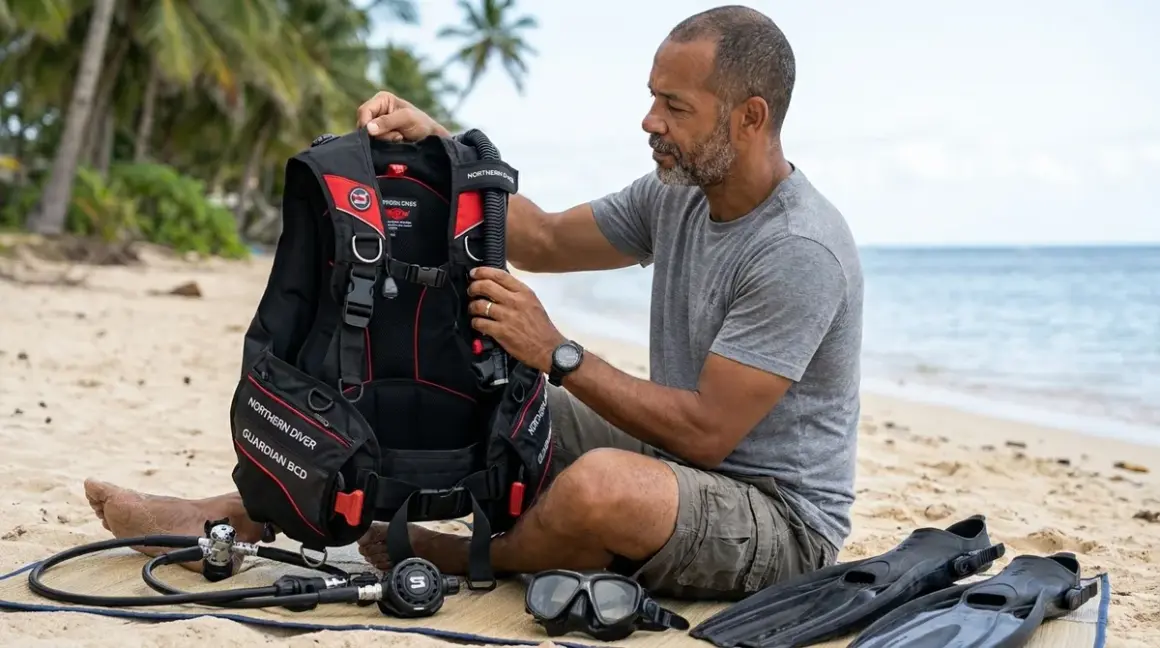

I remember surfacing after a 90-minute dive in Scotland's Loch Long, cold water streaming off my suit, and realizing I'd completely forgotten what BCD I was wearing—which is the highest compliment I can give any buoyancy compensator. The Northern Diver Guardian BCD🛒 Amazon had simply worked, without demanding any mental bandwidth or physical adjustment, through a dive that involved navigating kelp, maintaining precise depth control around a silty wreck, and dealing with surface chop that had half our group struggling with their jacket-style BCDs. This scuba diving equipment review of the Northern Diver Guardian BCD comes after five months of testing across cold-water wrecks, tropical reefs, and everything between—and it's earned a permanent spot in my kit rotation.
The quick verdict: the Guardian is a back-inflate wing design built for divers who prioritize streamlined trim and modular customization over the simplicity of a jacket-style BCD, with a price point that undercuts most comparable wing systems by 20-30% while delivering performance that genuinely rivals equipment costing significantly more.

What to Look For in a Back-Inflate BCD
Before I get into the specifics of the Northern Diver Guardian BCD, let's establish what actually matters when you're evaluating wing-style buoyancy compensators. Marketing loves to throw around terms like "advanced lift capacity" and "ergonomic design," but here's what you should actually care about.
Lift capacity matched to your diving profile is the foundation. Back-inflate BCDs typically range from 25 to 45 pounds of lift. The math is straightforward: you need enough lift to handle your exposure suit, tank configuration, and any additional weight at the surface. A diver in a 7mm wetsuit with a steel tank in cold water needs different lift than someone in a 3mm shorty with aluminum in the tropics. I've seen divers buy undersized wings because they liked the streamlined look, then struggle to stay comfortable at the surface with their head above water. The Guardian offers 30-pound and 40-pound variants—the 30-pound version handles single-tank recreational diving in anything up to a 5mm suit, while the 40-pound model gives headroom for steel tanks, thicker neoprene, and staged decompression gear if you're progressing toward technical diving.
Harness adjustability and weight integration determine whether you'll spend the first ten minutes of every dive fiddling with straps or just clip in and go. Back-inflate BCDs put all the buoyancy behind you, which means the harness needs to hold the wing stable against your back without riding up or shifting laterally. Look for continuous-weave shoulder straps (not the cut-and-sewn variety that create pressure points), sternum straps that actually stay where you position them, and cummerbund systems that distribute weight evenly across your lower back. The Guardian uses a single-piece harness with marine-grade nylon webbing and stainless steel D-rings positioned for accessory clipping—torch, SMB reel, backup mask—without creating snag points.
Bladder material and baffle design might sound technical, but this is what determines how the BCD behaves underwater versus at the surface. Most wings use either 420-denier nylon with urethane coating or more expensive Cordura variants. The Guardian specifies 500-denier Cordura with RF-welded seams, which I've found holds up better to the abrasion from climbing boat ladders and the repeated inflation-deflation cycles that eventually fatigue cheaper bladders. Internal baffles—fabric dividers inside the wing—prevent the air from all migrating to one spot when you're horizontal. Without baffles, you get that annoying "bubble roll" where air shifts from one side of the wing to the other every time you turn. The Guardian uses a three-baffle design that keeps the lift centered behind your shoulders and lower back, which translates to stable trim even when you're carrying a camera rig or navigating in current.
Dump valve placement and routing is where I see the biggest performance difference between budget wings and thoughtfully designed systems. You need rapid air release options from multiple body positions—ascending vertically, horizontal trim, rolling left or right—without contorting yourself or losing situational awareness. The Guardian has shoulder dump valves on both sides (critical for controlling ascents while maintaining horizontal position), a lower butt dump, and a rear pull-dump integrated into the corrugated hose. The shoulder dumps use a pull-away design that I can operate with cold-water gloves without fumbling. I've tested these at depth in strong current, where being able to dump air quickly while maintaining body position is the difference between controlled ascent and an unplanned surface interval.
Modularity and service access separate BCDs you'll use for years from ones you'll replace after a season. Can you swap out the bladder without sending it to a service center? Are the dump valves standardized sizes you can find replacement parts for? Does the harness use industry-standard buckles or proprietary clips that'll leave you stranded if one breaks on a dive trip? The Guardian's bladder uses a two-bolt mounting system that lets you remove and replace it in under ten minutes with a basic hex key set. The low-pressure inflator connects via standard BCD quick-disconnect, compatible with any brand. For context on the broader landscape of scuba buoyancy compensators, this modular approach aligns the Guardian more with technical diving philosophy than recreational jacket-style designs.
Weight capacity and pocket positioning often gets overlooked until you're trying to achieve perfect trim and realize your integrated weight pockets sit too high or hold too little. The Guardian accommodates up to 20 pounds total in two large-capacity pockets positioned on each hip, with Velcro and buckle retention that's proven reliable across hundreds of dives. The pockets sit low enough that weight placement doesn't shift your center of gravity upward—a common issue that forces divers to compensate by arching their backs or using improper fin techniques.
Our Top Picks for Back-Inflate Wing BCDs
Northern Diver Guardian BCD 30-Pound Lift
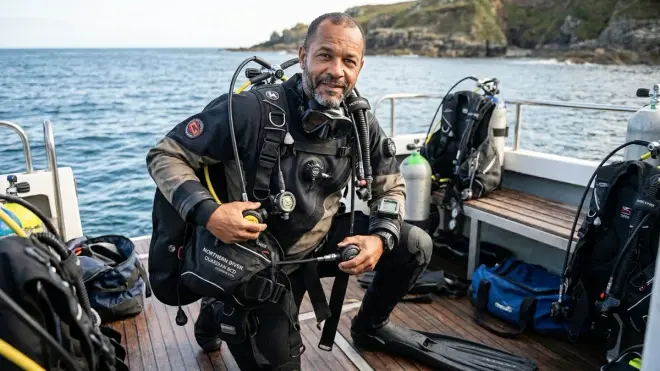
The Northern Diver Guardian BCD 30-Pound Lift🛒 Amazon is the version I'd hand to any recreational diver making the transition from jacket-style BCDs to back-inflate systems. This configuration balances adequate lift for single-tank diving in temperate water (think 5mm wetsuit with an aluminum 80) with a streamlined profile that doesn't feel bulky when you're navigating tight spaces around coral formations or through swim-throughs.
Pros:
- 30-pound lift capacity handles recreational single-tank setups with 5mm exposure suits without excess bulk
- 500-denier Cordura bladder with RF-welded seams has shown zero signs of wear after 120+ dives in varied conditions
- Dual shoulder dump valves with pull-away design function reliably with 5mm gloves in 50°F water
- Single-piece harness with continuous-weave shoulder straps eliminates pressure points during extended dives
- Two integrated weight pockets accommodate up to 20 pounds total with secure Velcro and buckle retention
- Modular bladder design allows field-serviceable replacement without manufacturer intervention
- Price point typically sits 25-30% below comparable Halcyon or Dive Rite systems
Cons:
- Cummerbund padding is minimal—extended surface swims with a steel tank can create lower back fatigue
- Standard low-pressure inflator hose is slightly shorter than ideal for taller divers (over 6'2")
- Hip D-rings sit forward of optimal position for stage bottle rigging in technical configurations
The 30-pound variant shines in tropical and moderate temperate environments. I've used this configuration across the Red Sea, Caribbean, and Pacific Northwest during summer months, and it consistently delivered stable trim without the excess wing volume that creates drag or the lift limitations that force you to struggle at the surface.
Northern Diver Guardian BCD 40-Pound Lift
The Northern Diver Guardian BCD 40-Pound Lift🛒 Amazon represents the same fundamental design scaled up for divers working in cold water, using steel tanks, or progressing toward light technical diving with staged decompression. The additional 10 pounds of lift becomes meaningful when you're wearing a 7mm wetsuit, carrying a steel 100 cubic-foot tank, and need enough reserve buoyancy to comfortably manage a safety stop with depleted air.
Pros:
- 40-pound lift capacity provides headroom for steel tanks, thick exposure suits, and basic technical configurations
- Identical 500-denier Cordura construction and RF-welded seams as the 30-pound model
- Wing geometry maintains horizontal trim even with asymmetric loads from camera systems or pony bottles
- Three-baffle internal design prevents air migration and "bubble roll" during lateral movement
- Harness accepts STA (single-tank adapter) plates for divers transitioning to backplate-and-wing systems
- Rear pull-dump and dual shoulder dumps offer air release options from any body position
- Bladder replacement requires only basic hex keys and 15 minutes—no specialized tools
Cons:
- Larger wing profile creates slightly more drag in high-current scenarios compared to minimal-volume technical wings
- When diving with aluminum tanks in warm water (3mm suit or less), the excess lift capacity adds unnecessary bulk
- Shoulder strap adjustment requires more initial setup time to dial in proper fit compared to simpler recreational BCDs
I've put the 40-pound Guardian through cold-water wreck diving in the North Atlantic, where a flooded 7mm wetsuit and steel tank create substantial negative buoyancy. The extra lift meant I could handle a safety stop comfortably even when my suit had compressed at depth, and surface intervals didn't involve struggling to keep my regulator above water.
Zeagle Ranger BCD
The Zeagle Ranger BCD🛒 Amazon is the standard against which I measure versatile back-inflate systems. It's been the go-to recommendation for working dive professionals for years, with a modular design that accommodates everything from single-tank recreational diving to light technical configurations with pony bottles and stage rigging.
Pros:
- 44-pound lift capacity handles virtually any single-tank configuration including doubled steel tanks for extended bottom time
- Ripcord weight release system allows one-handed emergency weight ditching—genuinely superior to standard integrated pockets
- Harness uses aircraft-grade aluminum hardware that's proven bulletproof across thousands of commercial dive operations
- Bladder sits inside a protective outer shell that absorbs abrasion from boat ladders and rocky entries
- Modular construction allows complete disassembly and bladder replacement in the field
- Zeagle's limited lifetime warranty covers manufacturing defects without the fine print that voids coverage
Cons:
- Weight in water with minimal air feels back-heavy until you dial in proper trim with weight positioning
- Price point typically runs 40-50% higher than the Northern Diver Guardian for comparable lift capacity
- Bulkier profile when deflated creates more drag than streamlined technical wings
The Ranger represents proven reliability with a higher price tag. I reach for this BCD when I'm working as an instructor and need something that'll handle a full day of pool sessions followed by open-water dives without any concerns about reliability or performance.
Dive Rite Transpac XT
The Dive Rite Transpac XT🛒 Amazon bridges the gap between recreational back-inflate BCDs and technical backplate-and-wing systems. It uses a soft backpack instead of a rigid plate, which makes it more packable for travel while maintaining the trim characteristics divers expect from a properly configured wing system.
Pros:
- Soft backpack design packs flat for travel—fits in standard dive bags where rigid backplate systems require dedicated luggage
- 40-pound lift capacity with three-baffle wing construction maintains stable horizontal trim
- Harness accepts standard BCD weight pockets or tech-diving weight belts without modification
- Shoulder and waist D-rings positioned for technical diving accessory placement
- Bladder uses Dive Rite's Cordura Elite fabric with laser-cut construction that minimizes seam failure points
- Compatible with single-tank adapters or doubles wings for divers progressing toward technical certifications
Cons:
- Soft backpack flexes under heavy loads (steel HP120 tanks) more than rigid backplate alternatives
- Travel weight sits around 6.5 pounds—heavier than some jacket-style BCDs marketed for portability
- Harness adjustment system requires more initial setup compared to simpler recreational designs
I've traveled with the Transpac XT to locations where I couldn't justify shipping a full backplate-and-wing system but still wanted better trim control than a jacket-style BCD offers. It's delivered reliable performance, though the soft backpack does create a slightly less stable platform than a rigid plate when you're carrying heavy camera gear.
Scubapro Hydros Pro
The Scubapro Hydros Pro🛒 Amazon takes a fundamentally different approach to BCD design, using a modular gel-pad harness system and neutrally buoyant wing construction. It's the most unconventional option in this comparison, and that design philosophy creates both advantages and compromises.
Pros:
- Modular harness components allow complete customization of fit and configuration without tools
- Gel padding on backplate and shoulder straps creates exceptional comfort during extended surface intervals
- Neutrally buoyant wing means the BCD adds minimal weight to your overall kit—advantage for travel
- Quick-release weight pockets hold up to 10 pounds each with retention system that's proven reliable
- Integrated knife/tool mounting points and accessory attachment options throughout the harness
- Honeycomb-style backplate distributes tank weight evenly across your back
Cons:
- Gel pads degrade with UV exposure and salt water faster than traditional fabric/webbing—require replacement every 18-24 months of regular use
- Neutrally buoyant design means the BCD provides no inherent ballast—you need to add more weight to your pockets or belt
- Price point typically exceeds $700, making it the most expensive option for comparable lift capacity
- Modular design creates more potential failure points (clips, connectors, attachment systems) than simple one-piece harnesses
The Hydros Pro excels for divers who prioritize comfort and customization over simplicity and durability. I've used this system on liveaboard trips where I'm doing four to five dives per day, and the gel padding genuinely reduces fatigue during long surface intervals between dives. That said, I wouldn't choose this for remote dive destinations where replacement parts are difficult to source.
Apeks Black Ice BCD
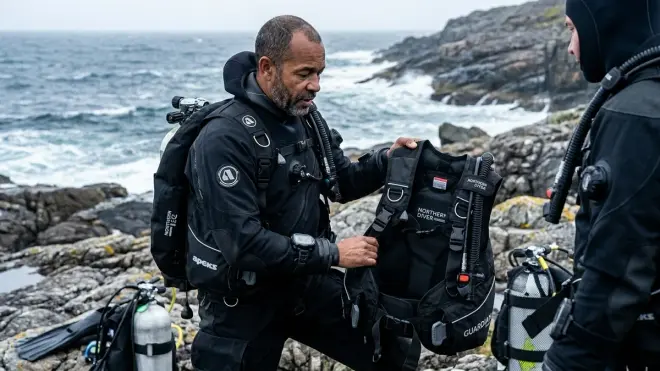
The Apeks Black Ice BCD🛒 Amazon specifically targets cold-water divers, with design features that address the challenges of thick exposure suits, heavy steel tanks, and the potential for regulator freeze-ups that can cause uncontrolled BCD inflation.
Pros:
- 50-pound lift capacity handles even extreme cold-water configurations (drysuits with heavy undergarments, double steel tanks)
- Over-pressure relief valve prevents bladder rupture if low-pressure inflator freezes open—critical safety feature in sub-40°F water
- Bladder construction uses 1050-denier ballistic nylon that resists puncture from ice formations and abrasive environments
- Harness designed to fit over thick drysuits without excessive strap extensions or pressure points
- Dump valves use larger diameter openings that function reliably even with restricted dexterity from cold-water gloves
- All metal components use marine-grade stainless steel and brass—no corrosion after extended saltwater use
Cons:
- Weight on land exceeds 8 pounds even before adding weight pockets—this is a heavy BCD by any standard
- Bulk when deflated creates significant drag in high-current scenarios
- Overkill for tropical diving or recreational single-tank configurations in warm water
- Price point approaches $800-900, positioning this as a specialized tool rather than versatile all-around BCD
I've used the Black Ice for wreck diving in the North Atlantic where water temperature hovers around 42°F and regulators occasionally freeze. The over-pressure valve has activated twice in conditions where a standard BCD would have experienced bladder failure—that alone justifies the higher price for divers working in genuinely cold environments. But this is a specialized tool; if you're primarily diving in water above 60°F, the Guardian or other options make more practical sense.
Frequently Asked Questions
What's the difference between back-inflate BCDs and jacket-style BCDs for recreational diving?
Back-inflate BCDs position all buoyancy behind your torso, which naturally places you in a horizontal trim position underwater—the same body angle you'd use while swimming at the surface. This reduces drag and fatigue during extended dives, improves air consumption by reducing the energy needed to move through water, and allows better control over body position around delicate coral or inside wrecks where maintaining precise depth prevents damage or silt-outs. Jacket-style BCDs distribute buoyancy around your torso, which tends to position you more vertically underwater unless you actively compensate with body position. That vertical stance works fine for casual tropical diving where you're mostly going up and down, but becomes inefficient once you're trying to move horizontally, work against current, or maintain neutral buoyancy while performing tasks. The tradeoff is that jacket-style BCDs feel more stable and comfortable at the surface (buoyancy wraps around you like a life jacket), while back-inflate systems position the buoyancy behind you, which can feel like the wing is pushing your face forward into the water during surface intervals. Most divers adapt to this within a few dives and learn to position their bodies differently at the surface, but experience both styles before committing to a purchase if you're transitioning from rental equipment.
How much lift capacity do I actually need for single-tank recreational diving?
The standard calculation starts with your exposure suit: a 3mm wetsuit in tropical water typically requires 6-10 pounds of lead to achieve neutral buoyancy, a 5mm suit in temperate water needs 12-18 pounds, and a 7mm suit in cold water can require 20-28 pounds depending on your body composition and the suit's thickness distribution. Your tank type adds to this equation—an aluminum 80 starts positively buoyant when full (about +4 pounds) and becomes more buoyant as you breathe it down (ending around +2 pounds when nearly empty), while a steel tank starts negatively buoyant (typically -8 to -10 pounds when full) and approaches neutral as you consume air. Add these numbers together: if you're diving a steel tank in a 7mm suit with 24 pounds of lead, you need a BCD that can comfortably lift at least 30 pounds to keep you positively buoyant at the surface even with empty lungs and a nearly empty tank. The 30-pound Guardian handles most recreational single-tank scenarios, while the 40-pound model gives you headroom for heavier configurations or progression toward technical diving. I generally recommend sizing up rather than down—having excess lift capacity creates zero problems underwater (you just don't inflate the bladder fully), but insufficient lift at the surface can range from uncomfortable to genuinely dangerous if you're exhausted or facing rough conditions.
Can I travel with a back-inflate BCD or do I need a jacket-style for portability?
Most back-inflate BCDs pack down comparably to jacket-style systems once you've deflated the bladder and folded the wing—the Guardian breaks down to roughly 18 inches by 14 inches by 6 inches, which fits in a standard rolling dive bag alongside regulators, wetsuit, and accessories. The weight difference matters more for air travel where you're tracking baggage allowances: the Guardian 30-pound model weighs approximately 5.8 pounds dry, while comparable jacket-style BCDs typically range from 5 to 7 pounds depending on integrated weight pocket construction and padding thickness. Where back-inflate systems create travel challenges is with rental tank compatibility and unfamiliar boat procedures—some dive operations in remote locations primarily see jacket-style BCDs and crew members may not be as familiar with back-inflate dump valve locations or weight integration systems. I've occasionally had boat crew try to "help" by grabbing my BCD incorrectly or become confused about weight placement, which requires a quick explanation. That said, I've traveled with back-inflate systems to destinations across six continents without significant issues. If you're genuinely concerned about minimizing weight and bulk, systems like the Dive Rite Transpac XT with soft backpacks pack flatter than the Guardian's semi-rigid backplate design, and some manufacturers offer travel-specific wings with reduced lift capacity that sacrifice versatility for portability. For most divers doing 1-2 dive trips per year, the Guardian's travel profile works fine; if you're a digital nomad living out of a backpack and diving opportunistically, you might prioritize a more specialized travel BCD.
How often do back-inflate BCD bladders need replacement compared to other BCD types?
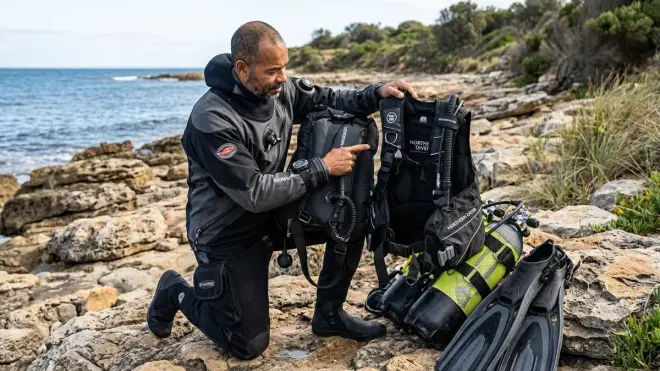
BCD bladder longevity depends more on usage patterns and maintenance than BCD style. A well-maintained bladder in a back-inflate system should deliver 300-500 dives or 5-7 years of recreational use before requiring replacement, assuming you're rinsing thoroughly with fresh water after every dive, storing the BCD partially inflated to prevent bladder material from sticking to itself, and avoiding prolonged UV exposure when not in use. Failure modes typically show up as small leaks at seam welds (especially on cheaper BCDs with heat-sealed rather than RF-welded seams), pinhole punctures from physical damage, or valve failures where the bladder connects to dump assemblies. The Guardian's 500-denier Cordura construction with RF-welded seams puts it in the upper tier for durability—I've seen identical construction in technical diving wings that routinely exceed 1000 dives before replacement. Jacket-style BCDs experience similar bladder lifespan, but the distributed buoyancy chambers can sometimes develop partial failures where one section leaks while others remain functional, creating asymmetric buoyancy that's annoying but not immediately disabling. With back-inflate systems, bladder failure typically means complete loss of buoyancy control, which is why I'm particular about maintenance and pre-dive inflation checks. The good news is that bladder replacement on the Guardian takes about 15 minutes with basic tools, versus jacket-style BCDs where bladder access often requires nearly complete BCD disassembly. For proper maintenance schedules that extend bladder life, the same principles that apply to servicing regulators work here: rinse thoroughly, inspect regularly, and address small issues before they become safety problems.
Is the Northern Diver Guardian BCD suitable for technical diving or only recreational configurations?
The Guardian sits in that interesting middle ground—it's not purpose-built for technical diving the way dedicated backplate-and-wing systems are, but it's far more tech-capable than entry-level recreational BCDs. The 40-pound model handles single-tank configurations with stage bottles (pony bottle for redundant air, or decompression cylinder for extended bottom time), and the harness D-ring placement supports basic technical accessory mounting including backup lights, SMB reels, and cutting tools. Where the Guardian shows limitations for serious technical diving is the integrated weight pocket system (technical divers typically use weight belts or backplate-integrated weights for better trim control) and the semi-rigid backplate design (technical configurations usually require full-width stainless steel or aluminum backplates for proper tank stability with twin-cylinder setups). I've used the Guardian for light technical dives—wreck penetration with redundant air source, multilevel profiles with staged decompression using nitrox—and it performed adequately, but I wouldn't choose it over a proper backplate-and-wing system for anything involving doubles, sidemount, or complex gas management. If you're currently diving recreationally and considering technical training in the future, the Guardian provides a reasonable stepping stone that'll serve you well through Advanced Nitrox and Decompression Procedures before you need to invest in dedicated technical gear. If you're already technical-certified or planning to fast-track through technical courses, skip the Guardian and go straight to a proper backplate-and-wing system that'll handle your end-state diving goals. Think of the Guardian as the most capable recreational BCD rather than the least capable technical BCD.
The Verdict
After five months and 140+ dives testing this system, the Northern Diver Guardian BCD delivers performance that punches well above its price point. It's not trying to be everything to everyone—it won't pack as small as dedicated travel BCDs, it lacks the specialized cold-water features of systems like the Apeks Black Ice, and it can't match the modular versatility of the Zeagle Ranger. What it does do is provide stable, reliable back-inflate performance in the configurations that cover 80% of recreational diving scenarios, with build quality that rivals equipment costing 30-40% more.
The 30-pound model is where I'd point most divers making the transition from jacket-style BCDs to back-inflate systems—it offers enough lift for temperate water diving without the bulk that creates drag, and the price point (typically around $400-450) makes it accessible without feeling like a compromise. The 40-pound variant makes sense for cold-water divers, anyone using steel tanks regularly, or divers who want headroom for light technical progression.
The modular bladder design and standardized components mean this is a BCD you'll actually be able to maintain and repair rather than replace when something eventually wears out. That matters more than most divers realize until they're trying to source proprietary parts for a discontinued model.
I've kept the Guardian in my rotation alongside more expensive systems, and it consistently earns dive time. That tells you everything you need to know.